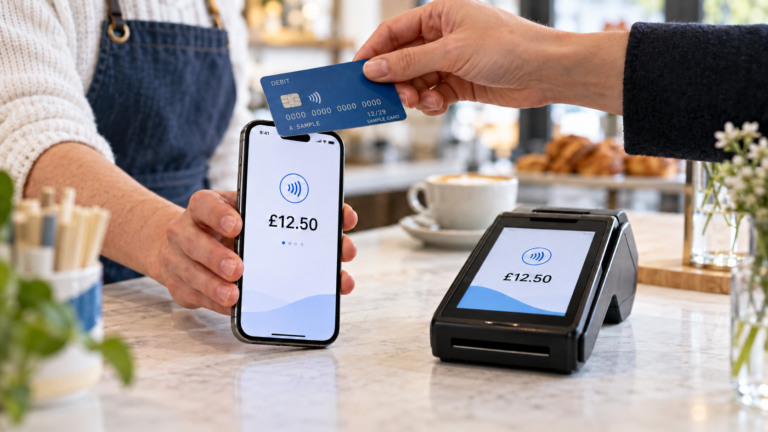
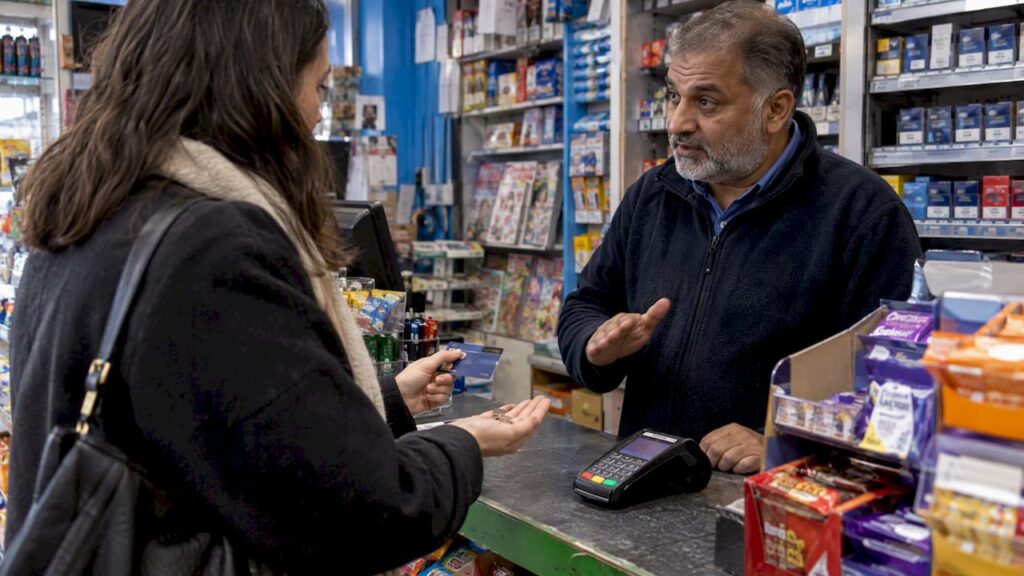
Yes, a UK business can set a minimum card spend. No law forbids it, and you can lawfully ask customers to pay cash for small purchases. What you cannot do is charge extra for paying by card. Get that line wrong and a £3 policy turns into a Trading Standards problem.
This guide is for owners and managers of shops, cafés, takeaways and restaurants, including those in Birmingham and Coventry. It covers what is legal, how to run a policy fairly, what it costs you in customers, and how to make the question matter less.
TL;DR
- A minimum card spend is legal in the UK. There is no minimum card payment law, and the limit is your choice as the trader.
- Surcharging is banned. Since 13 January 2018 you cannot add a fee for paying by card, debit, credit or digital wallet.
- Apply any minimum consistently and display it clearly. If you waive it for one customer, you still cannot charge them a card fee.
- Check your card acquirer contract first. Some terms restrict minimums.
- Lower processing costs often solve the problem the minimum was meant to fix. That is where a modern EPOS and payments setup helps.
Table of Contents
- Is a minimum card spend legal in the UK?
- The surcharge ban you must not trip over
- Check your card contract before you put up a sign
- Why shops set a minimum, and whether it works
- What customers expect now
- Options besides a minimum spend
- If you still want a minimum, do it properly
- Our view: why we think the minimum is mostly a symptom
- Making card payments pay: our EPOS and card options
- Practical checklist for Birmingham and Coventry businesses
- FAQ
- Sources
Is a minimum card spend legal in the UK?
Yes. Under contract law, a trader can refuse a non-cash payment, including for low-value sales, as long as no prohibited surcharge is applied. Southwark Council’s guidance for businesses sets this out plainly, and a UK business law explainer reaches the same conclusion: a minimum spend is not illegal, but extra card fees generally are.
In practice, minimums are usually £3 or £5 per transaction. Some pubs and restaurants have gone higher. Nobody sets the figure for you, which is both the freedom and the risk. A sign that says £10 minimum on a £2.50 coffee will lose you the sale.
What a minimum is, and what it is not
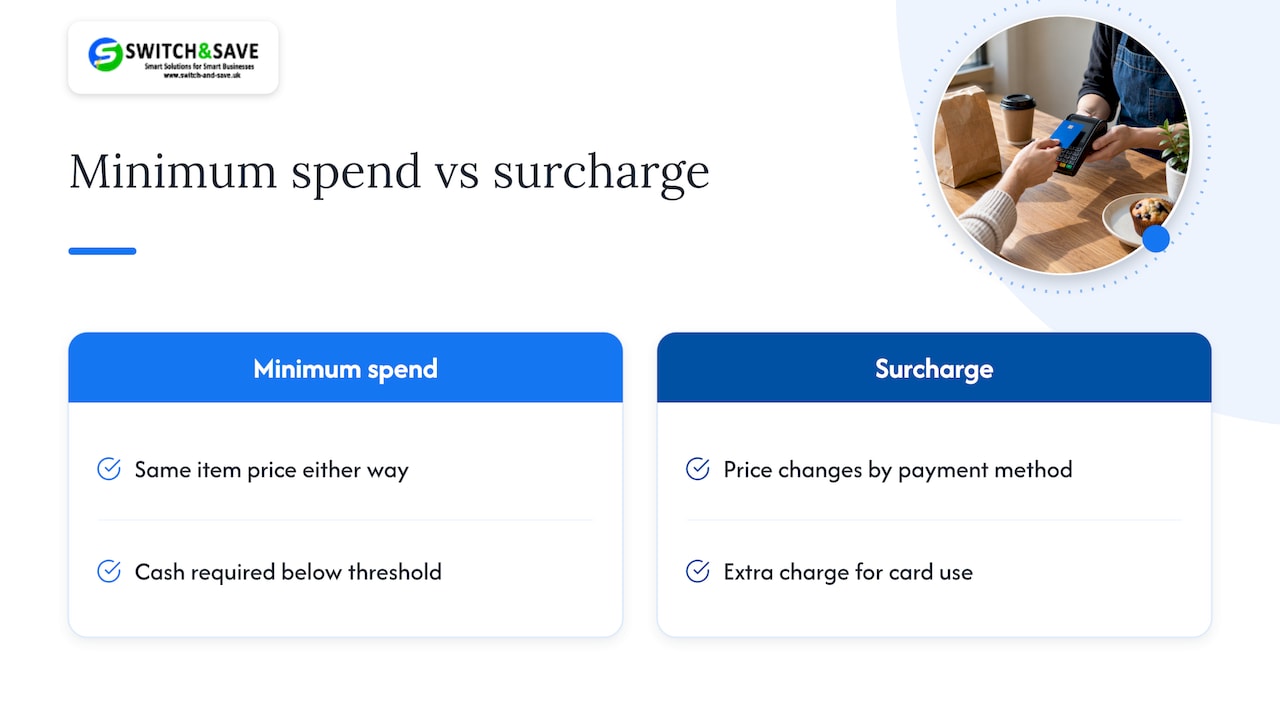
A minimum card spend means: “Below this amount, we only take cash.” The customer still pays the same price whichever way they pay.
It is not a fee. The moment the price changes depending on the payment method, you are in surcharge territory, covered below.
The surcharge ban you must not trip over
Since 13 January 2018, UK traders cannot charge customers extra for using consumer credit, debit or charge cards, or e-payment services such as PayPal, Apple Pay and Google Pay. The rule comes from the Consumer Rights (Payment Surcharges) Regulations 2012, as Pembrokeshire County Council’s consumer guidance explains. The wording of the law is on legislation.gov.uk, and GOV.UK’s summary of payment surcharges is a quick read.
This matters for minimum spends in three ways.
- No “card fee under £5” line. Telling a customer they can pay by card for a small purchase if they add 50p is a surcharge, not a minimum.
- Waiving is not a loophole. If you let a regular use their card below your minimum, you cannot then charge them to cover the processing cost. Southwark’s guidance treats that as a breach.
- Consistency protects you. Applying the rule to some customers and not others invites complaints.
Customers do get this wrong in the other direction too. Consumer forums are full of people who were told they would pay a fee for a sub-£5 card payment. If that is your policy as it stands today, change the wording to a plain “cash only under £X” or drop it.
Check your card contract before you put up a sign
The law is only half the picture. Your agreement with your acquirer, the company that processes your card payments, and the card scheme rules may limit what you can do. Trading Standards guidance, as Southwark summarises it, warns traders not to breach their supplier terms and conditions when refusing card payments on low-value sales.
Before setting a minimum:
- Read the sections of your merchant agreement on accepting cards.
- Ask your provider in writing whether a minimum spend is allowed.
- Keep the answer on file.
If your provider’s terms do not allow it, a sign on the counter will not protect you.
Why shops set a minimum, and whether it works
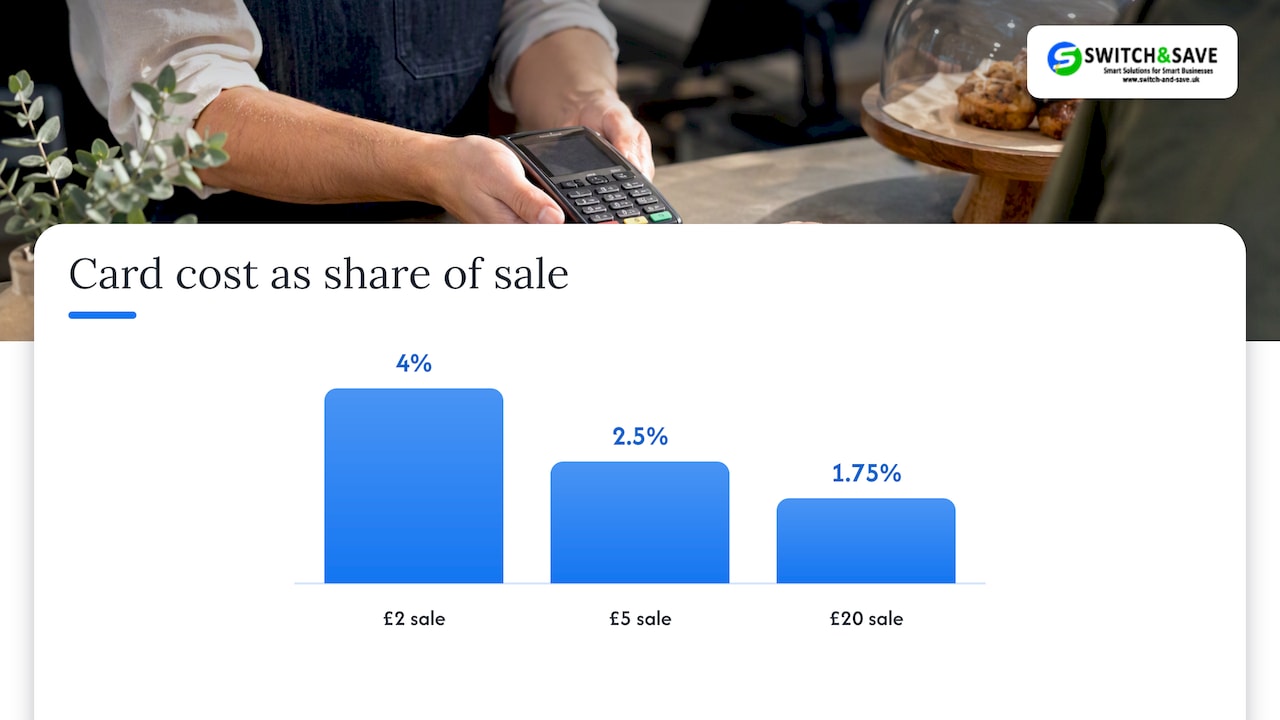
The motive is almost always cost. Each card sale costs you money. The Payment Systems Regulator explains that when a customer pays by card, the merchant’s bank pays an interchange fee to the customer’s bank, and you pay your own provider on top. Add a fixed per-transaction charge and a £1.80 sale can look like a loss.
A quick worked example, with illustrative figures rather than real rates. Suppose your provider charges 1.5% plus 5p per transaction.
| Sale | Card cost | Share of sale |
|---|---|---|
| £2.00 | 8p | 4% |
| £5.00 | 12.5p | 2.5% |
| £20.00 | 35p | 1.75% |
The fixed element bites hardest on small baskets. That is why the minimum feels like a fix. But the sums rarely tell the whole story:
- A customer who cannot pay by card may buy nothing, or buy elsewhere.
- You lose the add-on sale, such as the pastry with the coffee.
- Staff handle more cash, with more counting, banking and float.
Our cash versus card costs guide goes through the hidden side of cash handling for UK retail and hospitality.
What customers expect now
People pay differently than they used to. The PSR’s consumer research found that contactless has become the preferred way to pay for purchases under £100. Customers who are made to find a cashpoint for a small purchase tend to see it as an annoyance, and some will not come back.
That plays out on high streets in places like the Bullring area in Birmingham or Coventry’s city centre, where shoppers walk past plenty of alternatives. A café that refuses a £2.80 card payment is competing with the one next door that does not.
A note on contactless limits
One common confusion: the contactless limit is not a minimum. It is a ceiling on tap payments without a PIN. Until March 2026 it was set by regulation at £100 per payment. From 19 March 2026, the FCA replaced the fixed figures with a risk-based rule, so providers can set their own limits, though most UK banks and card providers have kept £100. Your terminal handles this automatically. You do not set it.
Options besides a minimum spend
If small card sales hurt, you have better choices than a blanket minimum. The PSR notes that retailers are free to set prices and often reflect payment costs in their overall prices for all customers. That is legal, because it applies to everyone whatever they pay with.
- Review your processing agreement. Look at the per-transaction fee, the percentage and any monthly minimum or terminal rental. Our guide on how to reduce card machine fees shows what to check.
- Build the cost into your prices. A small, even uplift on your range, the same for cash and card, is lawful.
- Encourage bigger baskets. Bundles, meal deals and add-ons lift the average sale without turning anyone away.
- Cut cash-handling cost. If you take more cards, you bank less cash and count less.
- Move to a system where the numbers work. An integrated EPOS and card terminal with clear pricing makes it easy to see exactly what each sale costs you.
If you still want a minimum, do it properly
Some businesses have good reasons: a market stall with weak signal, a pop-up with a single terminal and a queue. If that is you, follow these steps.
- Confirm your acquirer allows it, in writing.
- Pick a low figure. £3 to £5 is the usual range, and anything higher risks lost trade.
- Put it up where customers decide: at the door, on the menu and at the till.
- Word it as cash only below the limit. Never mention a card fee.
- Apply it to everyone, every time.
- Review it every quarter against your actual card costs and takings.
If a customer complains, a polite explanation and a copy of your signage usually settles it. Persistent disputes can go to your local Trading Standards team. In Birmingham and Coventry, that means your city council’s service.
Our view: why we think the minimum is mostly a symptom
We sell EPOS and card payment systems to UK retail and hospitality businesses, so we hear this question often. Here is where we stand.
A minimum spend is almost always a response to a costly or confusing payment setup. The owner sees a small sale, sees a fee and reaches for a sign. But the real issue is that many businesses do not know what each transaction costs them, because their card terminal, till and reporting live in three separate places.
When the till and payments are integrated, you see sales, card takings and stock in one dashboard. You can see which hours are busy, what small baskets add up to, and whether the cheap items are the ones that bring people through the door. A £2 sale that brings in a regular who spends £40 a week is worth taking.
Our advice is simple. Work out your real card cost. Fix the contract and the system first. Keep a minimum only if the numbers still do not work afterwards, and if you do, make it low, clear and consistent.
— Amir
Making card payments pay: our EPOS and card options
If you want one system for tills, stock and card payments, take a look at what we offer.
- Hospitality EPOS Bundle: from £349 + VAT upfront, with a monthly service plan on a 12-month minimum term (see EPOS pricing). Built for cafés, takeaways and restaurants. See the Hospitality EPOS bundle.
- Card machine included: every package includes a card machine, subject to provider approval; card processing fees are separate. See our card machines.
- Retail bundles: standard and premium options for shops. Browse the EPOS bundles for retail.
- Card machines: see our card machine range.
We publish our pricing, and the support team is UK-based. If you are moving from another provider, we can help with migration. 👉 Not sure which fits? Start with our guide to EPOS systems for small shops.
Practical checklist for Birmingham and Coventry businesses
Whether you run a restaurant in Coventry or a retail unit in Birmingham, run through this list.
- Do your signs mention a card fee anywhere? Remove it now.
- Does your merchant agreement allow a minimum spend? Get it confirmed.
- Do you know your average card transaction value and your cost per sale?
- Is your minimum, if you have one, at or below £5?
- Do staff know to apply it the same way every time?
- Do you take contactless and mobile wallets on every terminal, including on busy tables and at the counter?
- Is your payment data connected to your till and stock reports?
If you answer no to the last two, that is usually where the biggest savings and the happiest customers are.
FAQ
Is it legal to have a minimum card spend in the UK?
Yes. There is no UK law that bans a minimum card payment, and a trader may refuse card payment on low-value sales. You must not charge a surcharge for card use, and you should check your merchant agreement allows it.
Is there a minimum amount for card payment?
There is no legal or universal minimum. Individual businesses set their own, commonly £3 or £5, and some card machine providers do not impose one. Check your own terms with your provider.
Is there a minimum spend on contactless?
Not as a rule. Contactless has a ceiling for tap payments without a PIN, which most UK providers still keep at £100. The ceiling is not a minimum.
Can I charge a fee for paying by card?
No. Surcharges on consumer cards and wallets such as Apple Pay and Google Pay have been banned since 13 January 2018. You can build costs into your general prices, so long as they are the same whichever way the customer pays.
What should I do if my card costs make small sales unprofitable?
Review your processing fees and contract first. Then consider your pricing, bundles and add-on sales. Moving to an integrated EPOS and payment system can give you clearer costs per sale. A low, clearly displayed minimum is the last resort.
Sources
- Southwark Council: information for business on no extra charges for card payments
- Pembrokeshire County Council: supply of services and your consumer rights
- legislation.gov.uk: Consumer Rights (Payment Surcharges) Regulations 2012
- GOV.UK: Consumer rights, payment surcharges
- Payment Systems Regulator: the IFR and merchants
- Payment Systems Regulator: the IFR and consumers
- Payment Systems Regulator: consumer research 2022-3
- Sprintlaw: minimum card payment rules for UK businesses
- Zable: contactless limit in the UK