
What is a card payment?
A card payment is a cashless transaction where a cardholder uses a debit, credit, or prepaid card to transfer funds to a merchant, either through a physical terminal or online. Under the Payment Card Interchange Fee Regulations 2015, a payment card is formally defined as “a category of payment instrument that enables the payer to initiate a debit or credit card transaction.” That legal definition covers the plastic in your wallet, a virtual card number, and any digital device that triggers the same underlying transaction.
Card payments are now the default way the UK pays. 98% of the UK population holds a debit card, and total card payment value reached £102 trillion in 2023. For small business owners, that is not a background statistic. It means the vast majority of your customers expect to pay by card, every time.
The three main card types at a glance:
- Debit cards pull funds directly from the cardholder’s bank account at the point of purchase.
- Credit cards draw on a prearranged credit facility, with the cardholder repaying the lender later.
- Prepaid cards are loaded with funds in advance and are not linked to a live bank account.
Every card payment, regardless of type, routes through a network of five parties: the cardholder, the issuing bank, the card network, the acquiring bank, and the merchant. Understanding that chain is what separates a business owner who manages payment costs well from one who gets surprised by fees.
Types of card payments available in the UK
The Payment Card Interchange Fee Regulations 2015 draw a clear legal line between credit and debit card transactions, and that distinction has real cost implications for merchants.
Credit cards use a prearranged credit facility. The cardholder spends now and repays the lender, typically monthly. Consumer credit cards carry regulated interchange fee caps, while commercial credit cards do not, so merchants often pay higher fees when a business customer pays by corporate card.

Debit cards deduct funds directly from the cardholder’s account. Under UK law, a debit card transaction is defined as any card-based transaction that is not a credit card transaction, which means prepaid cards technically fall under the debit category for regulatory purposes.
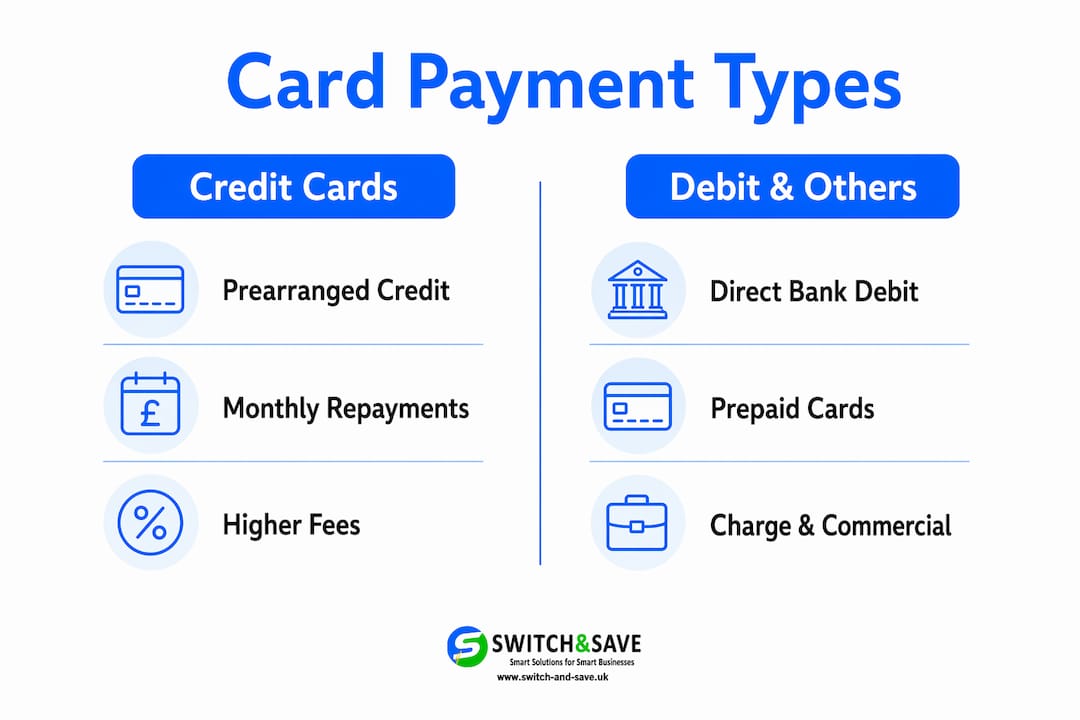
Prepaid cards are pre-loaded with a set amount. They look and feel like debit cards at the checkout, but the funding mechanism is different: there is no live bank account behind them. As a merchant, you may not always know whether a customer is paying with a prepaid card, yet the fee structures can differ from standard debit.
Charge cards require the full balance to be settled each month. They are less common in everyday retail but appear frequently in corporate travel and expense management.
Commercial and business cards sit in a separate legal category. They often carry higher interchange fees than consumer cards, which is worth factoring into your payment acceptance costs.
| Card type | Funding source | Typical UK use | Interchange category |
|---|---|---|---|
| Debit | Bank account | Everyday purchases | Regulated (capped) |
| Credit (consumer) | Credit facility | Retail, online shopping | Regulated (capped) |
| Credit (commercial) | Credit facility | Business expenses | Unregulated |
| Prepaid | Pre-loaded balance | Gifting, budgeting | Varies |
| Charge | Credit facility (full repayment) | Corporate travel | Unregulated |
For a deeper look at how these card types play out in retail and hospitality settings, the card payment options guide from Switch-and-save covers the practical differences well.
How card payments actually work in the UK
Five parties are involved in every card transaction: the cardholder, the issuing bank, the card network (Visa or Mastercard), the acquiring bank, and the merchant. Each plays a distinct role, and the process moves faster than most people realise.
The step-by-step flow:
- Initiation. The cardholder presents their card at a terminal or enters card details online.
- Authorisation. The terminal sends a request through the card network to the issuing bank, which checks available funds and card validity. This happens in seconds.
- Approval or decline. The issuer responds with an authorisation code or a decline. An approval confirms the funds exist at that moment.
- Clearing. Transaction data is batched and sent between the acquirer and issuer, usually at the end of the business day.
- Settlement. Funds move to the merchant within 2–3 working days after authorisation.
One point that catches many small business owners off guard: authorisation is not the same as payment. The Payment Systems Regulator confirms that an authorisation confirms funds availability but does not guarantee final payment, because chargebacks and settlement delays can still occur. A customer’s card being accepted at your till does not mean the money is in your account.
Pro Tip: Never release high-value goods or services based on authorisation alone. Wait for settlement confirmation, or use a pre-authorisation hold for bookings and deposits.

For online transactions, the flow is identical in structure but adds authentication layers such as 3D Secure (Verified by Visa or Mastercard Identity Check) to reduce fraud. Understanding instant checkout processes can help e-commerce businesses reduce cart abandonment while keeping that security layer in place.
Benefits of card payments for individuals and small UK businesses
Card payments are faster, safer, and more predictable than cash for almost every retail scenario. For a small business, the practical advantages go well beyond convenience.
Key benefits:
- Speed at the till. Contactless payments complete in under a second, reducing queue times and improving the customer experience.
- Higher average spend. Customers paying by card tend to spend more than those limited to the cash in their wallet.
- Reduced cash handling. No counting, no float, no trips to the bank, and no risk of till theft.
- Predictable cash flow. Card settlements arrive on a consistent schedule, making it easier to plan outgoings.
- Built-in fraud protection. Card networks and issuers carry liability for many types of fraud, protecting both the cardholder and, in many cases, the merchant.
The UK’s £102 trillion total payment value in 2023 reflects just how central card payments have become to the economy. With 98% of the population holding a debit card, refusing card payments is not a neutral business decision. It actively excludes the majority of potential customers.
Security is another genuine advantage. Chip and PIN technology, combined with contactless encryption, makes card fraud significantly harder than cash theft. For online sales, 3D Secure adds a further authentication step. The result is a payment method that protects your business and gives your customers confidence.
UK regulations and what they mean for your business
The UK’s card payment system operates under a layered regulatory framework. The Payment Systems Regulator (PSR), the Financial Conduct Authority (FCA), the Bank of England, and the Prudential Regulation Authority each oversee different parts of the system. The FCA sets out the roles and responsibilities of issuers, acquirers, card schemes, and merchants to protect both consumers and businesses.
The Payment Card Interchange Fee Regulations 2015 are the most directly relevant piece of legislation for merchants. They cap interchange fees on consumer debit and credit card transactions, which keeps your card acceptance costs lower for everyday retail sales. Commercial cards are exempt from those caps, so you will pay more when a business customer uses a corporate card.
Key regulatory points for merchants:
- Consumer debit and credit card interchange fees are capped under UK law.
- Commercial card fees are not capped and are typically higher.
- Merchants must inform customers if they do not accept all cards under a given scheme.
- Surcharging consumers for card payments is banned under the Payment Services Regulations 2017.
- The PSR monitors card scheme governance and can intervene where it finds harm to competition or consumers.
One common misunderstanding: authorisation and settlement are treated differently under UK payment law. Authorisation confirms a transaction is approved; settlement is when funds legally transfer. Chargebacks can reverse a settled payment, which is why understanding your chargeback rights and obligations matters as much as knowing your interchange rate.
For practical guidance on managing the cost side of card acceptance, Switch-and-save’s guide on reducing card machine fees is a useful starting point.
Which card schemes operate in the UK?
Visa and Mastercard dominate the UK card payments market. Both operate as four-party schemes, meaning they sit between the issuing bank and the acquiring bank, setting the rules, standards, and interchange fees that govern every transaction on their networks.
Visa issues consumer and commercial cards under its brand, including Visa Debit, Visa Credit, and Visa Prepaid. Its verification service, Verified by Visa (now Visa Secure), handles 3D Secure authentication for online payments.
Mastercard operates an equivalent range, including Mastercard Debit, Mastercard Credit, and Maestro (though Maestro was phased out for new UK cards from 2023). Mastercard Identity Check is its 3D Secure equivalent. For a closer look at how Mastercard’s network functions in practice, Switch-and-save’s practical guide to Mastercard payments covers the merchant-facing detail.
American Express operates as a three-party scheme in many cases, acting as both issuer and acquirer. It carries higher merchant fees than Visa or Mastercard and is accepted by fewer UK retailers, though its cardholder base tends to have higher average spend.
UnionPay is the largest card network globally by number of cards issued, though its UK merchant acceptance is limited mainly to retailers serving Chinese tourists and international visitors.
For UK small businesses, Visa and Mastercard acceptance is non-negotiable. Both networks dominate UK card payments and are the primary routes through which authorisation and settlement flow for the vast majority of transactions.
What is changing in card payments: contactless and mobile wallets
Contactless payments have become the standard for in-person transactions in the UK. The current limit sits at £100 per transaction, though individual banks can set lower limits on their cards. The technology uses near-field communication (NFC) to transmit encrypted card data between the card and terminal, with the same chip-level security as an inserted card.
Mobile wallets, including Apple Pay, Google Pay, and Samsung Pay, use the same NFC infrastructure but add a biometric authentication layer (fingerprint or face recognition) at the device level. This means a mobile wallet payment can exceed the standard contactless limit because the device itself has verified the user’s identity. For merchants, accepting mobile wallets requires no additional hardware if your terminal already supports contactless.
Trends shaping card payments in 2026:
- Buy now, pay later (BNPL) integration. BNPL providers increasingly issue virtual cards, meaning their transactions route through standard card networks and appear as card payments at the merchant’s terminal.
- Open banking overlays. Account-to-account payments are growing, but card networks are responding with faster settlement and improved dispute resolution to retain merchant preference.
- Tokenisation. Card networks replace actual card numbers with unique tokens for stored card details, reducing the risk of data breaches for merchants who save customer payment information.
- Tap to pay on mobile. Merchants can now accept contactless payments directly on a smartphone without a separate card terminal, using apps that turn the phone into a payment device.
For small businesses, the practical implication is straightforward: your payment setup needs to handle contactless and mobile wallet payments as a baseline, not an optional extra. Customers who cannot pay the way they prefer will simply go elsewhere.
Ready to accept card payments with confidence?
Understanding how card payments work is the first step. Having the right hardware and software to accept them efficiently is what actually moves your business forward. Switch-and-save offers EPOS systems built specifically for UK retail and hospitality businesses, with integrated card payment processing, real-time sales tracking, and cloud-based management.
Whether you are setting up for the first time or upgrading an existing system, Switch-and-save has a package to fit your business. Explore EPOS solutions or get in touch for a free demo today.
Key takeaways
Card payments are cashless transactions regulated under UK law, involving five distinct parties, with funds typically settling to merchants within 2–3 working days after authorisation.
| Point | Details |
|---|---|
| Legal definition | A payment card initiates a debit or credit transaction under the Payment Card Interchange Fee Regulations 2015. |
| UK adoption | 98% of the UK population holds a debit card; total card payment value reached £102 trillion in 2023. |
| Authorisation vs settlement | Authorisation confirms funds exist but does not guarantee payment; settlement takes 2–3 working days. |
| Commercial card costs | Commercial cards are exempt from interchange fee caps, so merchants pay higher fees on business card transactions. |
| Contactless limit | The standard UK contactless limit is £100 per transaction, with mobile wallets able to exceed this via biometric verification. |
FAQ
What is the definition of a card payment?
A card payment is a cashless transaction where a payment card (debit, credit, or prepaid) is used to transfer funds from a cardholder to a merchant. Under the Payment Card Interchange Fee Regulations 2015, a payment card is formally defined as a payment instrument that enables the payer to initiate a debit or credit card transaction.
What is the difference between a debit card and a credit card payment?
A debit card payment deducts funds directly from the cardholder’s bank account at the time of purchase. A credit card payment draws on a prearranged credit facility, with the cardholder repaying the lender at a later date, typically monthly.
What are the main types of card payments?
The main types are debit card payments, credit card payments, and prepaid card payments. Charge cards and commercial cards are also used, particularly in business contexts, and carry different fee structures under UK regulations.
Do card payments settle immediately?
No. Authorisation happens instantly, confirming that funds are available, but actual settlement to the merchant’s account typically takes 2–3 working days. Authorisation does not guarantee final payment, as chargebacks can still occur after settlement.
What card schemes are used in the UK?
Visa and Mastercard are the dominant card schemes in the UK, handling the vast majority of debit and credit card transactions. American Express operates a smaller but active network, and UnionPay has limited acceptance focused mainly on international visitors.