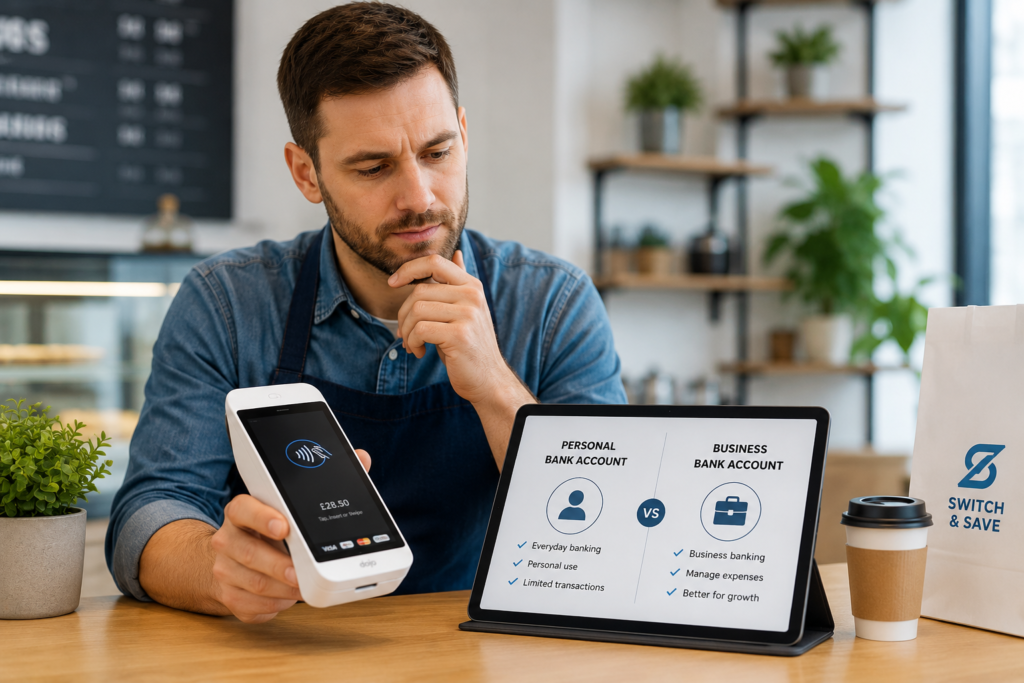
Yes, some UK sole traders can get a card machine without opening a separate business bank account. Certain payment providers may allow payouts to a personal current account when the account is in the sole trader’s legal name and the bank permits business transactions.
However, you will still need an eligible account into which the card payment provider can deposit your money. Limited companies should use a separate business bank account because the company is legally separate from its directors and owners. Provider acceptance also depends on identity checks, business verification and underwriting requirements.
Switch & Save helps UK businesses compare card machine options, understand application requirements and choose a payment setup that suits their legal structure, expected turnover and day-to-day operations.

Key Takeaways
| Question | Answer |
|---|---|
| Can a sole trader use a personal account? | Sometimes, provided both the bank and card payment provider allow it. |
| Can a limited company use a director’s personal account? | Generally no. Company money should be kept separate from personal finances. |
| Can you receive card payments without any account? | Usually no. The provider needs an eligible bank or payment account for payouts. |
| Does every card machine provider follow the same rules? | No. Account requirements and underwriting policies vary by provider. |
| What if you do not have a traditional business bank account? | A provider may offer an integrated business payment account or another eligible payout option. |
| What is the safest approach? | Confirm account compatibility before signing a card machine contract. |
Can You Get a Card Machine Without a Business Bank Account?
Whether you can get a card machine without a business bank account depends mainly on your business structure.
A sole trader may be able to connect a card payment service to a personal current account. For example, some payment providers accept personal accounts when the payment account holder and the registered sole trader are the same person. SumUp states that the account holder must match the registered profile owner when a personal account is used.
A limited company is different. The company is a separate legal entity, so its banking and accounting records should be kept separate from those of its directors. GOV.UK guidance states that a limited company’s banking must be separate from personal banking.
The simplest rule is:
- Sole trader: a personal account may be accepted.
- Limited company: use an account registered to the company.
- Partnership: check whether the provider requires an account in the partnership’s name.
- Charity, club or organisation: expect to need an account matching the registered organisation.
Approval is never automatic. The card machine provider must still verify who you are, what your business does and where the money should be paid.
Do You Still Need an Account to Receive Card Payments?
A card machine cannot normally send money directly into cash, a savings pot or an account belonging to somebody unrelated to the business.
When a customer pays by card, the transaction passes through the payment provider. After fees, refunds and any applicable adjustments, the provider transfers the settlement into your nominated payout account.
This means that getting a card machine without a business bank account is not the same as getting one without any account at all.
You will normally need one of the following:
- A business current account
- An eligible personal current account for a sole trader
- A payment or electronic money account supplied by the provider
- Another approved account registered in the correct legal name
For example, PayPal Point of Sale requires merchants to connect a bank account before deposits can be made. Other providers may offer their own business payment account as part of the service.
Can Sole Traders Use a Personal Bank Account?
UK sole traders are not generally legally required to open a separate business bank account. Government guidance says sole traders and ordinary partnerships may operate without one, although separating business and personal finances can make bookkeeping and tax reporting easier.
That does not automatically mean your personal bank will allow business transactions.
Some personal account terms prohibit or restrict commercial use. Before entering your sort code and account number on a card machine application, ask your bank:
- Can I receive regular card payment settlements?
- Is business use allowed under my current account terms?
- Are there limits on transaction volume or payment frequency?
- Could the account be restricted if business activity increases?
- Do I need to upgrade to a business account?
HMRC guidance specifically advises business owners to check with their bank which type of account can be used for business transactions.
Practical example: a self-employed mobile hairdresser
A mobile hairdresser operating as a sole trader may only process a small number of card payments each week. A payment provider might allow the hairdresser to receive settlements into a personal current account, provided:
- The account is in the hairdresser’s legal name
- The provider supports personal accounts for sole traders
- The bank allows business-related transactions
- Identity and address checks are completed successfully
As the business grows, a dedicated business account may make reconciliation and tax record-keeping easier.
Can a Limited Company Use a Personal Bank Account?
A limited company should not receive its card sales into the director’s personal account.
The company exists separately from the person who owns or manages it. Company income, expenses and liabilities must therefore be distinguishable from the director’s personal finances. GOV.UK states that there must be a clear division between a company’s finances and those of its owners and directors.
A card payment provider is also likely to check that the payout account name matches the registered company name.
Practical example: a limited-company takeaway
Suppose “Birmingham Pizza House Ltd” applies for a countertop card machine. The application lists the limited company as the merchant, but the bank details belong personally to one of its directors.
The provider may reject the bank account, request replacement details or delay the application because:
- The legal merchant is Birmingham Pizza House Ltd
- The bank account belongs to an individual
- The account and application names do not match
- The settlement arrangement could create verification and accounting concerns
The more appropriate option is a business account opened in the company’s registered name.
Business Bank Account Versus Merchant Account
A business bank account and a merchant account are not the same thing.
Business bank account
This is where your business keeps its money, pays suppliers, receives settlements and manages everyday finances.
Merchant account
This is part of the card payment arrangement used to process customer transactions. Depending on the provider, it may be a dedicated merchant account or part of an aggregated payment service.
Your merchant account does not always replace your bank account. The provider still needs somewhere to send your settled funds.
When comparing card machines for UK businesses, ask where your money will be held, how it will be paid out and what type of account can be connected.
What Will the Card Machine Provider Check?
Card machine providers have legal and commercial obligations to verify applicants before allowing them to process payments.
The precise requirements vary, but you may be asked for:
- Your legal name
- Trading name
- Business structure
- Trading address
- Contact details
- Bank account number and sort code
- Proof of identity
- Proof of address
- Proof that the business is trading
- Company registration details
- Website or social media information
- Expected monthly card turnover
- Average transaction value
- Products or services sold
You can review the full Switch & Save guide to the documents needed for a card machine application.
Make sure the details on your application, identity document, bank account and business records are consistent. Even a minor name mismatch can lead to additional checks.
Alternatives to a Traditional Business Bank Account
Not having a traditional high-street business bank account does not necessarily prevent you from accepting cards.
1. Open a digital business account
Several digital banking and payment platforms offer business accounts that can be opened online. Eligibility, fees and protection arrangements vary, so check whether the account is suitable for card settlements.
2. Use a payment provider’s account
Some payment providers offer an integrated business payment account. Your card sales may be settled into that account instead of being sent immediately to an external bank.
Check:
- Whether the account has a UK sort code and account number
- How quickly funds become available
- Whether money can be transferred elsewhere
- Which fees apply
- Whether the provider is a bank or an electronic money institution
- How eligible customer funds are protected
3. Begin as a sole trader with an eligible personal account
This may be an option for a new or low-volume sole trader, but only after checking the terms of both the bank and payment provider.
4. Open a dedicated second account
Some sole traders use a separate eligible account exclusively for business income and expenses. This may simplify record-keeping, although it does not become a formal business account unless the provider classifies it as one.
Risks of Using a Personal Account for Card Machine Payouts
Using a personal account may appear convenient, but it can create difficulties.
Your bank may restrict the account
A bank could identify frequent commercial transactions and ask you to move to a business product if personal account terms do not permit business use.
Bookkeeping becomes harder
Personal spending, supplier payments, refunds and card settlements can become mixed together. Sole traders must keep records of business income and expenses for their tax return.
Refund and chargeback tracking becomes confusing
When a payment dispute occurs, you need to identify the original transaction, settlement, fee and refund. A separate account makes this easier.
Your application may be delayed
The provider may request additional evidence if the account holder’s name does not match the application.
Growth may require a change later
A personal account that works for a weekend market stall may become unsuitable when the business opens permanent premises, hires staff or processes significantly more transactions.
How to Apply for a Card Machine Without Delays

Before applying, follow this checklist:
Step 1: Confirm your legal structure
Know whether you are applying as a sole trader, partnership, limited company, charity or other organisation.
Step 2: Check your account terms
Ask the bank or account provider whether card payment settlements and business transactions are permitted.
Step 3: Ask the card machine provider
Do not assume that a personal account will be accepted. Obtain confirmation based on your business type.
Step 4: Match your details
Use consistent names, addresses and contact information across the application and supporting documents.
Step 5: Estimate your card turnover accurately
Give a realistic estimate of your monthly sales and typical transaction value. Do not deliberately understate or overstate expected activity.
Step 6: Compare the complete cost
Review transaction fees, authorisation fees, terminal rental, minimum monthly service charges, PCI-related fees, contract length and early termination conditions.
Our guide to choosing the right card machine provider explains the main points to compare before signing.
How Switch & Save Can Help
Switch & Save helps UK small businesses find card payment solutions that suit how they actually trade.
Rather than looking only at the headline transaction rate, the team can help you consider:
- Your business structure
- Whether your payout account is likely to be accepted
- Your expected card turnover
- Countertop, portable or mobile payment requirements
- Contract terms and additional charges
- EPOS integration
- Reporting and reconciliation
- Future business growth
Businesses using a till may also benefit from an integrated setup in which the sale amount passes directly from the EPOS system to the card terminal. This can reduce manual entry and make end-of-day reporting easier.
For a clearer comparison, read POS vs card machine: which is right for your business?.
Frequently Asked Questions
Can I get a card reader with only a personal bank account?
Possibly. Some providers accept a personal current account from a sole trader when the account is in the applicant’s legal name. You must also confirm that your bank permits business transactions.
Can I get a card machine without any bank account?
Usually not. The payment provider needs an eligible bank, payment or electronic money account into which it can transfer your card sales.
Do sole traders need a business bank account in the UK?
Sole traders are not generally legally required to have one, but their bank may restrict business use of a personal account. A separate account can also simplify bookkeeping.
Does a limited company need a business bank account for a card machine?
A limited company should use a separate account in the company’s name. Company finances must be kept separate from the personal finances of directors and shareholders.
Does the bank account name need to match the card machine application?
Normally, yes. A mismatch may trigger additional verification or prevent the provider from approving the payout account.
Can card payments be sent to someone else’s account?
Providers will generally not allow business settlements to be sent to an unrelated third party. The account must normally belong to the applicant or registered business.
Can a new business get a card machine?
Yes. New businesses can apply, although the provider may request identification, bank details, proof of business activity and estimated card turnover.
Is a merchant account the same as a business bank account?
No. A merchant account supports card processing, while a business bank account is used to hold and manage the business’s money.
You may be able to get a card machine without a separate business bank account when you are a sole trader and both your payment provider and bank accept the use of a personal current account.
However, you cannot normally accept card payments without providing an eligible payout account. Limited companies should use a separate business account registered in the company’s legal name.
The safest approach is to confirm account eligibility before entering a card machine agreement. That helps prevent rejected applications, delayed payouts and the need to change accounts after installation.
Switch & Save helps UK businesses reduce costs with AI-powered EPOS systems, card payment solutions and business finance.