

For most UK retailers and hospitality venues, card processing is the visible cost line on every statement, while cash quietly costs more to handle once you add staff time, security and banking charges. Cash made up just 9% of all UK payments in 2024, down from 6 billion transactions the year before to 4.4 billion, yet many businesses still pay over £50 a month just to deposit it. We’ll walk through the real numbers so you can work out which mix suits your till.
TL;DR:
- Consumer credit rates commonly range from 0.65% to 1.85%, while UK debit charges can be about £0.01 to £0.18 per transaction, depending on payment type.
- LINK found that 15% of high street businesses pay more than £200 monthly to deposit cash, while many report fees above £50.
- Most consumer card surcharges are banned in the UK; permitted charges must match direct costs, so build fees into prices or negotiate lower rates.
- Calculate each method’s cost per transaction using fees, deposit charges, staff time, insurance, and transaction volume, then weigh savings against regulars who rely on cash.
Table of Contents
- Quick comparison: headline numbers and what they mean for UK businesses
- How card acceptance costs are structured in the UK
- Hidden and operational costs of accepting cash
- The law on surcharging and how it shapes merchant pricing choices
- A practical decision framework for UK businesses: how to choose whether to keep accepting cash
- Tactics to reduce payment costs without harming sales
- What running both payment methods actually teaches you
- How an integrated EPOS and payments bundle can lower your payment overheads
- FAQ
- Sources
Quick comparison: headline numbers and what they mean for UK businesses
If you only look at your merchant statement, card payments look like the expensive option. Cash looks “free” because no fee lands on an invoice. The numbers tell a different story once you add up everything cash actually costs you.
Cash use has been falling steadily. In 2024, cash payments dropped to 4.4 billion transactions, representing 9% of all UK payments, continuing a long decline as contactless and card payments took over as the default for most shoppers. Card fees, meanwhile, sit in a fairly predictable band once you know your transaction mix.
Here’s what typically shows up for a small retail or hospitality business:
- Card processing: a merchant service charge that varies by card type and provider.
- Cash handling: bank deposit charges, insurance, and staff time counting and reconciling tills.
- Cash deposit fees: many high street businesses report paying over £50 a month, with 15% paying more than £200 a month just to bank their takings.
Over £50 a month is what a sizeable share of high street businesses report paying just to deposit cash, according to LINK’s cash acceptance research. That figure alone often rivals what a low-volume retailer pays in card fees.
| Payment method | Typical per-transaction cost | Monthly cost example | Cashflow benefit |
|---|---|---|---|
| Card (debit, typical MSC) | Varies by card type, provider and ticket value | Scales with turnover | Settles into your account within 1 to 2 working days |
| Card (credit, typical MSC) | 0.65% to 1.85% of ticket value | Scales with turnover | Same settlement, slightly higher fee |
| Cash | No per-transaction fee, but fixed deposit charges apply | Often £50 or more in deposit fees alone | Immediate, but takings sit until banked |
The real comparison isn’t fee versus “free”. It’s a variable cost that scales with turnover against a fixed cost that scales with footfall, staff hours and how often you can get to a branch or deposit point.
How card acceptance costs are structured in the UK
Every card payment you take passes through several layers before the final cost reaches your statement. Understanding each layer helps you spot where you actually have room to negotiate.
A typical card transaction is made up of:
- Interchange fee: paid to the cardholder’s bank, set within regulated caps.
- Scheme fee: paid to the card network (Visa or Mastercard) for using their rails.
- Acquirer margin: the fee your payment provider or acquiring bank charges for processing the transaction.
Added together, these make up your merchant service charge, the figure that actually appears on your statement.
Interchange rates vary more than most business owners expect. Regulatory analysis shows UK debit card interchange can run from around £0.01 to £0.18 per transaction, while consumer credit card interchange commonly sits between 0.65% and 1.85% of the transaction value, depending on the card type and how the payment is taken. A card-not-present transaction, such as a phone order or online sale, may carry a different rate from an in-person payment.
0.65% to 1.85% is the typical UK interchange range for consumer credit transactions, a figure that explains why a shop that takes mostly credit card payments pays more per pound of turnover than one that takes mostly debit.
Several factors move your effective rate beyond the headline interchange figure:
- Transaction mix: a business that takes more credit cards than debit cards pays a higher blended average.
- Average ticket size: fixed per-transaction fees hit small-ticket businesses (cafés, convenience stores) harder than those with higher average spend.
- Terminal and acceptance method: contactless and chip-and-PIN transactions in person usually cost less to process than phone or online payments, because card-not-present transactions carry more fraud risk.
- Card type: commercial or business cards sometimes carry different interchange rates than consumer cards.
Once you understand those variables, you have levers to pull. Merchant service charges usually come in two shapes: an “interchange plus” structure, where you pay interchange plus a transparent acquirer margin, or a “blended rate”, where your provider charges one flat percentage regardless of card type. Interchange plus pricing is usually cheaper if your transaction mix favours lower-cost debit cards, because you benefit directly when a cheaper card is used. Blended rates are simpler to budget for but can cost more if your card mix shifts towards credit over time.
When you negotiate with an acquirer or payment provider, worth asking for:
- A breakdown of interchange, scheme fees and margin, rather than a single blended number.
- A monthly cap or volume discount if your turnover is growing.
- Clarity on whether contactless, chip-and-PIN and card-not-present transactions are priced differently.
Industry commentary points out that merchant service charges are largely driven by interchange, and that cost tends to be spread across all your customers through your general pricing, rather than isolated to card users. That’s one reason flat surcharging on card payments is tightly restricted in the UK, which we cover in the next section. If you want a fuller breakdown of how these rates are calculated for your specific setup, our guide on credit card processing rates walks through the maths in more detail.
Hidden and operational costs of accepting cash
Cash doesn’t show up as a line item on your payment statement, which is exactly why its costs are easy to underestimate. The expense is spread across staff time, security measures, banking charges and risk, rather than collected into one neat percentage.
Think through what cash actually requires on a normal trading day:
- Counting and reconciliation: staff time spent counting floats, balancing tills and matching takings against receipts.
- Secure storage: a safe or cash office, and the insurance premium that comes with holding cash on site.
- Banking the takings: either a trip to a branch or a cash-in-transit service, both of which carry a direct or indirect cost.
- Deposit charges: many banks charge per deposit or per note once you go over a free allowance.
Survey evidence from LINK’s cash acceptance research shows the scale of this clearly: 14% of high street businesses stopped accepting cash entirely in the past year, and a meaningful share of those that still accept it report paying more than £200 a month in deposit fees alone.
14% of high street businesses went cashless in the past year, according to LINK’s research, a sign that the operational burden of cash is pushing real decisions on the ground, not just theoretical ones.
Security is the part that’s easiest to overlook until it becomes a problem. Holding cash on premises carries robbery risk, and that risk has knock-on effects: higher insurance premiums, the cost of safes and CCTV, and the staff safety concerns that come with carrying takings to a bank. None of that appears on a merchant statement, but it’s a real cost of doing business in cash.
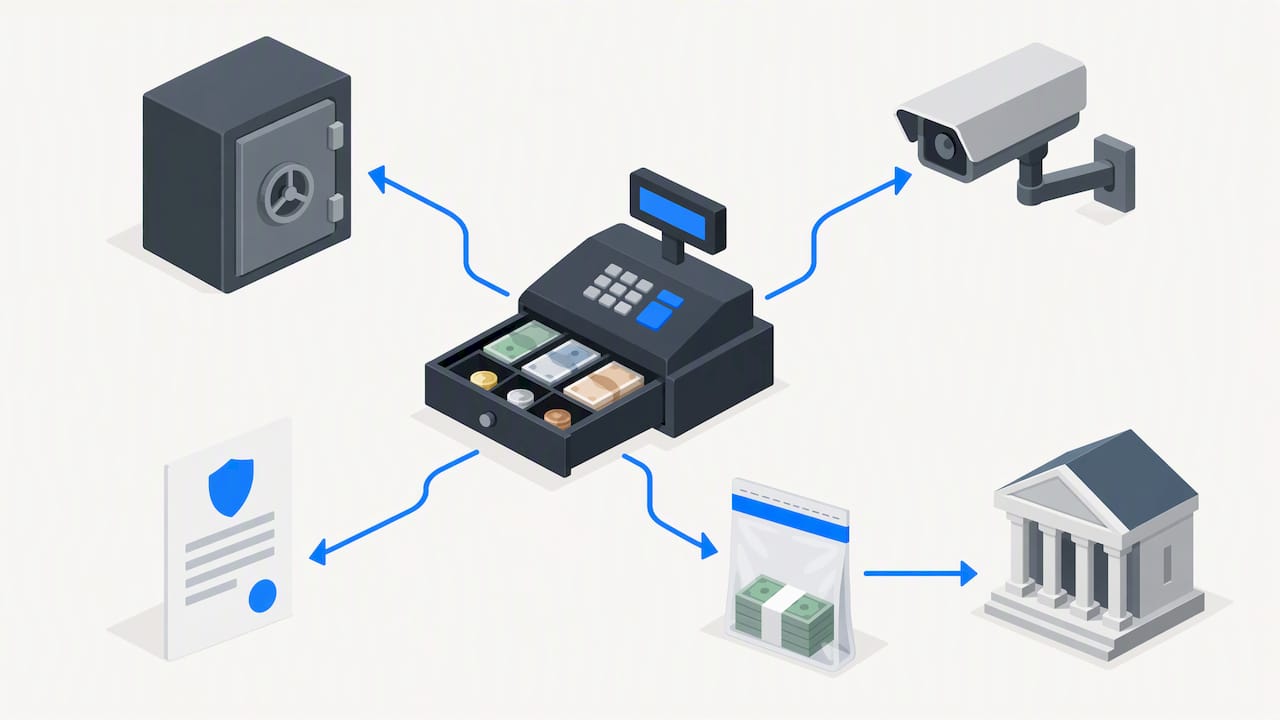
Practitioner insight from LINK’s analysis frames it plainly: the cost of cash extends well beyond banking fees into staff time, security measures and insurance, and that combination is why many retailers choose to stop taking cash rather than absorb those costs indefinitely.
There’s also a longer-term infrastructure pressure worth factoring in. The Bank of England’s oversight of the wholesale cash distribution market exists precisely because falling cash transaction volumes raise the likelihood of cash centre consolidation, which could make deposits and cash collection less convenient, and potentially more expensive, over time. If your area loses a cash centre or your bank reduces branch deposit facilities, the practical cost of continuing to accept cash can rise even if your transaction volumes stay flat.
None of this means cash is a bad choice for every business. LINK’s own research cautions that cash plays an important inclusion and resilience role for some customers, particularly those without easy access to card payments, and that merchants should weigh the real cost of cash against that role rather than assume it’s free or assume it should be dropped outright.
The law on surcharging and how it shapes merchant pricing choices
You can’t simply add a card surcharge to cover your processing costs in the UK, and it’s worth knowing exactly where the line sits before you set your pricing.
The Consumer Rights (Payment Surcharges) Regulations 2012 ban most surcharges on consumer card payments. The rules were tightened further in 2018 so that the ban now covers a wider range of payment methods, including services like PayPal, effective from 13 January 2018. For most consumer card payments, surcharges are banned.
Where a surcharge is genuinely permitted, GOV.UK guidance is clear that it must reflect the direct cost to the trader, not an estimated or inflated figure. That rules out treating surcharging as a way to pad your margin.
Since you generally can’t pass card costs directly onto card-paying customers, your realistic options are:
- Absorb the cost into your overall pricing, spreading it across all customers regardless of how they pay.
- Adjust your headline prices modestly to reflect your blended cost of accepting both cash and card.
- Negotiate a lower processing rate with your acquirer, which reduces the cost you need to absorb in the first place.
- Reconsider which payment methods you accept, if the operational cost of one method genuinely outweighs the custom it brings in.
If you do apply any surcharge in a context where it’s permitted, keep clear evidence of the direct costs involved. You’ll need to be able to show that any charge reflects what you actually pay to process that specific payment method, not a rounded-up or average figure applied across the board. For most retail and hospitality businesses, the simplest and safest route is to build your card costs into your pricing structure rather than attempt to surcharge at all.
A practical decision framework for UK businesses: how to choose whether to keep accepting cash
Deciding whether to keep accepting cash, encourage card, or run both isn’t a gut call. It’s a calculation you can do with numbers you already have access to.
- Pull your transaction data by payment type for a recent period: volume, average ticket size, and total value for both cash and card.
- Add up your actual card fees from your merchant statement, including any monthly minimums or terminal rental costs.
- Add up your actual cash costs: bank deposit charges, any cash-in-transit fees, insurance uplift for holding cash, and a rough estimate of staff hours spent counting and reconciling, valued at their hourly rate.
- Divide each total by your transaction volume for that method, to get a genuine per-transaction cost for cash and for card.
- Compare the two figures alongside your customer mix: if a meaningful share of your regulars pay in cash, the calculation isn’t just about cost, it’s about which customers you’d risk losing.
As a worked illustration, say a café takes 400 cash transactions and 1,200 card transactions a month, with an average ticket of £6. If card fees apply, estimate the monthly processing cost by applying your rate to your card takings. If cash deposit charges and staff counting time add up, compare those costs with cash takings to see what cash costs per pound of turnover. Figures like these will differ for every business, but running your own numbers through the same steps gives you a defensible, specific answer rather than a guess.
Once you’ve got your numbers, weigh them against a short checklist:
- Customer mix: how many of your regulars rely on cash, and would you lose that custom by discouraging it?
- Regulatory and community considerations: some sectors and high streets face pressure to maintain cash acceptance for financial inclusion reasons.
- Operational capacity: do you have the staff time and secure storage to keep handling cash safely?
- Security exposure: has your premises or area seen a rise in cash-related incidents that changes your risk profile?
Pro Tip: Before changing your policy permanently, run a short pilot: track your per-transaction cost for each method weekly, note any change in customer complaints or lost sales, and only make the shift permanent once you’ve got a full trading cycle of data behind you.
Tactics to reduce payment costs without harming sales
You don’t have to choose between accepting fewer payment methods and accepting higher costs. Several practical steps reduce your overheads on both sides without changing what customers can pay with.
On the card side, come prepared when you negotiate with your acquirer or payment provider:
- Ask for an interchange-plus breakdown rather than a blended rate, so you can see exactly what you’re paying for.
- Benchmark your current rate against what similar-sized businesses in your sector typically pay, and use that as a reference point in discussions.
- Query any monthly minimum fees or terminal rental charges that might be inflating your effective rate beyond the percentage you’re quoted.
- Review your rate annually, since providers rarely offer their best rate proactively once you’re a settled customer.
Our guide on reducing card machine fees covers the specific questions worth raising with a provider in more detail.
On the cash side, a few operational changes make a real difference:
- Batch your deposits rather than banking small amounts daily, which can reduce the number of chargeable transactions.
- Review till float sizes, since holding more cash on site than you need increases both insurance exposure and counting time.
- Consider a cash collection service if staff safety or deposit frequency is a genuine concern, weighing the service fee against the time and risk it removes.
Pro Tip: Ask your current bank or cash-in-transit provider for an itemised breakdown of what you’re charged per deposit. Many businesses are on a tariff that no longer matches their deposit frequency.
One of the simplest ways to cut admin on both sides is consolidation. When your EPOS system and your card payment processing run through the same provider, your sales data and your payment statements line up automatically, which gives you a much clearer picture of your true blended cost per transaction, and a stronger negotiating position when you do query your rates. It also means fewer separate invoices to reconcile each month, which saves the same kind of staff time that cash handling eats into. For a broader look at how these integrated setups compare, our overview of payment solutions for UK retail and hospitality is a useful starting point.
What running both payment methods actually teaches you
Most of the advice around cash versus card treats it as a binary choice, as if every business should pick a side. That’s the wrong frame. The businesses getting this right aren’t the ones that went fully cashless or the ones that stubbornly kept every payment method out of habit. They’re the ones that measured their actual costs, then made a specific call for their own till, their own footfall, and their own customer base.
What surprises most owners once they run the numbers is how much of the “cash is free” assumption falls apart under scrutiny, and how much of the “card fees are the enemy” instinct ignores that card costs scale predictably while cash costs tend to creep upward through deposit charges, insurance premiums and the slow erosion of nearby banking infrastructure.
The honest answer is that neither method is cheap. Each carries a cost that depends entirely on your specific business, your transaction mix and your local banking access. Treat it as a live calculation to revisit every year, not a decision you make once and leave alone, and stay alert to the surcharging rules whenever you review your pricing.
— Amir
How an integrated EPOS and payments bundle can lower your payment overheads
Running card payments through one system and your tills through another means double the invoices, double the statements to check, and double the admin when you’re trying to work out your true cost per transaction. Bringing both together under one provider gives you a single view of your sales and your fees, which makes it far easier to spot where your money is actually going.
An integrated setup typically means:
- One statement instead of several, so you can see your blended card cost per transaction at a glance.
- Sales and payment data in the same place, giving you the evidence you need when you negotiate your processing rate.
- Less time spent reconciling, since your till data and your payment data already match.
Our Integrated Payments Bundle, which combines EPOS hardware with a card terminal and the EPOS software subscription, brings EPOS and card payments together in one setup. For cafés, pubs and restaurants juggling a high mix of cash and card, our Hospitality EPOS Bundle pairs the same hardware approach with AI-powered cloud software designed around busy service periods.
If you’re reviewing your payment setup this year, book a free demo and we’ll walk through your current costs with you and show you where an integrated system could reduce your admin and strengthen your negotiating position with your acquirer. Get a free demo and see the difference for your own till.
FAQ
What percentage of UK payments are cash?
Cash accounted for 9% of all UK payments in 2024, down from 6 billion transactions in 2023 to 4.4 billion in 2024. That continues a long-term shift towards card and contactless as the default payment method for most UK shoppers.
Is it okay to pay a tradesman in cash?
You can ask a tradesman whether they accept cash. If you pay a tradesman in cash, keep a record of the payment and check official guidance for any tax or record-keeping requirements that apply.
Is cash being phased out in the UK?
Cash use is declining steadily rather than disappearing outright, with volumes falling to 4.4 billion transactions in 2024. Infrastructure pressures, including the risk of cash centre consolidation flagged in Bank of England oversight reports, mean cash access could become less convenient in some areas even where demand remains.
Why is paying with a card more expensive than cash for some businesses?
Card payments carry a visible merchant service charge, depending on card type and provider, which sits clearly on your statement. Cash, by contrast, hides its cost across staff time, insurance and deposit charges, which is why LINK’s research found many high street businesses pay over £50 a month, and some report paying more than £200, just to handle cash takings.
Can I add a surcharge for customers who pay by card?
In almost all consumer transactions, no. The Consumer Rights (Payment Surcharges) Regulations 2012 ban most card surcharges, and where a surcharge is permitted in limited business contexts, it must reflect only the direct cost of processing that payment.