Choosing the right payment solution is one of the most consequential decisions a UK retail or hospitality business can make. The landscape has shifted dramatically, with contactless cards, mobile wallets, and open banking all competing for space at your checkout. Get it wrong and you are paying too much in fees, losing sales to friction, or running a system that does not talk to your stock or accounting software. This guide walks you through the criteria that matter, the top payment solutions UK businesses are adopting, and a clear comparison to help you decide with confidence.
Table of Contents
- What to look for in a top payment solution
- The leading payment methods powering UK retail and hospitality
- How integrated open banking payments streamline your EPOS operations
- Contactless payment trends and regulatory updates in the UK
- Comparing top integrated payment solutions for UK businesses
- Our take: stop treating payment solutions as a commodity
- Ready to bring your payment processing and EPOS together?
- Frequently asked questions
Key Takeaways
| Point | Details |
|---|---|
| Integration quality matters | Choose payment solutions that integrate reliably with your existing accounting and EPOS systems to avoid operational issues. |
| Contactless payments dominate | Contactless cards account for nearly 40% of UK retail payments, making them essential to support. |
| Open banking is growing fast | ‘Pay by Bank’ payments offer near-instant settlement and lower fees, rapidly gaining UK adoption. |
| Regulations affect payment limits | FCA updates allow flexible contactless limits but most banks maintain current thresholds for now. |
| Compare payment providers | Evaluate fees, integrations, supported methods, and regulatory compliance to find the best fit for your business. |
What to look for in a top payment solution
To navigate this rapidly evolving payment landscape, you need to know exactly what to evaluate before committing to any provider. The wrong choice costs you more than money. It costs you time, staff headaches, and customer trust.
Here are the criteria that matter most for UK retail and hospitality businesses:
- Integration quality. As one industry guide puts it, “the most important question is whether the provider integrates natively and reliably with the software you already use.” That means Xero, QuickBooks, WooCommerce, or whatever powers your back office. A broken integration means manual data entry and small errors that add up fast.
- Pricing transparency. Understand whether you are being offered blended pricing (one flat rate per transaction) or interchange-plus pricing (the card network’s base rate plus a fixed margin). Interchange-plus is generally fairer for higher-volume businesses, as blended rates can quietly overcharge you on cheaper debit card transactions.
- Offline capability. Internet outages happen, especially in busy hospitality venues. Your EPOS and payment terminal should queue transactions locally and sync when connectivity is restored, rather than simply stopping.
- FCA authorisation. Always confirm that any payment provider is authorised or registered by the Financial Conduct Authority (FCA). This is non-negotiable for consumer protection and dispute resolution in the UK.
- Dual-currency settlement. If you serve international customers or operate across the UK and Ireland, GBP and EUR settlement support is worth checking before you sign anything.
- Multi-channel support. Whether you sell in-store, online, or via a mobile terminal at events, your payment solution should handle all three from one account.
You can explore more detail on the options available through our payment solutions resource section.
The leading payment methods powering UK retail and hospitality
With a clear understanding of what to prioritise, let’s explore the most influential payment methods that power UK retail and hospitality businesses today.
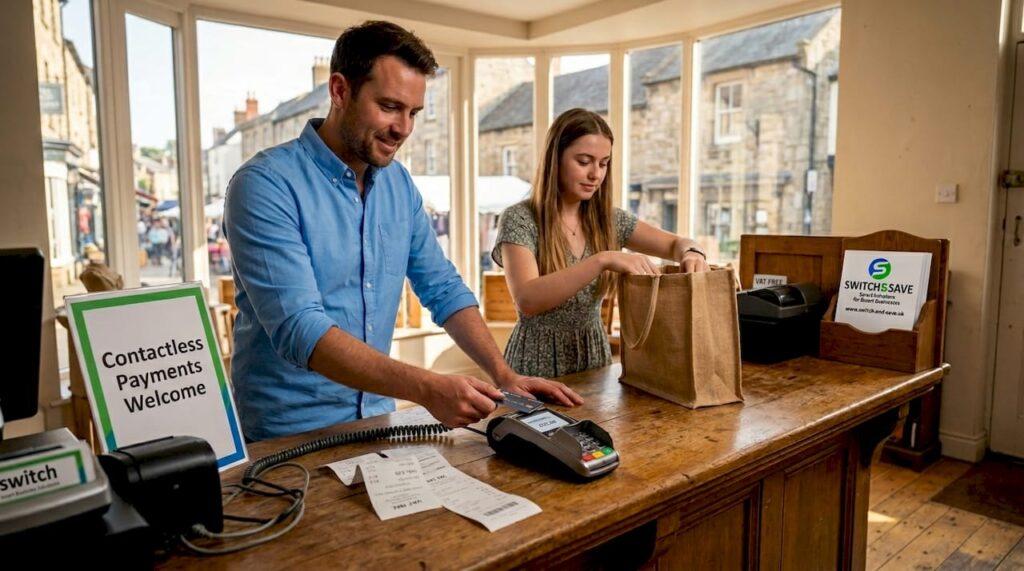
Contactless cards remain the undisputed leader. Contactless debit and credit card payments account for 39% of all UK payments in 2024, with 18.9 billion transactions recorded across the year. For most shop floors and restaurant tills, this is the default method customers reach for without thinking.

Mobile wallets are the fastest-growing subset of contactless. Apple Pay and Google Pay are now accepted expectations rather than nice-to-haves. Younger customers in particular will walk away from a venue that cannot accept them.
Open banking (Pay by Bank) is the one to watch. This method allows customers to authorise a direct bank-to-bank payment from within their banking app, with no card network involved. Amazon added Pay by Bank as a checkout option in the UK in 2026, which is a strong signal that mass-market adoption is genuinely here.
Key methods at a glance:
- Contactless debit and credit cards (dominant, 39% of UK payments)
- Mobile wallets: Apple Pay, Google Pay
- Open banking Pay by Bank (fast-growing, lower fees)
- Traditional chip and PIN (still needed for higher-value transactions)
- Online card payments via payment gateways (for e-commerce or pre-orders)
For a deeper look at how these stack up in practice, see our guide on the best card payment solutions available in 2026.
How integrated open banking payments streamline your EPOS operations
Next, we go deeper into how integrated open banking solutions can genuinely transform your day-to-day operations.
The core advantage is cost. Open banking payments bypass traditional card networks, settling near-instantly via the Faster Payments Service, which covers 99% of UK banks. That means no interchange fees paid to Visa or Mastercard, and no scheme fees layered on top. For a busy restaurant processing hundreds of transactions a day, that saving adds up to something meaningful by month end.
Here is what integrated open banking delivers in practice:
- Faster settlement. Payments arrive in your account within seconds rather than the one-to-three business days typical with card processors. This improves your cash flow, particularly during peak trading periods.
- Reduced reconciliation. When your EPOS system is connected via API to an open banking payment layer, transactions are matched to orders automatically. You spend less time cross-checking end-of-day reports.
- Enhanced security. Authentication happens directly in the customer’s banking app, and no card numbers are shared or stored. This removes a significant layer of fraud risk for you as a merchant.
- Regulatory backing. The FCA is actively developing clearer frameworks to make open banking commercially sustainable and scalable across the UK. This is not a fringe technology. It has regulatory momentum behind it.
“Open banking is not replacing cards overnight. But for businesses where margins are tight and cash flow matters, it is already a practical alternative worth building into your payment mix.”
Pro Tip: If your EPOS provider offers an open banking payment option, ask specifically about how it handles failed or cancelled bank authorisations. You want an automatic fallback to card payment to avoid losing the sale.
If reducing what you pay per transaction is a priority, our breakdown on card machine fees for UK retail is worth reading alongside this.
Contactless payment trends and regulatory updates in the UK
Now let’s look at the current contactless payment environment and the key FCA regulatory changes affecting merchants like you.
Changes to contactless limits came into force on 19 March 2026, allowing providers with strong fraud controls to set their own contactless limits rather than adhering to a single national cap. This is a meaningful shift. Previously, the limit was fixed across all providers. Now, providers can offer personalised limits to customers based on their individual fraud profiles.
In practice, most major UK banks are maintaining existing limits for now while they assess fraud data. But this is likely to evolve over the next 12 to 18 months.
Here is what you need to know as a merchant:
| Topic | What it means for your business |
|---|---|
| New FCA flexibility (March 2026) | Providers can set their own contactless limits if fraud controls are strong |
| Most banks holding current limits | No immediate action needed, but review your terminal settings |
| Personalised customer limits | Some customers may have higher or lower limits than the default |
| Strong Customer Authentication (SCA) | Exemptions apply for low-risk contactless transactions under threshold amounts |
| Fraud monitoring obligation | Your payment provider must track and report fraud rates to remain compliant |
The key takeaway is that you should not assume your terminal’s contactless limit reflects the latest rules. Check with your payment provider directly to understand what limits are active and whether there are settings you can adjust.
Pro Tip: If your business regularly processes high-value single transactions (for example, a hotel bill or a high-end restaurant table), make sure your terminal offers a smooth fallback to chip and PIN or Apple Pay for amounts above the contactless threshold. A clunky transition at the moment of payment frustrates customers.
For a full breakdown of terminal capabilities across payment types, see our payment terminal guide for UK retail and hospitality.
Comparing top integrated payment solutions for UK businesses
To help you weigh your options, here is a side-by-side comparison of the leading integrated payment solutions suitable for UK retail and hospitality businesses.
Most UK SMEs rely on popular accounting platforms like Xero, QuickBooks, and Sage, making native integration a deciding factor in any payment solution comparison. A provider that forces you to export CSVs manually is a step backwards.
| Feature | Basic EPOS payment providers | Advanced integrated solutions |
|---|---|---|
| Pricing model | Blended flat rate | Interchange-plus or custom |
| Accounting integration | Limited or manual export | Native API (Xero, QuickBooks, Sage) |
| Open banking support | Rarely included | Increasingly standard |
| Offline payment handling | Often unavailable | Local queuing and auto-sync |
| Multi-store management | Single terminal only | Centralised cloud dashboard |
| FCA authorisation | Varies | Confirmed authorised status |
| Contactless and mobile wallets | Yes | Yes, plus Pay by Bank |
| Settlement speed | 1 to 3 business days | Same day or near-instant |
When evaluating business payment solutions, look beyond the headline transaction rate. Ask:
- Does the fee structure reward volume? Interchange-plus pricing typically becomes more favourable once you pass £15,000 to £20,000 per month in card turnover.
- How does the system handle a busy Saturday afternoon if the internet drops? Offline mode is essential, not optional.
- Can you manage refunds, voids, and end-of-day reports from a central dashboard, or do you have to visit each terminal?
- Is there a contract lock-in, and what are the exit terms if the service falls short?
For a detailed look at how different card payment providers stack up on fees and service quality, our guide to switching card payment providers covers what to watch for.
Our take: stop treating payment solutions as a commodity
Most articles on this topic give you a list of providers and call it done. We want to say something more useful.
Many retail and hospitality businesses in the UK treat their payment processing as a utility. They pick a provider once and never revisit it. That is exactly how you end up paying blended rates on debit card transactions that should cost you a fraction of what you are being charged. It is also how you end up with a terminal that does not sync with your stock system, leaving you to guess what sold over the weekend.
The businesses we see running most efficiently are not necessarily using the most expensive solutions. They are using solutions where every component, the EPOS software, the payment terminal, the accounting integration, talks to one another cleanly. When a sale is processed, the stock updates, the revenue posts, and the end-of-day reconciliation writes itself. That is not a luxury. That is what good technology should do.
Open banking is the piece of this puzzle most businesses are ignoring. It is understandable. It feels new. But for a café owner tired of watching 1.5% to 2.5% disappear on every card transaction, or a retailer whose cash flow suffers because settlement takes three days, open banking is already a practical answer. The infrastructure is there. The regulation is improving. The question is simply whether your EPOS system supports it.
Do not make your final decision based on payment solution comparisons alone. Make it based on how well the whole system fits together for your specific business type, volume, and growth plans.
Ready to bring your payment processing and EPOS together?
At Switch and Save, we work with UK retail and hospitality businesses to find EPOS solutions that do more than just take payments. Our systems combine AI-powered software, integrated payment processing, and real-time stock management in one place, so you are not stitching together separate tools that barely speak to each other.
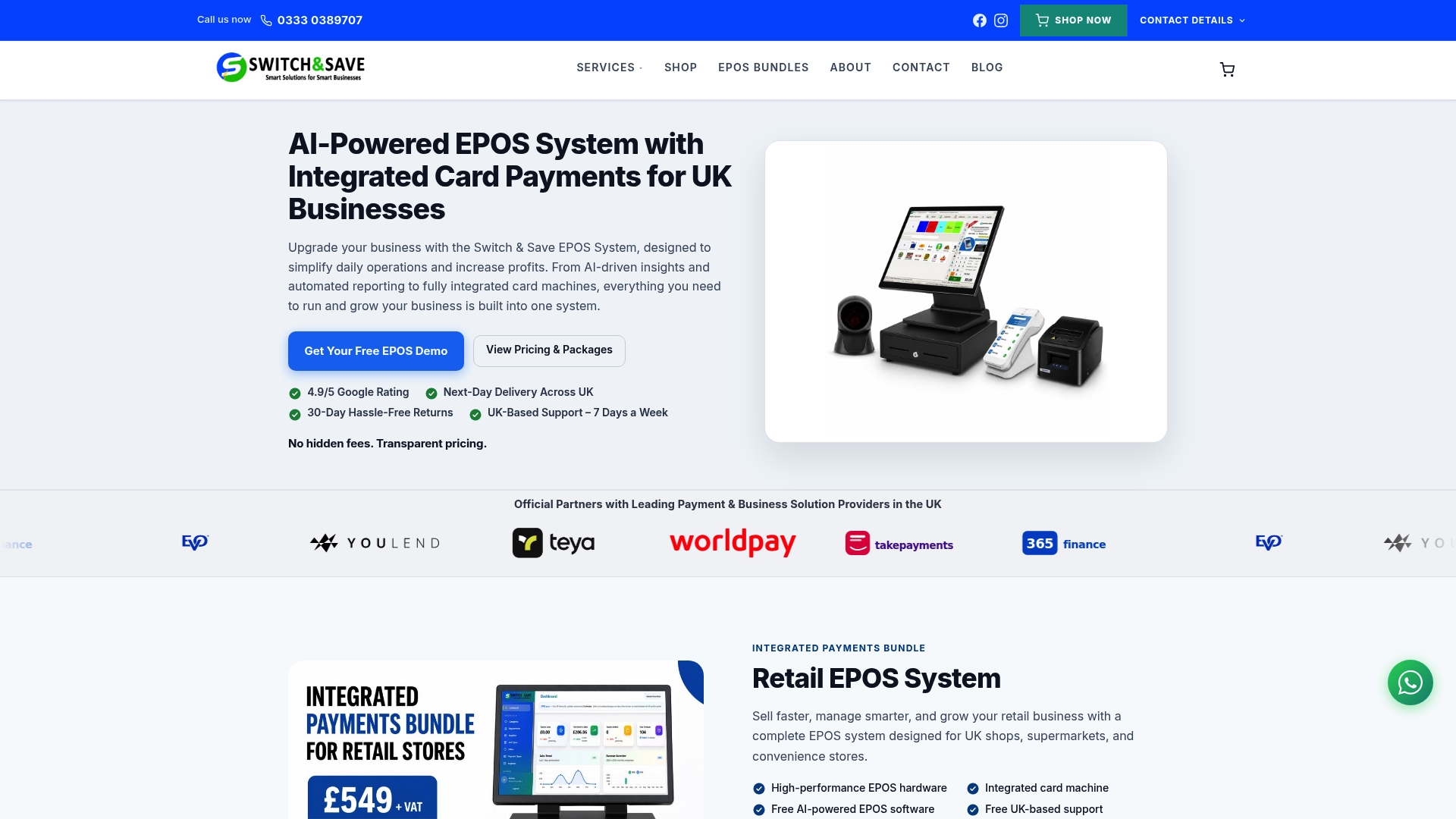
Whether you run a single café or a multi-site retail operation, we offer packages built around your actual needs, with transparent pricing and UK-based support on hand when you need it. The best way to see how it all fits together is to book a free demo and let us show you what a properly integrated setup looks like in practice. No pressure, no jargon, just a clear picture of what your business could look like with the right tools behind it.
Frequently asked questions
What are the benefits of using open banking payment solutions in the UK?
Open banking payments offer near-instant settlement, lower transaction fees, and improved security by connecting directly to customers’ bank accounts through regulated APIs. Payments settle via Faster Payments Service, bypassing traditional card networks entirely, which removes interchange fees from the equation.
How much of UK retail payments are contactless as of 2024?
Contactless payments accounted for 39% of all UK transactions in 2024, with approximately 18.9 billion transactions recorded, making it the single largest payment method by volume.
Have contactless payment limits changed recently in the UK?
Yes. From 19 March 2026, providers with strong fraud controls can set their own contactless limits rather than following a fixed national cap, though most UK banks are maintaining existing limits while monitoring fraud data.
What accounting software integrations should UK businesses prioritise in EPOS payment solutions?
Prioritise solutions with native or well-maintained API connections for Xero, QuickBooks, Sage, and FreeAgent. As industry guidance confirms, the reliability of that integration is more important than almost any other feature when assessing day-to-day operational value.
How does open banking improve payment security for merchants?
Authentication happens directly in the customer’s banking app, meaning no card numbers are shared or stored during the transaction, which significantly reduces the fraud risk that card-based payments carry.