
The retained UK Interchange Fee Regulation caps interchange at 0.2% for domestic consumer debit and 0.3% for domestic consumer credit transactions, but those caps cover only part of what you actually pay. Commercial cards, cross-border transactions, and scheme fees all sit outside the cap, and they can push your real costs well above any headline figure. The single most useful thing you can do right now is calculate your effective rate: divide your total monthly card costs by your total monthly card sales and multiply by 100. If that number surprises you, read on.
Key takeaways
Most UK SMEs are overpaying on card processing because they have never calculated their effective rate or requested an interchange-plus quote — two steps that cost nothing and can save hundreds of pounds a year.
| Point | Details |
|---|---|
| Calculate your effective rate | Divide total annual card costs by total annual card sales and multiply by 100 for a true cost picture. |
| IFR caps have limits | The 0.2% debit and 0.3% credit caps apply only to domestic consumer cards; commercial and cross-border cards are uncapped. |
| Blended pricing is the norm | Around 95% of UK merchants use blended plans, which often mask the true cost of premium and commercial cards. |
| IC+ suits higher-volume merchants | Above roughly £8,000–£25,000/month in card turnover, interchange-plus typically beats blended pricing for debit-heavy businesses. |
| Switch-and-save offers a free audit | Switch-and-save reviews your effective rate, fixed fees, and contract terms to identify savings for UK retail and hospitality merchants. |
Table of Contents
- What are credit card processing fees and who gets each part?
- How do the main pricing models work?
- What are typical UK processing costs for small businesses?
- How does the UK Interchange Fee Regulation affect what you pay?
- How do you calculate your effective processing rate?
- How can you reduce your processing costs and negotiate better terms?
- What should you ask when comparing payment and EPOS providers?
- What Switch-and-save can do for your processing costs
- Sources
- FAQ
What are credit card processing fees and who gets each part?
Every card transaction splits its cost between several parties, and understanding who receives what helps you challenge quotes intelligently.
The fee stack on a typical UK card transaction:
- Interchange fee — paid to the card issuer (the customer’s bank). This is the largest single component and the one capped by the UK IFR for eligible consumer cards.
- Scheme fee — paid to the card network (Visa or Mastercard) for routing and brand use. These are set by the schemes and passed through by acquirers.
- Acquirer margin / merchant service charge (MSC) — the profit element your payment provider keeps. This is the part you can negotiate.
- Gateway fee — charged by the payment gateway for authorisation and data routing, typically a monthly subscription plus a per-transaction pence charge.
- Terminal rental — a monthly hardware fee if you lease rather than own your card machines.
- Chargeback fees — levied per dispute, typically £15–£25 per case, regardless of outcome.
- PCI compliance fee — a monthly charge (often £4–£19) for maintaining Payment Card Industry Data Security Standard compliance.
- Statement / account fee — an admin charge of roughly £2–£10 per month.
On a blended plan, these collapse into a single percentage, which is precisely why the full cost stack is so easy to miss.
How do the main pricing models work?
Three models dominate UK merchant services, and the one you are on shapes both what you pay and how easy it is to compare quotes.
Interchange-plus (IC+ or IC++)
IC+ separates the regulated interchange and scheme fees from the acquirer’s markup. You see each component on your statement. Because the interchange element is passed through at cost, a debit-heavy merchant benefits directly from the IFR caps. The transparency also makes it straightforward to compare providers: you are comparing the markup alone, not a bundled margin that hides inside a blended rate.
Blended and flat-rate pricing
A blended rate bundles interchange, scheme fees, and acquirer margin into a single percentage. Around 95% of UK merchants use blended pricing, and 98% of those with under £10m annual card turnover are on blended plans. Providers favour it because it is simple to explain and because the margin on premium or commercial cards is absorbed into the pool rather than shown separately. Flat-rate providers go one step further, charging the same rate regardless of card type — often with a small fixed pence charge per transaction on top. This suits very low-volume or seasonal traders who want zero billing surprises.
Tiered pricing
Tiered models group card types into two or three buckets (typically “qualified”, “mid-qualified”, and “non-qualified”) with different rates for each. The problem is that the provider decides which bucket each transaction falls into, and the criteria are rarely transparent. Most industry analysts consider tiered pricing the least merchant-friendly model.
Model comparison at a glance:
| Pricing model | Transparency | Typical headline range | Best suited to |
|---|---|---|---|
| Interchange-plus | High — each component visible | Interchange + 0.20%–0.60% markup | Established merchants above ~£8,000–£25,000/month |
| Blended / flat-rate | Low — single bundled rate | 1.5%–2.5% for small merchants | Low-volume, seasonal, or startup traders |
| Tiered | Very low — provider-defined buckets | Varies widely | Rarely recommended |
The crossover point where IC+ tends to beat blended pricing depends on your monthly card turnover and card mix. Industry analysis commonly cites a monthly threshold of roughly £8,000–£25,000, with debit-heavy merchants benefiting most because domestic consumer debit interchange is capped at just 0.2%.
What are typical UK processing costs for small businesses?
Knowing the market ranges lets you spot quickly whether your current deal is competitive.
Typical headline percentage ranges for UK SMEs:
- Consumer debit (blended): 0.6%–1.2%
- Consumer credit (blended): 0.9%–1.8%
- Overall blended rate (mixed card portfolio): 1.5%–2.5% for most small retailers
- Premium or rewards credit cards: can reach 1.5%–2.5% on interchange alone, before acquirer margin
- Commercial/corporate cards: uncapped interchange, often 1.5%–2.5% interchange before any markup
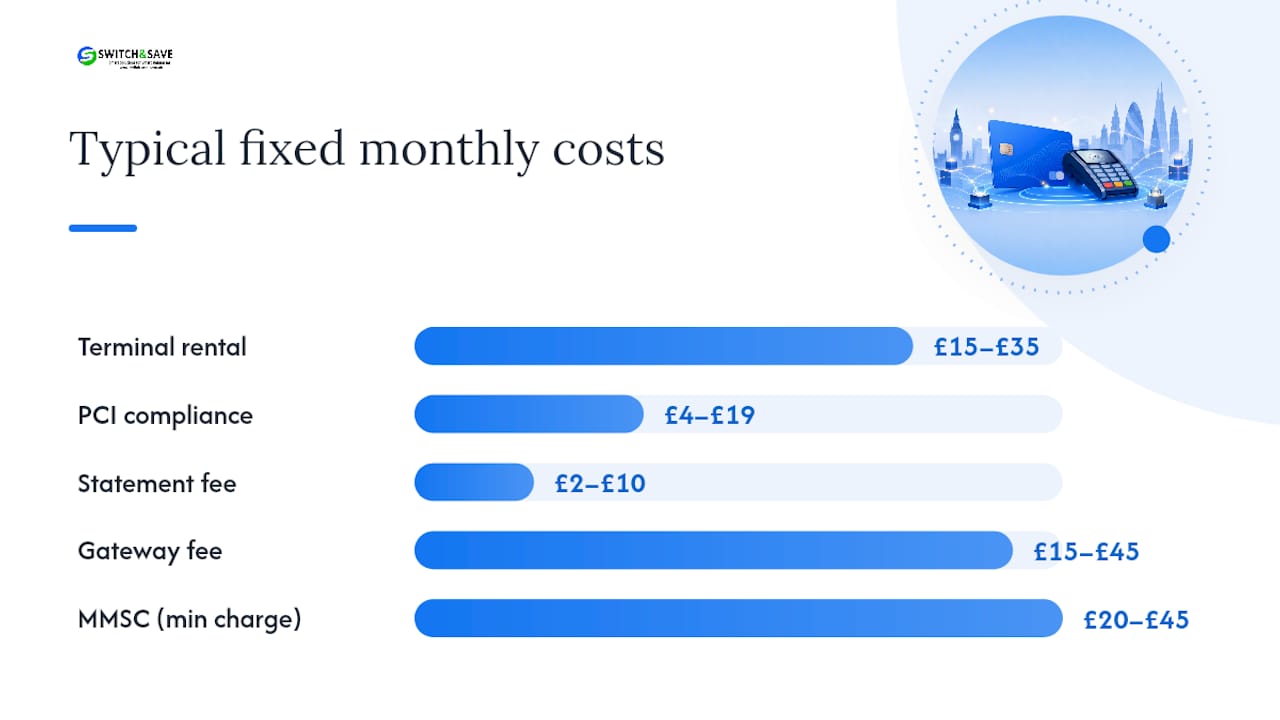
Common fixed monthly costs to budget for:
- Terminal rental: £15–£35 per terminal per month (leased)
- PCI compliance: £4–£19/month
- Statement/account fee: £2–£10/month
- Gateway fee: £15–£45/month plus pence per transaction
- Minimum monthly service charge (MMSC): £20–£45/month
Pro Tip: The MMSC is a floor charge — if your percentage fees fall below it in a quiet month, you pay the minimum instead. A slow January can cost you more than you expect if your MMSC is £40 and your actual fees only come to £22.
The table below shows how fixed costs affect the effective rate at different volumes. These are illustrative scenarios using the ranges above.
Fixed costs dilute at higher volumes, which is why your effective rate almost always falls as turnover grows — and why volume is your single strongest negotiating lever.
How does the UK Interchange Fee Regulation affect what you pay?
The UK Interchange Fee Regulation (IFR) is the retained post-Brexit legislation that caps interchange fees on domestic consumer card transactions. The Payment Systems Regulator (PSR) enforces it.
The exceptions matter enormously in practice:
- Commercial and corporate cards — issued to businesses rather than consumers. Interchange is uncapped and can be several times higher than consumer card rates. Under blended pricing, you subsidise these cards without knowing it.
- Cross-border transactions — if your customer’s card was issued outside the UK (common in tourist areas, online shops, or near borders), the IFR cap does not apply. The interchange rate reverts to the scheme’s standard commercial rate.
- Three-party schemes — American Express operates its own closed network and sets its own rates independently of the IFR.
👉 To spot uncapped transactions on your statement, look for line items labelled “commercial”, “corporate”, “business card”, “inter-regional”, or “cross-border”. On a blended plan these are invisible — another reason to request an IC+ quote if your business regularly takes corporate or tourist spend.
How do you calculate your effective processing rate?
Your effective rate is the single most honest measure of what card acceptance actually costs your business. It captures everything: percentage fees, fixed monthly charges, chargeback costs, and refund processing fees.
The formula:
(Total annual card costs ÷ Total annual card sales) × 100 = Effective rate (%)
“Total annual card costs” means everything: MSC fees, scheme fees, gateway fees, terminal rental, PCI charges, statement fees, chargeback fees, and any refund processing charges.
Step-by-step worked example:
- Pull your last 12 months of merchant statements.
- Add up all card-related charges. In this example: MSC fees £3,600 + gateway £480 + PCI £120 + terminal rental £360 + statement fees £72 + chargeback fees £90 = £4,722 total annual card costs.
- Find your total card sales for the same period: £210,000.
- Apply the formula: (£4,722 ÷ £210,000) × 100 = 2.25% effective rate.
- Compare this to any new quote by running the same calculation on the projected costs under the new pricing.
Pro Tip: *Always include refund and chargeback costs in your total.
Industry guidance consistently recommends the effective rate as the fairest basis for comparing quotes, precisely because headline percentages ignore fixed costs that hit small merchants hardest.
How can you reduce your processing costs and negotiate better terms?
Most UK merchants are paying more than they need to. The levers below are practical and proven — not theoretical.

Pricing model levers
Request an interchange-plus quote from your current provider or any new one you are considering. If you are above roughly £8,000–£25,000/month in card turnover and your mix is predominantly UK consumer debit, IC+ is likely cheaper than a blended rate. Ask for the acquirer markup to be stated separately from interchange and scheme fees.
Operational levers
Encouraging contactless and debit card payments over credit cards directly lowers your average interchange cost. For online sales, making debit the default payment method in your checkout reduces card-not-present premium card exposure. Reconcile chargebacks promptly — a dispute you do not contest costs you the transaction value plus the chargeback fee. Rationalising your terminal fleet (removing unused machines) cuts rental costs immediately.
Contract traps to avoid
- Long exit penalties — some contracts carry 12–18 month notice periods or early termination fees running into hundreds of pounds. Always ask for the exit clause in writing before signing.
- Opaque MMSCs — a minimum monthly service charge of £40 on a low-volume site can double your effective rate in quiet months.
- Scheme fee pass-through clauses — some contracts allow the provider to pass through scheme fee increases without notice or renegotiation rights. Ask whether scheme fees are fixed or variable.
Preparing your data before negotiating
Walk into any negotiation with three numbers ready: your monthly card turnover, your card mix (% debit vs credit vs commercial), and your current effective rate. Providers respond to specifics. A merchant who says “my effective rate is 2.4% and I process £25,000/month, 70% on consumer debit” will get a sharper quote than one who says “I want a better deal.” You can find practical guidance on getting low card machine rates that walks through this preparation in detail.
What should you ask when comparing payment and EPOS providers?
Use this checklist before signing any merchant services agreement.
Pricing clarity:
- Can you provide a full fee breakout: interchange, scheme fees, acquirer markup, and fixed monthly charges separately?
- What is the per-transaction pence charge, and does it apply to refunds?
- Is the rate fixed or can it change during the contract term?
- Are scheme fee increases passed through automatically?
Contract and exit terms:
- What is the minimum contract length and the notice period to exit?
- Is there an early termination fee, and how is it calculated?
- Is there a minimum monthly service charge, and what triggers it?
- Can I trial the system or request a demo before committing?
Service and operations:
- What are your support hours and response times? Is support UK-based?
- How quickly are funds settled into my account?
- Does the reporting show card-type breakout (debit vs credit vs commercial) so I can track my effective rate?
- How are chargebacks handled, and what support do you provide for disputes?
- Is PCI compliance support included, or is it an additional charge?
- Does the system support multiple terminals or locations if I expand?
For retail and hospitality merchants, it is worth asking specifically about card payment solutions for shops that integrate with your EPOS, since a disconnected payment terminal and till system creates reconciliation headaches and makes tracking your effective rate harder.
What the most common mistakes actually cost merchants
The two mistakes that consistently cost UK merchants the most money are accepting a blended quote without asking for an IC+ alternative, and never calculating their effective rate. Worked examples show potential monthly savings of several hundred pounds for a mid-volume merchant versus a 1.85% blended rate. Over a year, that is a material sum for any small business.
The second mistake is treating the headline rate as the whole cost. Volume changes everything.
What Switch-and-save can do for your processing costs
Paying less on card fees starts with knowing what you are actually paying. Switch-and-save provides UK retail and hospitality merchants with AI-powered EPOS systems that integrate directly with card payment processing, so your effective rate, card-type breakout, and fixed costs are visible in one place rather than buried across multiple statements.
Switch-and-save’s free processing-fee audit reviews your current effective rate, identifies uncapped commercial or cross-border card exposure, flags contract traps such as opaque MMSCs and exit penalties, and shows you what a transparent IC+ quote would look like for your business. The audit is straightforward: you share your recent statements, and the team works through the numbers with you. There is no obligation to switch, and UK-based support is available throughout. If you process primarily UK consumer debit cards and have not yet been offered an interchange-plus quote, the audit typically surfaces the clearest savings.
👉 Book a free demo or processing-fee audit and find out what your effective rate should be.
Sources
The sources below are the primary references behind this guide. Each one is worth bookmarking if you want to go deeper on the regulation or benchmarks.
- Payment Systems Regulator — the IFR
- UK retained legislation explanatory memorandum on the IFR
- Merchant Savvy — blended pricing vs interchange-plus
- CompareCardFees — interchange-plus vs blended pricing
- MerchantHQ — card machine fees explained: the UK SME guide for 2026
- Business Expert — interchange vs blended vs flat-rate pricing
This article is general information, not a substitute for advice from a qualified financial advisor. Consult a qualified financial professional about your own circumstances before acting on anything here.
FAQ
What is a good credit card processing rate for a UK small business?
Why is there a 3% fee on some card transactions?
Can UK merchants charge customers extra for paying by card?
Surcharging consumers for card payments has been prohibited in the UK for several years. You cannot pass a card fee directly to a consumer customer. You may set a minimum transaction value, though this is subject to your acquirer’s terms and scheme rules.
How do you avoid high transaction processing costs?
Calculate your effective rate first, then request an interchange-plus quote if you process above roughly £8,000–£25,000/month. Encourage debit and contactless payments, reconcile chargebacks promptly, and review your contract for MMSCs and exit penalties. A free audit from a provider such as Switch-and-save can identify the specific charges driving your costs up.