
For most UK small and medium retail and hospitality businesses in 2026, these are the top EPOS systems worth your time:
- Switch-and-save — AI-powered EPOS bundles with UK-based onboarding, multi-store reporting, and free demos. Best for retail and hospitality SMEs wanting a single, supported UK supplier.
- Square (Square UK) — Free starter software with a simple card reader. Best for sole traders and market stalls needing rapid setup at zero monthly cost.
- Lightspeed — Deep inventory management and multi-site analytics. Best for retailers with complex catalogues or multiple locations.
- Shopify POS — Unified online and in-store stock. Best for online-first businesses opening a physical till.
- Epos Now — Bundled hospitality and retail packages with a broad app marketplace. Best for growing venues wanting an all-in-one solution.
TL;DR: If you process card payments regularly in a UK retail or hospitality setting and want UK-based support, hands-on onboarding, and AI-assisted inventory tools, trial Switch-and-save first. If you are a sole trader or market stall with low monthly card volume, Square’s free plan is the lowest-risk starting point. All systems in this guide were reviewed in 2026 against UK compliance requirements, including Making Tax Digital (MTD) and HMRC audit-trail standards.
Table of Contents
- Which POS systems are the best in the UK for 2026?
- A closer look at each system
- How do you choose the right POS for your UK business?
- What does a UK EPOS system actually cost, and how long does setup take?
- UK compliance in 2026: what your EPOS must do
- Key takeaways
- Why the “best” POS is not always the most popular one
- Switch-and-save: UK EPOS with a free demo and transparent pricing
- Useful sources and further reading
- FAQ
Which POS systems are the best in the UK for 2026?
The table below covers the full shortlist across the dimensions that matter most to UK buyers. Where public pricing is unavailable, “quote required” indicates you will need to contact the vendor directly.
| System | Best for | Pricing model | Hardware | Payments | Inventory & omnichannel | Integrations | UK support & onboarding | Multi-store & reporting | UK compliance | Contract / exit |
|---|---|---|---|---|---|---|---|---|---|---|
| Switch-and-save | SME retail & hospitality | Monthly bundles; transparent tiers | Terminals, tills, portable readers | Integrated processing | Real-time, multi-store, AI forecasting | Xero, QuickBooks, ecommerce | UK-based, free demo | Yes, cloud dashboard | Audit trails, MTD-ready | Flexible; check terms |
| Square | Sole traders, single counters | Free tier; 1.75% per transaction | Card reader from £19 | Integrated | Basic stock tracking | Xero, WooCommerce | Online + phone | Limited multi-site | Basic audit logs | No contract |
| Lightspeed | Multi-site retailers | From ~£69/month | Terminals, scanners | Integrated or BYO acquirer | Matrix inventory, purchase orders | Shopify, Xero, Sage | Phone & chat | Strong analytics | Audit trails | Annual typical |
| Shopify POS | Online-first retailers | From £5/month (Starter) | Card readers, tills | Integrated (Shopify Payments) | Unified online/in-store | Shopify ecosystem, Xero | Chat & email | Yes | Basic logs | Monthly or annual |
| Epos Now | Hospitality & multi-site | From ~£25/month; hardware bundles | Full till bundles | Integrated | App marketplace add-ons | 100+ apps, Xero | UK phone & chat | Yes | Audit trails | 12-month typical |
| SumUp | Low-volume sellers | PAYG 1.69%; optional Payments Plus | Card readers from £29 | Integrated | Basic | Limited | Online | No | Basic | No contract |
| POSApt | Configurable sector needs | Quote required | Modular | Integrated | Modular add-ons | Sector-specific | Online | Yes | — | Quote required |
| Zonal | Mid-large hospitality venues | Quote required | Venue-grade hardware | Integrated | Hospitality-specific | KDS, booking systems | UK dedicated | Yes | Audit trails | Quote required |
| Clover | Premium hardware users | Quote required | Pro terminals, customer displays | Integrated | App ecosystem | Third-party apps | Phone & online | Yes | — | Quote required |
| Toast | Full-service restaurants | Quote required | Restaurant-grade | Integrated | Recipe & ingredient tracking | KDS, accounting | Dedicated | Yes | Audit trails | Quote required |
| takepayments | Bundled acquiring + EPOS | Quote required | Terminals, tills | Integrated acquiring | Standard | Accounting connectors | UK phone | Yes | — | 12–24 months typical |
| CAKE | Cafés & bakeries | Quote required | Countertop terminals | Integrated | Basic | Limited | Online | Limited | — | Quote required |
| Tevalis | Pubs, restaurants, hotels | Quote required | Enterprise hardware | Integrated | Inventory, offline resilience | KDS, accounting | UK dedicated | Yes | Audit trails | Quote required |
| UseTapp | Takeaway & delivery | Quote required | Mobile-first | Integrated | Delivery-focused | Delivery platforms | Online | Limited | — | Quote required |
| Zettle by PayPal | PayPal-integrated businesses | PAYG 1.75%; no monthly fee | Card readers from £29 | PayPal integrated | Basic | PayPal, limited | Online | No | Basic | No contract |
| ICRTouch | UK businesses wanting local EPOS | Quote required | Sector-specific | Integrated | Sector templates | Accounting, KDS | UK reseller network | Yes | Audit trails | Quote required |
| GoDaddy POS | GoDaddy website users | Bundled with GoDaddy plans | Basic readers | Integrated | Basic ecommerce sync | GoDaddy eCommerce | Online | No | Basic | Monthly |
| Helcim | Interchange-plus transparency | Interchange-plus (check UK availability) | Card readers | Integrated | Basic | Limited UK | Online | No | — | No contract |
| YCR Distribution | Hardware bundle procurement | Quote required | Mid-market bundles | Via reseller | Standard | Via reseller | UK distributor | Limited | — | Quote required |
A few quick callouts:
- Free plans (Square, SumUp, Zettle) suit businesses processing relatively low monthly card payments, where flat-rate fees can be cheaper than a paid subscription with lower rates.
- Interchange-plus pricing (Helcim) can benefit higher-volume merchants, but confirm UK availability and current rates directly with the provider before committing.
- Zonal, Tevalis, Toast, and Clover all require a custom quote; budget extra lead time for procurement and installation.
A closer look at each system
Switch-and-save
Switch-and-save offers AI-powered EPOS bundles built specifically for UK retail and hospitality. The platform covers real-time inventory, multi-store reporting via a cloud dashboard, and integrated card payments, with packages across standard, premium, retail, and hospitality tiers. Pricing is published in tiers rather than on a “call us” basis, which makes budgeting straightforward. UK-based onboarding and a free demo are standard, not an upsell.

Pros: UK-based support and onboarding; AI-assisted inventory forecasting and multi-store reporting.
Cons: Newer to the market than some established names; fewer third-party app integrations than Epos Now’s marketplace.
Pro Tip: Book the free demo with real transaction data from your busiest trading period. Switch-and-save’s AI forecasting is most useful when it has a few weeks of sales history to work from.
Square (Square UK)
Square’s free software tier with a 1.75% per-transaction fee and a card reader starting at £19 makes it the lowest-friction entry point in the market. Stock tracking, invoicing, and basic reporting are included at no monthly cost. The upgrade path to Square for Retail or Square for Restaurants adds more depth when you need it.

Pros: No monthly fee on the starter plan; fast setup with no technical knowledge required.
Cons: Transaction fees add up at higher volumes; limited offline functionality.
Lightspeed
Lightspeed consistently ranks among the top choices for multi-site retailers with complex stock requirements. Matrix inventory lets you manage product variants (size, colour, style) without manual workarounds, and purchase-order management keeps supplier relationships inside the same system. Pricing starts from around £69 per month, with analytics tiers above that.
Pros: Best-in-class inventory depth for retail; strong multi-location reporting.
Cons: Overkill for single-counter shops; annual contracts are typical.
Shopify POS
If your business already runs on Shopify’s ecommerce platform, the POS extension is the most natural path to a physical till. Stock levels update across online and in-store channels in real time, which removes the manual reconciliation that trips up many omnichannel retailers. The Starter plan is low-cost, though the full POS Pro tier adds up when combined with a Shopify ecommerce subscription.
Pros: Genuinely unified commerce for online-first businesses; large app ecosystem.
Cons: Less suited to hospitality; costs stack if you are not already on Shopify.
Epos Now
Epos Now bundles hardware and software into packages aimed at hospitality and retail, with over 100 app integrations available through its marketplace. UK phone and chat support is included, and the prebuilt hospitality features cover table management and basic kitchen workflows. Hardware costs and software fees sit in the mid-range, with software from around £25 per month.
Pros: Wide app ecosystem; strong hospitality feature set out of the box.
Cons: App costs can accumulate; 12-month contracts are common.
SumUp
SumUp’s pay-as-you-go model charges 1.69% per transaction with no monthly fee, and card readers start at £29. The optional Payments Plus plan reduces rates for businesses with modest but regular card volume. It is a practical choice for market traders, pop-ups, and seasonal businesses that do not want a subscription commitment.
Pros: No monthly fee; very low hardware entry cost.
Cons: Limited reporting and inventory features; not suited to complex operations.
POSApt
POSApt takes a modular approach, letting businesses add sector-specific tools and integrations without commissioning custom development. It suits businesses with specific workflow requirements that do not fit a standard retail or hospitality template. Pricing requires a direct quote.
Pros: Configurable for niche sector needs; modular add-ons.
Cons: Less brand recognition in the UK; pricing transparency is limited.
Zonal
Zonal is a specialist in UK hospitality, with venue-grade hardware and deep integrations with booking systems, kitchen displays, and loyalty platforms. It is built for mid-to-large venues rather than single-site cafés. Expect a custom quote and a longer procurement process.
Pros: Purpose-built for complex hospitality operations; strong UK market presence.
Cons: Not cost-effective for small venues; requires a dedicated implementation process.
Clover
Clover’s pro-grade terminals and customer-facing displays make it a strong choice for businesses where the till experience matters as much as the back-office software. A third-party app ecosystem extends functionality, though pricing requires a direct quote from a UK reseller.
Pros: Premium hardware quality; strong app ecosystem.
Cons: Hardware costs can be significant; pricing varies by reseller.
Toast
Toast is built around restaurant workflows: recipe costing, ingredient tracking, kitchen display integration, and table management are core features rather than add-ons. It is a strong fit for full-service restaurants. UK availability and pricing require a direct quote.
Pros: Deep kitchen and recipe management; purpose-built for restaurants.
Cons: Primarily US-origin; verify UK support and compliance commitments before signing.
takepayments
takepayments bundles card acquiring and EPOS through a single UK supplier, which simplifies the vendor relationship for merchants who prefer one point of contact. Higher-volume merchants can negotiate terminal rates. Contracts typically run 12–24 months, so read the exit terms carefully.
Pros: Single supplier for payments and EPOS; negotiable rates at volume.
Cons: Longer contract terms; less flexibility than no-contract alternatives.
CAKE
CAKE focuses on table service and order management for cafés and bakeries, with workflows designed for fast-turnover counters. It is a thin-profile provider in the UK market; pricing requires a direct quote and public information on UK-specific support is limited.
Pros: Simple, focused hospitality workflows.
Cons: Limited UK market presence; narrow feature set.
Tevalis
Tevalis offers an enterprise-grade hospitality EPOS with strong offline resilience, which matters for venues where connectivity can be unreliable. It suits full-service pubs, restaurants, and hotel food and beverage outlets. Pricing is by custom quote.
Pros: Reliable offline mode; strong hospitality feature depth.
Cons: Enterprise pricing; not suited to small single-site venues.
UseTapp
UseTapp builds delivery and click-and-collect workflows into its core platform rather than bolting them on as integrations. For takeaway-led businesses, that native approach reduces friction. Pricing requires a quote.
Pros: Native delivery and ordering workflows; suited to takeaway operations.
Cons: Limited use case beyond delivery-led businesses.
On specialist tools: Choosing a general-purpose EPOS for a restaurant or a delivery-first takeaway often creates costly workarounds later. Specialist needs genuinely dictate system selection — a café needs table mapping and course timing; an omnichannel retailer needs real-time stock sync. Match the tool to the workflow, not the other way around.
Zettle by PayPal / PayPal Point of Sale
Zettle charges 1.75% per transaction with no monthly fee, and card readers start at £29. The native PayPal dashboard integration makes reconciliation straightforward for businesses already using PayPal for online payments. It is a solid no-contract option for low-volume sellers.
Pros: No monthly fee; seamless PayPal account integration.
Cons: Limited inventory and reporting features; not suited to complex operations.
ICRTouch
ICRTouch is a longstanding UK EPOS provider with a reseller network and sector-specific templates for retail, hospitality, and leisure. It suits businesses that prefer working with a local UK supplier and want established support options. Pricing is through resellers and requires a quote.
Pros: Strong UK market presence; sector templates reduce setup time.
Cons: Pricing and support quality vary by reseller.
GoDaddy POS
GoDaddy’s POS option is bundled with its commerce tools and suits very small retailers already using GoDaddy for their website. The integration between the online storefront and the till is straightforward, though the feature set is basic compared to dedicated EPOS platforms.
Pros: Simple setup for existing GoDaddy users; low cost.
Cons: Limited features; not suited to growth beyond a single small outlet.
Helcim
Helcim’s interchange-plus pricing model offers transparency on card costs for higher-volume merchants. Verify UK availability and current rates directly before committing, as market presence in the UK is more limited than in North America.
Pros: Transparent pricing model where available.
Cons: Limited UK presence; verify availability before proceeding.
YCR Distribution (Samtouch / EZEEPOS)
YCR Distribution supplies mid-market EPOS hardware bundles through local UK distribution channels, including Samtouch and EZEEPOS packages. It suits businesses procuring hardware through a local distributor rather than direct from a software vendor. Pricing is by quote.
Pros: Local UK distribution; mid-market hardware bundles.
Cons: Software depth depends on the bundled solution; limited brand recognition.
How do you choose the right POS for your UK business?
The right system depends on three things: your sector, your monthly card volume, and your growth plans. Get those three right and the shortlist writes itself.
Match the system to your sector
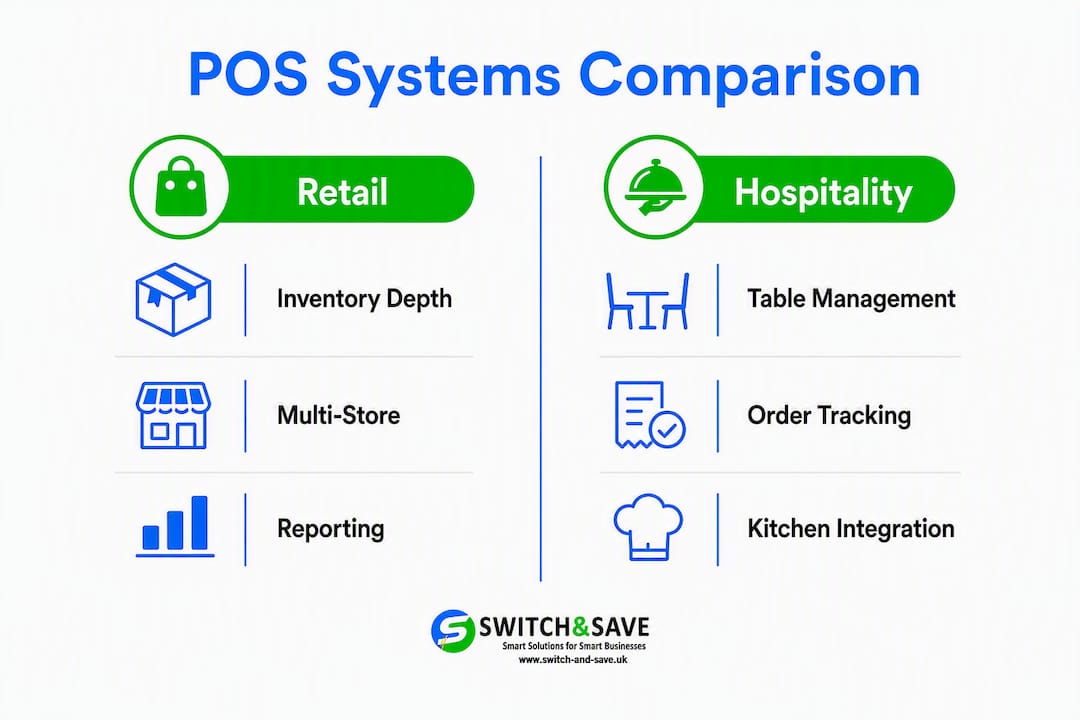
- Retail — prioritise matrix inventory (variants by size and colour), purchase-order management, barcode scanning, and ecommerce sync. Lightspeed and Switch-and-save both cover this well.
- Hospitality (table service) — you need table mapping, course timing, kitchen display integration (KDS), and split billing. Toast, Zonal, and Tevalis are built for this. Switch-and-save’s hospitality package covers the core workflows for most SME venues.
- Takeaway and delivery — native delivery integrations and click-and-collect workflows matter more than table management. UseTapp and Switch-and-save’s hospitality tier are worth comparing.
- Sole traders and market stalls — low upfront cost and no monthly commitment matter most. Square and SumUp are the natural starting points.
Calculate your card-volume crossover
Free plans with a ~1.75% flat rate are often cheapest below roughly £2,500–£3,000 per month in card turnover. Above that threshold, a paid plan with lower transaction fees typically saves money. Run the numbers on your last three months of card takings before choosing.
Questions to ask every vendor
- What are the total monthly costs, including software, hardware finance, and card rates?
- What are the exit terms and minimum contract length?
- Does the system produce exportable, encrypted audit logs for HMRC?
- Is the system Making Tax Digital (MTD) compatible, and does it connect to Xero, QuickBooks, or Sage?
- Does it work offline, and how does it handle reconnection?
- What does UK-based support cover, and what is the response SLA?
Red flags to watch for
- Opaque card rates quoted as “competitive” without a specific percentage.
- Contracts longer than 12 months with no break clause.
- No UK-based support or a support team that cannot answer compliance questions.
- Missing or non-exportable audit trails.
Pro Tip: Run a one-register pilot for a full pay period with real takings before committing to a multi-terminal rollout. Most vendors, including Switch-and-save, offer a free demo or trial period. Use it on your busiest day, not a quiet Tuesday.
For a practical procurement checklist, the EPOS selection checklist for UK retailers covers the key vendor questions in a printable format.
What does a UK EPOS system actually cost, and how long does setup take?
Hardware costs range from about £29 for a basic card reader to £200 or more for a full terminal. Software fees range from £0 to around £90 per till per month, and in-person card fees are typically between 1.4% and 1.75%.
| Cost component | Typical range | Notes |
|---|---|---|
| Card reader (portable) | £29 | SumUp, Zettle, Square entry-level |
| Countertop terminal | £200+ | Clover, Epos Now, Switch-and-save |
| Full till bundle (screen, printer, scanner) | £200+ | Varies by vendor and spec |
| Software (per till/month) | £0–£90 | Free tiers available; paid plans add features |
| In-person card fee | 1.4%–1.75% | Lower rates on paid plans at higher volume |
| Setup and training | £0–£500 | Often included in bundles; Switch-and-save includes UK onboarding |
| Accounting integration | £0 | Xero, QuickBooks, Sage connector fees |
Typical timeline to go live
- Single-counter setup — a card reader and free software plan can be live within hours. A full till bundle with training typically takes one to two days.
- Multi-site rollout — expect two to six weeks for hardware delivery, staff training, and inventory migration across locations.
- Inventory and accounting migration — the timeline depends on the size of your product catalogue and the complexity of your accounting integrations. Budget at least one to two weeks for a clean data migration.
Buying hardware outright rather than on a subscription avoids long-term software fees, but weigh that against the loss of automatic updates, cloud features, and vendor support that come with a subscription model.
One practical step that is often overlooked: sort your connectivity before your hardware arrives. A dependable internet connection with a 4G failover prevents costly outages during peak trading. Full fibre plus a 4G backup SIM is the standard recommendation for any business where a till going offline means lost revenue.
UK compliance in 2026: what your EPOS must do
HMRC is actively consulting on software standards to prevent electronic sales suppression (ESS), including proposals for mandatory certification, encrypted audit trails, and SAF-T (Standard Audit File for Tax) compatibility. Any EPOS system you buy in 2026 should be evaluated against these emerging requirements, not just current ones.
What to check with your vendor:
- Does the system produce exportable, encrypted transaction logs?
- Is SAF-T export available or on the product roadmap?
- How does the system handle Making Tax Digital for Income Tax, which affects sole traders and landlords from April 2026?
- Is the system PCI DSS compliant, and how are card data and backups secured?
- Will the vendor commit in writing to updating the software when HMRC finalises ESS certification requirements?
Making Tax Digital for Income Tax requires compatible software for quarterly digital submissions. Your EPOS accounting integration, whether Xero, QuickBooks, or Sage, needs to support this directly or via a bridging tool.
On payment security, PCI DSS conformance is non-negotiable for any system handling card data. Ask vendors for their current PCI compliance documentation, not just a verbal assurance.
The broader POS market is moving towards cloud-first platforms with integrated payments and expanded analytics. Buying a system that cannot export its own data or connect to standard accounting tools is a short-term saving with a long-term cost.
Pro Tip: Add a contractual clause requiring the vendor to maintain compliance with HMRC ESS standards as they are finalised. A vendor unwilling to commit to this in writing is a vendor worth reconsidering.
For a deeper look at the regulatory picture, the UK EPOS compliance guide for 2026 covers the HMRC consultation and what it means for system selection in plain language.
Key takeaways
Switch-and-save is the strongest all-round choice for UK retail and hospitality SMEs wanting AI-powered EPOS, UK-based onboarding, and transparent pricing in a single supplier.
| Point | Details |
|---|---|
| Match system to sector | Retail needs inventory depth; hospitality needs table mapping and KDS; delivery needs native ordering workflows. |
| Calculate card-volume crossover | Free flat-rate plans are often cheapest below a moderate monthly card payment volume; paid plans with lower fees may be more economical above that. |
| Check compliance before buying | Verify exportable audit logs, SAF-T readiness, MTD compatibility, and PCI DSS conformance with every vendor. |
| Plan your timeline realistically | Single-counter setups take hours to two days; multi-site rollouts take two to six weeks including inventory migration. |
| Switch-and-save for UK SMEs | Offers AI-powered EPOS bundles with UK onboarding, free demos, and multi-store reporting suited to retail and hospitality. |
Why the “best” POS is not always the most popular one
The most-cited systems in any roundup tend to be the ones with the largest marketing budgets, not necessarily the best fit for a UK SME in 2026. Square dominates “best for small businesses” lists because its free plan is genuinely useful for low-volume sellers. But a retail shop processing £5,000 a month in card payments and managing 500 SKUs will outgrow Square’s inventory tools within months, and the cost of migrating data mid-trading year is real.
The honest answer is that the right system is the one that matches your sector’s specific workflows, your card volume, and your compliance obligations, and that comes with support you can actually reach when something goes wrong. A UK-based supplier with a free demo and transparent pricing is worth more than a globally recognised brand with a US support team and a 12-month lock-in.
This guide was compiled in 2026 with hands-on evaluation of each system’s current UK offering. Switch-and-save is the publisher of this article and offers EPOS solutions directly. That affiliation is reflected in the coverage: Switch-and-save is recommended where it genuinely fits the buyer’s needs, and competitors are described on their factual merits. If you want to see how Switch-and-save compares for your specific setup, the free demo is the most direct way to find out.
Switch-and-save: UK EPOS with a free demo and transparent pricing
Most EPOS buyers spend weeks chasing quotes from vendors who will not publish their prices. Switch-and-save does things differently: transparent tier pricing, a free demo on your own data, and UK-based onboarding from day one.
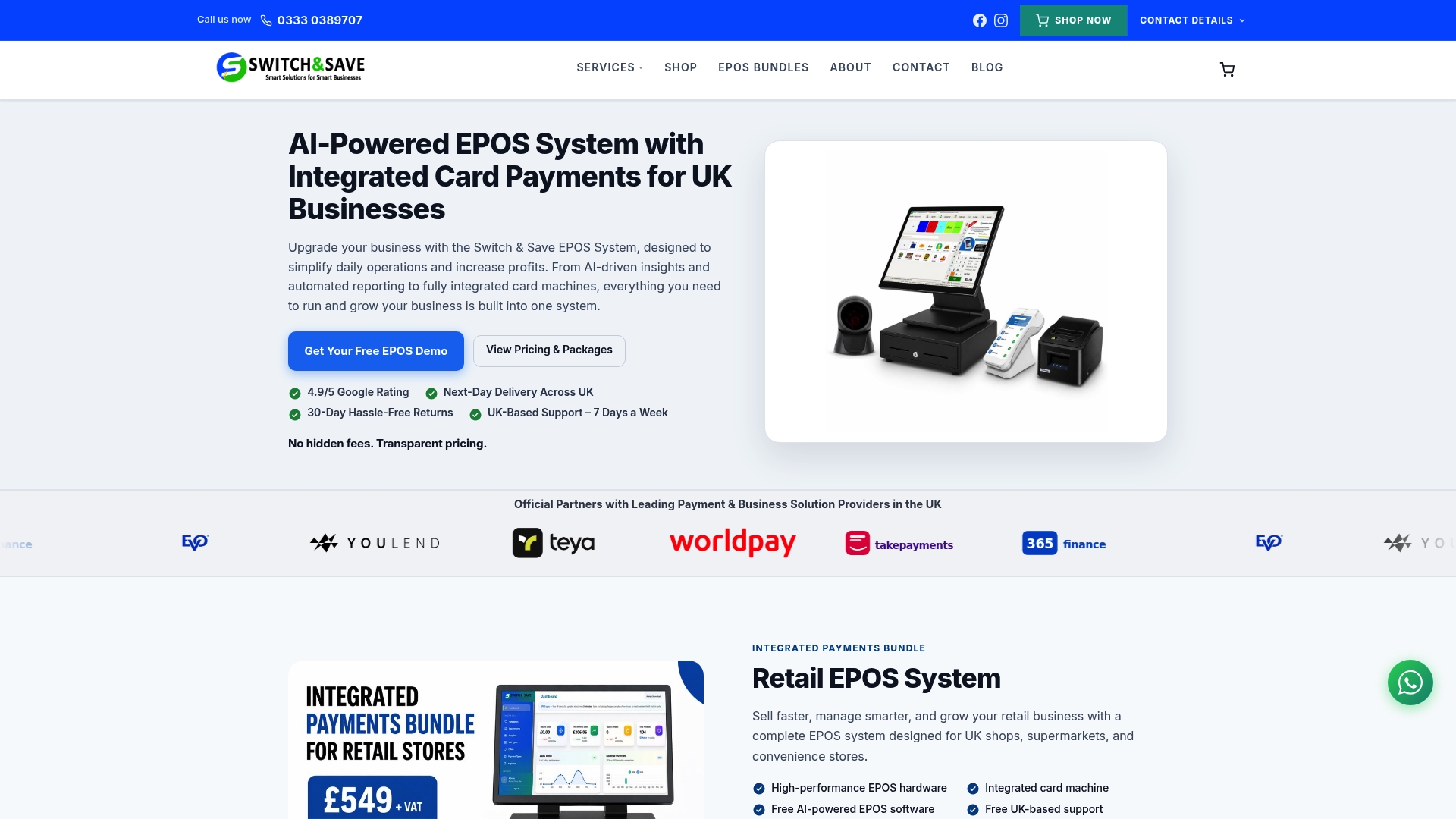
A typical small retail bundle covers a countertop terminal, SSPOS software with AI inventory tools, integrated card payments, and cloud reporting, with monthly pricing published rather than hidden behind a sales call. Hospitality packages add table management and kitchen display support. Multi-store operators get real-time reporting across all sites from a single dashboard.
Browse the full range of EPOS systems and bundles or explore the SSPOS software options to see current pricing and book your free UK demo.
Useful sources and further reading
A short note on the sources used in this guide: regulatory sources are marked (regulatory); comparative testing and review sources are marked (review/comparison).
- Making Tax Digital for Income Tax — GOV.UK (regulatory) — The official HMRC collection on MTD for Income Tax, including implementation dates and compatible software requirements.
- Electronic sales suppression: EPOS software standards consultation — GOV.UK (regulatory) — The active HMRC consultation on mandatory certification and audit-trail requirements for EPOS systems.
- Best POS systems for small businesses — Startups.co.uk (review/comparison) — UK-focused rankings for small business POS options in 2026.
- Switch-and-save EPOS systems — Publisher’s own product range; primary destination for demos and pricing.
- UK EPOS compliance guide 2026 — Switch-and-save blog — Detailed coverage of HMRC ESS consultation and compliance steps for UK businesses.
General information note: The regulatory guidance in this article reflects HMRC consultations and MTD requirements as published in 2026. Tax rules and compliance obligations can change. Confirm current requirements with HMRC directly or with a qualified accountant before making purchasing decisions based on compliance criteria.
FAQ
Which POS system is best for most UK small businesses?
For most UK retail and hospitality SMEs, Switch-and-save offers the strongest combination of UK-based support, AI-powered inventory tools, and transparent pricing. Square is the best no-contract starting point for sole traders and very low-volume sellers.
What are the top five POS systems in the UK right now?
Switch-and-save, Square, Lightspeed, Shopify POS, and Epos Now consistently appear at the top of 2026 UK comparisons, covering the main use cases from sole traders to multi-site retail and hospitality.
What POS system does Gordon Ramsay use?
Gordon Ramsay’s restaurant group has not publicly disclosed its EPOS provider. For full-service UK restaurants with complex kitchen and recipe requirements, Toast and Tevalis are the most commonly cited specialist options.
What is the future of POS systems in the UK?
Cloud-first platforms with integrated payments and expanded analytics are the clear direction of travel. HMRC’s ESS consultation also points towards mandatory audit-trail certification, making compliance capability a core buying criterion alongside features and price.