A halal butcher EPOS system should let you sell fresh meat by the kilo, scan labels on pre-weighed packs and ring up groceries in the same basket. It should also help staff spot stock approaching its use-by date and record what they remove from sale. When you compare tills, bring your scale model, a sample label and a typical customer basket to the demo. That will show you how the setup works at your counter. Meat Shop Till with Weighing Scale
| At the counter | What to check in a demo |
|---|---|
| You cut meat to order | The till reads the net weight from a compatible scale and applies the correct price per kilo. |
| You prepare packs for the chiller | A label from your scale scans as the right product, weight or price. |
| Customers buy meat and groceries together | A weighed item and a standard barcoded item go through in one sale. |
| You receive the same cut on different dates | Staff can identify which stock needs checking first. |
| You remove unsold meat from sale | The stock record reflects what was removed and why. |
How does a halal butcher EPOS system sell meat by weight?
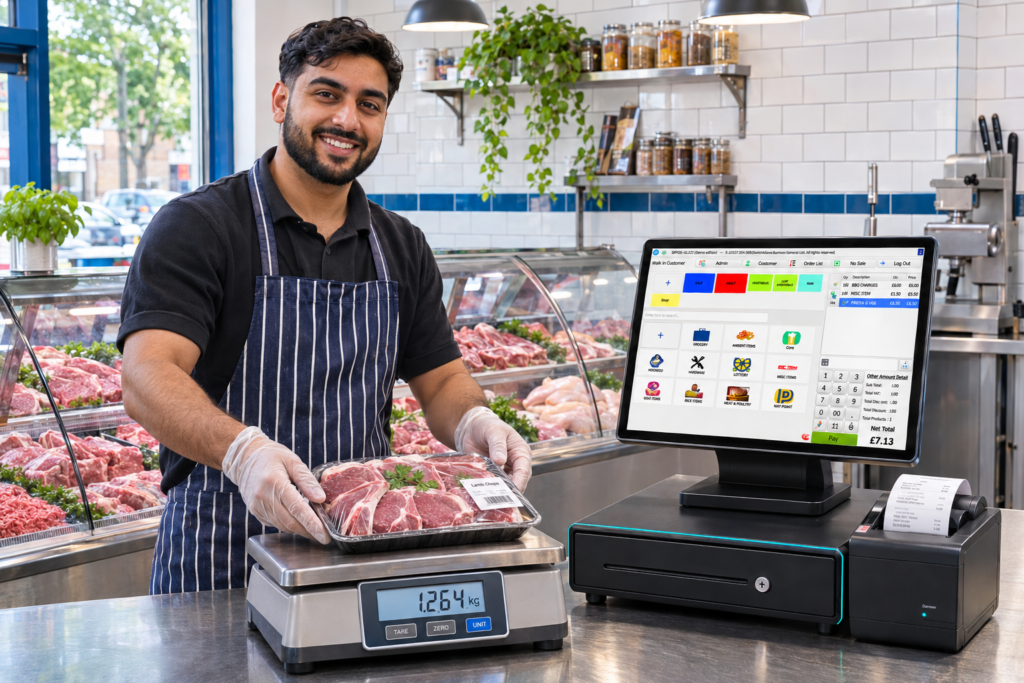
Set up each cut with its own product record and price per kilogram. When a customer asks for lamb chops, the cashier selects lamb chops on the till, weighs the portion and confirms the net weight. A compatible connected scale can send that weight straight to the till. With Switch&Save EPOS (Retail), staff can also enter the reading manually when a scale is used separately. Meat Shop Till with Weighing Scale
Say a customer at a Birmingham halal butcher buys 750g of lamb at an illustrative £12 per kilo. The till uses 0.750kg × £12 to calculate £9.00. If the customer adds rice and a bag of spices, the cashier scans those into the same basket. The customer pays once and gets a receipt for the whole shop.
What should you check on the scale?
Check that the scale is suitable and approved for trade use, then confirm that the exact model can communicate with your till. Ask your local Trading Standards team if you’re unsure what applies to your equipment. In England, Scotland and Wales, loose goods sold by weight use metric measurements. Northern Ireland has separate rules. GOV.UK
Show staff how to use the tare function so the tray or container is excluded from the weight charged. In a demo, weigh the same cut in two different trays and confirm the till receives the same net weight. Then add a grocery item and print the receipt. It’s a quick way to see whether the setup fits the way your team serves customers.
How do scale labels work at the checkout?
If you prepare trays of mince or chicken portions for the chiller, a compatible label scale can print a barcode for each pack. Depending on the scale and the till setup, that barcode can carry a product identifier plus a weight or a price. When staff scan it, the till uses those details to ring up the pack. Switch&Save supports this workflow for compatible scale labels. Meat Shop Till with Weighing Scale
What happens if the price per kilo changes?
First, find out whether your barcode carries the weight or the selling price. If it carries the weight, check which price per kilo the till uses at checkout. If it carries the selling price, ask how the till handles a pack labelled before the price change.
Try it with two trays of the same cut at different weights. Print both labels, change the price in your demo setup and scan both packs again. Check the label, till and receipt together. That test gives you a clear procedure for staff when prices change and labelled stock is still in the chiller.
What information should a butcher’s label carry?
Think about the type of sale before designing the label. A barcode can give the till information about the pack. The customer also needs the food information that applies to how it’s sold. A pack prepared and sealed on site before the customer chooses it can fall under the rules for prepacked for direct sale (PPDS). Food wrapped after the customer asks for it is treated differently, and allergen information requirements can still apply to loose foods. food.gov.uk
If you make and prepack marinated chicken or burgers for direct sale, the PPDS label needs the food name and a full ingredients list with any of the regulated allergens present emphasised. Check what other particulars apply to your product, including the date mark, storage instructions or origin information where required. Review the actual printed label and check that customers can read it. Food Standards Agency
A practical test is to change a marinade supplier in your trial setup. Ask who checks the new ingredient specification, updates the label and removes the old label template from use. Keep supplier records and any halal certification documents relevant to the claims you make about your products. Staff should know where to find them when a customer asks.
How can you manage short-date meat and reduce waste?
Start when goods arrive. Check the delivery against the order and record the product, quantity, relevant dates and any batch details you need for your traceability records. If two deliveries of the same cut have different use-by dates, make it easy for staff to tell them apart in the chiller.
Give someone responsibility for checking dates each shift and moving the earliest-dated stock forward. Switch&Save EPOS can flag short-life stock before its date and record wastage. In a demo, ask what staff need to enter when receiving goods, where alerts appear and how a colleague can see that an item has already been dealt with. Meat Shop Till with Weighing Scale
What should staff do when a pack is close to its use-by date?
Check the pack against your food safety procedures and decide whether it can still be offered for sale while within date and properly stored. Remove any pack past its use-by date from sale. Use-by dates relate to food safety, so a visual or smell check cannot replace the date. GOV.UK
Record the reason when stock is removed. If you group expired packs, damaged packaging and cutting waste under one reason, it’s harder to see where changes would help. For example, repeated waste on prepacked chicken portions might point to packing too many trays on quiet days. Compare the wastage record with what actually sold before adjusting your next order.
For Ramadan or Eid, review confirmed customer orders alongside previous sales. Set aside quantities promised for collection before deciding how much stock to put on general display. After the busy period, compare what sold and what was wasted so you can plan the next one with better figures.
What should you test before choosing a butcher’s till?
Ask your supplier to run a short demo with your scale model, a few labels and products from your own counter. Include a weighed cut, a pre-weighed tray, a bag of rice and a pack you need to remove from stock. Have the staff who’ll use the till do the test themselves.
- Counter sale: Weigh a portion, check the net weight and add a grocery item to the same basket.
- Chiller sale: Scan a label from your own scale and compare the pack price with the receipt.
- Stock check: Receive the same product with two different use-by dates and see how staff find the earlier one.
- Wastage: Remove a pack from sale and check what appears in the wastage record.
- Payment: Take a payment through the proposed terminal and check how it appears in the till report.
Switch&Save EPOS (Retail) comes with a till, desktop 2D barcode scanner, receipt printer and cash drawer. A weighing scale can be added. If you already have a counter scale or label scale, tell us its make and model so we can discuss whether it fits your setup. See our butcher EPOS system. Meat Shop Till with Weighing Scale
If you also sell groceries, bring a few everyday barcodes to the demo and test them alongside your weighed items. You can see the wider checkout and stock features on our retail EPOS system page. Switch&Save
Book a Switch&Save demo on 0333 038 9707. Have your scale model and a sample label ready so we can walk through a sale using the sort of basket your customers bring to the till.
What else do halal butchers ask about EPOS?
Can I use my existing weighing scale?
Possibly. Compatibility depends on the make, model and how it connects. Send the supplier the model number and, for a label scale, a sample barcode to test.
Can I sell meat by weight and groceries by item in one sale?
Yes. With Switch&Save EPOS (Retail), staff can add a weighed item and scan standard grocery barcodes into the same basket. Meat Shop Till with Weighing Scale
Does every scale barcode contain the weight?
Some formats carry the weight and others carry the price. Ask your supplier to scan a label from your scale and confirm how the till interprets it. Meat Shop Till with Weighing Scale
Can the till help staff spot short-date meat?
Switch&Save EPOS can flag short-life stock before its date. Keep regular physical date checks in your routine and record any items staff remove from sale. Meat Shop Till with Weighing Scale