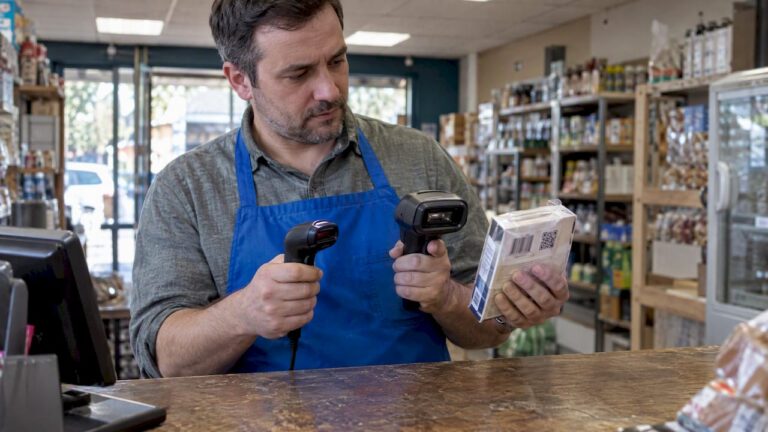
AI is changing EPOS systems by helping businesses use their sales data to make better decisions about stock, staffing and customer demand. Instead of only recording what happened at the till, some systems can highlight patterns and suggest what to do next.
For a UK shop or café owner, that could mean spotting a product that’s likely to run low, seeing which hours need more staff, or finding a slow-selling item before ordering another case. The useful part isn’t the “AI” label. It’s whether the system gives you information you can check and act on.
Key takeaways
| Area | How AI may help | What the owner still needs to do |
|---|---|---|
| Stock | Suggest future demand or flag unusual sales patterns | Check deliveries, promotions and local events |
| Staffing | Show likely busy and quiet periods | Build a workable rota with the team |
| Sales | Highlight changes that need attention | Find the cause before changing prices or products |
| Customers | Identify buying patterns where suitable data is available | Decide which offers are useful and appropriate |
| Reporting | Bring important findings to the surface | Check the figures and make the final decision |
What does “AI-powered EPOS” actually mean?
An EPOS system records transactions and can connect them to products, payments, stock and reports. AI adds another layer: software analyses that information to find patterns, estimate what may happen next or make suggestions.
A standard report might tell you that you sold 40 sandwiches last Tuesday. A forecasting feature might use past Tuesdays and other available data to estimate demand for next Tuesday. That estimate can help with preparation, but it isn’t an order you must follow.
There’s an important distinction here. A low-stock alert triggered when an item reaches five units is a useful rule, but it isn’t necessarily AI. A feature that considers recent sales, changing demand and delivery times before suggesting an order is doing more analysis. Ask a provider to show you what its “AI” feature actually uses and produces.
1. AI can make stock planning more useful
Stock decisions are difficult because you’re balancing two costs. Buy too much and you tie up cash or risk waste. Buy too little and customers may leave without what they came for.
An AI-supported forecast can look for patterns in sales history and suggest what you might need. Forecasting tools can use point-of-sale data, and some systems can also account for factors such as promotions. The exact inputs depend on the product. (SAP Help Portal)
Imagine a convenience shop that sells more bottled drinks on certain days. Instead of repeating the same order every week, the owner could compare a suggested quantity with what’s already in stock and what’s due from the supplier.
A forecast still needs a sense check. Perhaps roadworks are limiting footfall, or a nearby event will bring extra customers. Your system may not know that. Use its suggestion as a starting point, then apply what you know about your business.
For a closer look at the underlying stock records and reports, see our guide to using POS data for inventory management.
What about food waste?
A café can use item-level sales to see which meals sell steadily and which are unpredictable. Better information may help the team adjust prep quantities, particularly for ingredients with a short shelf life.
That doesn’t require a complicated system on day one. Accurate product buttons and regular sales reports are the foundation. Our article on reducing restaurant food waste with sales data shows how to put those figures to work.
2. AI can help you plan around busy hours
Anyone who runs a café, bar or takeaway knows that an average day isn’t very useful for staffing. You need to know when customers arrive.
Sales data can show the busy hours. More advanced analysis may help estimate whether those patterns are likely to repeat. A restaurant owner, for example, could compare Friday evening sales over several weeks before preparing the next rota.
That might reveal a regular rush between 6 pm and 8 pm, followed by a quieter final hour. The owner can then consider where extra cover helps customers most.
It’s still a people decision. A sales forecast can’t tell you everything about training, breaks, bookings or how long a particular task takes. It should support a sensible rota, with room for staff feedback and last-minute changes.
3. AI can draw attention to changes in sales
Most owners don’t have time to inspect every product report each morning. AI-assisted reporting can make the review quicker by pointing to changes that stand out.
For example, it might flag that a popular item sold much less than usual. That’s a prompt to investigate. Was it out of stock? Did someone change the product button? Was the weather different, or did a nearby business close for the day?
Here’s how to make that useful: check the alert against the transaction and stock records, find the likely cause, and decide whether anything needs changing. The value comes from acting on a reliable finding, not from collecting more alerts.
If you’re building a daily routine, start with the EPOS reports business owners should check. Consistent reporting gives you a sounder basis for any AI suggestions that follow.
4. AI can support more relevant offers
A well-organised EPOS system can help you see which products customers often buy together, which offers perform well and when demand changes. Some AI features may analyse these patterns and suggest an offer or product combination to test.
A takeaway, for instance, might notice that a particular side is often bought with one main meal. The owner could test a clearly priced meal deal and see whether customers choose it.
Keep the test simple. Compare sales and margin before and after the change, and check that staff can explain the offer easily. A deal that increases orders but leaves little profit needs another look.
If you use customer-level information for loyalty or marketing, ask the provider what data is collected, how it’s used and which settings you control. You should be comfortable explaining the experience to your customers.
5. AI can make reports easier to act on
An EPOS system can produce a lot of information: product sales, payment totals, refunds, stock movements and trading by hour. The challenge is finding the part that needs your attention today.
AI can help by summarising a change or suggesting an area to inspect. Picture a shop owner opening a report and seeing that sales rose, but a product category’s margin fell. That’s more useful than a long list of figures with no clear starting point.
You’ll still need access to the underlying numbers. If a summary says stock performance has worsened, you should be able to see which products and dates it refers to. Switch & Save’s guide to making better decisions with POS analytics explains the reporting basics.
What can’t AI in an EPOS system do reliably?
AI can’t rescue inaccurate records. If products share the wrong button, stock deliveries aren’t entered or refunds are recorded inconsistently, its suggestions may be misleading.
It also can’t predict every surprise. A new competitor, a local festival, a supplier delay or an unexpected closure can change demand quickly. Some forecasting services may decline to make a prediction when there isn’t enough usable data or sales vary too much.
Start with the basics: tidy product records, check stock counts and make sure staff use the till consistently. Then review AI suggestions against what actually happens. That tells you whether a feature is helping your business.
How do you choose an AI-powered EPOS system?
Ask for a demonstration using a realistic example from your type of business. A grocery shop needs to see how the system handles product and stock records. A restaurant may care more about menu items, busy periods and kitchen flow.
During the demo, ask:
- Which features use AI, and what do they do? Request a live example, not just a list of feature names.
- What data do they need? Find out what happens when you’re new and have little sales history.
- Can you inspect and change a suggestion? You should be able to use your own judgement before placing an order or changing a rota.
- How is the data kept up to date? Ask how sales, returns, deliveries and stock adjustments feed into reports.
- What does the full setup cost? Include hardware, software, payment fees, support and any optional tools.
Switch & Save provides AI-powered EPOS systems, card payment solutions and business finance for UK small businesses. When you book a demo, bring a real question, such as “Which products should I review before my next order?” That makes it easier to judge whether the tools answer something useful for you. Switch & Save also has a practical guide to AI-driven EPOS if you want to explore the features in more detail.
Frequently asked questions
What is an AI-powered EPOS system?
It’s an EPOS system with features that analyse business data to identify patterns, produce estimates or suggest actions. The features vary by provider, so ask to see exactly how they work.
Can AI predict how much stock my shop will need?
It can estimate demand when it has suitable data, but the result may be wrong. Check suggestions against current stock, supplier lead times, promotions and local circumstances before ordering.
Will AI replace a shop manager or restaurant owner?
No. It can help you review information faster, but owners and managers still make decisions about customers, staff, suppliers and unusual events.
Do I need AI if my business is small?
You need useful information more than you need a particular label. Start with accurate sales and stock reporting. If an AI feature then helps you make a measurable improvement, it may be worth using.
How can I tell if the feature is working?
Choose one task, such as ordering a group of products. Record your usual results, try the feature for a suitable period and compare stock shortages, waste and the time spent ordering. Allow for changes in trading conditions when you review the outcome.
See what your EPOS data could tell you
The best way to judge AI in an EPOS system is to give it a real business question. Can it help you order more accurately, prepare for a rush or spot a problem sooner? Ask to see the answer in a demo.
Switch & Save helps UK businesses reduce costs with AI-powered EPOS systems, card payment solutions and business finance.