


An AI driven EPOS system is a point-of-sale platform that combines traditional transaction processing with artificial intelligence to automate decisions, predict demand, and personalise customer interactions in real time. The industry term you will encounter from vendors is “intelligent point of sale,” though “AI-powered point of sale” is equally common. Platforms such as SymphonyAI Store Intelligence, the Appriss Retail platform, and Articsledge POS software each demonstrate how far this technology has moved beyond basic till functions. For UK retail and hospitality owners, the practical payoff is measurable: lower labour costs, fewer stockouts, faster service, and sharper fraud prevention. This guide covers everything you need to make a confident decision.
What are the core AI features in a modern EPOS system?
Modern AI driven EPOS systems do far more than record sales. They observe, learn, and act on live business data so your team can focus on customers rather than admin.
The most impactful features include:
- Real-time shelf monitoring. Computer vision cameras scan shelves continuously. AI vision systems detect 50 to 200% more phantom inventory errors than manual scans, meaning false “in-stock” records that cause lost sales are caught before a customer walks away empty-handed.
- Automated replenishment. When stock drops below a threshold, the system raises a purchase order without human input. Labour cost savings of up to 50% have been recorded where manual scanning has been replaced by AI shelf monitoring, with store sales rising 3 to 5% as a direct result.
- Fraud detection. The Appriss Retail platform scores every return transaction and makes a decision in under one second to block fraudulent returns such as wardrobing, where customers return worn items for a refund.
- Demand forecasting and dynamic pricing. The system analyses historical sales, weather, local events, and competitor data to adjust prices and order quantities automatically.
- Conversational business assistants. Articsledge POS software includes natural language queries over live business data, so you can ask “What were my top ten sellers last Saturday?” without opening a spreadsheet or needing an external AI subscription.
- Customer behaviour analytics. Purchase history, basket size, and visit frequency feed personalisation engines that trigger targeted promotions at the point of sale.
Pro Tip: When you introduce AI shelf monitoring or automated replenishment, your staff do not disappear. They shift from counting stock to advising customers. Plan that transition before go-live, not after, and you will see faster adoption and better morale.
How do AI EPOS systems integrate with existing technology?
One of the most common concerns we hear from business owners is this: “We already have a till system, an accounting package, and a stock database. Do we have to replace everything?” The short answer is no.

Successful AI EPOS deployments layer intelligence onto existing infrastructure via APIs and data connectors rather than replacing it wholesale. This modular approach protects your existing investment and dramatically reduces the risk of downtime during transition.
Here is how a typical integration unfolds:
- Audit your current stack. Identify your existing ERP, warehouse management system (WMS), and POS hardware. Note which systems expose APIs or data exports.
- Select an AI layer that speaks your data language. Platforms built with retail-native AI ontologies understand terms like SKU, shrinkage, and cover count without custom configuration. Unified merchandising and supply chain data consistently outperforms siloed systems where each department holds its own version of the truth.
- Connect via APIs, not replacements. Your existing till hardware can often remain in place. The AI software sits above it, pulling transaction data and pushing recommendations back down.
- Set role-based access controls. Decide which staff see which data. A floor supervisor does not need access to payroll analytics; a manager does not need to see individual cashier error logs unless there is a performance issue.
- Run a parallel period. Operate the old and new systems simultaneously for two to four weeks. This catches data mismatches before they affect trading.
- Go live with onboarding support. Most reputable providers, including those offering 30-day free trials with data migration services, assign an onboarding specialist to minimise downtime.
For businesses already using Magento or Shopify as their e-commerce backbone, connected AI workflows can extend the same intelligence from your online store into your physical EPOS, giving you one unified view of stock and customer behaviour across channels.
What are the security and compliance considerations?
Security is not a secondary concern with AI-powered point of sale systems. It is a primary one, and the right vendor will treat it that way from day one.
Key areas to examine before you sign any contract:
- AI model transparency. Demand to know how the vendor’s models were trained. Reputable platforms train on anonymised transaction data without using customer personally identifiable information (PII), which keeps you on the right side of UK GDPR.
- Risk-classified decisions. Not every AI decision carries the same risk. A product recommendation is low stakes. A fraud block that prevents a legitimate return is high stakes. Look for systems where AI models are retrained on demand and decisions are classified by risk level with full audit trails.
- Real-time fraud prevention. The ability to act on a suspicious transaction in under one second is not a luxury. It is the difference between stopping a fraudulent return and processing it.
- Continuous governance. Ask vendors how often their models are reviewed and updated. A model trained on 2023 data will not recognise 2026 fraud patterns.
- Data residency. For UK businesses, confirm that customer and transaction data is stored on UK or EEA servers to comply with post-Brexit data protection rules.
“Business owners must demand transparency about AI governance to ensure ethical, compliant EPOS system use.” — Appriss Retail
The EPOS systems that reduce human errors also tend to produce cleaner audit trails, because automated processes leave fewer gaps than manual ones. That is a compliance benefit that is easy to overlook until you face an inspection.
How does AI EPOS differ for retail versus hospitality?
The underlying technology is the same, but the applications diverge significantly depending on your sector. Understanding those differences helps you prioritise which features to activate first.
| Feature | Retail application | Hospitality application |
|---|---|---|
| Inventory management | Shelf-level stock monitoring, phantom inventory detection | Ingredient-level usage tracking, waste reduction |
| Customer personalisation | Loyalty-linked promotions at checkout | Table-side upsell suggestions based on order history |
| Fraud prevention | Return transaction scoring, receipt verification | Split-bill anomaly detection, staff discount abuse alerts |
| Demand forecasting | Seasonal replenishment, promotional uplift modelling | Cover count prediction, kitchen prep scheduling |
| Speed of service | Self-checkout AI assistance, queue management | AI order processing, contactless and multi-payment options |
In retail, the biggest wins come from shelf intelligence and labour optimisation. A convenience store using computer vision to monitor shelves can reallocate two members of staff from stock-counting to customer service without reducing operational accuracy. AI-driven personalised promotions at the till also increase basket size by surfacing relevant offers at the moment of purchase rather than sending generic email campaigns days later.
In hospitality, speed and accuracy define the customer experience. An AI-powered point of sale that processes orders directly from a handheld device, routes them to the correct kitchen station, and tracks table status in real time removes the most common sources of service failure: miscommunication and manual re-entry. For a busy restaurant or pub, that translates directly into table turns and revenue per cover.
Pro Tip: When evaluating smart EPOS solutions for hospitality, ask the vendor specifically about kitchen display system (KDS) integration. An AI EPOS that cannot talk to your kitchen is only solving half the problem.
What should you consider when choosing an AI EPOS system?
Choosing the right system is less about finding the most feature-rich platform and more about matching capability to your actual business needs and budget.
Work through these considerations before you commit:
- Define your priority problems first. Are you losing money to stockouts, fraud, slow service, or poor data visibility? The answer shapes which AI features matter most to you.
- Understand the pricing model. AI EPOS systems offer monthly subscriptions, lifetime ownership licences, and bundled hardware-software packages. A subscription suits businesses that want low upfront costs; a lifetime licence suits those planning long-term ownership.
- Insist on a trial period. A 30-day free trial with full onboarding and data migration is now standard among credible providers. If a vendor will not offer one, that tells you something.
- Ask about staff training. The technology is only as good as the people using it. Look for vendors who include training sessions, not just a PDF manual.
- Plan for measurement. Set baseline metrics before go-live: average transaction time, stockout frequency, fraud losses, and labour hours per shift. Review them at 30, 60, and 90 days post-implementation.
- Check UK-based support. For retail and hospitality businesses, a system failure at 11am on a Saturday is a crisis. UK-based telephone support is not a nice-to-have. It is a requirement.
A retail EPOS system that covers these bases will pay for itself faster than you might expect, particularly when you factor in the compounding effect of reduced shrinkage, fewer errors, and higher basket values over a full trading year.
Key takeaways
An AI driven EPOS system delivers measurable returns only when the right features are matched to your sector, integrated cleanly with existing systems, and governed with clear security and compliance standards.
| Point | Details |
|---|---|
| AI features drive real savings | Computer vision shelf monitoring cuts labour costs by up to 50% and lifts sales by 3 to 5%. |
| Integration does not mean replacement | Layer AI via APIs over your existing ERP and POS hardware to avoid costly infrastructure changes. |
| Security requires vendor scrutiny | Demand audit trails, risk-classified decisions, and GDPR-compliant data handling before signing. |
| Retail and hospitality need different features | Prioritise shelf intelligence for retail and order processing speed for hospitality. |
| Trial before you commit | A 30-day free trial with onboarding support is now standard and should be non-negotiable. |
Why AI EPOS adoption in the UK is still misunderstood
I have spoken with dozens of UK retail and hospitality owners over the past few years, and the same misconception comes up repeatedly. People assume that adopting an AI driven EPOS system means ripping out everything they have and starting again. That fear keeps genuinely good businesses running on outdated systems that cost them money every single day.
The reality is that the most successful implementations I have seen are the quiet ones. A modular AI layer added to an existing till setup. A computer vision unit mounted above a shelf. A fraud scoring engine connected to an existing payment processor. None of these required a full refit or a week of downtime.
What they did require was a business owner willing to ask the right questions: How was this model trained? What happens when it gets something wrong? Who do I call on a Sunday morning? Those questions separate vendors who have genuinely thought through governance from those selling a demo that looks impressive but falls apart in practice.
My honest view is that the greatest risk in 2026 is not adopting AI EPOS too quickly. It is waiting so long that your competitors have already built the data advantage that comes from 12 to 18 months of machine learning on live trading data. That gap compounds. Start with one feature, measure it properly, and build from there.
— Amir
Ready to explore AI EPOS systems for your business?
If you are a UK retailer or hospitality owner looking to put intelligent point of sale technology to work, Switch-and-save has a range of options built specifically for businesses like yours.
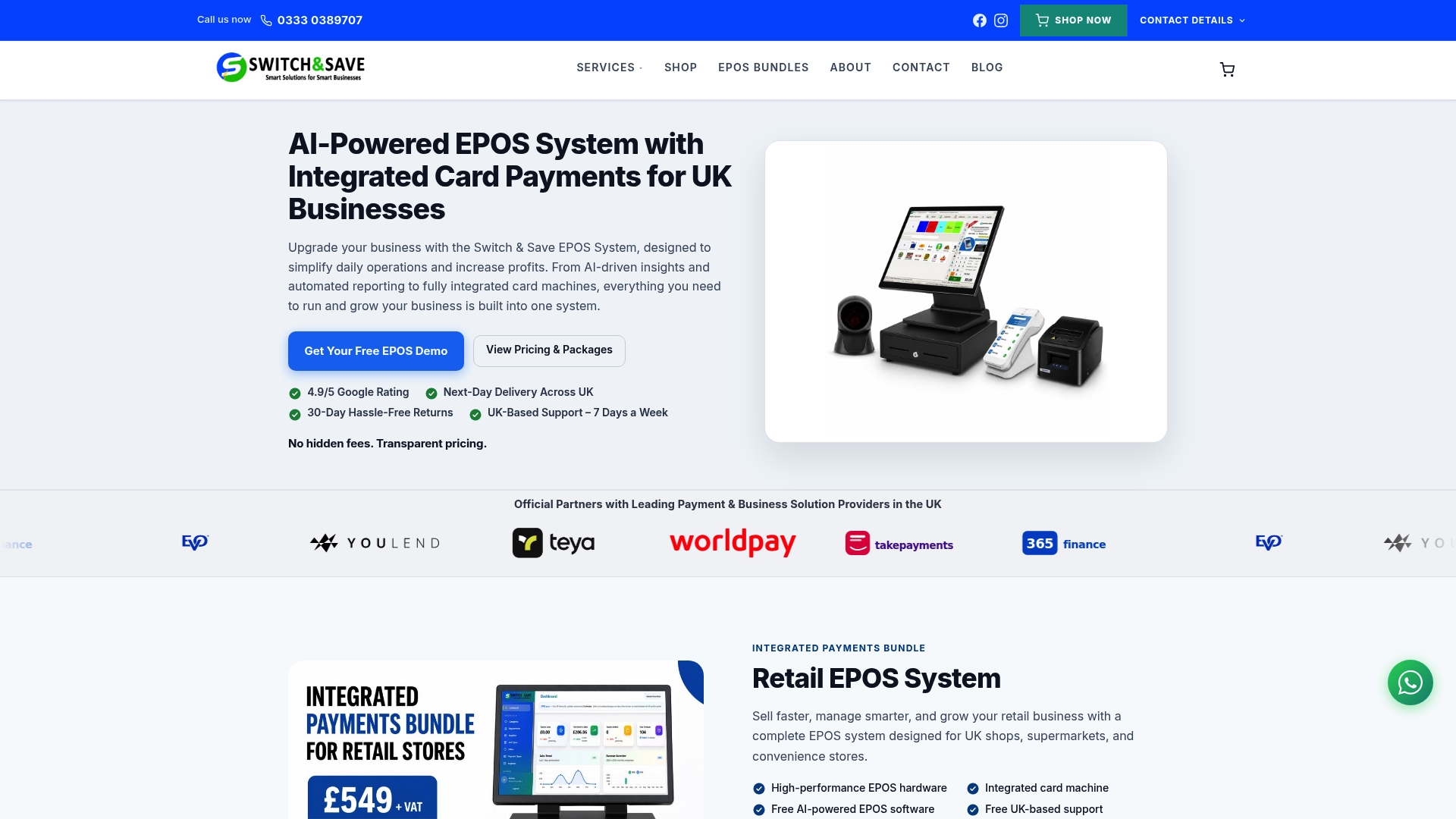
Browse the full range of EPOS systems including retail and hospitality packages, bundled hardware and software options, and AI-capable software licences. Switch-and-save also offers EPOS bundles that combine everything you need in one package, with transparent pricing and no hidden fees. Free demos and UK-based onboarding support are available across all packages. Speak to the team today to find the right fit for your business size and sector.
FAQ
What is an AI driven EPOS system?
An AI driven EPOS system is a point-of-sale platform that uses artificial intelligence to automate inventory management, detect fraud, forecast demand, and personalise customer interactions in real time. It goes beyond basic transaction recording to actively support business decisions.
How does AI EPOS work with my existing till setup?
Most AI EPOS deployments layer intelligence onto existing hardware via APIs and data connectors, so you do not need to replace your current till system. The AI software connects to your existing data and adds decision-making capability on top.
Is an AI powered point of sale system secure?
Yes, provided you choose a vendor with strong governance practices. Look for platforms that train models without customer PII, provide full audit trails, and offer risk-classified AI decisions with continuous model retraining to stay current with new fraud patterns.
What are the main advantages of AI EPOS for hospitality?
AI EPOS in hospitality speeds up order processing, reduces kitchen errors through direct routing, and enables personalised upselling at the table. These improvements directly increase table turns and average spend per cover.
How much does an AI EPOS system cost in the UK?
Pricing varies by vendor and model. Options include monthly subscriptions, lifetime ownership licences, and bundled hardware-software packages. Most credible providers offer a 30-day free trial with onboarding included, which allows you to assess value before committing to a full contract.