

A tronc is a pooled tip arrangement, and under the Employment (Allocation of Tips) Act 2023 you must ensure fair, transparent distribution of every tip, gratuity and service charge. The first thing to check is control: if you influence how tips are shared, you usually keep the PAYE and National Insurance responsibility. Within a day, map your tip flows, confirm or appoint a troncmaster, and notify HMRC if PAYE will move to them.
TL;DR:
- Employers must distribute tips by the end of the month after receipt, retain records for three years, and provide workers their individual figures on request.
- If you influence allocation, including mandatory service charges, you remain responsible for PAYE and Class 1 National Insurance; an independent troncmaster can take on PAYE.
- Tips cannot count toward National Minimum Wage or National Living Wage, so keep them separate from wages in every payroll calculation.
- A tronc shifts PAYE only when the troncmaster genuinely controls allocation; document the money flow, allocation rules, and written acceptance before notifying HMRC.
Table of Contents
- 1. What a tronc is and what a troncmaster does
- 2. Your legal duties under the Act and the Code of Practice
- 3. Tax, PAYE and National Insurance: the practical payroll rules
- 4. Setting up and running a tronc: your operational checklist
- 5. The payroll checklist for every pay period
- 6. How EPOS and integrated payments simplify tronc compliance
- 7. Choosing and appointing a troncmaster
- 8. Making the tronc system a strength, not a liability
- Simplifying tip records with the right EPOS setup
- FAQ
- Sources
1. What a tronc is and what a troncmaster does
A tronc is simply an organised pool for tips, gratuities and service charges that get shared among staff rather than kept individually, similar to how buying fragrances wholesale involves pooling resources to access better deals. The person who runs that pool, deciding who gets what and when, is the troncmaster. They might be a senior waiter, a manager, or an outside administrator, but their role is distinct from yours as the employer once the tronc is genuinely independent.
Distribution usually follows one of a few familiar patterns:
- Points systems, where hours worked, role or seniority earn a weighted share.
- Equal shares, splitting the pool evenly across everyone on shift.
- Hybrid models, blending a base amount with role-based weighting.
Funds can come from cash left on tables, card tips added at the terminal, or service charges, whether voluntary or added automatically to the bill. The practical test for what kind of tronc you have is control: an employer-run scheme keeps PAYE with you, a staff-run or independent tronc can shift that responsibility to the troncmaster, provided the arrangement is genuinely free of your influence.
2. Your legal duties under the Act and the Code of Practice
The Employment (Allocation of Tips) Act 2023 sets out duties that apply to every employer who receives tips, gratuities or service charges on behalf of staff. You must pass these on in full, without deductions beyond required tax, and distribute them fairly and transparently in line with the statutory Code of Practice on fair and transparent distribution of tips.
Three obligations matter most day to day:
- Timing: tips must be distributed no later than the end of the month following the month they were received, as set out in HMRC’s guidance on tips, gratuities, service charges and troncs.
- Recordkeeping: you must retain tipping records and be ready to produce them if a worker asks.
- Consultation: staff should understand, and ideally have a say in, how the allocation method works.
The statutory Code of Practice is treated by tribunals as the minimum standard for fairness, so employers who can show they followed it have a far stronger defence against a claim, according to the Code of Practice on fair and transparent distribution of tips. Ignore it, and you risk a tribunal claim and a compensation order on top of the tips you should have paid out in the first place. None of this is optional guidance dressed up as law: it is the baseline tribunals measure you against.
3. Tax, PAYE and National Insurance: the practical payroll rules
HMRC decides who handles PAYE based on a control and influence test, not on who physically hands over the cash. If you are involved in deciding how tips get shared, including setting rules for a mandatory service charge, you generally keep the PAYE and Class 1 National Insurance obligation, as explained in PAYE72080 on PAYE operation for tips, gratuities, service charges and troncs.
Three common scenarios play out differently:
- Customers tip staff directly, with no employer involvement: PAYE may not apply in the same way, since there is no employer control over the funds.
- You collect tips and pass them into a tronc, but an independent troncmaster decides the split: PAYE responsibility can sit with the troncmaster, provided the arrangement is genuinely independent of you.
- You apply a mandatory service charge and decide how it’s shared: PAYE and NICs stay with you, because you are exercising control.
One rule that catches employers out: tips, however they are distributed, can never count towards National Minimum Wage or National Living Wage obligations. Wages and tips are separate pots, and HMRC will treat any blending of the two as a minimum wage shortfall, regardless of how generous the tronc looks on paper.
4. Setting up and running a tronc: your operational checklist
Getting a tronc right starts with mapping the money, not with paperwork. Trace exactly how tips arrive (cash, card, service charge), who touches them first, and how they reach the pool before anyone gets paid.
- Document the flow: write down who receives each type of tip, when it’s banked, and how it moves into the tronc.
- Appoint a troncmaster and get their acceptance in writing. Accepting the role means they take on running PAYE for the tronc (or confirming you will) and keeping separate tronc records.
- Notify HMRC if a new tronc PAYE scheme is needed. PAYE20160 on setting up a tronc scheme sets out the evidence HMRC expects: an organised arrangement and someone who has clearly accepted the troncmaster role.
- Set a distribution frequency and stick to it, ideally monthly, always within the statutory deadline.
- Produce member statements showing what each person received and why, and keep records so staff can request their own figures at any time.
Pro Tip: Keep tronc records in a separate file or system from general payroll, even if the same software runs both, since HMRC looks for that separation as evidence of genuine independence.
For a closer look at the practical side of this, our guide on passing tips in full using EPOS walks through the five steps most operators still miss.
5. The payroll checklist for every pay period
Every pay run involving tips needs the same quick checks, whether you run the tronc yourself or a troncmaster does.
- Tag every tip and service charge by source (cash, card, mandatory or voluntary) before it reaches payroll.
- Confirm who operates PAYE for that period and apply PAYE and NICs wherever you retain control.
- File the statutory tipping records and be ready to hand over an individual’s figures if they ask, since Acas guidance on tips and service charges requires these records to be kept for three years.
- Check tronc payments haven’t crept into minimum wage calculations, since tips can never substitute for NMW or NLW pay.
Records must cover amounts received, amounts paid to workers, and amounts passed to a troncmaster, retained for three years, under the same Acas guidance. A missing month in that chain is usually what turns a routine HMRC query into a drawn-out one.
6. How EPOS and integrated payments simplify tronc compliance
Most of the recordkeeping burden above comes down to one thing: knowing exactly where each pound came from. An EPOS system that tags tips separately from the sale at the point of payment removes the guesswork later.
- Tag tips and service charges separately at the terminal, so voluntary tips never get muddled with mandatory charges.
- Run per-shift or per-terminal reports that show exactly what came in and when, ready to hand to a troncmaster.
- Export reports in a format payroll can use directly, cutting the manual reconciliation that causes most recordkeeping gaps.
Daily reconciliation, paired with an automated monthly distribution report and a three-year digital archive, covers most of what the statutory recordkeeping rules ask for without extra admin each week.
7. Choosing and appointing a troncmaster
Picking a troncmaster is as much about trust as it is about process. The right person understands the floor, commands respect from colleagues, and can explain the allocation method clearly when someone asks why their share looks different from last month.
Look for someone who isn’t directly managed by you in a way that compromises independence, since HMRC’s test for a genuine tronc hinges on freedom from employer control. A head waiter or senior team member often fits better than a duty manager who reports straight to ownership.
Before confirming the appointment, agree the basics in writing: how points or shares are calculated, how often distributions happen, and how disputes get resolved. Get their written acceptance of the role, since that acceptance is what tells HMRC the tronc is a real, organised arrangement rather than an informal habit.
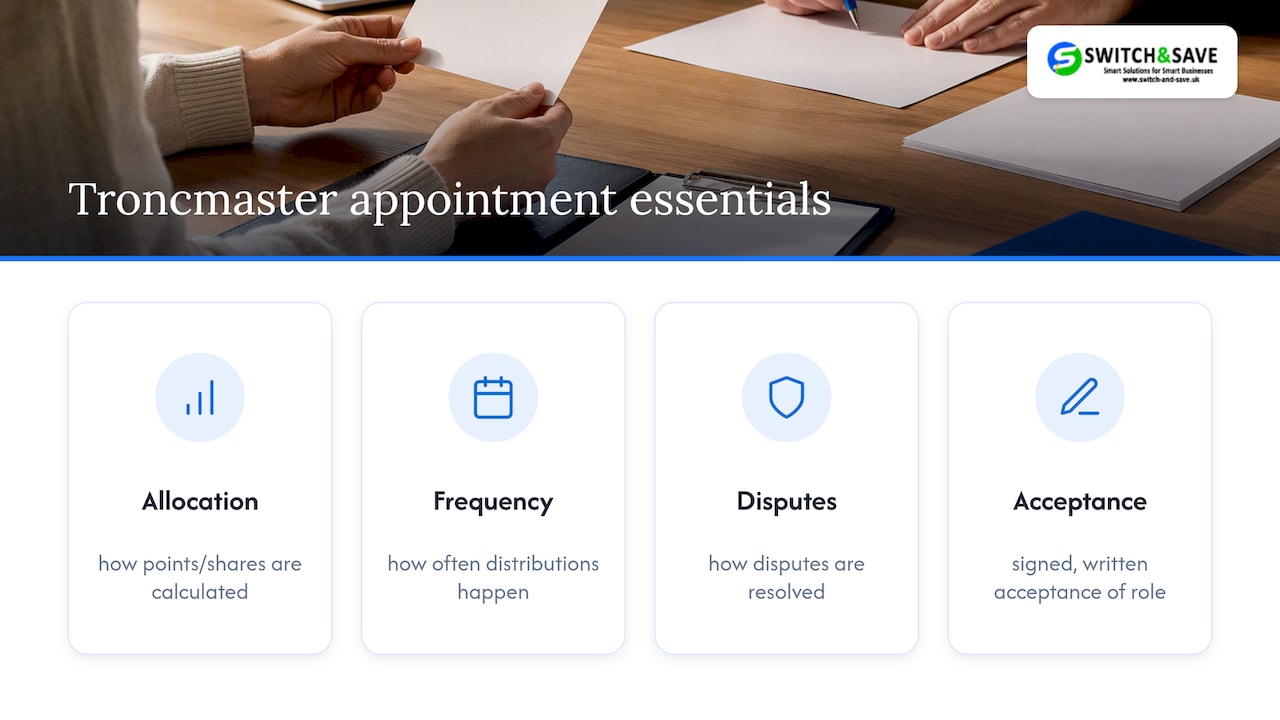
Review the arrangement periodically, particularly after any change in staff numbers or shift patterns, since an allocation method that felt fair at ten staff can feel arbitrary at thirty. A troncmaster who keeps clear, dated records of every distribution gives you the strongest protection if HMRC or a worker ever asks for evidence.
8. Making the tronc system a strength, not a liability
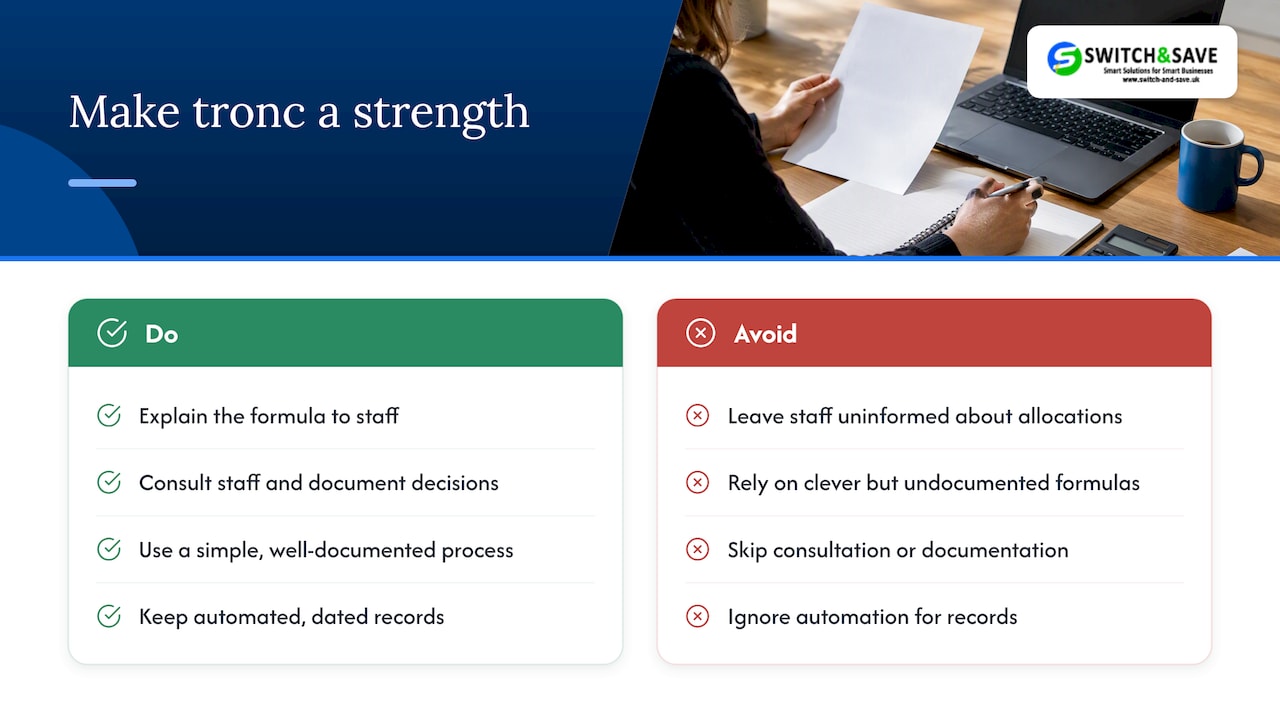
The employers who struggle with tronc rules usually aren’t the ones with complicated allocation formulas. They’re the ones who never explained the formula to staff in the first place. Consultation and clear documentation cost almost nothing and remove most of the friction before it becomes a dispute.
A simple, well-documented process beats a clever one every time. Automated, dated records settle arguments about who received what long before anyone needs to mention a tribunal.
— Amir
Simplifying tip records with the right EPOS setup
We build AI-powered EPOS and payment systems designed to integrate tip and service charge reporting efficiently. This is not a substitute for your legal duties as an employer, but it does remove the manual work of tracking where every tip came from.

Our Hospitality EPOS Bundle at £549 one-off, paired with the AI-powered cloud software at £20 per month, tags tips and service charges separately at the point of sale and exports the reports your troncmaster or payroll team need. For businesses that also take a high volume of card payments, our Integrated Payments Bundle, with the EPOS software subscription at £30 per month, combines the terminal and the reporting in one system, so card tips never need manual reconciling against till totals.
- Hospitality EPOS Bundle for tip and service charge tagging at the point of sale.
- Integrated Payments Bundle for combined card payment and reporting.
- Standard and Premium EPOS Bundles for retail businesses handling optional service charges.
Book a free demo or ask our UK-based support team for an implementation checklist through our hospitality EPOS page to see how the reporting fits your current payroll process.
FAQ
What is the new law on tips in the UK?
The Employment (Allocation of Tips) Act 2023 requires employers to pass on all tips, gratuities and service charges to workers in full, without deductions beyond tax, and to do so fairly and transparently. It is supported by a statutory Code of Practice that tribunals use to judge whether an employer’s distribution method meets the required standard, under GOV.UK guidance.
How much tax do you pay on tronc payments?
Tax treatment depends on who controls the distribution. Where the employer decides how tips are allocated, PAYE and Class 1 National Insurance apply as normal, but where an independent troncmaster runs the scheme free of employer influence, the troncmaster can take on the PAYE responsibility instead, according to HMRC’s PAYE manual.
What is the difference between tips and tronc payments?
A tip is money given directly by a customer to a worker or business, while a tronc is the organised pool and distribution system used to share tips, gratuities and service charges among staff. The tronc is the mechanism, the tip is the money that flows through it.
Is tipping mandatory in the UK?
Tipping itself remains discretionary for customers, but once a tip, gratuity or service charge is received, employers are legally required to pass it on to workers fairly and transparently. A mandatory service charge added to a bill is different from a voluntary tip and falls under the same distribution rules once collected, as set out in the statutory Code of Practice.