

“Service charge” means two different things in the UK, and the rules for each are separate. One is the charge a landlord makes for looking after a building. The other is the percentage a restaurant adds to a customer’s bill. If you run a shop or restaurant in Birmingham, Coventry or anywhere else in the UK, you may deal with both. This guide covers each in turn, with the law, the pitfalls and what to set up in your till.
TL;DR
- Property service charge: for a shop or restaurant lease, the lease itself sets what you pay. The statutory protections you see in most search results mostly cover residential leaseholders, not commercial tenants.
- Restaurant service charge: since 1 October 2024, the Employment (Allocation of Tips) Act 2023 means tips, gratuities and service charges you control must go to workers, in a fair and transparent way.
- Discretionary or not: a service charge added to the bill, voluntary or compulsory, counts as a service charge in law. Your EPOS should record it separately from sales.
- Paperwork wins: keep demands, certificates, tipping policies and distribution records. Most disputes turn on documents, not opinions.
Table of Contents
- Two kinds of service charge, two sets of rules
- Property service charges: what the law says
- Restaurant service charges: the tipping law
- Setting up your EPOS to handle service charge properly
- Our view: treat both charges as paperwork problems
- Where our EPOS fits
- A quick checklist for owners
- FAQ
- Sources
Two kinds of service charge, two sets of rules
Before you read any rule, work out which one you are dealing with.
| Property service charge | Restaurant or venue service charge | |
|---|---|---|
| Who charges whom | Landlord charges tenant | Business charges customer |
| Main rulebook | The lease, plus case law | Employment (Allocation of Tips) Act 2023 and its Code of Practice |
| Who it affects | Shop, café and restaurant tenants; flat leaseholders | Employers in hospitality and anywhere tips are added to bills |
| Key risk | Paying for costs you should not, or missing a lease procedure | Keeping money that belongs to staff |
| Where it shows up in your tools | Your accounts | Your EPOS and payroll |
The rest of this article takes them in that order.
Property service charges: what the law says
Residential leasehold is where the statutory rules sit
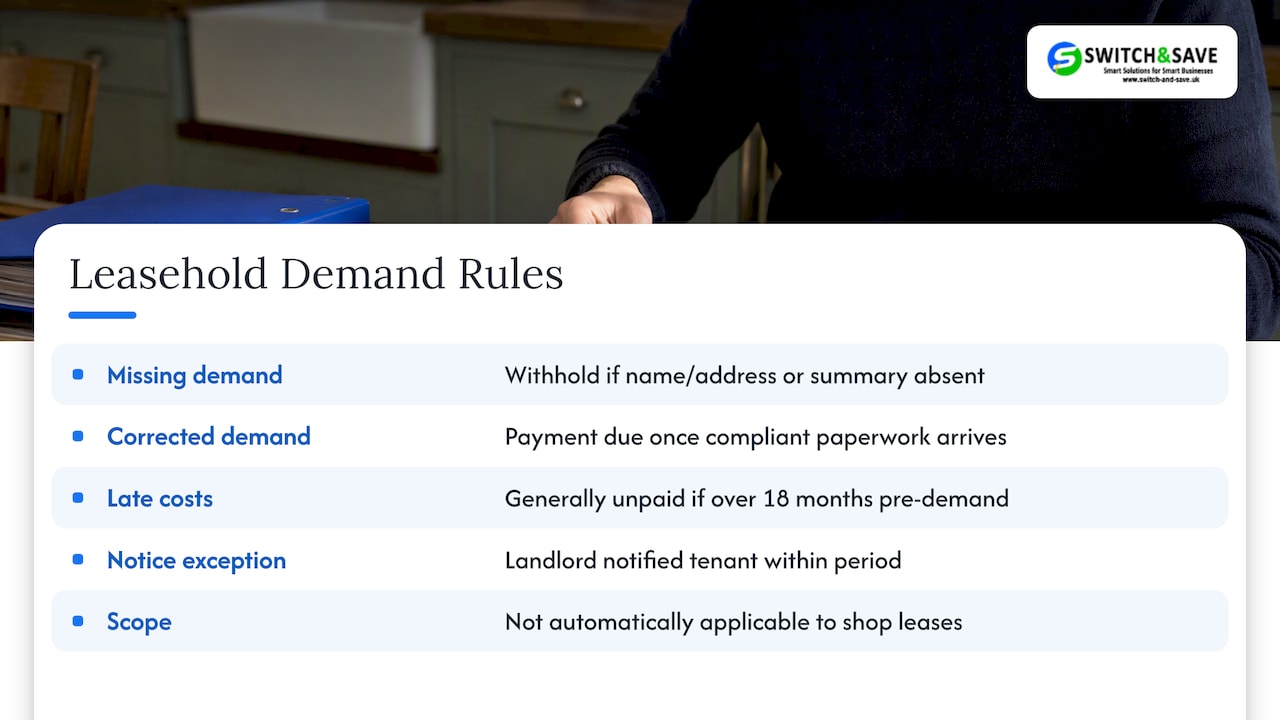
Most of the search results for this topic describe flat leaseholders. There, the landlord has to send a summary of rights and obligations with a demand, and the Leasehold Advisory Service explains that you can withhold payment if the demand lacks the landlord’s name and address or that formal summary.
There is one trap. Withholding is not a permanent excuse. It lasts only until the landlord corrects the demand. Once compliant paperwork arrives, the money is due. Check the demand before you decide to hold anything back.
The 18-month rule also comes up often. Under section 20B of the Landlord and Tenant Act 1985, if costs were incurred more than 18 months before the landlord demanded payment, the tenant generally cannot be made to pay them, unless the landlord notified the tenant within that period that costs had been incurred and would be charged. This sits in the statute’s residential service charge provisions, so do not assume it automatically covers your shop lease. Ask a solicitor whether your lease or any other clause gives you something similar.
Commercial leases: the lease is the rulebook
If you rent a unit in a shopping centre, a retail park or a parade, your service charge is mainly a matter of contract. A local authority tenants’ handbook describes it as the method by which a landlord recovers the cost of services in shared areas of a multi-let site. Typical items include communal areas, gutters, insurance and management fees.
Two practical points follow:
- Read the schedule of services. If a cost is not covered by the wording, ask why it is in your demand.
- Ask for the supporting figures. Budgets, year-end accounts and invoices should be available. A landlord who cannot back up a figure has a problem.
The RICS standard for commercial service charges
The RICS and ICAEW published the second edition of Service charges in commercial property in June 2025. The RICS says it supports early adoption, and it expects the provisions to be fully in place for service charge years ending on 31 December 2026 and beyond. It also publishes templates for agreements such as deferring recovery of costs over future periods, which is a payment plan.
This is a professional standard, not an Act of Parliament. It sets out how managing agents should behave, and it gives you something concrete to point to when a demand looks vague. Whether it binds a particular landlord depends on the lease and on who manages the building, so ask your managing agent whether they follow it.
“Pay now, argue later” clauses
Some commercial leases say the landlord’s certificate of the service charge is conclusive. The Supreme Court looked at this in Sara & Hossein Asset Holdings Ltd v Blacks Outdoor Retail Ltd. The court held that, on the true interpretation of that lease, the certificate was conclusive as to the sum payable, but not as to the tenant’s underlying liability.
In plain terms: you may have to pay the certified amount first, and challenge it afterwards. Refusing to pay risks a breach of the lease, which can have serious consequences. Whether your lease works this way depends on its exact wording, so get a solicitor to read the clause before you dispute a bill.
Disputes over lease wording are common across hospitality and retail. A Brighton craft beer taproom’s budget wish list for bars and pubs gives a useful picture of the pressures on independent venues, which is the context in which a rising service charge hurts most.
Checking a demand: a short routine
- Match every line to a service listed in your lease.
- Compare the budget to last year’s actual spend.
- Check dates. If a cost is old, ask when the landlord incurred it.
- Request invoices and the year-end certificate in writing.
- Pay anything undisputed on time, and write down your queries in the same email.
- If the sum is large, take advice from a solicitor or a chartered surveyor who works on service charges before you refuse payment.
That last step matters in Birmingham and Coventry as much as anywhere. Many units there sit in managed centres or shared estates where one landlord apportions costs across several tenants, so your share depends on the apportionment clause as well as the total.
Restaurant service charges: the tipping law
What changed on 1 October 2024
The law is the Employment (Allocation of Tips) Act 2023. Acas explains it applies to tips, service charges and gratuities over which an employer has “control or significant influence”. It is known as the Tipping Act 2023. In practice, employers must:
- pass these payments on to workers in full, with only tax and National Insurance deducted;
- keep records of how they were distributed for at least three years;
- have a written policy if they receive such payments more than occasionally;
- consult workers when creating or reviewing that policy.
Acas also notes that employers who fail can face tribunal claims, with compensation of up to £5,000 per worker. Acas additionally flags that the Employment Rights Act 2025 will bring further tipping changes by the end of 2026, including a requirement to share an anonymised summary of consultation feedback and to update the policy at least every three years. Check the Acas page for the current position before you finalise a policy.
Discretionary service charge: does “optional” change anything?
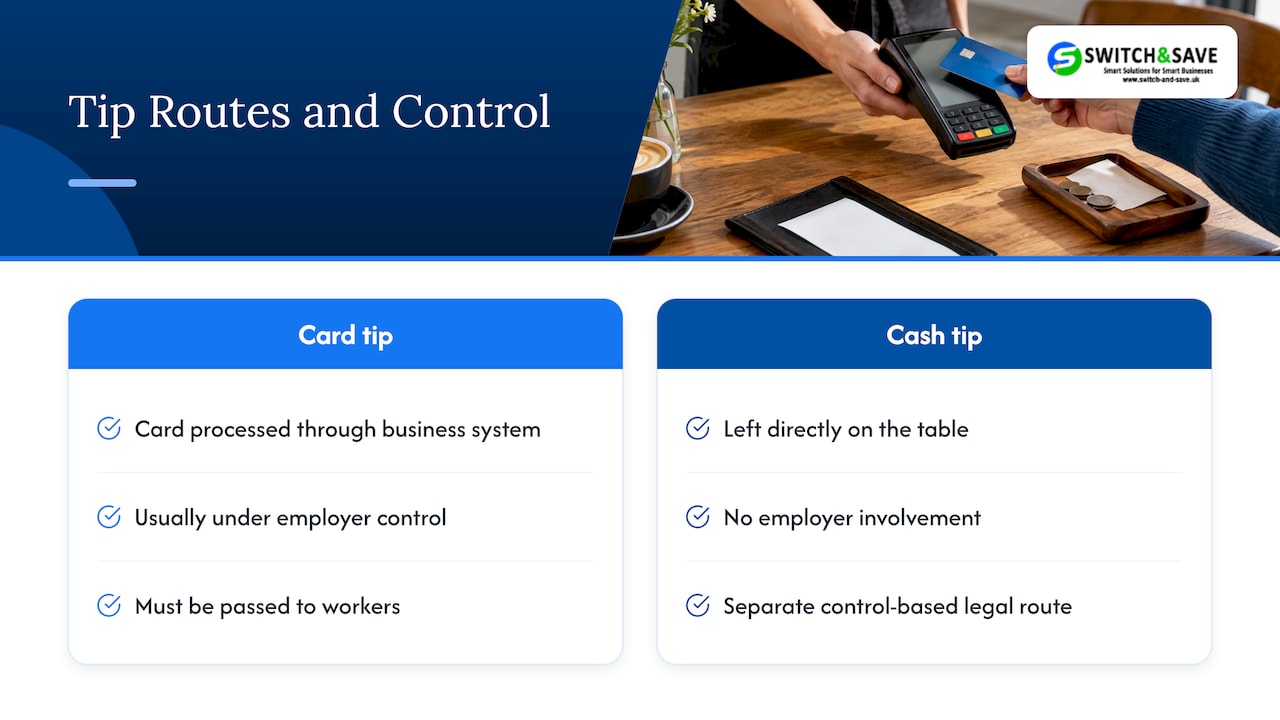
Not much. Acas defines a service charge as an amount a business adds to the customer’s bill before handing it over, and says it can be voluntary or compulsory. An “optional 12.5%” line printed on a bill and processed on a card is still a payment you control. It must be passed to workers.
The law does separate that from cash a customer leaves on the table with no involvement from you. The government factsheet and Acas guidance both turn on whether the employer has control or significant influence, and card payments through your system will usually fall on the control side.
The mistake we see most often
Some small operators assume card tips belong to the business to cover processing costs. The government’s tips and gratuities factsheet makes clear that these amounts must reach workers in full, and the Code of Practice says employers should not use them to offset overheads or top up wages. If you want to reduce what card payments cost you, look at your processing rates instead. We cover that in how to reduce card machine fees for UK retail.
Sharing fairly does not mean sharing equally
Acas guidance on sharing tips fairly says the split must be fair and transparent, not identical. You can base it on objective factors such as role, time of day or performance, but you have to consult staff, document the process and be able to show how you reached the policy. A plain written policy that staff have seen is your best protection.
For more on pay timing and the rules in each case, see our guides on paying tips by month end and UK tronc systems, the latter being one for which you should confirm PAYE duties.
Setting up your EPOS to handle service charge properly
Your till is where the law meets a Friday night. A sound setup should do these things:
- Keep service charge out of sales. Record it as a separate line so it never inflates revenue or gets mixed with takings.
- Label optional and fixed charges differently. If your policy treats them differently, your reports should too.
- Tie each payment to a shift and a staff group. That makes an allocation by role or hours straightforward.
- Export a report for payroll. Records must last at least three years, so choose a system that stores history and exports cleanly.
- Restrict who can change the percentage. A locked setting stops a manager removing the line on a quiet night. Our guide on fixing POS logins to prevent staff theft walks through permissions.
- Review it when your policy changes. If you update your tipping policy, update the till the same week.
Our step-by-step piece on passing tips in full with five EPOS steps goes deeper, and what businesses need to know about UK tipping culture covers the customer side.
Our view: treat both charges as paperwork problems
We sell EPOS systems to shops, cafés and restaurants, and the same pattern turns up with both kinds of service charge. The argument is rarely about whether the charge exists. It is about whether somebody can show how it was worked out.
On the lease side, owners tell us they only open the service charge demand when it is already a shock. Put the dates in your diary, ask for the breakdown early and keep a folder. On the tips side, the problem is usually a till that mixes everything into one total, so nobody can say later where the money went.
That is why we build our systems around clear reporting. A service charge line that is recorded separately, tied to a shift and exportable takes minutes to audit. One buried in daily totals can take days to reconstruct, and by then a tribunal claim or a staff complaint is already in motion.
We are not solicitors, and we do not give legal advice. We do see what a tidy set of records does for an owner who has to explain a figure, whether to a landlord, a worker or an adviser.
— Amir
Where our EPOS fits
If you run a restaurant, café or takeaway and want service charge and tips recorded cleanly, our Hospitality EPOS Bundle is £549 one-off, and the AI-powered cloud software is £20 per month. Retail owners can look at our retail EPOS system, and if you want till and card terminal in one, see the Integrated Payments Bundle, where the EPOS software subscription is £30 per month. We support UK businesses with UK-based support, and we can help you move over from another provider.
👉 Not sure which fits? Browse our EPOS bundles or ask for a free demo from the home page.
A quick checklist for owners
If you rent your premises
- Find the service charge clause and the schedule of services in your lease.
- Check whether the certificate is conclusive.
- Ask your managing agent whether they follow the RICS standard.
- Keep demands, budgets and year-end accounts together.
If you add a service charge to bills
- Write a tipping policy and consult your staff on it.
- Pass on every qualifying payment in full, less tax and National Insurance.
- Keep distribution records for three years or more.
- Make sure your EPOS reports the charge separately.
FAQ
Do you legally have to pay a service charge in the UK?
If your lease says you pay one, yes, in general. The lease creates the obligation, and for a commercial tenant it is the main source of the rules. Some leases require you to pay a certified sum first and dispute it afterwards, so take advice before withholding anything.
What is the 18-month rule for service charges?
Under section 20B of the Landlord and Tenant Act 1985, costs incurred more than 18 months before a demand generally cannot be recovered, unless the tenant was told within that time that they had been incurred and would be charged. It sits in the residential provisions, so a commercial tenant should ask a solicitor whether their lease gives equivalent protection.
Can I refuse to pay my service charge?
Only in limited cases. A residential leaseholder can withhold if a demand lacks the required landlord details or summary of rights, but only until the demand is corrected. If your commercial lease has a conclusive certificate clause, refusing could put you in breach, so challenge the charge after paying and get advice first.
Is a discretionary service charge in a restaurant treated differently from a tip?
No, not if you control or significantly influence it. Acas treats voluntary and compulsory service charges alike, and the Tipping Act 2023 requires them to be passed to workers. Cash that customers hand over with no involvement from you can fall outside the law.
Can a restaurant keep part of the service charge to cover card fees?
No. The government’s guidance says qualifying payments go to workers in full, with only tax and National Insurance deducted. Card processing costs should be dealt with by reviewing your rates, not by taking a slice of staff money.
Sources
- Employment (Allocation of Tips) Act 2023, legislation.gov.uk
- What the law says: tips and service charges, Acas
- Sharing tips fairly, Acas
- Factsheet: Tips and Gratuities, GOV.UK
- Landlord and Tenant Act 1985, section 20B, legislation.gov.uk
- Format of service charge demands, Leasehold Advisory Service
- Commercial tenants’ handbook, Milton Keynes City Council
- Service charges in commercial property, RICS
- Sara & Hossein Asset Holdings Ltd v Blacks Outdoor Retail Ltd, Supreme Court