

Qualifying tips must be allocated to workers and passed on in full, with no deductions except tax and National Insurance, under tipping laws UK employers now follow. The three immediate duties are a written tipping policy, fair allocation with proper records, and distributing tips by the end of the month after they’re received. The statutory Code and employment tribunals are the reference points if things go wrong.
TL;DR:
- Tips must be allocated fairly at each business location, with a written policy, timely distribution, and proper record-keeping as mandated by the 2023 law.
- Only qualifying tips, such as card payments and centralized cash collections, fall under the law; tips handed directly to workers are excluded.
- Employers need to notify HMRC about any troncs and ensure PAYE and National Insurance are properly applied to tips passing through the business.
- Staff can request records every three months to verify tips are fairly allocated, and disputes often stem from missing or inaccurate records.
- Using EPOS systems to tag and export detailed tip data simplifies compliance, helping prevent legal claims and ensuring transparency.
Table of Contents
- What the law requires: the Employment (Allocation of Tips) Act 2023 and the Code of Practice
- Which tips count: scope, control and place of business
- Tax and troncs: PAYE, National Insurance and payroll steps
- Building a compliant tipping policy: a checklist for employers
- Checking your tips as a worker: records and disputes
- How EPOS and payment setups support compliance
- Enforcement and remedies: what happens when employers get it wrong
- How UK tipping rules got here
- How UK rules compare with tipping laws elsewhere
- What compliance looks like in hospitality versus retail
- Where disputes usually come from and how they get resolved
- Telling staff and customers how tips work
- A pragmatic view from someone who watches this closely
- Switch&Save: EPOS support for tip records and payout timing
- FAQ
- Sources
What the law requires: the Employment (Allocation of Tips) Act 2023 and the Code of Practice
The Employment (Allocation of Tips) Act 2023 inserted new duties into employment law, and the accompanying Code of Practice on fair and transparent distribution of tips sets out how employers meet them. Together, sections 27D, 27F, 27G, 27I and 27J cover fair allocation, written policies, distribution timing, record keeping and workers’ right to request those records.
The Code isn’t just advice. Employment tribunals assess an employer’s conduct against it when a worker brings a claim, so following it closely is the main defence available.
- Section 27D requires fair allocation of qualifying tips between workers at a place of business.
- Section 27F requires a written policy on how tips are dealt with.
- Section 27G sets the payment deadline.
- Section 27I and 27J cover record keeping and workers’ right to see those records.
Qualifying tips must reach workers by the end of the month following receipt, under the statutory timetable in the Code. A tip taken in March, for example, must be paid out by 30 April at the latest.
Which tips count: scope, control and place of business
Not every tip falls under the Act. The law applies where an employer has “control or significant influence” over how tips are handled, according to Acas guidance on tips and service charges. That covers service charges added to a bill and cash collected by the business, but not cash a customer hands directly to a server who keeps it without any employer involvement.
- Qualifying tips: card-paid service charges, tips processed through the till, cash collected centrally by the business.
- Outside the Act: cash left on the table and kept by the worker with no employer handling or control.
- Independent troncs: a genuinely independent tronc, run by a troncmaster separate from management, allocates tips without falling under the employer’s direct allocation duty, though notification and tax rules still apply.
- Agency workers: agency staff working at a place of business are included in the fair allocation duty for that location, not excluded because of their employment status.
Allocation happens at the level of each place of business, so a multi-site operator can’t simply average tips across all locations if the sites don’t share a common tip pool or staffing pattern.
Tax and troncs: PAYE, National Insurance and payroll steps
Tax treatment hinges on who controls the money. HMRC’s guidance on tips and tax confirms that tips paid directly to a worker, with no employer involvement, are the worker’s own responsibility to declare. Tips that pass through the employer or a tronc are subject to PAYE, and National Insurance may apply depending on who controls the allocation.
A tronc is a separate pay arrangement for distributing tips, run by a troncmaster rather than the employer directly. HMRC’s tronc guidance requires the troncmaster to operate PAYE on tronc payments, and employers must notify HMRC that a tronc arrangement exists. Many businesses set up an independent tronc specifically to manage National Insurance exposure, but that only works if the tronc is genuinely independent and properly notified.
For payroll teams, the practical steps are:
- Record every tip by type (cash, card, service charge) at the point it’s taken.
- Reconcile tip totals against payroll figures before each month-end run.
- Confirm whether a tronc is in place and whether HMRC has been notified.
- Apply PAYE and NIC correctly depending on who controls the distribution.
Building a compliant tipping policy: a checklist for employers
A written policy is non-negotiable under the Act, and it needs to cover more than a single line about “tips are shared fairly.”
- Write down how tips are accepted. Specify cash, card and service charge routes, and who handles each.
- Set out the allocation method. Explain the factors used (hours worked, role, seniority) and confirm the approach is objective and non-discriminatory.
- State the distribution schedule. Commit to paying out by the end of the month following receipt, as the Code requires.
- Run a staff consultation. Ask for feedback before finalising or reviewing the policy, and keep a record of that process.
- Publish an anonymised summary. Share the consultation outcome with staff without naming individuals, in line with Acas guidance under the Employment Rights Act.
- Keep records for three years. Retain tip totals, allocation records and distribution dates, matching the retention period set out in the Code.
- Feed payment data into payroll monthly. Use EPOS or terminal logs so figures are accurate and time-stamped.
Pro Tip: Review your tipping policy every time you change your payment setup, not just once a year, since new terminals or service charge options often change how tips are captured.
Checking your tips as a worker: records and disputes
If you suspect your tips haven’t been fairly allocated, you have a legal route to check. Under the Code, you can request tipping records once every three months, and your employer must respond within four weeks.
- Ask for the total tips received at your place of business for the period in question.
- Check your own allocation against that total, including dates and amounts.
- Raise an informal grievance with your manager first if the figures don’t add up.
- Use Acas conciliation as a free step before any tribunal claim.
- Be aware that tribunal claims generally need to be brought within 12 months of the issue arising.
How EPOS and payment setups support compliance
Configuring your point-of-sale system to tag voluntary tips separately from service charges makes the record-keeping duty far easier to meet.
- Record tip totals by terminal and location, not just as a single lump sum.
- Export monthly reports timed to match the end-of-month distribution deadline.
- Retain exported records for at least three years, as the Code requires.
- Use the same reports to build the anonymised consultation summary for staff.
Enforcement and remedies: what happens when employers get it wrong
Workers who believe their tips haven’t been fairly allocated can bring a claim to an employment tribunal, which has the power to order reallocation of tips or require payments directly to affected workers. Tribunals weigh the Code of Practice heavily when judging whether an employer’s process was fair, so a documented, transparent policy is the strongest protection against a claim succeeding.
Acas conciliation is usually the first step before a claim reaches tribunal, giving both sides a chance to resolve the dispute without a hearing.
- Common findings against employers include failure to consult staff before setting or changing a policy.
- Poor or missing records are a frequent, standalone reason claims succeed, even when the amount in dispute is small.
- Allocation methods that disadvantage particular groups or roles without objective justification are treated as discriminatory and unfair.
How UK tipping rules got here
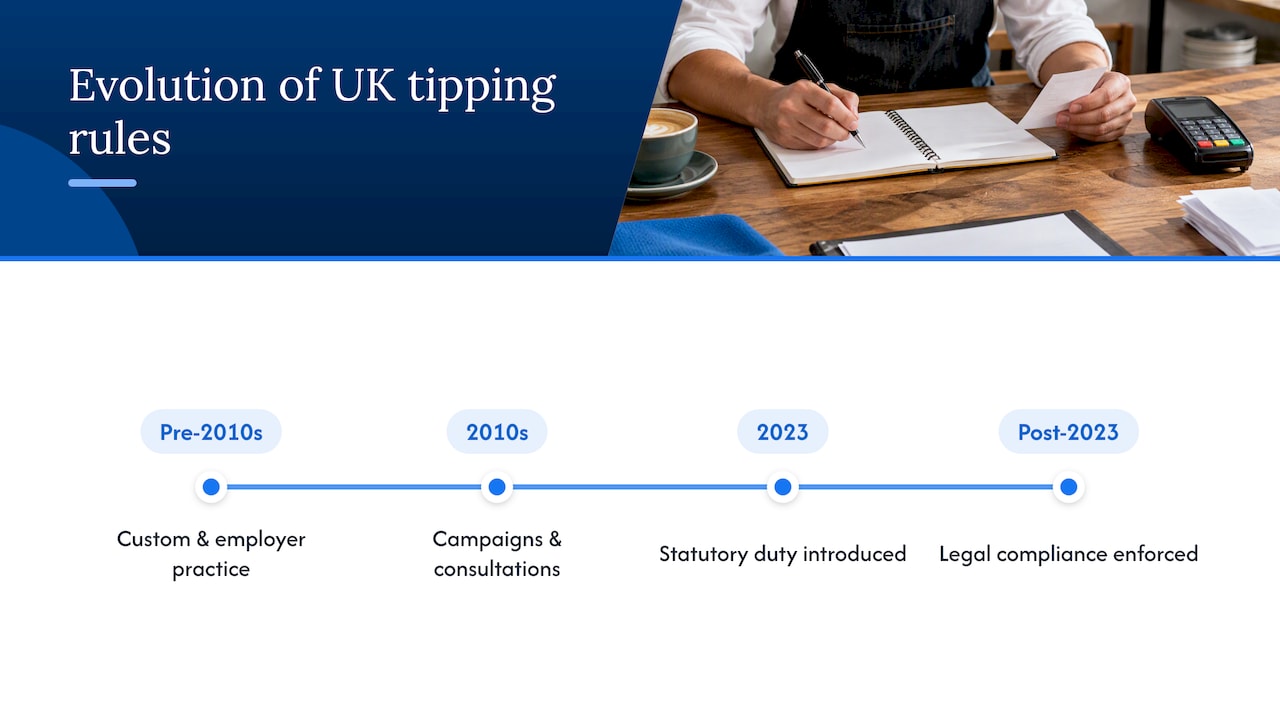
Tipping in the UK sat largely outside statutory regulation for decades, left to custom and individual business practice. Service charges were sometimes added to bills with little clarity about where the money ended up, and reports of employers retaining a share of tips to cover costs or top up wages became a recurring source of public concern.
Pressure built through the 2010s as campaigns highlighted cases where card-paid service charges were deducted before reaching staff, prompting government consultations on tipping practices in hospitality. Voluntary codes existed, but with no legal force, enforcement depended entirely on an employer’s goodwill.
The Employment (Allocation of Tips) Act 2023 changed that by introducing a statutory duty to pass on qualifying tips in full and allocate them fairly, backed by the Code of Practice and tribunal enforcement. The shift moved tipping from a matter of custom and individual negotiation to one of documented legal compliance, with written policies, records and consultation duties replacing informal arrangements. For employers who’d previously treated tips as a flexible pool to offset wage costs or cover shortfalls, the Act closed that option and introduced real exposure to tribunal claims for getting it wrong.
How UK rules compare with tipping laws elsewhere
The UK’s approach sits apart from tipping cultures where gratuities are baked into pay structures. In the United States, many states allow a lower minimum cash wage for tipped workers on the basis that tips make up the difference, a system with no equivalent in UK law, where tips can never be used to meet minimum wage obligations.
European countries vary widely. Some, including France, build service charges into menu prices as a matter of custom, reducing reliance on discretionary tipping altogether. Others leave tip distribution largely unregulated, similar to the UK’s position before 2024.
What sets the UK framework apart now is the combination of a statutory right to full allocation, a Code that tribunals actively apply, and enforceable record-keeping and consultation duties. Few comparable economies have moved to this level of prescriptive detail on tip handling, which places a real documentation burden on UK employers that doesn’t exist in many other jurisdictions.
What compliance looks like in hospitality versus retail
Hospitality businesses face the sharpest exposure, since tipping volume, service charges and tronc arrangements are often a normal part of daily operations. Restaurants and pubs typically need the fullest version of a tipping policy: clear rules on service charge allocation, a functioning tronc if one is used, and monthly reconciliation that keeps pace with high transaction volumes. A hospitality sector perspective on cost pressures also highlights why getting tip handling right matters financially, not just legally, for operators already managing tight margins.
Retail businesses tip less often but aren’t exempt. A café counter or a salon till that occasionally takes a card tip still falls under the Act if the business has any control over that money. The common mistake in retail is assuming low tip volume means the written policy and record-keeping duties don’t apply. They do, regardless of how occasional the tips are.
Both sectors benefit from treating tip compliance as an extension of normal payment processing rather than a separate administrative task bolted on at month-end.
Where disputes usually come from and how they get resolved
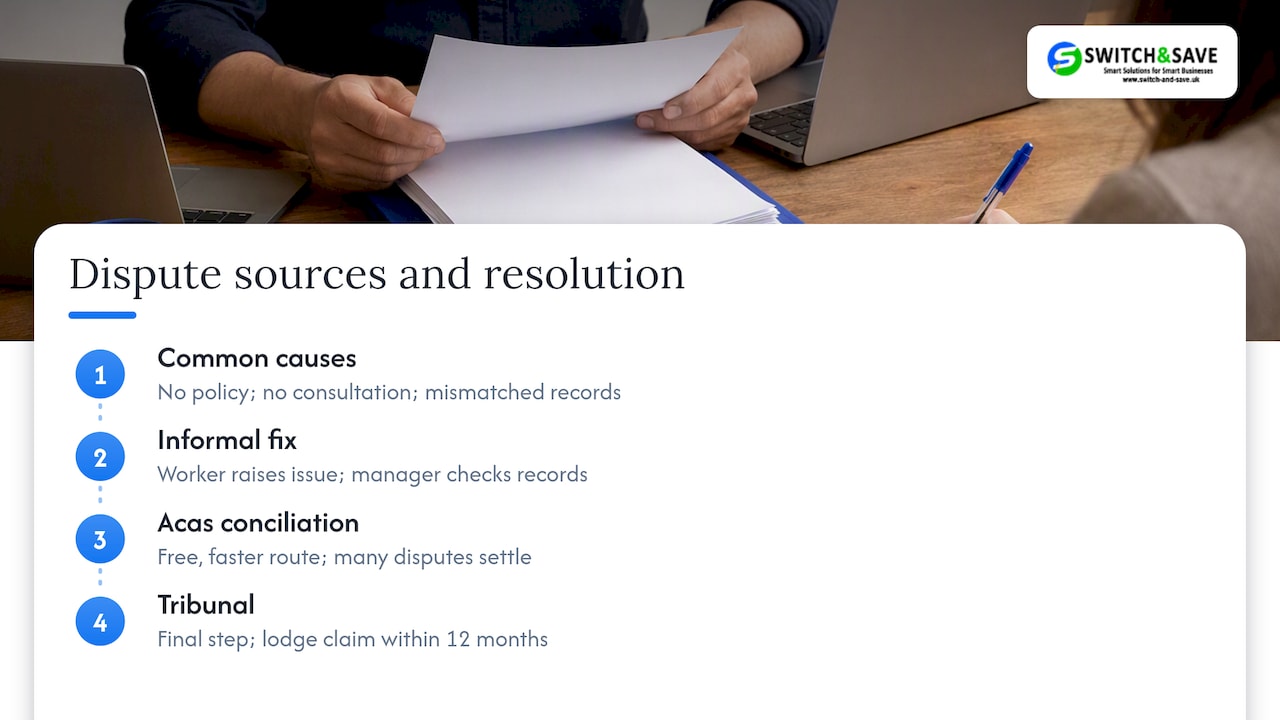
Most disputes trace back to one of three gaps: no written policy, no consultation before a policy changed, or records that don’t match what staff were actually paid. Acas guidance on policies and records notes that a missing or incomplete tipping record is often enough on its own to support a successful claim, even where the financial amount involved is modest.
The usual resolution path starts informally: a worker raises the discrepancy directly with their manager, often prompted by requesting their tipping records. Many disputes end here once records are checked and corrected. Where that doesn’t resolve things, Acas conciliation offers a free, faster route than a tribunal hearing, and a large share of disputes settle at this stage.
Tribunal claims remain the final step, used when an employer disputes the worker’s account or when the dispute involves a pattern affecting multiple staff rather than a single payment error. Claims brought to tribunal typically need to be lodged within 12 months of the issue arising, making early record requests and informal grievances the most practical first move for workers.
Telling staff and customers how tips work
A policy only works if people actually know about it. For staff, that means more than a line in the handbook: run a short consultation before finalising the policy, explain how allocation is calculated, and confirm when they can expect payment. Publishing an anonymised summary of that consultation, as encouraged under Employment Rights Act guidance, shows staff their feedback was actually considered.
Customers deserve clarity too, even though the Act doesn’t set out specific customer-facing wording requirements. A simple note on receipts or menus explaining whether a service charge is discretionary and how it’s shared removes ambiguity at the point of payment, which reduces awkward conversations at the till and builds trust in the business’s handling of tips. Clear, consistent messaging, repeated the same way on menus, receipts and staff noticeboards, avoids the confusion that often leads to a tip-related grievance in the first place.
A pragmatic view from someone who watches this closely
The businesses that struggle with this law aren’t dishonest, they’re disorganised. Get a one-page policy, accurate EPOS tagging and monthly reconciliation sorted, and most risk disappears. Never let tips cover minimum wage shortfalls or make deductions nobody signed off on.
— Amir
Switch&Save: EPOS support for tip records and payout timing
Our EPOS systems can tag voluntary tips and service charges separately at the point of sale, helping make tip totals ready for payroll without manual sorting.

Our Hospitality EPOS Bundle and Integrated Payments Bundle both export location-level tip reports timed to the monthly distribution deadline, which makes the record-keeping and consultation summary duties far less fiddly to manage. Book a free review of your tip settings and we’ll show you where your current setup falls short.
FAQ
Is it compulsory to tip in the UK?
No, tipping itself remains voluntary for customers in the UK. Once a tip, gratuity or service charge is given, though, tipping law requires employers to allocate and pass it on fairly to workers.
Is 10% tip ok in the UK?
There’s no legal minimum or standard percentage for tipping in the UK, so the amount is entirely the customer’s choice. Many restaurants add a discretionary service charge to the bill, which customers can ask to have removed if they prefer to tip separately or not at all.
What is the new law on tips in the UK?
The Employment (Allocation of Tips) Act 2023, backed by a statutory Code of Practice, requires employers to pass on qualifying tips in full, keep a written policy, consult staff and maintain records. Tips must reach workers by the end of the month following receipt, and workers can request records once every three months.
Will tipping law change in October 2026?
There’s no publicly listed change to tipping law scheduled for the near future. Employers should keep following the current Employment (Allocation of Tips) Act 2023 and its Code of Practice, and check GOV.UK for any future updates.
Are tips taxable in the UK?
Yes, but the treatment depends on how the tip is paid. HMRC guidance confirms that tips handed directly to a worker are reported by that worker, while tips passed through an employer or a tronc go through PAYE and may attract National Insurance.