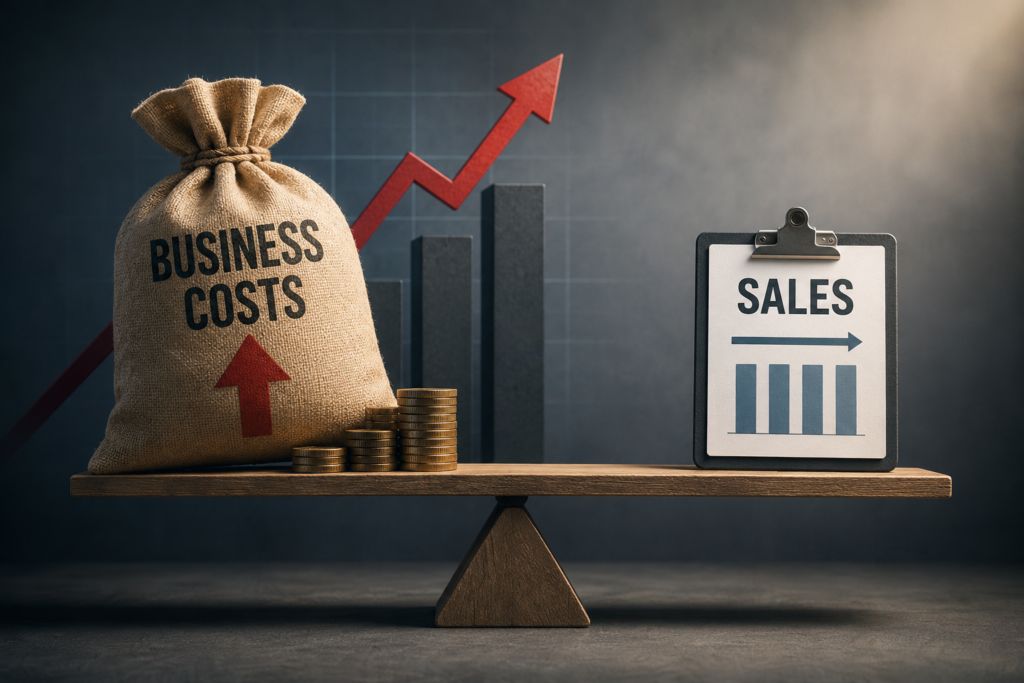
When business costs rise while sales stay flat, your profit margin gets smaller. You’re making the same amount of money, but more of it is being spent on wages, rent, utilities, stock, payment fees and other operating costs.
For a small UK business, even a relatively modest increase across several expenses can make a noticeable difference.
The good news is that you don’t always need more sales to improve your position. You can also look at where money is leaving the business and whether those costs can be reduced or managed more efficiently.
That could mean reviewing your card payment fees, improving stock control, reducing unnecessary admin, upgrading your EPOS system or finding better ways to manage cash flow.
Here’s how it works.
Key Takeaways
| What’s happening | What it means for your business |
|---|---|
| Sales stay the same | Revenue hasn’t increased to absorb higher expenses |
| Costs increase | More of your revenue goes towards running the business |
| Profit margin falls | You keep less money from each pound of sales |
| Costs go unnoticed | Small increases can add up across several suppliers and services |
| Efficiency improves | Better systems can reduce admin, waste and avoidable costs |
| Regular reviews matter | You can identify expensive areas before they become bigger problems |
What happens to your profit when costs rise?
The simplest way to understand rising business costs is to look at the money left after expenses.
Imagine a small café makes £30,000 in monthly sales.
After paying for stock, staff, rent, utilities, card processing and other expenses, suppose the business has £5,000 left.
Now several costs increase, but sales remain at £30,000.
The business might still look busy. Customers are still coming through the door. The till is still ringing.
But the amount left at the end of the month is lower.
That’s the problem with rising costs. You can have the same turnover while making less profit.
And if costs continue to increase, the gap becomes harder to ignore.
Revenue isn’t the same as profit
This is an easy distinction to lose sight of when you’re focused on daily sales.
Revenue is the money coming into the business from customers.
Profit is what remains after your business expenses have been paid.
So, if your shop takes £10,000 more in sales but your costs rise by £12,000, you haven’t actually improved your financial position.
This is why looking only at sales figures can give you an incomplete picture.
Which business costs can put pressure on your margins?
Different businesses have different cost structures, but most small businesses have a mixture of fixed and variable expenses.
Fixed costs
These are costs that generally don’t change directly with each sale.
Examples include:
- Rent
- Insurance
- Software subscriptions
- Some salaries
- Equipment leases
- Professional fees
If these costs increase while sales stay flat, your margin can quickly come under pressure.
Variable costs
These tend to move with the amount you sell or the activity of your business.
For example:
- Stock
- Packaging
- Delivery costs
- Card payment fees
- Some staff costs
- Supplier charges
For a takeaway, rising food and packaging costs can make each order less profitable.
For a grocery shop, supplier price increases can squeeze the margin on individual products.
For a mobile shop, higher stock and payment costs can affect the amount earned from each transaction.
That’s why it’s useful to understand cost per sale, not just total monthly expenses.
Why rising costs are particularly difficult when sales stay flat
When sales are growing, a business may be able to absorb some cost increases.
But when sales remain unchanged, there’s no additional revenue to cover them.
Consider a simple example.
A takeaway sells 1,000 meals per month at an average value of £10.
That’s £10,000 in sales.
If the cost of ingredients, packaging, payment processing and other expenses increases, the takeaway still has the same 1,000 orders.
It can’t simply spread those extra costs across more customers.
The owner has a few choices.
They could:
- Increase prices.
- Reduce unnecessary expenses.
- Improve operational efficiency.
- Increase average order value.
- Generate more sales.
- Accept a lower margin.
The right option depends on the business.
Often, the smartest approach is to look at the costs first.
Where can a small business reduce costs?
You don’t need to slash every expense. Some costs are necessary for running the business properly.
Instead, look for areas where you’re paying more than you need to or spending money without getting enough value in return.
Start with your biggest recurring expenses
Go through your regular payments.
Look at rent, suppliers, software, card processing, equipment, utilities and other services.
Ask yourself:
“If I had to reduce my monthly costs by £500, where would I start?”
This question can make the review much more practical.
You may discover that the answer isn’t one large expense. It could be several smaller ones.
Review your card payment costs
Card payments are now part of everyday trading for most retail and hospitality businesses.
But accepting cards comes with costs.
Depending on your agreement, you may be paying transaction fees, monthly charges, terminal costs or other charges.
Don’t just look at the advertised transaction rate.
Look at what you’re actually paying across a month.
Switch & Save’s guide to card payment fees for small businesses explains why looking at the complete cost can give you a clearer picture. (Switch&Save)
Look for wasted stock
Stock that doesn’t sell ties up cash.
For a grocery shop, that might mean products approaching their use-by date.
For a restaurant, it could be ingredients being ordered in larger quantities than needed.
For a mobile shop, it might be accessories sitting on shelves for months.
A better view of product performance can help you make more informed purchasing decisions.
Reduce unnecessary admin
Time is also a business cost.
If staff are manually entering payments, checking several systems or producing reports by hand, those hours add up.
This is one area where better technology can help.
The aim isn’t to replace people. It’s to remove repetitive tasks so your team can spend more time serving customers and running the business.
How EPOS can help control rising business costs
An EPOS system can do more than process a sale.
A modern system can bring sales, stock and reporting into one place. That gives you a clearer view of what is actually happening inside the business.
For example, you might discover that:
- One product sells far better than another.
- Certain items aren’t moving.
- Sales are stronger at particular times.
- Refunds are higher than expected.
- Staff are spending too much time on manual processes.
- Payment records are difficult to reconcile.
These details can help you make better decisions.
For a café, that might mean adjusting stock orders based on actual sales.
For a restaurant, it could mean identifying popular dishes and reviewing low-selling items.
For a convenience shop, it might help you understand which products deserve more shelf space.
Switch & Save provides AI-powered EPOS systems designed to give UK businesses better visibility over sales, stock and daily operations.
The goal isn’t simply to have a newer till.
It’s to have better information when you’re deciding where your money should go.
Review your card payment costs
Payment costs deserve their own review because they’re linked directly to your sales.
Every time a customer pays by card, there may be a processing cost associated with that transaction.
So, what actually happens when a customer taps their card?
The transaction is processed through your payment provider, the payment is recorded, and the funds are eventually settled into your business account.
If your EPOS and payment system aren’t properly connected, you may also have additional manual work when checking that your sales and payments match.
Integrated payments can make this process easier by connecting the transaction recorded in your EPOS with the payment made through the card terminal.
You can read Switch & Save’s guide to integrated card payments for a closer look at how this works in hospitality. (Switch&Save)
For businesses reviewing their costs, the key question is simple:
Are you getting enough value from what you’re paying for?
If the answer isn’t clear, it’s worth reviewing the agreement.
What if cutting costs isn’t enough?
There comes a point where cutting expenses can only take you so far.
You still need to run the business.
You still need staff. You still need stock. You still need equipment. And you still need to serve customers properly.
That’s where improving revenue and cash flow becomes part of the conversation.
You might increase your average transaction value by introducing bundles or complementary products.
A café could promote a drink with a breakfast item.
A takeaway could create meal combinations.
A grocery shop could place complementary products together.
If additional working capital is needed, business finance may also be an option, depending on eligibility and the terms available.
For businesses with fluctuating sales, flexible finance can sometimes be structured around future card sales rather than a fixed monthly repayment. However, business owners should always compare the total cost and make sure the arrangement is suitable for their circumstances. (Switch&Save)
The goal shouldn’t be to borrow simply because costs are rising.
It should be to make a sensible decision about cash flow, investment and the future of the business.
A simple cost review for your business
You don’t need a complicated spreadsheet to get started.
Set aside an hour and review the last three months.
Step 1: Write down your total sales
Look at your actual turnover for each month.
Has it increased, decreased or stayed roughly the same?
Step 2: List your main expenses
Include rent, wages, stock, utilities, payment fees, software, equipment and other regular costs.
Step 3: Find the costs that increased
Compare the last three months with the previous period.
Which expenses are taking more money from the business?
Step 4: Separate necessary costs from avoidable costs
Not every expense can or should be cut.
Focus on costs where you can negotiate, switch provider, reduce waste or improve efficiency.
Step 5: Review your systems
Ask whether your current EPOS, payment setup and reporting tools are helping you save time and money.
If you’re using several disconnected systems, there may be a more efficient option.
Step 6: Check the result
After making changes, track the difference.
A saving isn’t really useful if you can’t see whether it actually improved your bottom line.
How Switch & Save can help
Rising business costs don’t always mean you need to work longer hours or chase more customers.
Sometimes, the first step is simply getting a clearer view of where your money is going.
Switch & Save helps UK businesses across retail and hospitality review their technology and business services, including AI-powered EPOS systems, card payment solutions and business finance.
For a grocery shop, café, restaurant, takeaway, bar or mobile shop, the right setup can make it easier to manage sales, payments and daily operations.
If your costs have increased but your sales haven’t moved, now is a good time to review the numbers.
Switch & Save helps UK businesses reduce costs with AI-powered EPOS systems, card payment solutions and business finance.
Check your savings today.
FAQs
What happens when business costs rise but sales stay the same?
Your profit margin decreases because you’re spending more money to generate the same level of revenue. If costs continue rising without an increase in sales or other savings, profitability can fall further.
What are rising business costs?
Rising business costs are increases in the expenses required to operate a business. These can include rent, wages, stock, utilities, payment processing fees, software, equipment and other operating expenses.
How can a small business reduce rising costs?
Start by reviewing your largest recurring expenses. Compare supplier prices, payment fees and subscriptions, reduce unnecessary stock waste and look for ways to automate repetitive admin.
Can an EPOS system reduce business costs?
An EPOS system can help by improving visibility over sales, stock and business performance. It can also reduce some manual admin and make it easier to identify products or processes that may be costing the business money.
Should I switch card payment providers if my costs are increasing?
It may be worth reviewing your current agreement and comparing the total cost. Don’t look only at the transaction rate. Consider monthly charges, terminal costs, contract terms, settlement arrangements and other applicable fees.
Can business finance help when costs are rising?
Business finance may help eligible businesses manage cash flow or fund specific needs, but it isn’t a solution for every business. Compare the total cost, repayment structure and suitability before accepting finance.