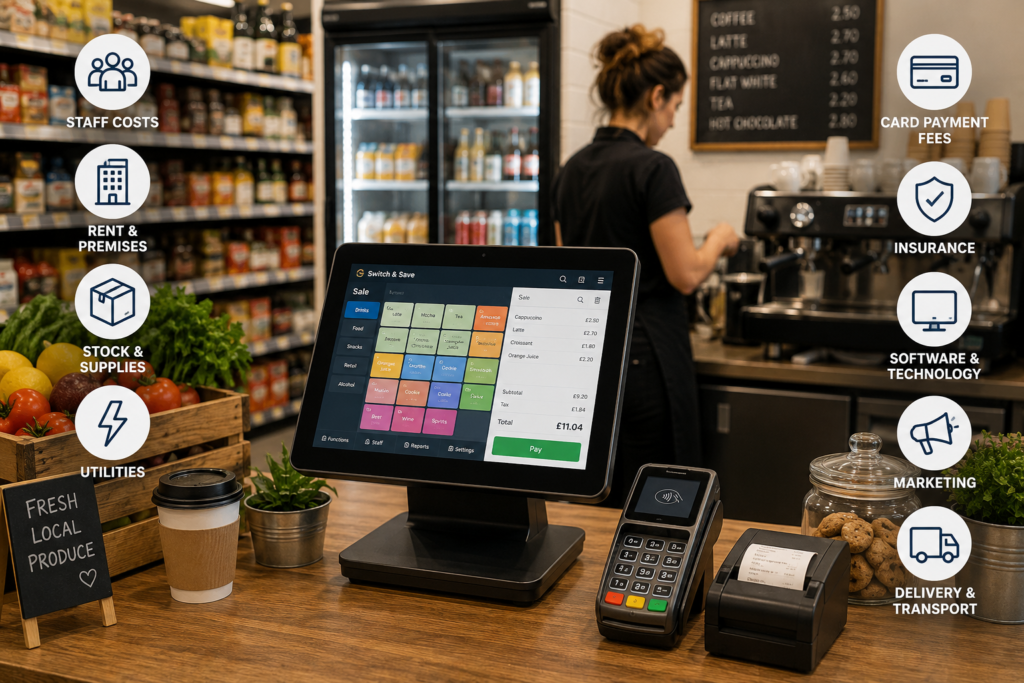
For most UK small businesses, the biggest expenses are staff wages, rent and premises costs, stock or ingredients, utilities, card payment fees, insurance, software, marketing and transport.
Which cost takes the biggest share depends heavily on your type of business. A restaurant may spend heavily on staff, food and energy. A convenience store may have a large amount of cash tied up in stock. A mobile shop might have lower staffing costs but spend more on high-value inventory and premises security.
The important thing isn’t simply knowing what you spend. It’s understanding which expenses are necessary, which are increasing and which could be reduced without damaging your sales or customer experience.
This guide looks at the biggest small business expenses UK owners commonly face and where you should focus when reviewing your costs.
Key Takeaways
| Expense | Why It Matters | What to Review |
|---|---|---|
| Staff | Often a major cost in hospitality and retail | Rotas, overtime and quiet periods |
| Rent and premises | Usually a fixed monthly commitment | Lease terms, rates and space usage |
| Stock | Uses cash before products are sold | Waste, overstocking and slow sellers |
| Utilities | Particularly important for food and grocery businesses | Energy use and contracts |
| Card payments | Costs increase with transaction volume | Total processing cost and extra fees |
| Insurance | Essential protection for many risks | Cover, excess and renewal terms |
| Technology | Can reduce admin but also create recurring costs | EPOS and unused subscriptions |
| Marketing | Necessary for growth when it produces results | Cost against enquiries and sales |
| Transport | Significant for delivery-based businesses | Fuel, servicing and route efficiency |
| Repairs | Unpredictable but unavoidable | Maintenance and emergency reserves |
What Counts as a Small Business Expense?
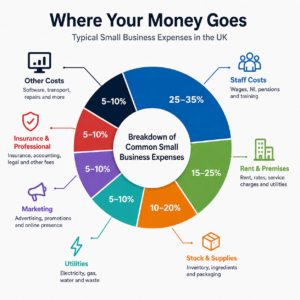
A business expense is money your business spends while operating.
Some expenses are fairly predictable. Your rent, insurance and monthly software subscriptions may stay roughly the same regardless of whether you’ve had a busy or quiet week.
These are generally known as fixed costs.
Other expenses change as your business gets busier. A takeaway selling more meals needs more ingredients and packaging. A retailer making more sales may pay more in card processing charges.
These are variable costs.
Understanding the difference helps because cutting every expense in the same way rarely works.
You need to know what is actually driving the cost.
1. Staff Wages and Employment Costs
For many cafés, restaurants, takeaways, bars and larger retail shops, employees are one of the biggest operating expenses.
And your staffing cost isn’t limited to basic wages.
Depending on your circumstances, it may also include employer costs, pension contributions, holiday pay, training, bonuses, agency workers and overtime.
The problem isn’t necessarily that you’re paying staff too much.
Often, the bigger issue is when people are working.
Imagine a café has six employees working on Tuesday afternoon even though sales are consistently quiet. On Saturday morning, however, the same café becomes extremely busy and struggles with only four people.
The business doesn’t necessarily need fewer staff. It needs a better rota.
Sales reports from your EPOS can help you compare staffing levels against genuine trading patterns.
That gives you a better basis for deciding when additional staff are actually needed.
2. Rent, Business Rates and Premises Costs
Rent can take a significant share of revenue for businesses operating from physical premises.
That includes:
- Shops
- Restaurants
- Cafés
- Takeaways
- Pubs and bars
- Convenience stores
- Salons
- Mobile phone shops
Your premises costs can also include business rates, service charges, security, cleaning, maintenance and property insurance.
Because these costs are relatively fixed, they’re harder to reduce quickly.
That’s why location needs careful consideration before signing a lease.
A cheaper shop isn’t automatically better if hardly anybody walks past it. Equally, an expensive high-street location doesn’t make sense if the additional footfall doesn’t generate enough sales to cover the extra cost.
Look at premises costs alongside revenue rather than in isolation.
3. Stock, Ingredients and Supplies
Stock is another major small business expense in the UK, particularly for retail and hospitality businesses.
The problem is that spending money on stock doesn’t guarantee that stock will sell.
Suppose a convenience store purchases £3,000 of additional products.
If customers buy them quickly, that’s normal business activity.
But if £1,000 worth remains on the shelves for months, part of the business’s cash is effectively sitting there waiting to be converted back into money.
Hospitality businesses have another problem: waste.
Fresh meat, vegetables, dairy products and prepared food have limited shelf lives. Ordering more than customers actually buy can quickly eat into your margin.
Good stock management should help you identify:
- Fast-selling products
- Slow-moving items
- Low-stock products
- Excess inventory
- Damaged stock
- Wastage
- Expiring products
The goal isn’t simply to buy less.
It’s to buy the right amount of the right products.
If you’re reviewing costs more widely, see our [internal link: How to Reduce Business Costs Without Hurting Sales] guide.
4. Gas, Electricity and Other Utilities
Utilities can become a substantial operating expense, especially when your equipment needs to remain running for long periods.
Think about a grocery shop.
Its refrigerators and freezers may operate continuously. There are also lights, heating, air conditioning, security systems, EPOS equipment and other electrical devices.
Restaurants and takeaways can have even greater requirements because of ovens, grills, extraction systems, refrigeration and food preparation equipment.
Reducing energy costs doesn’t mean making customers uncomfortable or switching essential equipment off.
Start by looking for waste.
Check equipment that’s running unnecessarily, heating schedules, older inefficient equipment and your current utility arrangements.
Small operational changes can sometimes be more sensible than immediately replacing expensive equipment.
5. Card Payment and Banking Costs
Card payments are convenient for customers, but accepting them isn’t free.
Businesses may encounter costs such as:
- Transaction charges
- Terminal rental
- Monthly charges
- Authorisation fees
- Additional terminal charges
- Other payment-service fees
The important figure isn’t always the advertised transaction percentage.
What matters is the total amount your business pays compared with the value of payments you’re processing.
For example, two payment arrangements could advertise similar transaction rates while producing very different monthly bills once other charges are included.
This becomes increasingly important as card turnover increases.
If your business has grown significantly since signing your current agreement, it’s worth reviewing whether that payment setup still suits your trading profile.
Switch & Save provides card payment solutions alongside its EPOS systems, allowing businesses to review how payments fit into their wider operating costs.
6. Insurance and Professional Fees
Insurance can feel like another outgoing until you actually need it.
Depending on your business, you might have costs for areas such as employer’s liability, public liability, buildings, contents, stock, business interruption, vehicles or professional cover.
Don’t simply select insurance based on the cheapest premium.
Make sure you’re comparing what each policy actually covers.
Our [internal link: What Insurance Does a Small Business Need in the UK?] guide explains the main types of cover small businesses may want to consider.
Professional services also belong in this category.
Accountants, solicitors, payroll providers and other specialists all cost money, but paying for the right advice can be considerably better than discovering an accounting, tax or contractual problem later.
7. EPOS, Software and Technology
Technology should make running your business easier.
Unfortunately, software subscriptions can quietly accumulate.
You might be paying separately for:
- EPOS
- Stock management
- Reporting
- Staff management
- Accounting
- Online ordering
- Loyalty software
- Booking systems
- Website tools
- Cloud storage
One £20 subscription doesn’t look significant.
Neither does another £35 subscription.
But when you have ten different services, the combined monthly cost can become much more noticeable.
Review your subscriptions regularly.
Ask whether each system is still being used and whether multiple tools are performing similar jobs.
An integrated EPOS system can potentially bring several operational functions together, including sales reporting, stock control and transaction records.
The objective isn’t to buy more technology.
It’s to reduce unnecessary manual work and give you better visibility over what is happening inside your business.
8. Marketing and Advertising
Marketing is an expense, but that doesn’t automatically make it a cost you should cut.
A campaign generating profitable customers may deserve more budget.
A campaign producing plenty of clicks but no meaningful sales probably needs reviewing.
This applies to:
- Google advertising
- Social media advertising
- Flyers
- Local sponsorship
- Email marketing
- Website costs
- SEO
- Promotional offers
Track where customers are coming from whenever possible.
Imagine you spend £500 on two campaigns.
Campaign A costs £250 and generates £2,000 in profitable sales.
Campaign B also costs £250 but produces almost nothing.
Your marketing budget isn’t necessarily the problem.
Campaign B is.
9. Delivery, Vehicles and Transport
Transport costs matter particularly if your business offers deliveries, collects stock or operates vehicles.
Typical expenses might include fuel, vehicle insurance, servicing, repairs, parking and other business travel costs.
Restaurants and takeaways also need to consider the cost of providing delivery.
A £25 order doesn’t automatically mean the business earned £25.
Ingredients, packaging, labour, payment fees and delivery costs all come out before you reach the actual profit.
That is why turnover and profit shouldn’t be confused.
You can explore the difference further in our How Much Profit Should a Small Business Make? guide.
10. Repairs, Maintenance and Unexpected Costs
Not every business expense arrives neatly on the first of the month.
A freezer stops working.
Your oven develops a fault.
A shop shutter needs repairing.
A printer fails just before a busy weekend.
These costs can create cash-flow pressure because they’re difficult to predict precisely.
Regular maintenance can reduce some problems, but unexpected expenses will always exist.
This is one reason businesses should try to maintain some financial flexibility rather than spending every available pound.
Where eligible businesses need funding for equipment, stock or other business requirements, different finance options may also be available.
Finance should still be assessed carefully against affordability, costs and your expected cash flow.
Which Small Business Expenses Can You Reduce?
Start with costs that customers don’t value directly.
You might find unnecessary spending in:
- Unused software
- Excess stock
- Food waste
- Poorly planned staffing
- Uncompetitive payment arrangements
- Unnecessary energy consumption
- Ineffective advertising
- Duplicate services
Be more cautious when cutting anything that directly affects product quality, customer service, security or your ability to trade reliably.
Saving £300 a month isn’t useful if the change costs you £1,000 in lost sales.
Here’s a simple principle:
Remove waste before removing value.
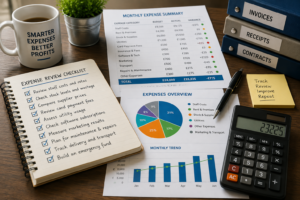
How EPOS Can Help You Control Business Expenses
Your EPOS won’t magically make expenses disappear.
What it can do is give you better information.
For example, a well-configured system can help you understand which products are selling, when your busiest periods occur, what stock is moving slowly and how sales change throughout the week.
That information can support better decisions about stock ordering, staffing and pricing.
Switch & Save provides AI-powered EPOS systems, card payment solutions and business finance for UK retailers, restaurants, cafés, takeaways, bars, grocery shops, mobile shops and other small businesses.
The aim is straightforward: give you clearer information and help your business operate more efficiently.
Don’t Just Look at Your Biggest Expense
One final point.
The biggest cost isn’t always where your biggest saving will come from.
Suppose your rent is £4,000 a month and you’re locked into a lease. There may be very little you can realistically change right now.
But perhaps you’re also losing money through £600 of unnecessary stock, £250 of waste and £150 of unused software every month.
Those smaller expenses are much easier to control.
So don’t only ask:
“What costs us the most?”
Also ask:
“Which costs can we actually improve?”
That’s where expense management becomes useful.
Frequently Asked Questions
What are the biggest expenses for a small business in the UK?
The biggest expenses commonly include staff wages, rent, stock, utilities, card payment costs, insurance, software, marketing, transport and maintenance. The exact mix depends on your sector and business model.
What is usually the biggest expense for a restaurant?
Staff, ingredients, rent and utilities are often major expenses for restaurants. The exact ranking depends on location, menu, staffing model, opening hours and sales volume.
What are the main expenses for a retail shop?
Common retail expenses include stock, rent, employees, business rates, utilities, card payment fees, insurance, EPOS technology, marketing and security.
Are stock purchases a business expense?
Stock and goods bought for resale form part of business costs, although the accounting and tax treatment depends on your business structure and accounting method. Keep accurate purchase and stock records and seek professional advice where necessary.
Which small business expenses are tax deductible?
Many genuine business costs may qualify for tax relief, but the exact rules depend on your circumstances and whether you’re operating as a sole trader, partnership or limited company.
HMRC distinguishes between different types of expenditure, including revenue and capital costs, so don’t assume every payment leaving your business account is automatically deductible.
How can I reduce my business expenses?
Start by reviewing stock waste, staff scheduling, card payment costs, utility arrangements, suppliers, software subscriptions and marketing performance.
Cut expenses that aren’t producing value before reducing anything that could damage customer experience or sales.
How often should I review business expenses?
A monthly review is practical for many small businesses. You should also carry out a deeper review before major contracts such as insurance, utilities, software or payment services renew.
Can an EPOS system help control business costs?
Yes, particularly by improving visibility.
Sales, stock and transaction reporting can help you identify slow products, busy periods, wastage and other areas that may be creating unnecessary costs.
Check Your Potential Savings
Running a business will always cost money.
The objective isn’t to eliminate expenses. It’s to make sure the money you’re spending is supporting the business rather than quietly reducing your profit.
Switch & Save helps UK businesses reduce costs with AI-powered EPOS systems, card payment solutions and business finance.