Choosing the right business bank account in the UK comes down to how your business actually handles money. Look beyond the headline monthly fee and compare transaction charges, cash deposits, card-payment settlements, accounting integrations, access for staff, borrowing options, customer support and how your money is protected.
A café taking hundreds of card payments each week will have different banking needs from a mobile repair shop, online retailer or self-employed tradesperson. The best account is therefore not necessarily the cheapest one. It’s the account that fits the way money moves through your business.
For a limited company, company finances need to be kept separate from the personal finances of directors and owners. Sole traders have more flexibility, although HMRC says you still need accurate records that clearly identify business transactions. You should also check whether your bank allows business activity through a personal account.
Key Takeaways
| Area | What to check |
|---|---|
| Account costs | Monthly fees plus charges for payments, cash and transfers |
| Cash handling | Deposit fees, branch or Post Office access and limits |
| Card payments | How easily card settlements reach your account |
| Accounting | Whether transactions can connect with your bookkeeping software |
| Business structure | Limited companies must keep company banking separate |
| Protection | Whether deposits qualify for FSCS protection or another safeguarding arrangement |
| Access | Mobile banking, online banking and additional user permissions |
| Growth | Overdrafts, lending and other business finance options |
| Support | How quickly you can get help if payments or access fail |
What Is a Business Bank Account?
A business bank account is an account used specifically for your company’s or trading activity’s money.
Customer payments come in, while rent, stock purchases, wages, tax payments, utilities and supplier bills go out. Keeping those transactions together gives you a clearer picture of what your business is actually doing.
That becomes particularly useful at the end of the month.
Instead of scrolling through personal supermarket purchases, household bills and business expenses in the same statement, you can see your trading activity much more clearly.
For businesses running an EPOS system, card machines and accounting software, a dedicated account can also make reconciliation easier.
Reconciliation simply means checking that the money recorded as sales matches the money that actually reached your bank.
Does Every UK Business Need a Business Bank Account?
It depends on your business structure.
Limited companies
A limited company is legally separate from the people who own and manage it. GOV.UK says there must therefore be a clear division between company finances and those of its owners and directors, including separate banking.
So if you’re operating a limited company, don’t run your everyday company income and spending through your personal current account.
Sole traders
A sole trader isn’t legally required to have a separate business bank account.
HMRC does, however, require proper records of sales, income and expenses, and you need to be able to identify your business transactions. HMRC also advises checking with your bank to confirm what type of account can be used for business activity.
In practice, a dedicated account usually makes life easier even when it isn’t compulsory.
Imagine running a busy takeaway. You’ve got card settlements arriving, cash being banked, food suppliers being paid and delivery-platform charges leaving the account.
Keeping that separate from your household spending makes bookkeeping much simpler.
What Should You Look for in a Business Bank Account?
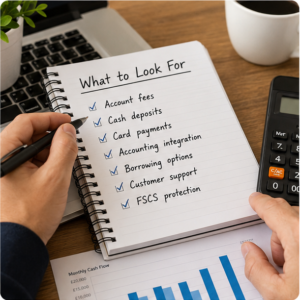
Start with the way your business trades rather than simply searching for the lowest monthly fee.
Ask yourself:
- How much money comes into the account each month?
- Do customers mainly pay by card or cash?
- How often do you pay suppliers?
- Do you deposit cash regularly?
- Do you make international payments?
- Will several employees need banking access?
- Do you need an overdraft or finance?
- What accounting software do you use?
Once you’ve answered those questions, comparing accounts becomes much easier.
1. Compare the Real Banking Fees
A business bank account advertised as “free” isn’t automatically the cheapest.
There may still be charges for individual transactions.
Depending on the account, you could pay for things such as cash deposits, bank transfers, international transactions, cheque deposits or payments above an allowance.
So calculate your likely monthly cost based on your normal trading pattern.
For example, imagine two accounts.
One costs £8 per month with most everyday electronic transactions included. Another has no monthly fee but charges for certain transactions your business makes frequently.
The free account may cost more overall.
This is particularly important for busy retail and hospitality businesses with large numbers of transactions.
2. Think About How You Handle Cash
Not every business is moving towards completely cashless trading.
Convenience shops, grocery stores, takeaways, barbers and local retailers can still handle significant amounts of cash.
If that’s your business, check how the bank handles cash deposits.
Look at where you can deposit money, how much you can deposit, the charge for doing so and how quickly deposited cash becomes available in your account.
A digital-only account may look attractive until you discover that depositing several thousand pounds in weekly takings is awkward or expensive.
On the other hand, an online business that rarely sees physical cash may have little reason to pay extra for branch facilities.
Match the account to your operation.
3. Consider Your Card Payment Setup
If most customers pay by debit card, credit card or contactless payment, your bank account and payment setup need to work smoothly together.
So, what actually happens when a customer taps their card?
The transaction is processed by your payment provider before the funds are settled into your nominated business bank account. Settlement timing and reporting depend on the payment arrangement you’ve chosen.
Your bank doesn’t necessarily need to provide your card machine.
In fact, it can be useful to review your banking and payment-processing costs separately instead of assuming both services have to come from the same provider.
Switch & Save helps UK businesses compare and set up practical card payment solutions for retail, hospitality and other small businesses.
You can also read the Switch & Save guide on why UK businesses switch to card payments.
4. Check Accounting and Bookkeeping Integration
Good banking software can save a surprising amount of admin.
Many business accounts can connect directly with accounting platforms, allowing bank transactions to appear automatically in your bookkeeping records.
That doesn’t remove your responsibility for checking the figures, but it can reduce manual data entry.
For example, a café owner might have sales data from an EPOS system, card-payment settlements arriving in the bank and supplier invoices recorded in accounting software.
The easier those systems are to reconcile, the easier it becomes to understand daily and monthly cash flow.
This is one area where your EPOS setup matters too.
A modern EPOS system can give you clear records of sales, refunds, VAT, product performance and payment types. You can then compare those reports against the money reaching your bank.
Switch & Save provides AI-powered EPOS systems designed to give UK business owners clearer visibility over everyday trading activity.
5. Look at Online Banking and User Access
You’ll probably interact with your business bank account far more often through an app or browser than inside a branch.
Check what you can actually do online.
Can you download statements easily? Can you search older payments? Can you approve transactions from your phone? Can multiple directors have access?
For larger businesses, user permissions become particularly important.
You might want your bookkeeper to see transactions without allowing them to send payments. Or you might want large supplier payments to require approval from two directors.
Think about the controls you’ll need as the business grows, not just what you need on opening day.
6. Consider Overdrafts and Future Finance
You may not need borrowing today, but your requirements could change.
A restaurant might later refurbish its dining area. A grocery shop might need additional refrigeration. A retailer could need extra stock ahead of Christmas.
Check what facilities could potentially be available, such as overdrafts, business credit cards or lending products.
Don’t choose a bank solely because it offers borrowing. Approval will normally depend on eligibility and affordability assessments.
It’s also worth remembering that your bank isn’t your only potential source of business funding.
Businesses with regular card turnover may have other options. Switch & Save supports businesses looking at flexible business finance options, subject to eligibility and the finance provider’s terms.
7. Check How Your Money Is Protected
This part is easy to overlook.
Don’t assume that every provider offering something that looks like a business current account is legally structured in exactly the same way.
Eligible deposits with UK-authorised banks, building societies and credit unions may be protected by the Financial Services Compensation Scheme. As of 2026, the FSCS deposit protection limit is £120,000 per eligible person or company, per authorised firm, not per individual bank brand.
That’s an important distinction.
Some brands operate under the same banking authorisation, which means the protection limit can apply across your combined deposits with those brands.
You should also check whether the provider is actually a bank.
Some payment and electronic-money institutions operate under safeguarding rules rather than direct FSCS deposit protection. The FCA says money held by payment and e-money firms isn’t directly protected by FSCS; relevant customer funds are instead subject to safeguarding requirements.
Before moving a large balance, understand exactly where your money sits and what protection applies.
8. Decide Whether Branch Access Matters
Digital banking is convenient, but branches can still matter.
A restaurant banking cash several times per week has different requirements from a consultancy receiving every payment by bank transfer.
Think about what happens when something goes wrong too.
If your card is blocked, a large payment is stopped or you lose account access during a busy trading week, how will you contact the provider?
Check the available support channels and opening hours.
Low fees don’t feel particularly cheap when you’re unable to access your money and can’t speak to anyone.
Common Mistakes When Choosing a Business Bank Account
One common mistake is focusing only on the monthly account fee.
Another is choosing the same bank you’ve always used personally without checking whether its business services actually suit your company.
Business owners also sometimes forget to compare cash-deposit costs, overseas-payment fees, additional-user access and accounting integrations.
And don’t automatically bundle every financial service together.
Your business bank account, card-payment provider, EPOS system and business finance can be separate services. What matters is whether they work efficiently together.
A Simple Way to Compare Business Bank Accounts
Create a comparison based on your actual monthly activity.
| Question | Your business |
|---|---|
| Monthly incoming payments | £_____ |
| Number of supplier payments | _____ |
| Cash deposited monthly | £_____ |
| Card sales each month | £_____ |
| International payments | _____ |
| Number of account users | _____ |
| Need branch access? | Yes / No |
| Need accounting integration? | Yes / No |
| Need overdraft facilities? | Yes / No |
Then put the charges and features of each account against those numbers.
This produces a much more useful comparison than choosing an account because one fee happens to be lower.
Imagine you run a neighbourhood convenience store.
Most customers pay by card, but you still take cash every day. You pay wholesalers several times each week and your accountant needs monthly transaction records.
Your priorities might therefore be:
- affordable cash deposits
- reliable card-payment settlement
- easy transaction exports
- good accounting integration
- multiple payment options
- strong online banking
- quick access to support
Now compare that with an online retailer.
The online retailer may accept almost no cash, so branch access and cash deposits matter far less. Instead, international payments, integrations and online banking may be more important.
Same question. Very different answer.
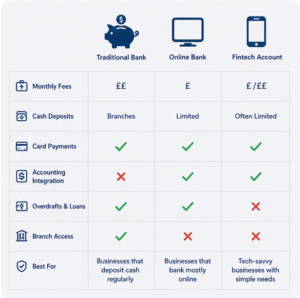
That’s why there isn’t one perfect business account for every UK small business.
Choosing Banking as Part of Your Wider Business Setup
Your bank account is only one part of how money moves through your company.
Sales start with the customer.
Your EPOS records what was sold. Your payment solution processes the transaction. The money reaches your bank. Your accounting records then help you understand revenue, costs, VAT and profit.
When those parts work together properly, managing your business becomes much clearer.
For retail shops, restaurants, takeaways, cafés, bars, grocery stores and mobile shops, it’s worth reviewing the whole payment journey rather than looking at the bank account in isolation.
How Switch & Save Can Help
Switch & Save doesn’t exist to tell you which bank to choose.
Our role is to help make the other parts of your business setup more efficient.
Switch & Save supports UK small businesses with AI-powered EPOS systems, card payment solutions and business finance. That can help you keep clearer sales records, improve payment processes and understand how money is moving through your business.
If you’re already reviewing your banking costs, it’s a good opportunity to review your card-payment, EPOS and finance arrangements at the same time.
Switch & Save helps UK businesses reduce costs with AI-powered EPOS systems, card payment solutions and business finance.
Frequently Asked Questions
What is the best business bank account for a small business?
There isn’t one best business bank account for every small business. The right choice depends on your transaction volume, cash deposits, card sales, international payments, accounting requirements and the level of support you need.
Does a sole trader need a business bank account?
A UK sole trader isn’t generally legally required to open a separate business bank account. However, you must keep accurate business records and identify business transactions. You should also check whether your personal account provider permits business use.
Does a limited company need separate banking?
Yes. A limited company is a separate legal entity and its finances need to remain clearly separate from the personal finances of its owners and directors. GOV.UK specifically states that company banking must be separate from personal banking.
Can I receive card payments into a business bank account?
Yes. Card-payment providers normally settle processed transactions into your nominated business bank account, subject to the provider’s settlement arrangements.
Can I change my business bank account later?
Yes. Businesses aren’t locked into the same banking relationship forever. Before switching, check how the change could affect Direct Debits, standing orders, payroll, supplier payments, card-payment settlements and accounting integrations.
Are business bank accounts protected by FSCS?
Eligible business deposits with qualifying UK-authorised banks, building societies and credit unions can receive FSCS protection. The current limit is up to £120,000 per eligible person or company, per authorised firm. Different rules apply to payment and e-money institutions, so check the provider’s regulatory status and protection arrangements.
Should I choose my bank and card-payment provider together?
Not necessarily. They can be separate providers. Compare each service based on cost, reliability, settlement arrangements, integrations and support rather than assuming they need to come from the same company.