For a small UK business, the real cost of accepting card payments is usually more than the transaction rate shown on an advert or quote.
You may pay a percentage of each sale, but there can also be terminal rental, fixed transaction charges, online payment fees, chargeback costs and other account fees. The exact amount depends on your provider, sales volume, average transaction value, card types and whether customers pay in person or online.
So, if somebody tells you their card rate is 1.2%, that doesn’t necessarily mean accepting £10,000 of card payments will cost exactly £120.
To understand card payment fees for small business, you need to look at the complete monthly cost.
This guide explains what you’re actually paying for, how the fees work and how to compare card payment quotes properly.
Key Takeaways
| Question | Quick answer |
|---|---|
| How much do card payments cost? | It depends on your transaction rate, card mix, sales volume and additional fees. |
| Is the advertised transaction rate the full cost? | Not always. Terminal rental, fixed fees and other charges may apply. |
| What is an interchange fee? | A fee generally paid between the merchant’s acquiring bank and the customer’s card-issuing bank. |
| Are UK interchange fees capped? | Certain domestic UK consumer transactions are capped at 0.2% for debit and 0.3% for credit cards. |
| Is my total merchant fee capped? | No. The interchange cap does not cap your complete merchant service charge. |
| Can different cards cost different amounts? | Yes. Card type, location and payment method can affect processing costs. |
| How should I compare providers? | Compare the total monthly cost against your total card turnover, not just the headline rate. |
How Much Do Card Payments Cost a Small Business?
There isn’t one standard card processing rate that every UK small business pays.
Your cost depends on how your payment agreement is structured.
One business might pay a straightforward percentage on every transaction. Another might pay different rates depending on whether the customer uses a debit card, credit card, commercial card or overseas card.
You may also have monthly charges.
That’s why the better question isn’t:
“What’s the transaction rate?”
It’s:
“What percentage of my total card turnover am I actually losing to payment costs?”
That gives you a much clearer picture.
What Happens When a Customer Pays by Card?
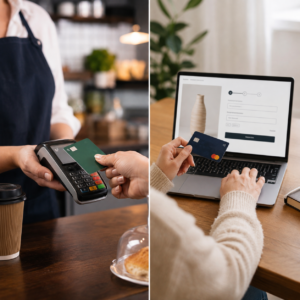
So, what actually happens when a customer taps their card?
Imagine somebody spends £24.50 in your convenience store.
Your card terminal sends the payment request through the payment network. The customer’s bank checks whether the transaction can be approved. Once authorised, the payment moves through the system before the money is settled into your business account.
Several organisations may be involved in making that transaction happen.
The terminology can sound complicated, but you don’t need to become a payments expert.
You simply need to understand that the fee charged to your business can contain several different components.
If you’d like a wider explanation of the different ways customers can pay, see Switch & Save’s guide to card payment options for retail and hospitality.
What Fees Make Up Your Card Payment Costs?
Transaction or processing fees
This is normally the fee businesses notice first.
It may be shown as something like:
X% per transaction
Some agreements may also include a fixed pence charge for each transaction.
For example, imagine your agreement charged 1.4% plus 5p per transaction.
A £10 payment would have both the percentage charge and the fixed 5p charge attached to it.
That fixed fee matters particularly if your business handles lots of low-value transactions.
A café processing hundreds of £3 to £6 payments may therefore need to look at its pricing differently from a furniture shop processing fewer transactions at much higher values.
Terminal rental
Some card machines are purchased outright. Others are supplied under a monthly rental agreement.
You might therefore pay a monthly fee for each terminal.
If you run a restaurant with three portable card machines, make sure you’re comparing the total cost for all three devices.
Merchant service charge
The merchant service charge, often shortened to MSC, is the amount charged to a merchant for accepting card payments.
It can include several underlying payment costs.
The Payment Systems Regulator explains that interchange fees usually form part of the merchant service charge paid by the retailer.
Scheme and processing fees
Card payment networks can also charge scheme and processing fees.
Scheme fees relate to participation in a card scheme, while processing fees can relate to activities such as authorisation, clearing and settlement.
These costs have also received regulatory attention in the UK. The Payment Systems Regulator’s card scheme and processing fee market review was updated in July 2026.
Online payment fees
Taking a card through a website can be priced differently from accepting the same card through a physical terminal.
You may have:
- online transaction charges
- payment gateway fees
- monthly ecommerce fees
- different rates for card-not-present transactions
If your takeaway receives half of its payments online and half at the counter, don’t assume the same rate applies to every transaction.
Chargeback fees
A chargeback happens when a cardholder disputes a transaction and the payment is challenged through the card system.
Depending on your agreement, you may face an administration fee as well as potentially losing the original sale.
Other possible charges
Depending on the provider and agreement, you may also come across fees relating to PCI compliance, refunds, minimum monthly service levels, paper statements, additional terminals or ending a contract early.
These charges aren’t universal.
That’s exactly why reading the full pricing schedule matters.
What Is an Interchange Fee?
Interchange is one of the most misunderstood parts of card processing.
In simple terms, an interchange fee is generally paid by the merchant’s acquiring payment provider to the bank that issued the customer’s card.
For qualifying domestic UK consumer transactions, the UK Interchange Fee Regulation currently caps interchange at:
| Card type | Interchange cap |
|---|---|
| Consumer debit card | 0.2% |
| Consumer credit card | 0.3% |
These limits apply where the relevant UK regulatory conditions are met.
Here’s the important part.
That does not mean your card payment provider can only charge you 0.2% or 0.3%.
Interchange is only one component of the overall cost.
The Payment Systems Regulator specifically notes that the regulation caps certain interchange fees but does not cap the complete merchant service charge paid by businesses.

Why Do Card Payment Rates Vary?
Two businesses taking the same monthly card turnover can have different card processing costs.
Several factors can affect the final price.
Debit versus credit cards
Different card categories can carry different underlying costs.
Your actual card mix therefore matters.
Consumer versus commercial cards
A company card used by a business customer may not be priced the same way as an ordinary UK consumer debit card.
UK versus international cards
Overseas cards can create different costs.
Following the UK’s withdrawal from the EU, certain cross-border transactions are outside the domestic interchange caps.
Card-present versus online payments
A customer tapping a physical card machine is a different payment environment from somebody entering their card details on a website.
The pricing can therefore differ.
Your transaction volume
A business processing substantial monthly card turnover may have a different commercial agreement from a new business processing a relatively small amount.
Average transaction value
The average value of each payment matters when fixed transaction charges apply.
A 5p charge is insignificant on a £200 payment.
It’s much more noticeable on a £2.50 transaction.
What Do Card Payment Fees Look Like in Practice?
Here are three simplified examples.
These are illustrations, not typical market rates or Switch & Save quotations.
Example 1: Independent café
Imagine a café processes:
£12,000 per month in card payments
If its illustrative blended transaction rate were 1.5%, the transaction cost would be:
£180
Add £20 of terminal or account charges and the total becomes:
£200 per month
Its effective payment cost would therefore be approximately:
1.67% of card turnover
Example 2: Convenience store
Now imagine a grocery shop processes:
£30,000 per month
At an illustrative 1.2% processing cost:
£360
Add £30 in other monthly costs:
£390 total
Effective cost:
1.30%
Example 3: Takeaway with online orders
Imagine a takeaway processes £20,000 of card payments:
- £14,000 in person at an illustrative 1.4%
- £6,000 online at an illustrative 1.9%
- £20 in additional payment-related charges
That would produce:
£196 + £114 + £20 = £330
Effective total cost:
1.65% of card turnover
This is why simply asking for “the card rate” can be misleading.
How to Calculate Your Real Card Payment Cost
The easiest way is to look at a complete month.
Take your:
Total card processing costs ÷ Total card turnover × 100
For example:
Card turnover: £25,000
Total card-related fees: £400
£400 ÷ £25,000 × 100 = 1.6%
Your effective card payment cost is therefore 1.6%.
Include every relevant cost you can identify, rather than using only the percentage transaction fee.
Once you’ve calculated this number, you have something meaningful to compare.
Hidden Card Machine Charges to Check

Before signing a card payment agreement, ask for the complete pricing schedule.
Pay particular attention to:
- terminal rental
- minimum monthly charges
- fixed transaction charges
- authorisation fees
- PCI-related charges
- chargeback fees
- refund charges
- international card pricing
- commercial card pricing
- online payment fees
- additional terminal costs
- contract length
- early termination charges
You don’t necessarily need the provider with the lowest advertised percentage.
You need the arrangement that gives your business the best overall combination of cost, reliability, settlement, support and payment functionality.
Switch & Save has a more detailed guide to choosing card payment solutions for UK small businesses.
Can You Charge Customers Extra for Paying by Card?
Usually, you shouldn’t assume you can simply add a card fee at checkout to recover your processing costs.
UK rules prohibit surcharges for many common consumer payment methods, including card payments covered by the relevant rules. The restrictions have applied since January 2018.
For most ordinary retail, café, restaurant and takeaway transactions, building payment costs properly into your overall business pricing and margins is a safer approach than attempting to add a separate consumer card charge.
How Can a Small Business Reduce Card Payment Costs?
You don’t necessarily need to stop taking cards or push customers towards cash.
Instead, understand your current numbers.
Start by collecting three months of merchant statements.
Work out:
- Your total card turnover.
- Your total payment-related fees.
- Your effective processing percentage.
- How much you’re paying in fixed monthly charges.
- Whether certain card types are costing significantly more.
- Whether you’re still paying for terminals you don’t need.
Then compare alternative arrangements on exactly the same transaction profile.
For example, if one quote says 1.1% and another says 1.3%, don’t automatically choose 1.1%.
The first option may have higher terminal fees or additional charges that make it more expensive overall.
Can EPOS Integration Reduce Payment Problems?
Integration doesn’t automatically make the underlying payment processing rate cheaper.
But it can make the payment process more efficient.
With an integrated EPOS and card terminal, the till can send the transaction amount directly to the card machine.
If a customer’s restaurant bill is £46.80, your employee doesn’t need to manually enter £46.80 into the terminal.
That can reduce manual keying mistakes and make it easier to reconcile card transactions against EPOS sales.
For hospitality businesses, our guide to integrated card payments for restaurants explains the process in more detail.
When Should You Review Your Card Payment Provider?
Don’t wait until there’s a major problem.
Review your arrangement when:
- your contract is approaching renewal
- your card turnover has increased significantly
- your business has opened another location
- you’re adding online ordering
- you need more terminals
- your payment fees aren’t easy to understand
- your EPOS and card terminal don’t integrate
- you’re experiencing unreliable equipment or support
If you’re already considering changing your setup, read our guide to switching card machine providers in the UK before making the move.
Look Beyond the Headline Rate
The cheapest-looking card payment quote isn’t always the cheapest agreement.
A difference of a few tenths of a percentage point matters, particularly as your turnover grows. But the real decision should still be based on your complete cost.
Look at what leaves your bank account.
Look at how much card turnover you processed.
Then calculate the effective percentage.
Once you’ve done that, comparing card payment fees becomes much easier.
You can also explore the current Switch & Save card machine options if you’re reviewing your existing payment setup.
How Switch & Save Can Help
Switch & Save works with UK businesses across retail, hospitality, takeaways, cafés, restaurants, bars, grocery shops and other small-business sectors.
Rather than looking only at the card machine sitting beside your till, it makes sense to consider your wider setup.
That includes how you process payments, how your EPOS records sales, how easily your team can reconcile transactions and what the entire system costs your business.
Switch & Save provides AI-powered EPOS systems, card payment solutions and access to business finance options for eligible businesses.
Check Your Potential Savings
Switch & Save helps UK businesses reduce costs with AI-powered EPOS systems, card payment solutions and business finance. Check your savings today.
Frequently Asked Questions
How much do card payments cost a small business in the UK?
There is no single standard rate. Your cost depends on your payment provider, transaction volume, average transaction size, card mix, payment channel and additional fees such as terminal rental. The best approach is to calculate your total monthly card costs as a percentage of your monthly card turnover.
What are card payment processing fees?
Card payment processing fees are the charges associated with accepting debit and credit card payments. They can include transaction charges, interchange, scheme and processing costs, terminal rental and other account-related charges.
What is the difference between an interchange fee and a transaction fee?
Interchange is an underlying fee generally transferred between the acquiring side of the transaction and the bank that issued the customer’s card. Your transaction or merchant fee is what your payment provider charges your business and can include interchange alongside other costs.
Are debit card fees cheaper than credit card fees?
They can be, but your final merchant cost depends on the pricing structure agreed with your payment provider. Certain qualifying domestic UK consumer interchange fees are capped at 0.2% for debit and 0.3% for credit, but those caps don’t represent the total amount your business necessarily pays.
Does every card transaction cost the same?
Not necessarily. Costs can vary according to card type, where the card was issued, whether it’s a consumer or commercial card and whether the transaction happens in person or online.
Should I choose the card provider with the lowest percentage?
Not automatically. Compare the total expected cost, including fixed transaction charges, terminal costs, monthly fees and any other relevant charges.
How can I tell whether I’m paying too much for card payments?
Calculate your effective rate by dividing your total monthly payment processing costs by your monthly card turnover and multiplying the answer by 100. Then use the same transaction profile when comparing alternative quotes.
Do integrated card payments save money?
Integration doesn’t automatically reduce the processing percentage, but it can reduce manual work and keying errors by sending the correct sale amount directly from your EPOS to the terminal.
Can a UK business charge customers extra for paying by card?
Surcharging is prohibited for many common consumer card payments under UK rules. Businesses shouldn’t assume they can simply add a card-processing fee at checkout.