If you accept debit or credit cards, the real cost is rarely just the transaction percentage advertised by your payment provider.
Card payment fees for a small business can include transaction charges, card terminal rental, processing fees, authorisation charges, PCI-related fees, online payment gateway costs, chargeback fees and contract costs. What matters is the total amount you pay compared with your monthly card turnover, not simply the headline transaction rate.
For example, a business processing £20,000 per month at an illustrative 1.2% transaction rate would pay £240 in transaction charges alone. Add a £20 terminal rental and £10 of other monthly charges, and the actual monthly cost becomes £270.
That’s why two card payment quotes with very similar-looking rates can produce very different bills.
Key Takeaways
| Question | Direct answer |
|---|---|
| What are card payment fees? | The charges your business pays to accept debit, credit and other card-based payments. |
| Is the transaction rate the total cost? | Usually not. Terminal rental and other service charges may apply. |
| What should businesses compare? | Transaction rates, fixed charges, terminal costs, contract terms, card types and total monthly cost. |
| Are debit and credit cards always charged the same? | No. Costs can vary depending on card type, transaction type and pricing structure. |
| Can international or commercial cards cost more? | They can. Always check your provider’s pricing for different card categories. |
| What’s the easiest comparison method? | Calculate your total monthly payment costs as a percentage of monthly card turnover. |
| Can integrated EPOS payments help? | They can reduce manual entry and make payment reconciliation easier. |
How Much Do Card Payments Cost a Small Business?
There isn’t one universal rate for UK businesses.
Your cost depends on factors including:
- Monthly card turnover
- Average transaction value
- Debit versus credit card usage
- Consumer versus commercial cards
- UK versus international cards
- Face-to-face versus online payments
- Number of card terminals
- Pricing model
- Contract terms
A café processing £10,000 per month won’t necessarily receive the same pricing as a supermarket processing £100,000.
Volume matters, but it isn’t the only factor.
The best way to understand your cost is to calculate everything you pay to accept cards over a month or year rather than focusing on one percentage printed at the top of a quotation.

What Actually Makes Up a Card Payment Fee?
So, what actually happens when a customer taps their card?
The payment appears almost instant from the customer’s point of view, but several organisations are involved behind the scenes.
Your payment provider processes the transaction through the relevant payment infrastructure before the money reaches your business.
There are several underlying costs.
Interchange fee
An interchange fee is generally paid by the merchant’s acquiring bank to the bank that issued the customer’s card.
For eligible domestic UK consumer transactions, the UK Interchange Fee Regulation currently caps interchange at 0.2% for consumer debit cards and 0.3% for consumer credit cards.
However, this is important: those percentages are not the same as the transaction rate your business will necessarily pay.
Interchange is only one component of card acceptance costs.
Scheme and processing fees
Card schemes also charge fees connected with operating and processing card transactions.
The Payment Systems Regulator has examined these charges closely. Its 2025 market review found that core scheme and processing fees charged to acquirers had increased by at least 25% since 2017 and also highlighted problems with the complexity and transparency of card fee information.
Acquirer or payment provider charge
Your payment provider also needs to cover its own service and processing costs.
Depending on your agreement, these costs might be combined into a single transaction rate or shown separately.
That brings us to the number most businesses actually see.
Card Transaction Fees Explained
Your card transaction fee is normally charged as a percentage of each card payment.
Imagine a customer spends £50.
At an illustrative transaction rate of 1.2%:
£50 × 1.2% = £0.60
Your processing cost on that transaction would therefore be 60p.
If 400 similar transactions were processed during the month:
400 × £50 = £20,000 card turnover
Transaction charges would be:
£20,000 × 1.2% = £240
These figures are examples rather than a suggested market rate. Your actual rate depends on your provider and contract.
Flat or blended pricing
Some payment services charge one simple percentage across many transactions.
It’s easy to understand because you can estimate your costs quickly.
For a business processing £15,000 at an illustrative 1.3% rate:
£15,000 × 1.3% = £195
Simple.
The trade-off is that the simplified rate may not reflect the actual underlying cost of every individual card type.
More detailed pricing
Other merchant agreements separate costs according to factors such as interchange, card scheme charges and the provider’s margin.
This can make statements harder to read, but it gives you more detail about where your money is going.
Neither pricing model should automatically be considered cheaper.
Compare the final cost using your actual sales pattern.
How Much Does a Card Machine Cost?
Card terminal costs are another part of the calculation.
Depending on your agreement, you might:
- Rent the terminal monthly
- Purchase hardware upfront
- Receive the terminal as part of a wider payment package
- Pay separately for additional terminals
A restaurant may need several portable terminals for table payments, while a small grocery shop might need only one countertop machine.
That difference can change your monthly cost considerably.
Suppose your transaction fees total £260 and you pay £25 monthly for your terminal.
Your real payment cost is already:
£260 + £25 = £285
Not £260.
If you’re considering a new payment setup, our guide to card payment solutions for UK shops explains the main terminal and payment options available to businesses.
Other Card Payment Charges You Should Compare
The headline rate attracts attention, but smaller charges can add up.
Before signing an agreement, check whether any of the following apply.
Authorisation or processing charges
Some pricing structures may contain a fixed charge for processing or authorising individual transactions.
For businesses with a large number of low-value purchases, per-transaction charges deserve particular attention.
Minimum monthly service charges
Some agreements may require you to pay at least a certain amount each month.
This can matter for seasonal businesses or businesses with low card turnover.
PCI-related charges
PCI DSS stands for Payment Card Industry Data Security Standard.
It’s a security framework designed to protect cardholder information. Depending on your payment arrangement, fees or administration charges connected with compliance may appear on your bill.
Refund charges
Don’t assume a refund automatically reverses all the original processing costs.
Check how your provider handles refunded transactions and whether additional charges apply.
Chargeback fees
A chargeback happens when a cardholder disputes a payment and the transaction is challenged through the card payment process.
Providers may charge for managing these disputes.
If chargebacks are common in your type of business, check the terms carefully.
Early termination charges
A cheap transaction rate isn’t particularly helpful if you’re locked into an unsuitable contract with expensive exit terms.
The Payment Systems Regulator has previously identified contract and terminal arrangements as factors that can make it harder for smaller merchants to switch providers.
Always check:
When does the agreement end, and what happens if you leave early?
Online payment gateway costs
If you sell through a website, online ordering platform or payment link, additional gateway or card-not-present charges may apply.
This means your online payment cost might differ from payments taken through a physical card machine.
Card Payment Cost Examples for Small Businesses
Let’s make the numbers more practical.
These are illustrative examples, not quoted Switch & Save rates.
Example 1: Independent café
Monthly card turnover: £18,000
Illustrative transaction rate: 1.25%
Transaction fees:
£18,000 × 1.25% = £225
Terminal and other monthly charges: £28
Total:
£253 per month
The transaction percentage wasn’t the full story. The effective monthly payment cost is roughly:
£253 ÷ £18,000 × 100 = 1.41%
Example 2: Busy takeaway
Monthly card turnover: £35,000
Illustrative transaction rate: 1.05%
Transaction costs:
£367.50
Terminal and other charges: £40
Total:
£407.50 per month
Effective cost:
£407.50 ÷ £35,000 × 100 = 1.16%
Example 3: Why the lowest percentage isn’t always cheapest
Imagine a retailer processing £25,000 per month.
Quote A
Transaction rate: 1.20%
Other charges: £20
Total:
£300 + £20 = £320
Quote B
Transaction rate: 1.00%
Other charges: £75
Total:
£250 + £75 = £325
Quote B has the lower headline transaction rate but costs more overall.
That’s exactly why you should compare the full bill.
The Simple Formula Every Business Owner Should Use
When comparing card payment fees for small business, calculate your effective payment rate:
Total monthly card acceptance costs ÷ monthly card turnover × 100
Suppose you process £40,000 per month and all your payment-related charges total £440.
£440 ÷ £40,000 × 100 = 1.10%
You now have one number that reflects the overall cost much better than the advertised transaction rate alone.
Do the same calculation for every quote.
Better still, compare costs across a full year if your sales are seasonal.
How Can You Reduce Card Payment Fees?
You don’t necessarily need to stop accepting cards or encourage customers back towards cash.
Start by understanding your existing bill.
Use your actual card turnover
Don’t ask for a generic quotation if you already have trading history.
Provide realistic monthly card turnover and, where possible, transaction information. It gives you a better basis for comparing your current setup against another offer.
Review your agreement regularly
Card payment contracts shouldn’t simply disappear into a filing cabinet.
Check:
- Current transaction rate
- Monthly terminal costs
- Extra charges
- Contract expiry
- Exit terms
- Number of terminals
- Settlement arrangement
The PSR’s card-acquiring review found that many smaller merchants don’t regularly search, switch or negotiate even though better outcomes may sometimes be available.
Remove terminals you don’t need
If you’re paying monthly for four terminals but only regularly using three, the spare device could be creating unnecessary cost.
Review what your staff actually use.
Compare total annual cost
Saving 0.1 percentage points sounds small.
But the impact grows with card turnover.
At £50,000 monthly card turnover:
0.1% = £50 per month
Over 12 months:
£600
Small differences become more meaningful as your business grows.
Should Your Card Machine Integrate With Your EPOS?
Payment cost isn’t the only thing worth considering.
The way the card terminal connects to your till can affect day-to-day operations too.
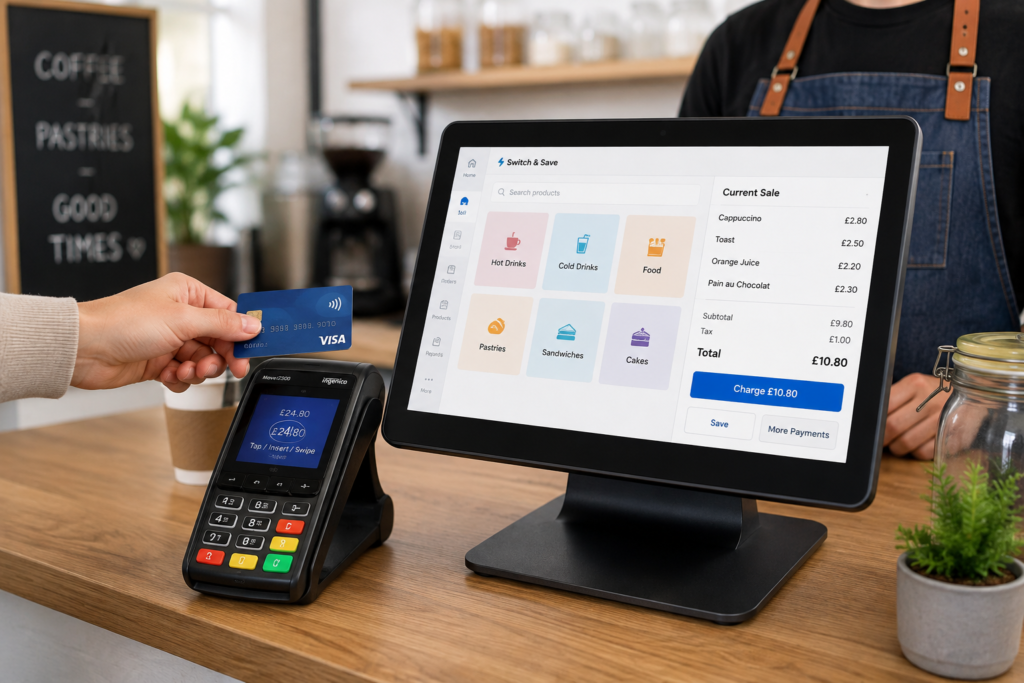
With a non-integrated setup, a staff member may enter £24.80 into the EPOS and then manually type £24.80 into the card terminal.
With integrated payments, the EPOS can send the payment amount directly to the terminal.
That can reduce manual keying and make it easier to match till records with completed card transactions.
For a café processing hundreds of orders, a takeaway working through a Friday-night rush or a restaurant taking payments at tables, that operational difference matters.
You can read more in our guide to integrated card payments for restaurants or our explanation of how modern EPOS systems work.
If you’re deciding between different ways of taking payments, our guide to contactless payments also explains what happens when customers tap a card, smartphone or smartwatch.
How Switch & Save Can Help
The cheapest-looking card processing quote isn’t always the cheapest once everything is included.
That’s why it makes sense to look at your payment setup as a whole.
Switch & Save works with UK retailers, cafés, restaurants, takeaways, bars, grocery shops and other small businesses.
We can help you review your card payment setup alongside your EPOS requirements, rather than treating payments and the till as completely separate systems.
Our solutions include AI-powered EPOS, integrated payment options, stock and sales reporting and business finance solutions.
You can also explore the Switch & Save EPOS and payment solutions to see how the wider system fits together.
Check Your Potential Savings
Switch & Save helps UK businesses reduce costs with AI-powered EPOS systems, card payment solutions and business finance.

Frequently Asked Questions
How much are card payment fees for a small business in the UK?
There isn’t one fixed fee. Your total cost can include transaction percentages, terminal rental, processing costs and other account or service charges. The exact amount depends on your turnover, transaction mix, card types, terminals and contract.
What percentage do businesses pay for card transactions?
Your merchant rate depends on your provider and agreement. Don’t confuse your quoted merchant rate with interchange fees. Eligible UK domestic consumer interchange is currently capped at 0.2% for debit cards and 0.3% for credit cards, but interchange is only one part of the overall cost of accepting a payment.
Are debit card payments cheaper than credit cards?
They can be, but not every payment agreement prices them separately. Some providers use blended pricing, while others charge according to card type and underlying costs.
Check your actual merchant statement rather than assuming every debit or credit transaction costs the same amount.
Do businesses have to pay monthly for a card machine?
It depends on the payment arrangement. Some terminals are rented monthly, some are purchased, and others form part of a wider package. Compare the hardware cost alongside transaction charges.
Are international cards more expensive to accept?
They can be. Cross-border transactions aren’t always covered by the same interchange caps as eligible UK domestic consumer card payments, so the underlying cost can differ.
What hidden card machine fees should I look for?
Check for terminal rental, fixed transaction charges, minimum monthly fees, PCI-related fees, payment gateway charges, chargebacks, refunds, additional terminal fees and early termination charges.
How can I tell whether I’m paying too much for card payments?
Start with your effective rate:
Total card payment costs ÷ total card turnover × 100
Then compare that figure against alternative quotations using the same sales volume and card mix.
Don’t compare headline percentages alone.
Is an integrated card machine worth it?
For businesses with regular transactions, integration can make checkout and reconciliation easier because the EPOS sends the payment amount directly to the terminal. This reduces manual entry and gives your payment and sales records a closer connection.