
Starting a dropshipping business in the UK means selling products online without keeping the stock yourself. When a customer places an order, you send the order details to your supplier, and the supplier ships the product directly to the customer.
It can be a relatively lean way to start an ecommerce business because you don’t need to buy hundreds of products before making your first sale. But dropshipping isn’t completely hands-off. You’re still responsible for your customers, pricing, returns, taxes, product safety and the overall buying experience.
If you’re starting from scratch, this guide explains how dropshipping works in the UK, the legal and tax points to understand, how to choose suppliers and how to work out whether your idea can actually make money.
Key Takeaways
| Area | What You Need to Know |
|---|---|
| Business model | You sell products without normally holding the stock yourself |
| Legality | Dropshipping is legal in the UK, provided you follow relevant business, tax, consumer and product rules |
| Business structure | Many people start as sole traders, although a limited company may suit some businesses |
| Suppliers | Delivery speed, product quality and communication matter as much as wholesale price |
| Consumer rights | Your customer buys from you, not your supplier |
| VAT | UK VAT registration is generally compulsory once taxable turnover exceeds £90,000 |
| Profitability | Calculate product, delivery, transaction, advertising, refund and other operating costs before choosing a product |
| Biggest risk | Poor suppliers can create delivery, quality and customer service problems that your business has to resolve |
What Is a Dropshipping Business?
Dropshipping is an ecommerce fulfilment model.
Instead of ordering stock, storing it in your home or warehouse and posting every order yourself, you work with a supplier that holds the products.
Here’s how it works.
A customer visits your website and buys a product for £35. You then purchase that product from your supplier for £18. The supplier packages it and sends it directly to your customer.
The difference between your selling price and your overall costs contributes towards your profit.
Notice the words overall costs.
If the product costs £18 and you sell it for £35, you haven’t automatically made £17 profit. You may still have payment processing costs, advertising costs, website fees, delivery charges, refunds and tax to account for.
That’s why successful dropshipping is less about finding the cheapest possible product and more about understanding the numbers behind every order.
Is Dropshipping Legal in the UK?
Yes. Dropshipping is legal in the UK.
There isn’t a special licence simply for operating a dropshipping business. However, the normal rules that apply to UK businesses and online retailers still apply to you.
For example, online sellers need to provide customers with information including their business details, product descriptions, prices, payment arrangements and delivery information. UK distance-selling rules also give consumers cancellation rights for many online purchases.
Product safety matters too. Depending on your role in the supply chain, responsibilities can apply to manufacturers, importers and distributors placing or supplying goods on the UK market.
That’s particularly important if your supplier is outside the UK.
Selling an electrical product, cosmetic, toy or children’s product, for example, may involve requirements that don’t apply to something simpler such as a notebook.
If you’re completely new to running a business, our guide to starting a small business in the UK covers the wider setup process.
How Does Dropshipping Work in Practice?
Imagine you create an online shop selling desk accessories.
You list a laptop stand for £39.99.
A customer in Manchester orders one and pays you £39.99.
Your website records the sale and you place an order with your supplier. Perhaps the supplier charges you £20 including delivery.
The supplier then ships the laptop stand directly to your customer.
From the customer’s point of view, however, they bought the product from your business.
If the parcel doesn’t arrive, the wrong product is sent or the item is faulty, telling the customer to sort it out with your supplier isn’t a good solution.
You need processes for dealing with the problem.
This is why supplier reliability matters so much.
How to Start a Dropshipping Business in the UK
1. Choose a Product Area
Don’t begin by uploading thousands of random products.
Start with a defined customer and product category.
You might sell:
- Home organisation products
- Pet accessories
- Desk and home-office accessories
- Travel accessories
- Kitchen storage products
- Gardening accessories
Try to understand why somebody would buy from your website rather than from a large marketplace.
Perhaps your product selection is better. Maybe you’ve built useful content around a particular niche. You could offer faster UK delivery, bundles or stronger customer support.
You need some reason for the business to exist beyond simply adding a margin to somebody else’s product.

2. Research Demand Before Spending Heavily
It’s easy to become excited by a product because another seller appears to be doing well.
That doesn’t mean you should immediately spend £2,000 advertising it.
Check search demand, marketplace activity, customer reviews, typical selling prices and the number of competing sellers.
Read negative reviews too.
They can be surprisingly useful.
If customers repeatedly complain that similar products break after a month, arrive damaged or take three weeks to arrive, you’ve discovered something important before putting your own name behind the product.
3. Decide How You’ll Structure the Business
You can operate a dropshipping business as a sole trader or through a limited company.
A sole trader structure is often simpler when testing a new business idea. However, you and the business aren’t legally separate.
A limited company is a separate legal entity and comes with additional administrative responsibilities.
If you’re considering the simpler route first, read our complete guide to becoming a sole trader in the UK.
HMRC says people buying goods with the intention of reselling them for profit are likely to be trading. If your total gross trading income exceeds the £1,000 trading allowance during the tax year, you may need to tell HMRC about that income.
4. Find Reliable Dropshipping Suppliers
Your supplier can make or break the business.
Don’t choose one simply because its wholesale price is 50p cheaper.
Ask about:
Delivery times. If your website promises three-day delivery but your supplier regularly takes two weeks, you’ll spend a lot of time answering unhappy emails.
Stock accuracy. You don’t want customers buying products that your supplier stopped stocking last week.
Returns. Find out exactly where unwanted or faulty products need to be returned.
Packaging. Ideally, customers shouldn’t receive packaging covered with another retailer’s branding or an invoice showing the supplier’s price.
Product quality. Order samples yourself before selling anything.
Use the product exactly as a customer would. Look at the packaging, instructions, finish and delivery experience.
If you wouldn’t be comfortable selling it to somebody face to face, don’t hide behind an online store and sell it there.
5. Build Your Online Store
You now need somewhere to take orders.
That could be your own ecommerce website or an established online marketplace.
Your store should make the basics immediately clear:
- What the product is
- What it costs
- When customers should receive it
- What your returns policy is
- How customers can contact you
- Who operates the business
UK online-selling rules require businesses to provide specified information to customers, including business contact details, pricing and delivery arrangements.
Don’t copy product descriptions directly from your supplier either.
Apart from possible copyright concerns, you’ll end up with the same generic description as dozens of other shops.
Write for your own customer.
6. Calculate Your Real Selling Price
This is one of the most important steps.
Suppose you sell an item for £40.
Your costs might look something like this:
| Cost | Example |
|---|---|
| Supplier product cost | £18 |
| Delivery | £4 |
| Payment costs | £1 |
| Average advertising cost per sale | £7 |
| Allowance for returns/other costs | £2 |
| Remaining contribution | £8 |
These figures are only an example, but they show why looking at the supplier price alone can be misleading.
And don’t forget VAT if your business becomes liable for it.
UK businesses generally need to register for VAT when taxable turnover exceeds £90,000. Voluntary registration below that level is also possible.
Dropshipping goods from overseas can introduce additional VAT and customs considerations. The treatment can depend on where goods are located, their consignment value and whether sales are made directly or through an online marketplace.
Speak to an accountant or HMRC if you’re unsure how these rules apply to your particular supply chain.
7. Set Up Payments and Financial Records
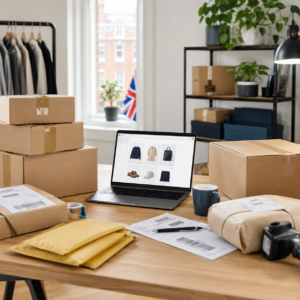
You need a reliable way to take customer payments and clear records showing what you’ve sold and what you’ve spent.
Keep track of:
Sales, refunds, supplier payments, advertising, website charges, delivery costs, transaction charges and other business expenses.
As order volume grows, trying to reconstruct everything from bank statements at the end of the year becomes painful.
Our guide to the reports a new business should track from day one explains some of the figures worth monitoring from the beginning.
If you’re planning to combine your ecommerce business with a physical shop, showroom or collection point, an EPOS system can also bring in-person sales, payments, stock and reporting together.
8. Test Before You Scale
You don’t need 500 products on day one.
Try ten.
See which products receive clicks, which generate sales and which produce customer service problems.
You might discover that one product produces plenty of revenue but also creates a high number of refunds. Another may sell slightly less but leave you with better margins and fewer problems.
The second product could be much more valuable to your business.
Track what actually happens rather than making decisions based purely on sales revenue.
How Much Does It Cost to Start Dropshipping in the UK?
There isn’t one fixed dropshipping start-up cost.
Your main expenses may include:
A domain name, ecommerce platform, product samples, advertising, branding, payment processing, accounting software and potentially professional advice.
The attraction of dropshipping is that you normally don’t have to purchase large quantities of stock before launching.
But that doesn’t mean you should expect to start a serious business for nothing.
A sensible approach is to keep your initial setup lean, test several products with controlled spending and invest more once you’ve found evidence that customers actually want what you’re selling.
What Makes a Good UK Dropshipping Supplier?
A good supplier isn’t simply the company offering the lowest unit price.
Look at the complete customer experience.
Fast UK dispatch can be particularly valuable. A product costing £2 more from a UK warehouse may sometimes make more commercial sense than a cheaper product taking several weeks to arrive from overseas.
Communication matters too.
What happens when something goes wrong? Can you actually reach the supplier?
Before launching, test how quickly they respond to questions and how they handle a sample return.
Your customer’s opinion of the supplier eventually becomes their opinion of your business.
Common Dropshipping Mistakes to Avoid
One common mistake is choosing products purely because they’re trending on social media.
Trends can disappear quickly.
Another is promising unrealistic delivery times. If your supplier normally delivers within seven to ten working days, don’t advertise next-day delivery and hope for the best.
Poor margin calculations can be equally damaging.
A store can generate plenty of orders while still losing money if advertising, refunds and payment costs consume the margin.
Finally, don’t ignore after-sales service.
Dropshipping removes the need to pack every parcel yourself. It doesn’t remove the need to look after the person who bought it.
Can Dropshipping Actually Be Profitable in the UK?
Yes, a dropshipping business can be profitable, but the business model itself doesn’t guarantee profit.
Your results depend on product selection, selling price, customer acquisition costs, supplier costs, delivery performance, refunds and operating expenses.
Rather than asking, “How much can I make from dropshipping?”, ask:
How much money remains from each order after every realistic cost has been included?
That number tells you far more.
For example, 1,000 monthly orders producing £2 of genuine contribution each may be less attractive than 300 orders producing £12 each.
Revenue looks impressive on a screenshot. Margin pays the bills.
How Switch & Save Can Support a Growing Ecommerce Business
A pure online dropshipping store may not need a traditional till system.
But some ecommerce businesses eventually move beyond online-only selling.
You might open a small retail unit, attend exhibitions, add click-and-collect or begin selling products directly from a showroom.
That’s where having connected payment, sales and reporting systems becomes more useful.
Switch & Save works with UK businesses on AI-powered EPOS systems, card payment solutions and business finance, helping owners understand their operating costs and choose technology that fits the way they trade.
If you’re preparing to take payments in person as well as online, our guide on setting up card payments before opening day is a useful next read.
You can also read our guide on whether you can get a card machine without a business bank account if you’re still organising the financial side of your new business.

Frequently Asked Questions
Is dropshipping legal in the UK?
Yes. Dropshipping is legal in the UK. However, you still need to comply with applicable business, tax, consumer protection, online-selling and product safety requirements.
Do I need to register a company for dropshipping?
Not necessarily. You can operate as a sole trader instead of forming a limited company. The right structure depends on your circumstances, risk and plans for the business.
Do I need to tell HMRC about dropshipping income?
Potentially, yes. If you’re buying products with the intention of reselling them for profit, you’re likely to be trading. HMRC says you may need to report trading income once total gross trading income exceeds the £1,000 trading allowance for the tax year.
Do I need to register for VAT when dropshipping?
UK VAT registration is generally compulsory once your VAT-taxable turnover exceeds £90,000. Different VAT rules can also apply when goods are supplied from overseas, so check your individual arrangement rather than relying only on the standard threshold.
Can I dropship products from overseas suppliers to UK customers?
Yes, but you need to understand delivery times, VAT, customs, product compliance and returns before doing so. Rules can depend on where the goods are located and how they’re sold.
Can I start dropshipping with no money?
Dropshipping can reduce the amount of money you need for stock, but running the business still has costs. You may need to pay for a website, domain, product samples, advertising, payment processing and other operating expenses.
Do I need to hold stock when dropshipping?
Usually not. That’s the main difference between traditional ecommerce fulfilment and dropshipping. Your supplier normally stores and dispatches the products on your behalf.
Is dropshipping worth starting in 2026?
It can be, particularly if you’ve found a clear niche, reliable supplier and workable margin. Avoid treating dropshipping as a shortcut to easy income. It’s still a retail business, and customers expect reliable products, delivery and support.
Starting a dropshipping business in the UK can be a practical way to test an ecommerce idea without investing heavily in stock.
The basic model is simple: find a product, market it, take the customer’s order and have your supplier fulfil it.
Running it well takes more work.
Choose suppliers carefully, understand your legal responsibilities, calculate your actual margins and keep accurate financial records from your first sale.
Most importantly, remember that your supplier might send the parcel, but your customer has chosen to buy from you.
Treat the business that way from day one.
Ready to Reduce Your Business Costs?
Switch & Save helps UK businesses reduce costs with AI-powered EPOS systems, card payment solutions and business finance.