To starea, understand your customers, prepare a business and cash-flow plan, choose a legal structure, register for the correct taxes, obtain any required licences, arrange payments and operational systems, and keep enough working capital available for your first months of trading.
Most UK businesses begin as either a sole trader or a limited company. The right option depends on your expected income, personal liability, tax position, funding plans and administrative responsibilities. plains how to launch a small business UK customers can trust, with practical advice for shops, restaurants, cafés, takeaways, bars, grocery stores and other independent businesses.
Key Takeaways
| Question | Direct answer |
|---|---|
| What is the first step? | Confirm that real customers are willing to pay for your product or service. |
| Should you become a sole trader or limited company? | Sole trader status is simpler, while a limited company is legally separate from its owners. |
| When must a sole trader register? | You generally need to register for Self Assessment if your gross trading income exceeds £1,000 in a tax year. |
| When is VAT registration required? | VAT registration is generally compulsory when taxable turnover exceeds £90,000. |
| Does a food business need to register? | Yes. Most food businesses must register with their local authority at least 28 days before trading. |
| What systems should a new shop or restaurant arrange? | Banking, bookkeeping, insurance, EPOS, card payments, stock control and staff procedures. |
1. Check Whether Your Business Idea Is Viable

Before registering a company or signing a property lease, confirm that there is sufficient demand for your idea.
Define exactly:
- What you will sell
- Who will buy it
- Why customers should choose you
- What they currently use instead
- How much they are willing to pay
- How often they are likely to purchase
Speak directly with potential customers rather than relying only on opinions from friends and family. Review nearby competitors, online reviews, local footfall, pricing and service gaps.
Someone planning a takeaway should research more than the popularity of the cuisine. They should also examine local delivery coverage, competitor menu prices, average delivery times, parking, kitchen capacity, staffing requirements and demand at different times of day.
A promising idea still needs to work financially. Selling large volumes will not create a sustainable business if ingredient, labour, rent, energy, delivery and payment costs leave little profit.
2. Write a Practical Business Plan
A business plan explains how the business will attract customers, generate revenue and cover its costs. It can also support applications for finance or investment. GOV.UK recommends preparing a business plan and points new businesses towards cash-flow forecast templates and other planning resources. uld cover:
Business overview
Explain what the business offers, where it will operate and what problem it solves.
Target market
Describe your ideal customer by location, needs, spending habits and buying behaviour.
Competitor analysis
Identify direct and indirect competitors. Compare their prices, reviews, product range, opening hours, payment options and customer experience.
Sales and marketing plan
Explain how customers will discover the business. This might include local search, social media, leaflets, partnerships, email marketing, delivery platforms or passing footfall.
Operational plan
List the premises, equipment, suppliers, staff, software, payment systems and licences needed to trade.
Financial forecast
Estimate sales, gross profit, overheads, tax, loan repayments and monthly cash flow. Include a realistic scenario and a more cautious scenario.
3. Calculate Your Start-Up Costs
Many new businesses underestimate how much cash they need before opening and during the first few months.
Common start-up costs include:
| Cost category | Examples |
|---|---|
| Premises | Deposit, advance rent, legal fees and fit-out |
| Equipment | EPOS hardware, refrigeration, shelving, kitchen equipment or displays |
| Initial stock | Products, ingredients, packaging and consumables |
| Professional costs | Accountant, solicitor, licences and registrations |
| Technology | Website, broadband, EPOS software and card machine |
| Staffing | Recruitment, training, uniforms, payroll and pension costs |
| Marketing | Signage, photography, local advertising and launch promotions |
| Working capital | Rent, wages, stock replenishment and bills before sales stabilise |
Separate one-off costs from monthly operating expenses. You should also calculate your break-even point: the level of sales required to cover all fixed and variable costs.
For example, a grocery shop may need to budget not only for shelves and opening stock but also for refrigeration, barcode scanning, card processing, security, waste, price changes and ongoing stock replenishment.
4. Choose a Legal Structure
The most common structures for a small business in the UK are sole trader, limited company and business partnership.
| Structure | Main advantages | Main considerations |
|---|---|---|
| Sole trader | Simple setup and fewer administrative requirements | You are personally responsible for business debts |
| Limited company | The company is legally separate from its owners | More reporting, accounting and director responsibilities |
| Partnership | Suitable when two or more people run a business together | Partners need a clear agreement covering responsibilities and profit sharing |
A sole trader has unlimited liability, meaning the owner is personally responsible for business debts. A limited company is legally separate from its owners and must file company accounts and tax information. cture depends on your risk, income, funding plans and personal circumstances. Consider speaking with an accountant before deciding.
5. Register Your Business and Taxes

Registering as a sole trader
You can begin trading as a sole trader without first incorporating a company. However, you generally need to register for Self Assessment when your gross trading income exceeds £1,000 during a tax year, which runs from 6 April to 5 April. You must also keep adequate business records. ng a limited company
A limited company must be registered with Companies House before it starts trading.
As of July 2026, online company incorporation costs £100 and is usually completed within 24 hours. You will need information including the company name, registered office address, directors, shareholders and people with significant control. Identity verification may also be required. nies must manage Corporation Tax, annual accounts, confirmation statements and other filing responsibilities. ng for VAT
Businesses generally have to register for VAT when their taxable turnover for the previous 12 months exceeds £90,000, or when they expect to exceed £90,000 within the next 30 days.
A business can also register voluntarily below the threshold, although this should be considered carefully with an accountant. should also check whether the Making Tax Digital for Income Tax rules apply to them, as the phased rollout began on 6 April 2026 for people meeting the relevant qualifying-income criteria. icences, Premises and Insurance
The permissions you need depend on your industry, location and activities. The GOV.UK licence finder covers hundreds of licences, permits and certifications, while local councils manage many activity-specific permissions. re permission to:
- Sell alcohol
- Prepare or sell food
- Trade on a street or market
- Play recorded music
- Provide late-night refreshments
- Display external signage
- Place tables or chairs on a pavement
- Operate gaming machines
- Provide certain regulated services
Food business registration
Restaurants, cafés, takeaways, grocery shops, mobile food businesses and other food operators normally need to register with their local authority at least 28 days before starting to trade. Registration is free and cannot normally be refused. premises
Most shops, pubs, offices and other non-domestic properties may be subject to business rates. Rules and relief schemes can vary between England, Scotland, Wales and Northern Ireland, so check the requirements for your location. insurance
Consider public liability, product liability, stock, contents, interruption, cyber and professional indemnity cover according to your risks.
Once you become an employer, you will normally need Employers’ Liability insurance from an authorised insurer, with cover of at least £5 million. Banking and Bookkeeping
Create a clear separation between personal and business transactions. A dedicated business account makes it easier to track sales, pay suppliers, reconcile card settlements and prepare tax returns.
Set up bookkeeping from your first transaction. Record:
- Sales
- Purchases
- Operating expenses
- Supplier invoices
- Payroll
- VAT, where applicable
- Cash takings
- Card settlements
- Refunds
- Stock adjustments
Do not wait until the end of the tax year to organise your records. Regular bookkeeping makes it easier to identify cash shortages, unpaid invoices, excessive spending and declining margins.
8. Choose Your EPOS and Payment Systems
Retail and hospitality businesses should choose their operational technology before opening rather than adding disconnected systems later.
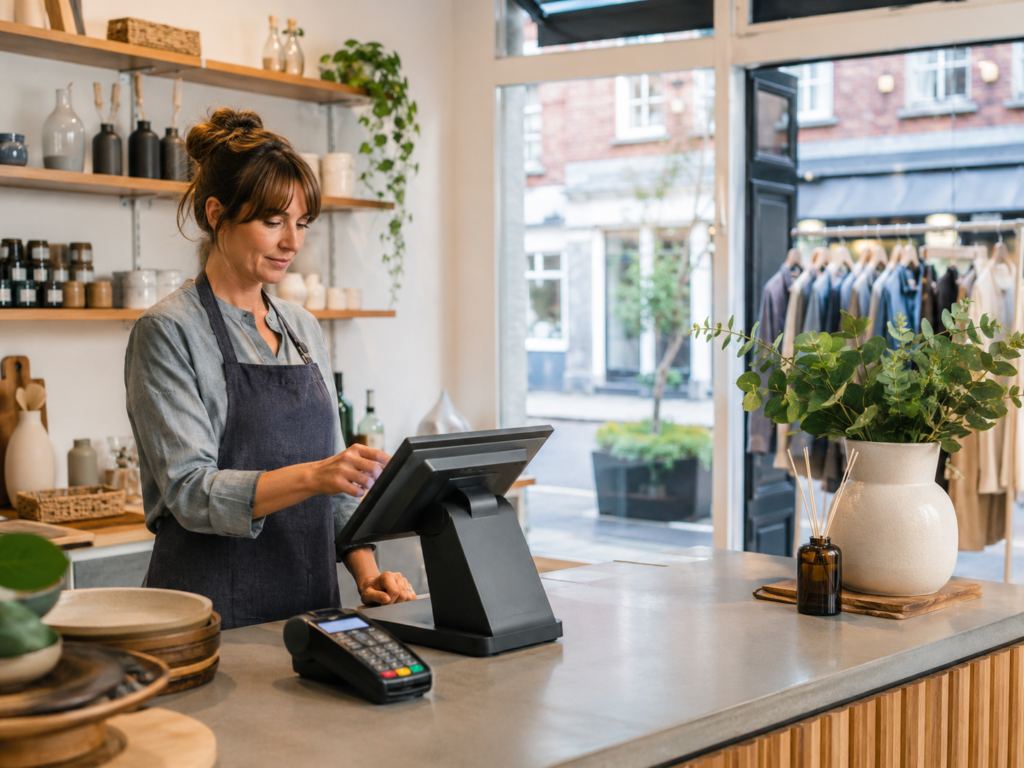
A modern EPOS system can bring together checkout, product information, stock control, sales reports, staff access, discounts and customer records.
For retail businesses, Switch & Save provides an AI-powered retail EPOS system designed for shops, supermarkets, convenience stores and other retailers.
Restaurants, takeaways, cafés and bars can explore a dedicated hospitality EPOS system with tools for ordering, table management, kitchen communication and reporting.
When comparing card machines for UK businesses, consider:
- Transaction rates
- Monthly charges
- Contract length
- Settlement times
- Minimum monthly fees
- Refund charges
- Mobile wallet acceptance
- EPOS integration
- Technical support
- Costs for additional terminals
The cheapest advertised transaction rate is not always the lowest total-cost option. Compare the complete agreement based on your expected card turnover and average transaction value.
9. Arrange Business Funding
Your funding requirement should come from your business plan and cash-flow forecast rather than an approximate figure.
Possible funding sources include:
- Personal savings
- Family investment
- Bank lending
- Start-up loans
- Asset finance
- Overdrafts
- Investor funding
- Business finance linked to trading performance
Keep a cash reserve for delays, unexpected repairs, seasonal sales changes and higher-than-expected costs.
New businesses considering external funding should review the Switch & Save guide to business finance for UK start-ups. Finance remains subject to eligibility, affordability checks and provider terms.
10. Launch, Market and Measure Your Business
A successful launch is not simply an opening-day promotion. It should create awareness, collect customer feedback and establish repeatable marketing channels.
Before opening:
- Create your website and local business listings.
- Make opening hours, location and contact details easy to find.
- Test your EPOS, printers, card machines and broadband.
- Train employees on payments, refunds, stock and customer service.
- Test suppliers and delivery schedules.
- Run a controlled soft launch where possible.
- Prepare launch offers without damaging your margins.
After opening, monitor a small group of useful metrics:
- Daily and weekly sales
- Gross profit
- Average transaction value
- Best- and worst-selling products
- Labour cost
- Stock loss and waste
- Refunds and discounts
- Cash and card differences
- Repeat customer activity
- Available cash
An EPOS reporting dashboard can make these figures easier to review without relying on handwritten records or separate spreadsheets.
Small Business UK Start-Up Checklist
Before opening, confirm that you have:
- Validated customer demand
- Selected a business name
- Written a business plan
- Prepared a cash-flow forecast
- Calculated start-up and monthly costs
- Chosen a legal structure
- Registered with HMRC or Companies House where required
- Checked VAT obligations
- Applied for licences and registrations
- Arranged suitable insurance
- Secured premises or permission to work from home
- Opened a dedicated bank account
- Selected suppliers
- Set up bookkeeping and payroll
- Installed EPOS and card payment systems
- Trained employees
- Created a launch marketing plan
- Kept emergency working capital available
How Switch & Save Supports New UK Businesses
Switch & Save helps small and growing UK businesses put essential systems in place without dealing with multiple disconnected providers.
Our services include:
- AI-powered retail and hospitality EPOS systems
- Card payment solutions
- Stock and sales reporting
- Integrated business tools
- Flexible business finance options
- Support for reducing operational costs
Switch & Save helps UK businesses reduce costs with AI-powered EPOS systems, card payment solutions and business finance.
Frequently Asked Questions
How much money do you need to start a small business in the UK?
There is no standard amount. A home-based service business may require relatively little equipment, while a restaurant, grocery shop or retail store may need premises, stock, fittings, licences, staff and substantial working capital. Prepare an itemised start-up budget and cash-flow forecast before committing funds.
Can I start a business while employed?
Yes. You can be employed and operate as a sole trader at the same time. Check your employment contract for restrictions relating to competing businesses, confidential information or outside work. Sole traders must register for Self Assessment when the relevant income requirements are met. ter to be a sole trader or limited company?
A sole trader structure is generally simpler to establish and administer. A limited company is a separate legal entity and may offer greater separation between personal and business liabilities. Tax, risk, administration and funding requirements should all be considered before choosing. to register for VAT immediately?
Not necessarily. Compulsory VAT registration generally begins when taxable turnover exceeds £90,000 over a rolling 12-month period or is expected to exceed that amount within the next 30 days. Voluntary registration is also possible. an EPOS system when starting a business?
An EPOS system is not compulsory for every business, but it can be valuable for shops and hospitality businesses that need to manage sales, products, stock, payments, staff activity and reports from one system.
Do I need a card machine for a small business?
It is not a universal legal requirement, but businesses that serve customers in person should consider how much demand they expect for contactless, debit card, credit card and mobile wallet payments. Compare total fees, contracts, connectivity and settlement arrangements before choosing a provider.
What records should a new business keep?
Businesses should keep accurate records of income, expenses, purchases, invoices, payroll, tax, stock and other relevant transactions. Sole traders need records to calculate profit or loss for Self Assessment, while limited companies have additional accounting and filing responsibilities. etails