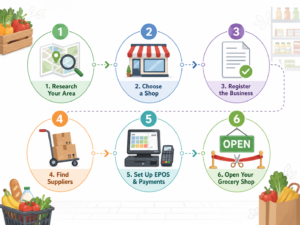
Starting a grocery shop in the UK means more than finding a premises and filling the shelves. You’ll need to research your local market, choose the right location, register your business, register as a food business, find reliable suppliers, organise stock control and set up a way to take payments.
The good news is that you don’t need to make everything complicated from day one. A well-planned local grocery shop can start with a focused product range and expand as you learn what your customers actually buy.
This guide explains how to start a grocery shop in the UK step by step, including the legal requirements, stock planning, EPOS, card payments and the practical things worth sorting before opening your doors.
Key Takeaways
| Area | What you need to do |
|---|---|
| Market research | Understand local customers, competition and demand |
| Business structure | Choose between options such as sole trader or limited company |
| Premises | Check rent, business rates, storage, accessibility and permitted use |
| Food registration | Register your food business with your local authority at least 28 days before trading |
| Food safety | Put suitable food-safety management procedures in place |
| Stock | Start with products your local customers are likely to buy regularly |
| Suppliers | Compare wholesalers on price, minimum orders, delivery and reliability |
| EPOS | Use sales and stock data to understand what is selling |
| Payments | Accept card and contactless payments alongside cash where appropriate |
| Finance | Budget for stock, equipment, deposits and working capital |
Is a Grocery Shop a Good Business to Start?
A grocery shop can work well when it solves a clear local need.
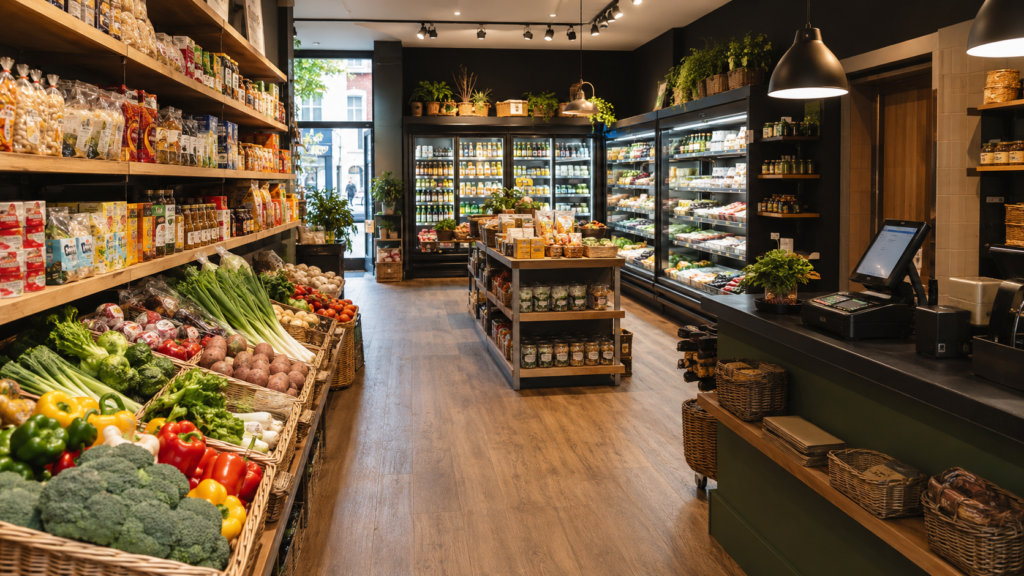
You might be serving residents who want everyday essentials without travelling to a supermarket. You could focus on international groceries, fresh produce, convenience products, halal food, specialist ingredients or a mixture of everyday household items.
What matters most is understanding why customers would choose your shop.
A small grocery store near flats and family homes, for example, may do well with milk, bread, eggs, drinks, frozen products and household essentials. A shop in a multicultural area may need a completely different range.
Don’t try to copy a large supermarket. Your advantage is usually convenience, relevant products and understanding the local community.
1. Decide What Type of Grocery Shop You Want
Before looking for premises, decide what you’re actually opening.
Possible grocery business models include:
- Local convenience store
- Independent grocery shop
- International food store
- Asian grocery shop
- Halal grocery store
- Organic or specialist food shop
- Fruit and vegetable shop
- Mini-market
- Grocery shop with local delivery
You don’t necessarily have to stay in one category.
For example, you might open an international grocery store but still stock everyday British essentials such as milk, bread, cereal and cleaning products.
The important thing is to have a clear core customer.
If you’re completely new to running a business, our guide to starting a small business in the UK can help you understand the wider setup process.
2. Research Your Local Market
Don’t sign a long lease just because a shop looks affordable.
Spend some time around the area first.
Look at who lives nearby, how busy the street becomes at different times and which other shops customers already use.
Visit competing grocery stores as a customer. Look at their product range, prices, opening hours and where queues appear.
More importantly, look for what’s missing.
Perhaps nearby supermarkets close early. Maybe residents have to travel elsewhere for specialist ingredients. Or there could be strong demand for quick evening purchases from people returning from work.
Talking to potential customers can be surprisingly useful.
Ask simple questions such as:
“What do you normally have to travel elsewhere to buy?”
The answers may influence your first stock order more than a complicated spreadsheet.
3. Write a Grocery Shop Business Plan
Your grocery business plan doesn’t need to be 50 pages long.
It does need to answer some basic questions clearly.
You should know:
- Who your customers are
- What you’re going to sell
- Where you’ll operate
- Who your main competitors are
- How much money you need
- Your expected monthly costs
- How you’ll price products
- How you’ll attract customers
- How you’ll manage stock
- Whether you’ll employ staff
Think about working capital too. That’s the money available to keep the business running while sales build up.
A shop can be full of stock and still struggle with cash flow if too much money is sitting in products that aren’t selling.
4. Work Out Your Grocery Shop Start-Up Costs
The cost of opening a grocery shop varies enormously depending on the premises, location and size of your product range.
Instead of looking for one headline figure, build your own start-up budget.
Include costs such as:
Premises: deposit, rent, legal fees and possible refurbishment.
Shop equipment: shelving, counters, fridges, freezers, baskets and signage.
Technology: EPOS system, barcode scanner, receipt printer and card machine.
Opening stock: your initial wholesale orders.
Professional costs: insurance, accounting and any required licences.
Working capital: money for wages, utility bills, supplier invoices and unexpected expenses after opening.
Keep a reserve rather than spending every available pound before launch.
If funding the initial setup is putting pressure on your cash flow, you can also explore business finance options before committing to major purchases.
5. Choose the Right Business Structure
Many independent grocery owners operate either as sole traders or through limited companies. The structure you choose affects areas including taxation, administration and personal liability. GOV.UK provides separate registration processes for both structures.
If you’re starting alone and want to understand the simpler route first, read our complete UK sole trader guide.
A limited company may be more suitable in other circumstances, particularly where several people are involved or you want a legally separate company.
Consider speaking with an accountant if you’re unsure which structure suits your situation.
Don’t forget VAT
As of August 2026, businesses generally have to register for VAT once their VAT-taxable turnover goes above £90,000, although voluntary registration is possible below the threshold.
If you’re operating as a sole trader, also check whether Making Tax Digital for Income Tax applies to you. From 6 April 2026, it applies to qualifying sole traders and landlords with qualifying annual income above £50,000.
6. Find Suitable Grocery Shop Premises
Location can have a major effect on how practical your grocery business is to operate.
Don’t judge a premises only by what customers can see from the street.
Check:
- Customer access
- Delivery access
- Storage space
- Refrigeration possibilities
- Electrical supply
- Security
- Nearby competition
- Parking where relevant
- Rent and lease terms
- Business rates
- Planning or permitted-use position
Business rates apply to most non-domestic properties, including shops, although your business may qualify for a form of rates relief depending on the property and circumstances.
Ask your local authority or a suitable property professional about planning and permitted use before committing to premises if there’s any uncertainty.
7. Register Your Grocery Shop as a Food Business
This is one of the most important steps.
A grocery shop selling food is a food business. Across the UK, food businesses generally need to register their premises with the appropriate local authority at least 28 days before opening. Registration is free.
So, do you need a specific “grocery shop licence”?
There isn’t one universal licence covering everything a grocery shop might sell. Food-business registration is a core requirement, while additional licences depend on your products and location.
For example, if you’re planning to sell alcohol, additional licensing rules apply. In England and Wales, alcohol sales normally require an appropriate premises licence, with a designated premises supervisor who holds a personal licence.
Scotland and Northern Ireland operate different alcohol-licensing systems, so check the requirements that apply where your shop is based.
8. Understand Food Safety and Labelling Requirements
You need procedures showing how your shop keeps food safe.
Food businesses must operate a food-safety management system based on HACCP principles. HACCP simply means identifying potential food-safety hazards and putting controls in place to reduce them.
For a grocery shop, this can cover areas such as:
- Chilled and frozen storage
- Cleaning
- Temperature monitoring
- Allergen controls
- Staff training
- Safe storage
- Stock rotation
The Food Standards Agency also provides a Safer Food, Better Business for Retailers pack specifically for smaller food retailers such as convenience stores and corner shops.
What about Natasha’s Law?
If you prepare and package food on the same premises before customers choose it — known as prepacked for direct sale or PPDS food — specific ingredient and allergen-labelling requirements can apply.
PPDS products must carry the food name and a full ingredients list, with allergens emphasised within that list. These rules are commonly known as Natasha’s Law.
For example, if your grocery shop prepares sandwiches, salads or bakery items and packages them before placing them on display, you need to understand these requirements.
9. Find Reliable Grocery Wholesalers and Suppliers
Your supplier relationships will affect your prices, availability and cash flow.
Don’t automatically choose the cheapest wholesaler.
Compare:
- Product prices
- Delivery charges
- Minimum order values
- Delivery frequency
- Payment terms
- Product range
- Returns policies
- Reliability
You may end up using several suppliers.
For example, one wholesaler might supply packaged groceries while another handles fresh produce and a specialist importer supplies international products.
Keep your buying controlled at the beginning.
Ordering five cases because the unit price looks attractive isn’t a saving if four cases are still sitting in your stockroom months later.
10. Decide What Products to Stock
A common mistake is trying to stock everything from opening day.
Start with products that match the area.
A typical local grocery shop might carry:
Everyday essentials: milk, bread, eggs, rice, pasta and cooking oil.
Drinks and snacks: soft drinks, water, crisps, biscuits and confectionery.
Fresh and chilled products: dairy, produce and selected ready-to-eat items.
Frozen products: meals, vegetables, desserts and specialist lines.
Household essentials: toiletries, cleaning products and basic household goods.
Then use actual sales information to decide what deserves more shelf space.
Customers will quickly show you what they want.
11. Set Up an EPOS and Stock Management System
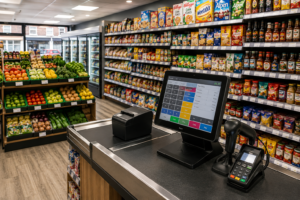
Stock control becomes difficult surprisingly quickly in a grocery shop.
You’ve got hundreds or potentially thousands of individual products. Prices change. Deliveries arrive. Items expire. Some products sell several times a day while others hardly move.
That’s where an EPOS system can help.
Instead of using a basic till only to record payments, an EPOS system can connect sales with your product and stock information.
For example, when a customer buys two bottles of juice, the sale can reduce the recorded stock quantity automatically. Over time, you can see which items are selling, which aren’t and which products may need reordering.
An effective grocery EPOS setup can also help with:
- Barcode scanning
- Stock levels
- Product pricing
- Sales reporting
- Low-stock monitoring
- Staff access
- Promotions
- Receipt management
Switch & Save provides AI-powered EPOS systems for UK businesses, including retailers that need clearer stock control and sales reporting.
12. Arrange Card and Contactless Payments
Customers may still use cash, but your shop should be ready to accept the payment methods your customers prefer.
That normally means having a reliable card machine that supports chip and PIN and contactless payments.
Don’t leave your payment setup until the night before opening.
You’ll need time for the merchant account or payment setup, equipment delivery, installation and testing.
Check the complete pricing rather than looking only at one transaction rate. Consider transaction charges, hardware costs, contract terms and any other fees that apply to your agreement.
13. Hire and Train Staff
If you’re running a very small shop, you may initially cover much of the work yourself.
But grocery retail involves long opening hours, deliveries, replenishment, cleaning, customer service and cash handling. Eventually you may need help.
Train staff properly on:
- EPOS use
- Cash handling
- Refunds
- Stock procedures
- Food hygiene
- Age-restricted sales where applicable
- Customer service
- Opening and closing procedures
If you become an employer, Employers’ Liability insurance is generally compulsory and must provide at least £5 million of cover from an authorised insurer, subject to limited exemptions.
14. Prepare for Opening Day
Don’t treat opening day as the deadline for discovering whether everything works.
Run test transactions first.
Scan products through your EPOS system. Check prices. Test the card machine. Print receipts. Make sure opening stock has been entered correctly.
Walk through a normal customer purchase from beginning to end.
Then test something going wrong.
What happens if a barcode isn’t recognised? Can staff find a product manually? Do they know how to handle a refund? Who calls for support if the card terminal stops working?
A few test runs before opening can uncover problems while there’s still time to fix them.
A Simple Grocery Shop Opening Checklist
Before opening, check that you have:
- Chosen your business structure
- Secured suitable premises
- Registered the food business in time
- Checked relevant licences
- Arranged suitable insurance
- Set up food-safety procedures
- Opened supplier accounts
- Purchased opening stock
- Installed shelving and refrigeration
- Added products and prices to your EPOS system
- Set up card payments
- Trained staff
- Tested your checkout process
- Planned your launch
Then open with a manageable product range and improve it using real customer demand.
How Switch & Save Supports New Grocery Businesses
Opening a grocery store gives you enough things to think about without juggling disconnected payment and retail systems.
Switch & Save helps UK businesses reduce costs and improve efficiency with AI-powered EPOS systems, card payment solutions and business finance.
For grocery businesses, that can mean having sales, product and stock information in one system rather than trying to manage everything manually.
Whether you’re opening your first corner shop, taking over an existing grocery store or building a larger retail business, having the right systems in place from day one can make the operation easier to manage.
Switch & Save helps UK businesses reduce costs with AI-powered EPOS systems, card payment solutions and business finance.
Frequently Asked Questions
How much does it cost to start a grocery shop in the UK?
There isn’t one standard figure. Your cost will depend on the premises, deposit, refurbishment, opening stock, refrigeration, shelving, technology, insurance and working capital.
Create a detailed budget based on the actual shop you’re considering rather than relying on a generic start-up estimate.
Do I need a licence to open a grocery shop in the UK?
There isn’t one universal grocery-shop licence. However, grocery stores selling food generally need to register as food businesses with their local authority at least 28 days before trading. Other licences can apply depending on what you sell, particularly products such as alcohol.
Do I need to register a grocery shop with the council?
Yes. A grocery store is normally a food business and must be registered with the appropriate local authority before opening. Food-business registration should normally be completed at least 28 days before trading.
Can I start a grocery shop as a sole trader?
Yes. A grocery business can be operated as a sole trader, although you should consider the tax, liability and administrative differences between operating as a sole trader and forming a limited company.
Does a grocery shop need an EPOS system?
An EPOS system isn’t simply a legal requirement for opening a grocery store. However, it can make managing a product-heavy retail business much easier by connecting transactions with product, stock and sales information.
How do I choose products for a new grocery shop?
Start with the needs of customers in your immediate area. Build a core range of frequently purchased products, track what sells and gradually change your range based on actual sales rather than trying to predict every customer requirement before opening.
Can a grocery shop sell alcohol?
Yes, but licensing requirements apply. For example, in England and Wales, premises selling alcohol normally need the relevant premises licence, and a designated premises supervisor must hold a personal licence. Rules differ elsewhere in the UK.