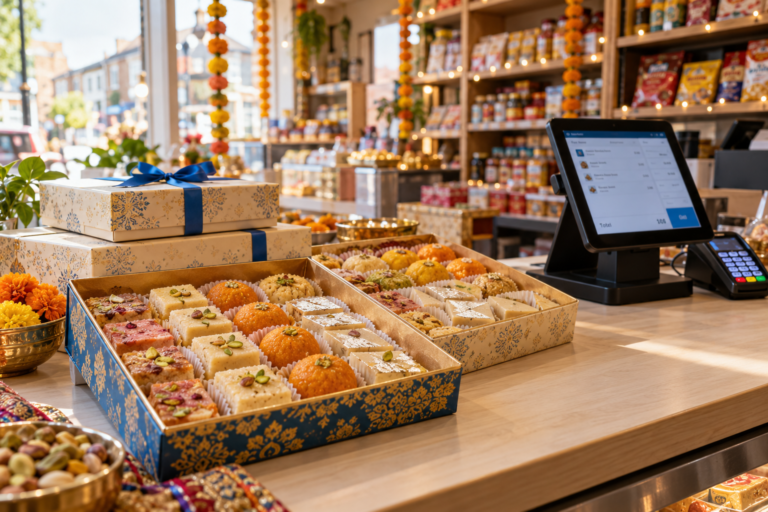

AI can help UK small businesses forecast demand, plan stock, draft marketing content, answer routine enquiries and make sales reports easier to understand. For retailers and hospitality owners, the best starting point is one repetitive task that takes too much time or leads to avoidable waste. You don’t need to automate your whole business to get something useful from it.
Whether you run a grocery shop, café, takeaway or restaurant, the aim is straightforward: use your information to make everyday work easier, while keeping people responsible for decisions.
What does AI mean for a small business?
Artificial intelligence is software that can recognise patterns, generate content or make predictions from information. In practice, that might mean turning a sales spreadsheet into a plain-English summary or suggesting how much stock you’ll need next week.
There are two useful types to understand. Generative AI produces things such as text and images. Predictive AI uses past information to estimate what might happen next, such as demand for a product.
Ordinary automation is different. Sending an order to a kitchen printer or triggering a low-stock alert doesn’t necessarily involve AI. Both can be useful, but an “AI” label alone doesn’t tell you whether a feature will solve your problem.
Key takeaways
| Business task | Practical AI use | What you should check |
|---|---|---|
| Retail stock | Estimate demand and flag unusual patterns | Stock accuracy, delivery times and promotions |
| Food preparation | Suggest quantities using previous sales | Waste records, weather and local events |
| Marketing | Draft offers, product descriptions and posts | Prices, availability and brand voice |
| Customer enquiries | Draft answers to common questions | Correct policies and a route to a person |
| Reporting | Summarise sales and highlight changes | Calculations and underlying records |
| Staff planning | Estimate busy periods | Availability, skills and practical cover |
Practical uses of AI in retail
Make stock ordering more informed
AI stock forecasting can look for patterns across sales history, weekdays and seasonal demand. It can then suggest which products may need replenishing and which deserve a closer look before you reorder.
Imagine a Birmingham convenience shop where chilled drinks sell quickly on warm weekends. A forecasting tool could use previous sales and, if supported, weather information to suggest a higher order. The owner still checks fridge space, supplier lead times and expiry dates.
The prediction is only as useful as the records behind it. If deliveries aren’t entered or damaged stock remains counted as available, AI may recommend the wrong quantities.
Spot slow-moving products
A mobile phone shop might have accessories that sell steadily and older cases that rarely move. AI-assisted analysis can flag those differences, helping the owner decide what to reorder, display differently or include in a promotion.
Check margins alongside sales. A popular product isn’t automatically profitable, and a slower seller may still be useful to your customers.
Understand sales changes
You could ask an analysis tool: “Compare this week’s category sales with last week. Show the largest changes and any missing data.”
That gives you a starting point for investigation. A drop in bread sales might reflect a stock shortage rather than weaker demand. AI can highlight the change, but you’ll need to check the cause before adjusting an order.
Practical uses of AI in hospitality
Plan preparation and reduce avoidable waste
AI in hospitality can support demand forecasting: estimating how many items customers might order during a particular shift.
For example, a café could review sandwich sales by weekday and compare them with quantities prepared and thrown away. A tool may suggest preparing fewer of one filling on quiet afternoons and more of another before the lunch rush.
Sales alone don’t show everything. When an item sells out early, recorded sales can understate demand. Keep notes on shortages and waste so you don’t mistake “we ran out” for “customers didn’t want it”.
Review menu performance
A restaurant can use AI-assisted analysis to compare dishes by sales, ingredient cost and contribution margin. Contribution margin means what remains from the selling price after the variable costs included in your calculation.
Suppose a popular takeaway meal brings in plenty of revenue but uses expensive ingredients and packaging. An analysis tool could flag it for review. You might then check portion sizes, supplier prices or the menu price.
AI shouldn’t set prices without oversight. Your customers’ expectations, nearby alternatives and service quality still matter.
Support staff planning
A pub or restaurant can use demand estimates to identify likely busy periods. This may help managers plan kitchen, bar and floor cover more carefully.
Check any suggested rota against availability, experience and breaks. Remember that quieter periods can still involve deliveries, cleaning and preparation.

Marketing, customer enquiries and admin
Draft useful marketing content
Generative AI can turn a few accurate details into a first draft for a social post, email or product description. It’s particularly helpful when you know what you want to say but struggle to find the time.
A useful prompt might be:
Write a short Facebook post for our independent café in Leeds. Promote our £7.50 soup-and-sandwich lunch, available Monday to Friday, 12–2 pm. Use friendly UK English. Don’t invent ingredients or offers.
You’ll still need to check the price, availability and wording before publishing. Specific instructions usually give you a more useful draft than simply asking AI to “write a promotional post”.
Handle routine enquiries
An AI assistant can help draft answers about opening hours, bookings, delivery areas and collection arrangements. If you use a customer-facing chatbot, give it an approved source of information and an easy handover to a person.
Keep sensitive questions under human control. A restaurant chatbot shouldn’t guess whether a dish is safe for someone with an allergy. Staff need to check current ingredient and preparation information.
Prepare everyday paperwork
AI can help draft supplier emails, summarise meeting notes and turn an approved procedure into a staff checklist. These are manageable starting points because someone can review the output before it’s used.
For financial summaries, check every figure against your records. A fluent explanation isn’t proof that the maths is correct.
Where AI-powered EPOS fits in
An electronic point of sale system, or EPOS, records transactions and can support stock management and reporting. Consistent records give AI analysis a better foundation than scattered receipts and incomplete spreadsheets.
Switch & Save offers AI-powered EPOS systems for UK businesses. When comparing systems, ask to see the specific AI feature working with an example relevant to your shop or venue. Check what information it uses and whether the feature is included in your chosen package.
For restaurants, cafés and takeaways, explore hospitality EPOS alongside the everyday tasks your team handles. Order processing, kitchen communication and accurate reporting need to work well before additional analysis can help.
The uses described in this guide are examples of what suitable AI tools can support. Availability depends on the software, integrations and data you have.
How to start without wasting money
Choose one task with a clear outcome. “Spend less time drafting weekly offers” is easier to test than “make the business smarter”.
Run a small trial over several comparable weeks. Record the time spent before and after, including the time needed to correct mistakes. For stock or preparation forecasting, track shortages and waste as well as sales.
Compare the benefit with the full cost: subscription fees, setup, integrations, staff training and review time. A free tool can still create work if its suggestions need constant repair.
You don’t need to commit to a business-wide rollout. If a trial helps with one task, build from there. If it doesn’t, adjust the approach before spending more.
Protecting information and checking results
When AI uses personal information, data protection needs to be part of the setup. The Information Commissioner’s Office provides AI and data protection guidance explaining how UK GDPR principles apply to AI systems. ICO
As a practical starting point, avoid pasting customer contact details, staff records or payment information into an unapproved tool. Check the provider’s data handling terms, access controls and retention settings before sharing business information.
AI can produce incorrect answers with convincing wording. Keep a person responsible for reviewing outputs, especially where errors could affect customers, staff or spending decisions. Ask it to identify missing information rather than fill gaps with assumptions.
Find a practical starting point
Useful AI starts with a real business problem. That could be uncertain stock orders, food waste or too much time spent writing weekly promotions.
Switch & Save helps UK businesses reduce costs with AI-powered EPOS systems, card payment solutions and business finance. Check your savings today and discuss the daily tasks you want to improve.
FAQs
What is the best use of AI for a small business?
Start with a repetitive task you can review easily, such as drafting marketing content or summarising sales. Forecasting becomes more useful when your business has reliable historical records.
Can AI help a small grocery shop?
Yes. Suitable tools can support stock forecasting, identify slow-moving products and explain sales patterns. Owners still need to check expiry dates, stock accuracy and supplier delivery times.
How can restaurants use AI?
Restaurants can use AI to support preparation forecasts, menu analysis, marketing drafts and demand-based staff planning. Keep people responsible for food safety, allergy enquiries and final decisions.
Do I need an AI-powered EPOS system?
Not for every task. Marketing drafts can use a separate tool. Sales and stock analysis need reliable records, which may come from EPOS reports or compatible integrations.
Is AI free for small businesses?
Some tools have free versions, but features and usage may be limited. Check subscription charges, integrations and the staff time required to review outputs before deciding whether a tool offers value.