
A sole trader is someone who owns and operates a business as an individual. You keep the profits after tax, make the decisions and take responsibility for the business’s debts.
It’s the simplest business structure to set up in the UK. You don’t need to register a company with Companies House, and you can start trading straight away. However, you’ll usually need to register for Self Assessment if your gross trading income goes above £1,000 during a tax year.
This guide explains how to become a sole trader in 2026, what tax you’ll pay, which expenses you can claim and how Making Tax Digital may affect your business.
Information in this guide reflects UK rules for the 2026/27 tax year. Tax circumstances vary, so speak to an accountant or HMRC when you need advice about your individual situation.
Key takeaways
| Area | What sole traders need to know |
|---|---|
| Ownership | You own and control the business personally |
| Registration | Register for Self Assessment if gross trading income exceeds £1,000 |
| Liability | You’re personally responsible for business debts |
| Income Tax | You normally pay tax on business profit, not total sales |
| National Insurance | Class 4 National Insurance may apply when profits exceed £12,570 |
| VAT | Registration is generally compulsory when taxable turnover exceeds £90,000 |
| Making Tax Digital | Applies from April 2026 to qualifying sole traders with income over £50,000 |
| Records | Business records normally need to be retained for at least five years after the relevant filing deadline |
What is a sole trader?
A sole trader is a self-employed person who owns a business.
You might run a corner shop, takeaway, mobile phone shop, café, market stall or independent service business. You can work alone, employ staff and trade under your own name or a separate business name.
The important point is that you and the business aren’t legally separate. This is different from a limited company, which exists as its own legal entity.
As a sole trader, you’re entitled to keep the profits after paying tax. However, you also have unlimited liability. In plain English, that means you’re personally responsible for the business’s debts and losses.
For example, suppose you open a small convenience store and take out finance for equipment. If the business can’t repay what it owes, you may still be personally responsible for the debt.
What are the advantages of being a sole trader?

The main advantage is simplicity.
There’s no company incorporation process, no confirmation statement and no requirement to file company accounts with Companies House. You control the business and can usually make decisions quickly.
Other benefits include:
- Relatively simple registration and administration
- Direct control over business income and spending
- Fewer formal reporting duties than a limited company
- The ability to start small and change structure later
- Business details aren’t automatically published through Companies House
This structure can work particularly well for new businesses that want to test an idea before taking on more complicated company administration.
For example, someone opening a small coffee kiosk may begin as a sole trader. Once the business grows, takes on investors or opens more locations, they can review whether a limited company would offer better protection.
What are the disadvantages?
The biggest disadvantage is personal liability.
Business debts aren’t separated from your personal finances. Depending on the circumstances, your personal savings or assets could be at risk if the business fails to meet its obligations.
You’re also responsible for managing your own tax, National Insurance, records and payment deadlines. There’s no employer automatically deducting tax from your business income.
Raising investment can also be harder because a sole trader business doesn’t issue shares. Some larger customers, landlords and lenders may prefer dealing with limited companies, although this varies by sector.
How to register as a sole trader in the UK
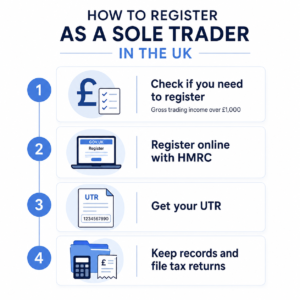
You can begin trading before completing a company registration because sole traders don’t incorporate at Companies House.
However, you normally need to register as self-employed with HMRC when your gross trading income exceeds £1,000 during a tax year. Gross income means the money received before deducting expenses.
The UK tax year runs from 6 April to 5 April.
Sole trader registration deadline
You must generally tell HMRC by 5 October following the end of the tax year in which you need to submit a return.
For example, someone who started trading in June 2026 would be trading during the 2026/27 tax year. Their normal registration deadline would therefore be 5 October 2027.
After registering, HMRC will provide a Unique Taxpayer Reference, commonly called a UTR. You’ll use it when managing your Self Assessment obligations.
Choosing a sole trader business name
You can trade using your own name or choose a separate trading name.
However, the name can’t include terms such as “Limited”, “Ltd”, “LLP” or “plc”. It must not be offensive or too similar to a protected trade mark.
Check the name carefully before paying for signs, menus, packaging or a website. Registering a trade mark may also be worth considering if the brand will be important to your business.
For more guidance on getting started, read Switch & Save’s UK starting a business guides.
What tax does a sole trader pay in 2026?
Sole traders normally pay Income Tax on their taxable profit, not their total sales.
Your profit is broadly the income your business receives minus allowable business expenses.
For example, suppose a takeaway receives £80,000 in sales and has £52,000 of allowable costs. Its starting business profit would be £28,000, rather than the full £80,000 turnover.
Income Tax rates for 2026/27
For most taxpayers in England, Wales and Northern Ireland, the standard Personal Allowance for 2026/27 is £12,570.
The main bands are:
| Taxable income | Income Tax rate |
|---|---|
| Up to £12,570 | 0% under the standard Personal Allowance |
| £12,571 to £50,270 | 20% |
| £50,271 to £125,140 | 40% |
| Above £125,140 | 45% |
Scottish Income Tax bands are different. Your Personal Allowance can also be affected by your total income and personal circumstances.
National Insurance for sole traders
For the 2026/27 tax year, Class 4 National Insurance applies when self-employed profits exceed £12,570.
The rates are:
- 6% on profits from £12,570 to £50,270
- 2% on profits above £50,270
When profits are at least £7,105, Class 2 contributions are normally treated as paid, helping to protect your National Insurance record without requiring a Class 2 payment. Voluntary Class 2 contributions may be available in some circumstances.
Self Assessment deadlines
Online Self Assessment returns are normally due by 31 January following the end of the relevant tax year. The tax owed is generally due on the same date.
For the tax year ending 5 April 2026, the online filing and payment deadline is 31 January 2027. Paper returns are normally due earlier, on 31 October.
Some sole traders must also make payments on account towards their next tax bill. These are generally required when the previous Self Assessment bill was at least £1,000 and less than 80% of the tax was collected outside Self Assessment.
The first bill can therefore feel larger than expected. Setting aside part of your profit throughout the year can make the deadline easier to manage.
How does Making Tax Digital affect sole traders in 2026?
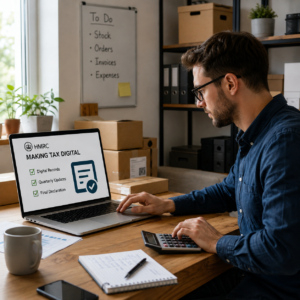
Making Tax Digital for Income Tax became mandatory on 6 April 2026 for qualifying sole traders and landlords whose combined gross income from self-employment and property is more than £50,000.
Those affected must use compatible software to:
- Maintain digital income and expense records
- Submit quarterly updates to HMRC
- Finalise their figures and complete their tax return
- Pay the amount due by the normal deadline
The £50,000 test is based on qualifying gross income before expenses, rather than business profit.
The planned threshold reduces to more than £30,000 from April 2027. Sole traders should therefore check their position even if they weren’t included in the first phase.
In practice, this makes accurate digital record keeping increasingly important. A modern till or EPOS system can help a retailer or hospitality business keep clearer sales records, monitor stock and produce reports for bookkeeping.
What expenses can a sole trader claim?
Allowable expenses are legitimate business costs that can be deducted when calculating taxable profit.
Common examples include:
- Stock and raw materials
- Rent, heating and electricity for business premises
- Business insurance and bank charges
- Staff wages and subcontractor costs
- Phone, internet and office costs
- Advertising and marketing
- Accountancy and certain legal fees
- Qualifying travel and vehicle costs
- EPOS equipment, software and payment-related costs, subject to the relevant accounting treatment
Personal spending can’t be claimed simply because it passed through a business account. Where something has both personal and business use, you can generally claim only the business proportion.
Trading allowance or actual expenses?
The trading allowance can provide up to £1,000 of relief against gross trading income.
When gross trading income is above £1,000, you may be able to deduct the trading allowance instead of calculating actual business expenses. You can’t use the trading allowance and claim actual expenses against the same income.
For a small side business with very few costs, the allowance might be simpler. For a shop, restaurant or takeaway spending heavily on stock, rent and equipment, claiming actual allowable expenses may produce a better result.
Does a sole trader need to register for VAT?
VAT registration is generally compulsory when taxable turnover for the previous rolling 12-month period goes above £90,000.
You may also need to register if you expect taxable turnover to exceed £90,000 within the next 30 days. Businesses below the threshold can choose to register voluntarily.
Remember that this is a rolling 12-month test, not simply your financial year or the April-to-April tax year.
For example, a busy takeaway could cross the threshold during December. The owner shouldn’t wait until the end of the tax year before checking the registration rules.
Does a sole trader need a business bank account?
A sole trader isn’t generally legally required to open a separate business bank account.
However, some personal account providers don’t allow business use, so check your bank’s terms. Keeping business and personal transactions separate also makes bookkeeping, tax returns and cash-flow monitoring much easier.
A separate account gives you a clearer view of what the business is earning and spending. It also reduces the time spent working through personal transactions when preparing your accounts.
What records must a sole trader keep?
You need records of your business income and expenses, along with relevant information about personal income.
Depending on the business, these may include invoices, till reports, card payment statements, receipts, bank statements, purchase orders, stock records, mileage logs and payroll information.
HMRC says self-employed business records normally need to be kept for at least five years after the 31 January submission deadline for the relevant tax year.
Cash basis accounting is now the standard method for most sole traders. Under cash basis, you usually record income when you receive payment and expenses when you pay them. Businesses can opt for traditional accounting where appropriate.
For shops, cafés and hospitality venues, an EPOS system designed for small businesses can make daily record keeping more manageable by bringing sales, stock and reporting information together.
Can a sole trader employ staff?
Yes. Being a sole trader doesn’t mean you must work alone.
You can employ full-time, part-time or temporary workers. You’ll need to check their right to work, meet employment law requirements and arrange appropriate workplace insurance.
Where PAYE is required, you must register as an employer before the first payday. You can’t normally register more than two months before you start paying employees.
For example, a café owner may operate as a sole trader while employing baristas, kitchen staff and weekend workers.
Sole trader or limited company: which is better?
Neither structure is automatically right for every business.
A sole trader structure may suit you when:
- You’re starting a relatively simple business
- You want minimal administration
- You don’t need outside shareholders
- Your financial and legal risks are manageable
A limited company may deserve consideration when:
- The business has significant debts or contractual risks
- You want clearer separation between personal and business finances
- You plan to bring in shareholders
- Larger contracts require a company structure
- The business has grown and its tax position needs reviewing
Tax shouldn’t be the only consideration. Liability, administration, financing and future plans all matter. An accountant can compare the options using your expected profit and personal circumstances.
How Switch & Save supports sole traders
Running a business as a sole trader may be straightforward legally, but the daily work can still become complicated.
You need to take payments, manage stock, understand sales, control costs and maintain reliable records. That’s where the right systems can make a practical difference.
Switch & Save supports UK retailers and hospitality businesses with AI-powered EPOS systems, card payment solutions and flexible business finance guidance. Its solutions are designed for businesses such as shops, cafés, restaurants, takeaways and grocery stores.
A connected EPOS and payment setup can help you track daily sales, manage products and reduce manual work. It won’t replace proper bookkeeping or professional tax advice, but it can give you cleaner business information to work with.
Check how much your business could save
Switch & Save helps UK businesses reduce costs with AI-powered EPOS systems, card payment solutions and business finance.
Frequently asked questions
Can I be employed and a sole trader at the same time?
Yes. You can have a PAYE job while also running a sole trader business. Your employment income and self-employed profit may both need to be included when calculating your overall tax position.
Do sole traders register with Companies House?
No. Sole traders normally register for Self Assessment with HMRC rather than incorporating at Companies House.
Can I start trading before registering with HMRC?
Yes. You can begin trading first, but you must meet the relevant HMRC registration deadline if you need to complete a Self Assessment return.
Do I need to register if I earn less than £1,000?
You may not need to tell HMRC when your total gross trading income is £1,000 or less. However, exceptions apply, including situations where you want to claim a trading loss or make voluntary National Insurance contributions.
Does a sole trader pay Corporation Tax?
No. A sole trader normally pays Income Tax and applicable National Insurance on business profits. Corporation Tax applies to companies.
Can a sole trader have employees?
Yes. A sole trader can employ staff, provided the business meets PAYE, employment, pension, insurance and workplace obligations.
Is a sole trader personally responsible for debt?
Yes. Sole traders have unlimited liability, meaning the owner is personally responsible for business debts. Suitable contracts, risk controls and business insurance may reduce some risks, but they don’t change the legal structure.
When should a sole trader consider becoming a limited company?
You may want to review your structure when profits increase, risks become more significant, you take on major borrowing, bring in investors or begin signing larger contracts. Get individual advice before changing because the legal and tax consequences depend on your circumstances.