Good cash management with a POS comes down to one routine. You start the day with a known float and record every movement in and out of the drawer. You close the session with a Z report, count the drawer, and compare the two. Any gap gets investigated and written down. It never gets quietly adjusted away.
This guide is for owners and managers of shops, cafés and restaurants, including those in Birmingham and Coventry. It walks through that routine step by step, covers the HMRC rules that sit behind it, and shows where a modern EPOS makes it faster.
TL;DR
- Reconcile the opening float, cash sales and recorded movements (expenses, bankings) against the count. Do not just check the count against the till roll.
- Run an X report during the day if you need a snapshot. Run the Z report once, at close, because it closes the session.
- Never force the till to balance. Record shortages and overs in a separate till-difference account and look for patterns.
- Keep the drawer secure: limited keys or logins, a locked safe or cabinet, and a dated record of every bank deposit.
- An integrated EPOS gives you the reports, audit trail and remote view that make all of this quicker.
Table of Contents
- What cash management in a POS actually covers
- X reports and Z reports: what each one is for
- A daily cashing-up routine you can copy
- Why you should never force the till to balance
- Cash drawer security
- Money laundering rules and cash
- How a modern EPOS helps
- Our view: the routine matters more than the kit
- Setting up your EPOS for better cash control
- Common mistakes to avoid
- FAQ
- Sources
What cash management in a POS actually covers
It is easy to think of cash management as counting notes at the end of the night. In practice it has four parts:
- Float control: how much is in the drawer at the start, and who put it there.
- Movement tracking: every pay-in, pay-out, refund, petty cash item and banking is recorded with a reason.
- Reconciliation: what the system says should be in the drawer versus what is there.
- Security and records: who can open the drawer, where cash is kept, and what evidence you hold if HMRC or your accountant asks.
Card and cash sales both flow through your EPOS, so the same system should give you one view of takings. The CASS guidance on reconciling cash takings and till differences makes a point worth remembering: the amount banked is not always the day’s sales. Card settlements, refunds and other movements all sit between the two figures.
X reports and Z reports: what each one is for
These are the two reports most small businesses use daily.
| X report | Z report | |
|---|---|---|
| When | Any time during trading | End of day or end of shift |
| Closes the session? | No | Yes |
| Resets totals? | No | Yes, for the next session |
| Typical use | Mid-shift check, handover, spot check | Cashing up and the daily record |
Think of the X report as a look at the scoreboard, and the Z report as the final whistle. Most systems follow this convention, though menu names vary, so check your own EPOS. The Z report tells you what the system believes you should hold in cash, card and other payment types. That is your target figure when you count.
Keep payment types separate in the report. Cash, card, vouchers and any other tender should each have their own line. That makes it far easier to spot where a difference has come from.
A daily cashing-up routine you can copy
HMRC describes cashing up as counting all the payments a business has received and reconciling them with its sales record. Here is a practical version.
Before you open
- Count the float in front of a second person where you can. Agree the amount against the figure you left yesterday.
- Enter the float in the EPOS when you open the session, so the opening figure is on record.
- Check the drawer opens only through the system, and that the receipt roll and card terminal are working.
During the day
- Log every cash movement that is not a sale: a pay-out for a delivery, a safe drop, a change request. Give each one a reason.
- Keep petty cash and personal withdrawals out of the till. The CASS guidance is clear that these should be kept strictly separate from takings.
- Make safe drops when the drawer builds up. Less cash in the drawer means less to lose.
- Run an X report at shift changes so the outgoing and incoming staff agree the position.
At close
- Run the Z report to close the session.
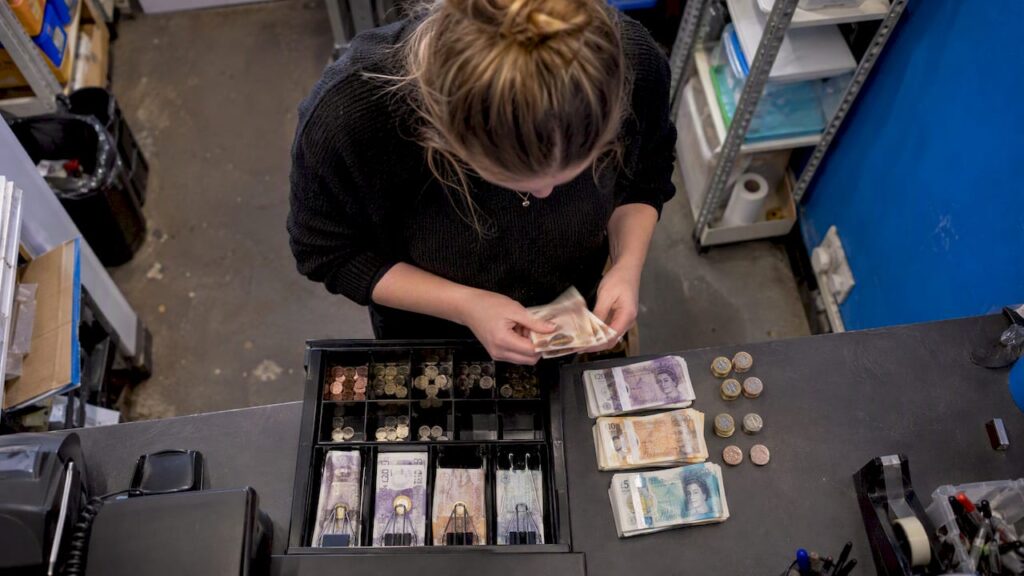
- Count the drawer by denomination and write the totals down.
- Work out the expected cash: opening float plus cash sales, plus pay-ins, minus pay-outs and refunds paid in cash.
- Compare expected with counted. Record the difference, whatever it is.
- Take out the float for tomorrow, and prepare the bank deposit with a dated slip that matches a specific trading period.
- Lock the cash away and file the Z report with your count sheet.
A worked example
Say a café opens with a £150 float. The Z report shows £842.50 in cash sales and £12 in cash refunds. During the day £40 was paid out for a milk delivery, and it was logged.
Expected cash in the drawer: £150 + £842.50 – £12 – £40 = £940.50.
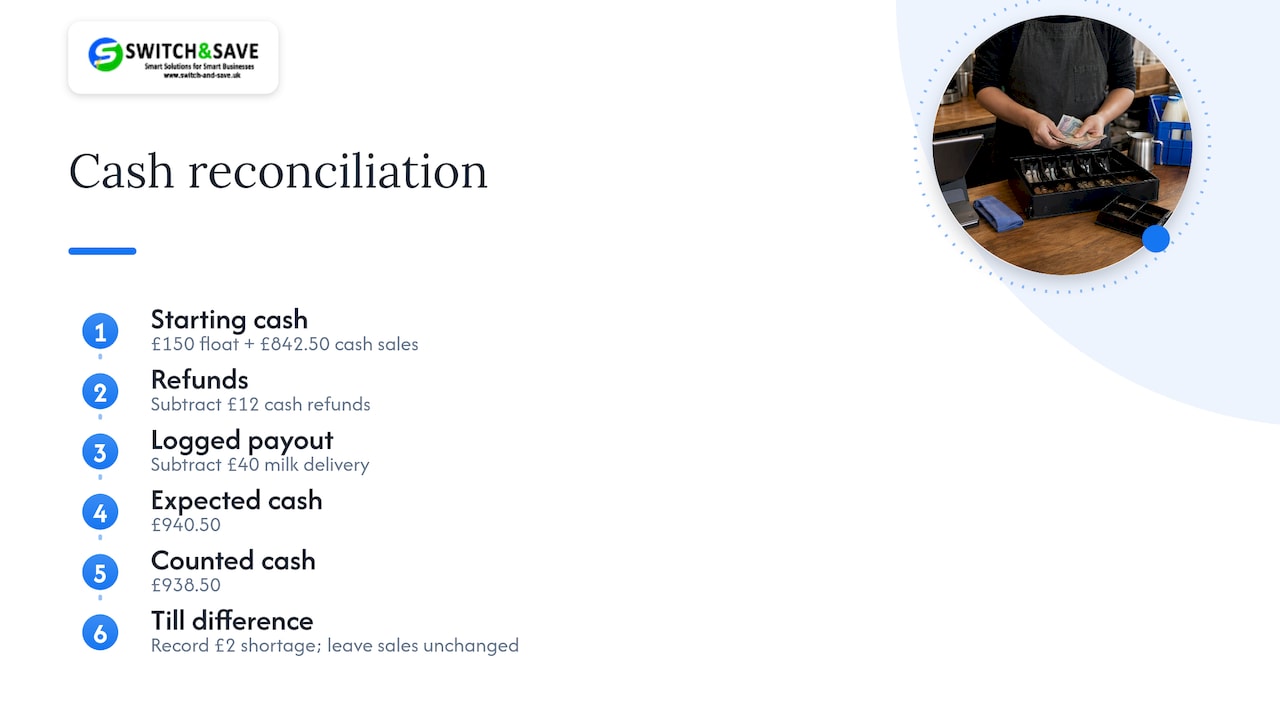
The count comes to £938.50. That is a £2 shortage. You record £2 as a till difference, you do not alter the sales figure, and you note it against the shift. If it happens again, you now have a pattern to look at.
Why you should never force the till to balance
It is tempting to nudge a sales figure so the drawer matches. Don’t. The HMRC VAT notice for the Point of Sale Retail Scheme says that businesses using the scheme must keep a daily gross takings record. That record has to capture the full value of retail supplies, including cash, cards and vouchers. It is not just the cash you happen to hold.
The same notice says you cannot reduce your takings because of shortages caused by theft, poor cash handling or voids. You can make adjustments that are backed by evidence for things like counterfeit notes, a till fault or a float discrepancy. The HMRC manual on till shortages and excesses goes into the detail of unders and overs if you want the technical rules. Your accountant can tell you how they apply to your VAT scheme.
The practical answer is a till-difference account. Shortages and overs go in as separate entries. Over a month you can see:
- whether one person or one shift keeps appearing
- whether differences cluster around refunds or voids
- whether they come from a specific time of day, such as the lunchtime rush
Often the cause is a training gap or an unclear refund process, not theft. Either way you cannot fix what you have hidden.
Cash drawer security
Most losses are small and repeated. A few habits close most of the gaps.
- Limit access. Give each member of staff their own login so every drawer opening and every sale is tied to a person.
- Use auto-open only for sales. If the drawer opens only when a cash sale or a logged “no sale” is processed, you get an audit trail of every opening.
- Keep a low float. Move excess cash to a safe through the day.
- Store cash out of sight. Overnight cash belongs in a locked safe or secure cabinet, not in the drawer. Good lockable office storage in the back office helps keep keys, float bags and paperwork out of reach.
- Handle keys properly. Know who holds the drawer key and the safe key, and keep a spare in a separate secure place.
- Count in private. Cash up away from the shop floor and customers, ideally with two people.
The Northern Ireland government’s cash handling in retail guidance is also a good general checklist. Cash is still simple and cheap to accept, but it needs written procedures.
If you spot a counterfeit note
Do not bank it. The National Crime Agency’s advice for retailers on counterfeit currency treats suspect notes as evidence. Offences are dealt with by the police, not Action Fraud. Secure the note in a plastic wallet, keep any CCTV footage of the transaction, and report it to the police on 101 or online. The agency’s guidance covers England and Wales, which includes Birmingham and Coventry.
Money laundering rules and cash
If your business is covered by the money laundering regulations, cash handling is part of your risk assessment. GOV.UK explains that regulated businesses must assess their money laundering risk and put in place measures proportionate to it. Not every shop or restaurant is a regulated business, so check with your supervisor or accountant whether you are. If you are, a repeatable, recorded cash routine makes the paperwork much easier.
How a modern EPOS helps
Paper cash-up sheets work, but they depend on someone remembering every step. An integrated EPOS builds the routine into the system.
- Automatic end-of-day reports. The Z report is produced at close, with cash, card and other tenders itemised.
- Staff-level audit trail. Sales, refunds, voids and drawer openings are linked to a login.
- Real-time takings. An owner with two sites, say one in Birmingham and one in Coventry, can see both from a cloud dashboard without phoning for figures.
- Fewer keying errors. Our guide on how EPOS systems reduce human errors in retail shows where manual entry goes wrong.
- One record for cash and card. With card payments integrated, you are not reconciling a separate terminal against the till.
For larger operations, automated cash-handling hardware goes a step further. A Heart of England Co-op case study describes store managers’ daily cash-up time being cut by moving to automated cash handling. That kind of kit is for busy cash-heavy sites. For most independent shops and restaurants, the biggest gain comes from a solid EPOS and a disciplined routine.
If you are weighing up a till against a full system, read our comparison of a cash register vs an EPOS system. Our complete guide to a till for UK small businesses covers the basics.
Our view: the routine matters more than the kit
We talk to a lot of owners who want to replace their EPOS because “the cash never adds up”. Usually the problem is not the machine. It is a missing float record, refunds taken out of the drawer without a log, or a Z report that nobody compares with the count.
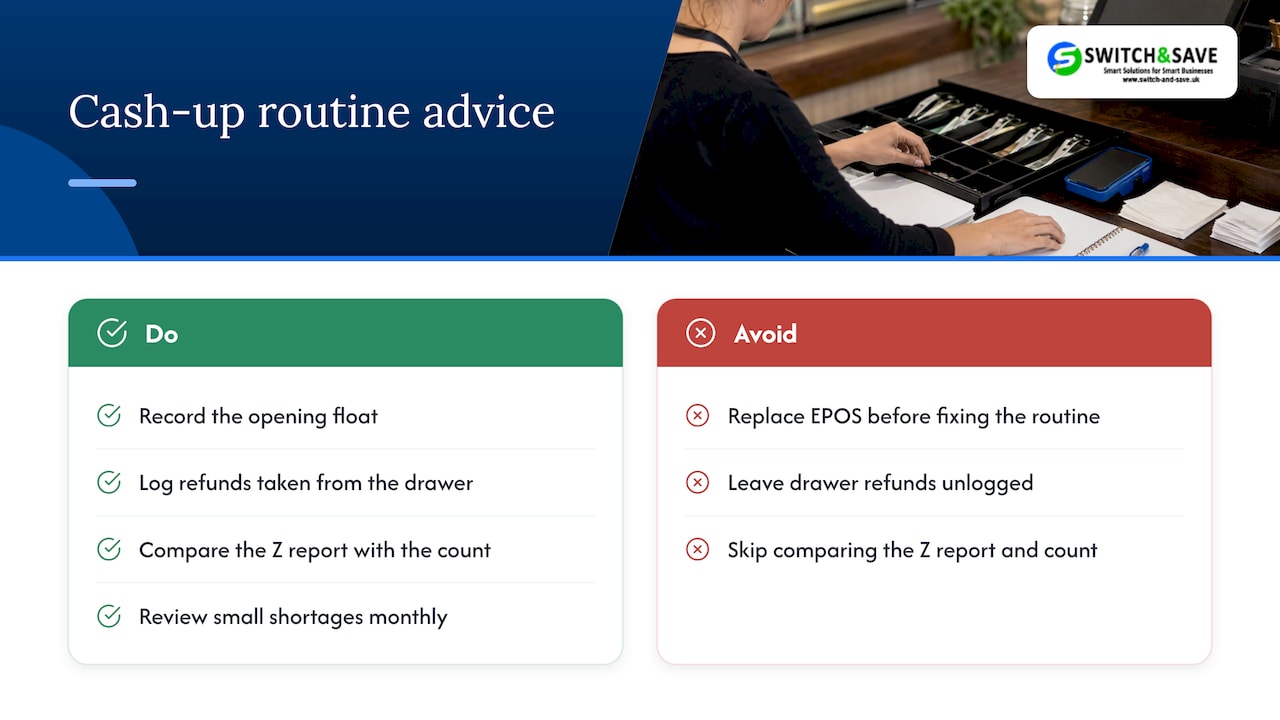
So our advice is to fix the routine first, then pick a system that makes the routine hard to skip. Look for three things: login-per-person, reports that split cash from card, and a dashboard you can read from home. If a system can’t show you who opened the drawer and when, it won’t help you find a pattern.
We also think owners should treat a small, regular shortage as information. A £2 gap every Friday is telling you something about Friday. Record it, look at it monthly, and talk to the team about it before it grows.
— Amir
Setting up your EPOS for better cash control
If you are choosing or replacing a system, our offers are built around exactly this routine.
- Our Hospitality EPOS Bundle is £549 one-off, with AI-powered cloud software at £20 per month. It suits cafés, takeaways and restaurants.
- The Integrated Payments Bundle combines EPOS and card terminal, with the EPOS software subscription at £30 per month.
- For shops, see our EPOS bundles for retail, or look at our card machines if you only need payments.
👉 Not sure which fits? Start from our EPOS system page and we will talk you through it, with UK-based support and easy migration from your current provider.
Common mistakes to avoid
- Counting only against the till roll. Include float, pay-outs and bankings in your expected figure.
- Running the Z report more than once. It closes the session, so run it once, after the last sale.
- Skipping the log for small pay-outs. Small errors add up.
- Sharing one login. You lose the audit trail.
- Banking without a dated slip. You need to match deposits to a trading period.
- Leaving explanation for later. Note the cause of a difference on the day while staff still remember it.
FAQ
What is the difference between an X report and a Z report?
An X report gives a snapshot of sales so far and does not close the session or reset totals. A Z report is run at the end of the day or shift, closes the session and starts a fresh one. Use X for mid-day checks and Z for cashing up.
How do I reconcile a cash drawer?
Start with the opening float, add cash sales and pay-ins, then subtract pay-outs and cash refunds. That gives the expected cash. Count the drawer and record the difference in a separate till-difference account rather than changing sales.
Can I adjust my sales figure when the till is short?
No, not to hide a shortage. HMRC’s retail scheme guidance says you cannot reduce your daily gross takings for theft, poor cash handling or voids. Evidence-backed adjustments are allowed for specific things such as a till fault or counterfeit notes, so ask your accountant if unsure.
How often should I cash up?
At least once a day at close, and at each shift change if more than one person uses the drawer. Busy sites also benefit from safe drops during the day. The aim is that every cash movement can be traced to a time and a person.
Sources
- Point of Sale VAT Retail Scheme (VAT Notice 727/3), GOV.UK
- VRS4150 Till shortages and excesses, HMRC internal manual
- CH259100 Cashing up overview, HMRC internal manual
- How should I reconcile cash takings and till differences? CASS
- Counterfeit Currency: Advice to Retailers, National Crime Agency
- Risk assess your business for money laundering supervision, GOV.UK
- Cash handling in retail, nibusinessinfo.co.uk
- Heart of England Co-op case study, Volumatic