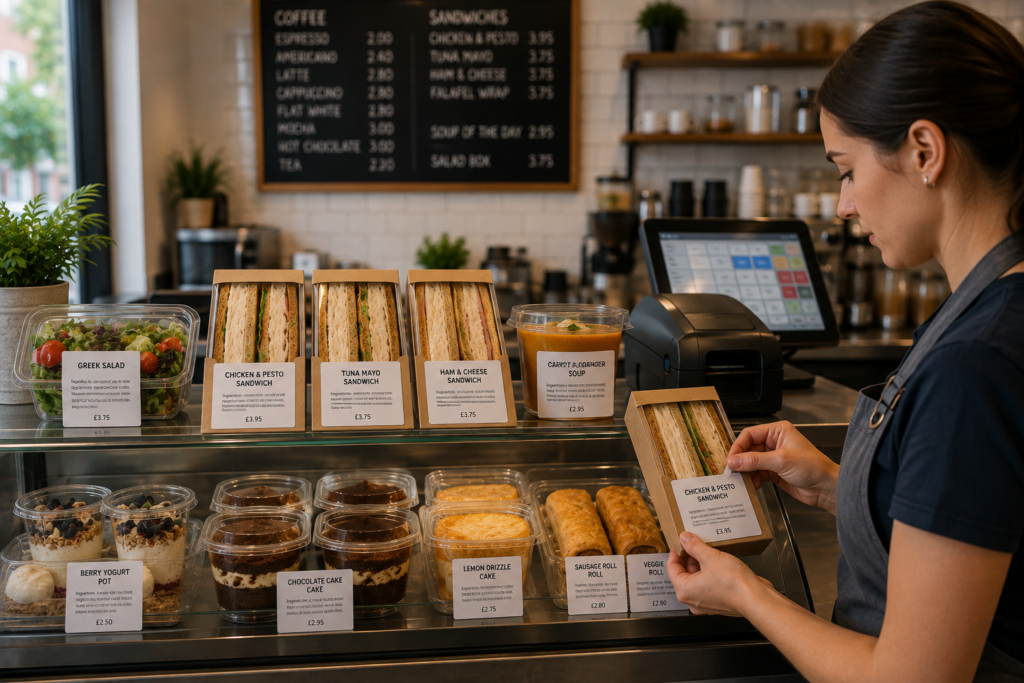
Natasha’s Law requires UK food businesses to provide a full ingredients list on food that is prepacked for direct sale, with any of the 14 legally recognised allergens clearly emphasised.
The law applies when a food business packages food at the same location where it is sold, before the customer orders or selects it. Cafés, takeaways, restaurants, bakeries, pubs, delis, mobile food sellers, schools and other food providers may therefore need to follow Natasha’s Law.
The requirements came into effect across the UK on 1 October 2021. They are intended to help people with food allergies make safer, better-informed purchasing decisions.
Key Takeaways
| Question | Direct answer |
|---|---|
| What is Natasha’s Law? | A UK food-labelling requirement for food that is prepacked for direct sale. |
| When did it take effect? | 1 October 2021. |
| Who must follow it? | Any food business producing prepacked-for-direct-sale food. |
| What must the label show? | The food name, a full ingredients list and clearly emphasised allergens. |
| Does it apply to food made to order? | No, but allergen information must still be provided under other food laws. |
| Does it apply to online orders? | The specific PPDS requirements do not apply in the same way, but allergen information must be available before purchase and when the food is delivered. |
| Who enforces the rules? | Local authorities. |
| Can “may contain” replace an ingredients list? | No. It is additional precautionary information and should only be used following a genuine risk assessment. |
What Is Natasha’s Law?
Natasha’s Law is the commonly used name for rules requiring food businesses to provide full ingredients and allergen information on prepacked-for-direct-sale food, often shortened to PPDS food.
A PPDS food label must include:
- The name of the food
- A complete ingredients list
- Clear emphasis of any of the 14 regulated allergens contained in the ingredients
Allergenic ingredients can be emphasised using bold text, capital letters, underlining or a contrasting colour, provided the information remains clear and easy to read.
Natasha’s Law applies throughout the UK. The Food Standards Agency provides guidance for businesses in England, Wales and Northern Ireland, while Food Standards Scotland publishes separate Scottish guidance.
Why Was Natasha’s Law Introduced?
Natasha’s Law was named in memory of Natasha Ednan-Laperouse, who died after suffering an allergic reaction to sesame in a baguette.
At the time, foods prepared and packed on the premises where they were sold did not always need a full ingredients label. The law was introduced to close that information gap and give customers clearer information before buying packaged food.
The purpose of the law is not simply to add more text to packaging. It is to ensure that customers can identify ingredients and allergens without relying entirely on a conversation with a member of staff.
What Does Prepacked for Direct Sale Mean?
Food is generally considered prepacked for direct sale when it meets the following conditions:
- It is packaged before the customer orders or selects it.
- It is packaged at the same premises or site where it is sold.
- The food and packaging form a single item ready to be presented to the customer.
The packaging may fully or partly enclose the food, but the product must not be capable of being altered without opening or changing that packaging.
A takeaway prepares chicken sandwiches at 8am, places them in sealed paper bags and displays them in a refrigerator for customers to select at lunchtime.
Those sandwiches are likely to be PPDS food because they were:
- Prepared by the business
- Packaged before selection
- Offered for sale at the same premises
The sandwiches therefore need compliant labels.
However, when the same business makes and packages a sandwich only after a customer orders it, that sandwich is not normally PPDS food. Allergen-information requirements still apply, but the Natasha’s Law labelling rules do not apply in the same way.
Who Must Follow Natasha’s Law?
Natasha’s Law applies to any food business producing PPDS food, regardless of whether it is an independent shop, national chain, permanent premises or temporary food operation.
Businesses that may need to comply include:
- Cafés and coffee shops
- Restaurants
- Takeaways
- Bakeries
- Sandwich shops
- Delicatessens
- Pubs and bars serving food
- Convenience stores
- Farm shops and butchers
- Mobile food vans
- Market and street-food sellers
- Supermarket cafés
- Schools, colleges, universities and nurseries
- Contract and institutional caterers
The determining factor is not the business category or size. The key question is whether the business packages food before it is selected or ordered and sells it from the same site.
A small independent bakery can have the same PPDS responsibilities as a large restaurant chain.
Which Foods Are Covered by Natasha’s Law?
Examples of food that may be PPDS include:
- Sandwiches prepared and wrapped before sale
- Salad boxes placed in a refrigerated display
- Soup poured into sealed pots before customers order
- Prepacked paninis intended to be reheated
- Pizza placed into boxes before selection
- Cakes wrapped individually in cling film
- Pies placed into packaging
- Prepacked burgers held under a hot lamp
- Deli products wrapped before customers select them
- Prepared food displayed in tied or sealed bags
Even relatively simple packaging may count. A folded paper bag, tied plastic bag or cling film can meet the packaging definition when the food cannot be altered without opening or changing the packaging.
Hot drinks can sometimes be PPDS
A tea or coffee made after a customer orders it is not normally PPDS food.
However, when a business prepares drinks in advance, places lids on them and holds them ready for customers to select, those drinks may fall within the PPDS definition and require appropriate labelling.
Which Foods Are Not Covered?
Natasha’s Law does not normally cover food that is:
- Made and packaged after the customer orders it
- Sold loose without packaging
- Displayed on an open tray
- Served on a plate
- Available through an open salad bar
- Sliced from a larger cake after selection
- Placed into packaging at the customer’s request
For example, an unpackaged cake displayed behind a counter is not PPDS merely because it is protected by a larger display cover. When the cake is sliced and placed into a bag after the customer orders it, the PPDS rules do not normally apply.
This does not mean allergen information is optional. Food businesses must provide allergen information for prepacked and non-prepacked foods and must manage allergen risks effectively during food preparation.
What Must Appear on a PPDS Food Label?
Every qualifying PPDS product must display three essential elements.
1. The name of the food
The label must show the legal, customary or sufficiently descriptive name of the product.
A vague description such as “Freshly Made” would not adequately identify the food. A clearer name would be “Chicken and Pesto Sandwich” or “Cheese and Onion Pasty”.
2. A full ingredients list
The ingredients list must be introduced by a suitable heading that includes the word ingredients.
Ingredients are generally listed in descending order according to their weight when the food was made. Compound ingredients must also be handled correctly.
For example, the bread used in a sandwich contains several ingredients of its own. Those ingredients may need to be shown within the sandwich’s complete ingredients list.
3. Emphasised allergens
Every regulated allergen must be emphasised each time it appears in the ingredients list.
A simplified example could look like this:
Chicken and Pesto Sandwich
Ingredients: Bread (WHEAT flour, water, yeast, salt), chicken, pesto (MILK, cashew NUTS), mayonnaise (EGG, mustard), lettuce.
The exact label will depend on the product, supplier information, recipe and applicable food-labelling rules.
Labels must be visible and clearly legible. Customers should not need to open the packaging to find the mandatory information. Handwritten labels are permitted when they meet presentation and legibility requirements.
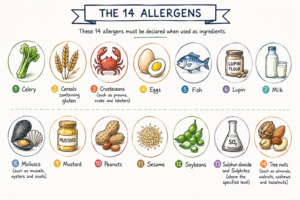
What Are the 14 Allergens?
The 14 allergens that must be declared when used as ingredients are:
- Celery
- Cereals containing gluten, including wheat, rye, barley and oats
- Crustaceans, such as prawns, crabs and lobsters
- Eggs
- Fish
- Lupin
- Milk
- Molluscs, such as mussels and oysters
- Mustard
- Peanuts
- Sesame
- Soybeans
- Sulphur dioxide and sulphites above the legally specified concentration
- Tree nuts, including almonds, hazelnuts, walnuts, cashews, pecans, pistachios, Brazil nuts and macadamia nuts
Food businesses must also remember that customers can react to ingredients outside this regulated list. The 14 allergens are the substances specifically required to be declared as allergens under food law.
Can a Business Simply Write “May Contain Allergens”?
No. A general “may contain” warning does not replace the required food name, complete ingredients list or emphasised allergen information.
Precautionary statements such as “may contain” are intended to communicate a genuine risk of unintended allergen cross-contact. They should only be used following a proper risk assessment where the risk cannot be removed through reasonable controls such as cleaning, segregation or changes to preparation procedures.
Using blanket warnings on every product may provide customers with less useful information and could unnecessarily restrict their choices.
Does Natasha’s Law Apply to Online and Telephone Orders?
The specific PPDS labelling changes do not apply in the same way to food sold through distance selling, including internet and telephone orders.
However, food businesses selling through websites, apps or telephone ordering must provide allergen information:
- Before the customer completes the purchase
- When the food is delivered
The Food Standards Agency advises businesses to make written allergen information available at both stages.
For example, a takeaway should display allergen information through its online ordering journey and provide suitable information with the delivered order.
Some businesses choose to label all applicable packaged products consistently, even when different sales channels technically have different requirements. This can simplify internal procedures, but the business remains responsible for ensuring that each sales route follows the relevant law.
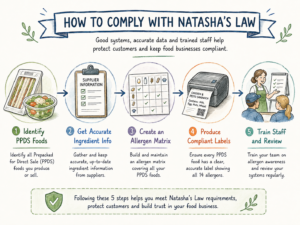
How Can Food Businesses Comply With Natasha’s Law?
Compliance requires more than purchasing a label printer. Labels are only reliable when the ingredient and recipe data behind them is accurate.
1. Identify every PPDS product
Review everything prepared and packaged before customers place an order.
Do not focus only on sandwiches. Include cakes, salads, desserts, hot-held foods, deli items, drinks and temporary products.
2. Obtain complete supplier information
Collect current product specifications and ingredients lists from suppliers.
Do not assume that two similar products from different suppliers contain identical ingredients or allergens.
3. Standardise recipes
Document the exact ingredients used in every PPDS product, including sauces, breads, garnishes, oils and compound ingredients.
Staff should not make unrecorded ingredient substitutions.
4. Create an allergen matrix
Use an allergen matrix to connect each product with the allergens found in its ingredients.
The matrix should support staff training and checking, but it does not replace the full ingredients label required on PPDS food.
5. Produce compliant labels
Labels should show the food name, ingredients and clearly emphasised allergens.
Printed labels, approved labelling software, preprinted packaging or legible handwritten labels may be used, depending on the business model.
6. Check labels before products go on sale
Create a two-stage checking process where practical:
- One person prepares and labels the product.
- Another verifies the product, recipe and label.
Remove any product when the business cannot confidently verify its ingredients.
7. Control supplier and recipe changes
An apparently minor supplier substitution can change the ingredients or allergen profile.
Food businesses should have a procedure for updating product records and labels whenever suppliers, ingredients or recipes change.
8. Train every relevant employee
Employees preparing food, printing labels, serving customers and handling allergy enquiries should understand their responsibilities.
The Food Standards Agency states that food businesses must ensure staff receive allergen training and provides free training resources.
9. Prepare for printer or system failures
Keep a documented backup process for situations where the label printer, software or network is unavailable.
A food business should not sell an unlabelled PPDS product simply because its normal printing process has stopped working.
How Technology Can Support Allergen Management
Technology can help food businesses organise menu information, product records, recipes, supplier changes and staff procedures. However, an EPOS system or label printer does not automatically guarantee legal compliance.
A connected hospitality system may help a business:
- Keep menu items organised
- Control staff access
- Update products centrally
- Manage takeaway and dine-in orders
- Record item notes and modifiers
- Maintain more consistent operating procedures
- Connect ordering, payments and reporting
Switch & Save provides hospitality EPOS systems for restaurants, takeaways, cafés, pubs and other UK food businesses. Its systems can support ordering, kitchen communication, integrated payments, online ordering and reporting.
You can also read:
- How the Right EPOS System Can Transform Your Food Business
- EPOS With Online Ordering for Restaurants and Takeaways
- Integrated Card Payments for Restaurants
Food businesses should confirm that any EPOS, recipe-management or label-printing setup meets their specific workflow and legal responsibilities. Where necessary, seek guidance from the local authority or a qualified food-safety professional.
What Happens If a Business Does Not Comply?
Local authorities enforce allergen-information regulations.
A business that does not comply may receive advice or formal action. An improvement notice may be issued when the business fails to correct a problem, and failure to meet the notice can lead to a penalty. In some circumstances, prosecution may also be possible.
The commercial consequences may also include:
- Serious risk to customers
- Product withdrawals
- Lost customer trust
- Negative publicity
- Operational disruption
- Financial and reputational damage
Businesses should therefore treat allergen information as a core food-safety control rather than a basic administrative task.
Frequently Asked Questions
Does Natasha’s Law apply to small businesses?
Yes. Business size does not determine whether the rules apply. A small independent bakery, takeaway or market seller must comply when it produces PPDS food.
Does Natasha’s Law apply to home bakers?
It may apply when a registered home food business packages products before they are selected and sells them directly from the same premises or operating site. The exact sales and packaging arrangement should be checked against official guidance.
Does Natasha’s Law apply to takeaways?
Yes, when a takeaway prepares and packages food before the customer orders or selects it. Food packaged only after an order is placed is not normally PPDS, although other allergen-information requirements still apply.
Does every food need an ingredients label?
No. The full PPDS label applies to qualifying prepacked-for-direct-sale food. Loose food and food made to order follow different allergen-information requirements.
Do cakes wrapped in cling film need labels?
When individual cakes are wrapped before customers select them and the cling film meets the packaging definition, they are likely to be PPDS and require compliant labels.
Are products behind a counter covered?
They can be. Food does not need to be self-service to qualify. A packaged product held behind the counter may still be PPDS when it was packaged before the customer ordered it.
Can allergens be listed separately instead of in the ingredients?
PPDS labels require a full ingredients list with regulated allergens emphasised within that list. A separate “contains” statement does not normally replace this requirement.
Is vegan food automatically safe for people with milk or egg allergies?
No. Vegan products may still be exposed to accidental cross-contact with animal-derived allergens during preparation. Businesses should not treat “vegan” as equivalent to “allergen-free”.
Who should a business contact for guidance?
Businesses can contact the food-safety or trading-standards team at their local authority and consult official Food Standards Agency or Food Standards Scotland guidance.
Natasha’s Law applies to UK businesses that prepare and package food before customers order or select it and sell that food from the same premises or operating site.
Qualifying PPDS food must display:
- The food’s name
- A complete ingredients list
- Clear emphasis of any regulated allergens
The safest compliance process is to identify every PPDS product, document recipes, obtain current supplier information, train staff, control ingredient changes and check labels before food is offered for sale.
Switch & Save helps UK businesses reduce costs with AI-powered EPOS systems, card payment solutions and business finance.
This article provides general business information and is not a substitute for legal or professional food-safety advice.