
To dispute a chargeback on a carservices provider immediately, check the chargeback reason code and submit evidence before the deadline shown in the notification. Your evidence may include the card receipt, EPOS transaction record, invoice, proof of delivery or collection, signed agreement, refund policy and customer communications.
You do not normally challenge a chargeback directly through the card machine. Your acquiring bank or payment provider manages the dispute process and sends your evidence to the cardholder’s bank. The cardholder’s bank then decides whether the payment should remain with your business or be returned to the customer.
Key Takeaways
| Question | Direct answer |
|---|---|
| Can a merchant challenge a chargeback? | Yes, when the sale was legitimate and supporting evidence is available. |
| Who handles the dispute? | Your merchant services provider or acquiring bank. |
| What should you check first? | The reason code, transaction details and response deadline. |
| What evidence is useful? | Receipts, EPOS records, invoices, delivery confirmation, signed documents and customer messages. |
| How quickly should you respond? | Immediately. Use the exact deadline provided by your payment provider. |
| Can a chargeback be challenged using the terminal? | Usually no. Responses are normally submitted through your provider’s portal, support team or dispute system. |
| Is a chargeback the same as a refund? | No. A refund is issued voluntarily by the merchant, while a chargeback is raised through the customer’s bank. |
What Is a Card Machine Chargeback?
A chargeback is a reversal of a debit or credit card payment initiated through the cardholder’s bank.
The customer may tell their bank that:
- They do not recognise the transaction.
- The card was used without permission.
- The goods or services were not provided.
- An item was faulty or not as described.
- The wrong amount was charged.
- The payment was processed twice.
- A promised refund was not received.
- A recurring payment continued after cancellation.
Chargeback is available for both debit and credit card purchases. It is separate from Section 75 protection and is governed by the operating rules of card schemes such as Visa, Mastercard and American Express rather than being a standalone legal right. geback Versus Refund
A refund is agreed and processed directly by the business. A chargeback begins when a customer asks their bank to challenge a transaction.
For example, a customer returns a faulty kettle to a grocery shop and the retailer agrees to return the money. That is a refund.
If the customer contacts their bank and claims that the shop refused to resolve the problem, the bank may begin a chargeback investigation. Refunds and chargebacks are therefore not interchangeable. Merchant Dispute a Chargeback?
Yes. A merchant can dispute a chargeback when there is credible evidence that the transaction was legitimate or that the customer’s claim is incorrect.
The process of challenging a chargeback is sometimes called chargeback representment. It involves presenting the transaction again, together with evidence explaining why the payment should not be reversed.
However, not every chargeback should be challenged. A response is more likely to be worthwhile when:
- The correct customer authorised the payment.
- The amount charged matches the agreed price.
- The product was delivered or collected.
- The service was completed.
- Your refund or cancellation terms were clearly disclosed.
- A refund has already been issued.
- The customer continued using the service after the disputed payment.
- EPOS, order and payment records support your version of events.
You should not submit an unsupported response simply because you do not want to lose the sale. The evidence must directly address the customer’s stated reason for disputing the transaction.
How to Dispute a Card Machine Chargeback
Step 1: Read the Chargeback Notification
Your payment provider or acquiring bank should send a notification containing information such as:
- Transaction date
- Transaction amount
- Disputed amount
- Card scheme
- Chargeback reason code
- Merchant reference
- Response deadline
- Evidence submission instructions
Do not assume the deadline will be the same for every case. Card scheme and provider deadlines vary, and the acquiring bank may give the merchant less time than the overall scheme permits.
Mastercard advises that merchant response deadlines are commonly between 20 and 45 days after notification, while acquiring banks may operate shorter internal timeframes. Missing the deadline can result in the dispute being lost by default. 2: Identify the Exact Reason Code
The reason code explains why the customer is challenging the payment.
Your response should answer that specific allegation. Sending a large collection of unrelated documents can make the case harder to review.
For example:
| Dispute reason | Evidence that may be relevant |
|---|---|
| Transaction not recognised | Receipt, order details, trading name, date, time and customer communications |
| Goods not received | Signed delivery record, tracking information or collection confirmation |
| Service not provided | Appointment record, signed work sheet or proof the service was completed |
| Duplicate transaction | Separate receipts and order records showing two genuine purchases |
| Wrong amount charged | Itemised bill, agreed quotation, menu, invoice or signed total |
| Refund not received | Refund receipt, refund date and provider reference |
| Cancelled recurring payment | Cancellation terms, cancellation date and billing history |
| Item not as described | Product listing, order specification and correspondence about the complaint |
Step 3: Find the Sale in Your EPOS and Payment Records
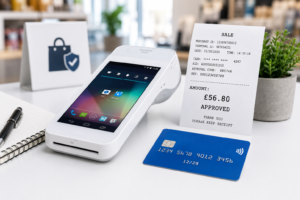
Locate the original transaction using the date, amount, terminal reference or order number.
An integrated EPOS and payment setup can make this stage easier because the business may be able to match:
- The items sold
- Transaction date and time
- Staff member
- Till or terminal
- Payment method
- Receipt number
- Order type
- Customer details
- Refund history
Switch & Save provides integrated EPOS bundles that help businesses connect sales, payment and reporting information. Integration can reduce manual entry errors and make it easier to investigate a disputed transaction.
Businesses reviewing their existing setup can also read our guide to POS system integration and compatibility.
Step 4: Contact the Customer Where Appropriate
A customer may have raised a dispute because they did not recognise the trading name on their statement or could not reach the business.
Contacting them may clarify what happened. Keep the conversation professional and record any relevant response.
Do not pressure the customer to withdraw a legitimate claim. The purpose is to understand the complaint and, where possible, resolve a genuine misunderstanding.
Using a consistent business and trading name on payment records can help prevent customers from mistaking a legitimate sale for fraud. Clear customer service and accurate record-keeping may also reduce avoidable chargebacks. 5: Prepare a Clear Evidence Pack
Your evidence pack should be organised and easy to review.
Include:
- A short summary of the case.
- The transaction receipt.
- The EPOS sales record.
- Evidence addressing the reason code.
- Relevant customer correspondence.
- Your terms, refund policy or cancellation policy.
- Proof that the customer accepted those terms, where available.
The written summary should explain what was purchased, when it was supplied and how the documents disprove the claim. Mastercard recommends a concise rebuttal that connects the evidence directly to the dispute reason. 6: Submit the Response Through Your Provider
Follow the instructions supplied by your card payment provider.
Depending on the provider, you may submit the evidence through:
- An online merchant portal
- A chargeback management platform
- A secure document-upload link
- A dedicated disputes email address
- Your account manager or support team
The acquiring bank reviews the response and forwards the relevant information through the card scheme to the cardholder’s issuing bank. The issuing bank then decides whether the chargeback should be upheld or reversed. 7: Record the Outcome
Keep an internal record of:
- The original sale
- The reason code
- Evidence submitted
- Submission date
- Outcome
- Amount recovered or lost
- Any chargeback fee
- Process changes required
The case should become part of your operational learning. For example, repeated “transaction not recognised” disputes may indicate that your statement descriptor is unclear. Repeated “goods not received” cases may point to weak delivery or collection records.
What Evidence Should You Submit?
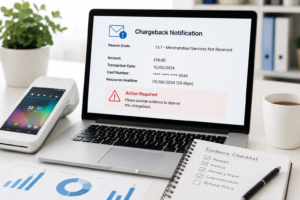
The strongest evidence depends on the type of business and dispute.
Retail Shops and Grocery Stores
Useful evidence may include:
- Itemised till receipt
- CCTV retention reference, where lawfully available
- Product barcode and description
- Refund or exchange record
- Signed collection confirmation
- Authorisation and terminal details
Restaurants, Cafés and Takeaways
A hospitality business may provide:
- Itemised order
- Table number or order type
- Order time
- Kitchen ticket
- Delivery confirmation
- Online ordering record
- Signed bill
- Messages with the customer
A hospitality EPOS system can help connect the payment to the table, takeaway, delivery or collection order.
Service Businesses
Barbers, salons, repair shops and other service businesses may use:
- Appointment records
- Signed quotations
- Before-and-after photographs
- Job completion forms
- Messages confirming the appointment
- Evidence that the customer attended
- Terms covering deposits or cancellations
Mobile Phone and Electronics Shops
For higher-value products, retain:
- Product serial number or IMEI
- Itemised invoice
- Warranty registration
- Signed collection record
- Proof of identity checks where appropriate
- Repair or diagnostic reports
- Customer communications
Only collect information that is genuinely necessary and that your business can store and protect responsibly. Should You Accept a Chargeback?
Accepting a chargeback may be more appropriate when:
- The payment was genuinely duplicated.
- The wrong amount was entered.
- The agreed product or service was not supplied.
- A refund was promised but not processed.
- Your records cannot support the sale.
- The transaction appears to be genuinely unauthorised.
- The value of the dispute does not justify the administration required.
- Your own terms or customer communications support the claim.
Before accepting it, confirm that no separate refund has already been issued. A customer should not receive both a merchant refund and a chargeback for the same transaction. ical UK Chargeback Examples
How to Reduce Future Card Payment Disputes
Good prevention is usually more efficient than responding after a chargeback has been raised.
Businesses should:
- Use a recognisable trading name on customer statements.
- Provide itemised receipts.
- Display refund and cancellation terms clearly.
- Record delivery and collection.
- Reconcile EPOS sales against card settlements.
- Avoid manually entering payment amounts where integration is available.
- Respond to customer complaints promptly.
- Keep order, refund and communication records organised.
- Investigate duplicate or unusual transactions quickly.
- Train staff to confirm the amount before requesting payment.
Switch & Save offers card machine solutions for UK businesses alongside EPOS integration and reporting tools. Matching the card payment to the correct order can support faster reconciliation and provide a clearer transaction record if a dispute arises.
Frequently Asked Questions
Can I dispute a chargeback from the card machine?
Usually not directly. The card terminal processes the original payment, but the chargeback response is normally handled through your payment provider, acquiring bank or merchant portal.
How long do I have to respond to a chargeback?
Use the exact deadline in your provider’s notification. Merchant deadlines vary by provider, card scheme and reason code. Respond as early as possible rather than relying on a general timeframe.
What happens if I ignore a chargeback?
The case may be decided without your evidence, and the disputed amount may remain with the customer. Your provider may also charge a fee depending on your merchant agreement.
Does a card receipt prove that the customer authorised the sale?
A receipt can be useful, but it may not be sufficient by itself. The required evidence depends on the reason code. For example, a goods-not-received dispute may require delivery confirmation rather than only a payment receipt.
Can a customer receive both a refund and a chargeback?
A customer should not be reimbursed twice for the same purchase. If you have already issued a refund, submit the refund confirmation and transaction reference to your provider.
Who makes the final decision?
The cardholder’s issuing bank normally reviews the claim and merchant response. Your acquiring bank or payment provider manages the submission of your evidence through the card scheme.
Can Switch & Save decide a chargeback case?
No. Chargeback outcomes are determined through the payment provider, acquiring bank, card scheme and issuing bank. Switch & Save can help businesses choose suitable payment and EPOS solutions, but it cannot guarantee or control a dispute decision.
Final Checklist
When a card machine sale is disputed:
- Open the notification immediately.
- Check the response deadline.
- Identify the chargeback reason code.
- Locate the EPOS and card transaction.
- Gather reason-specific evidence.
- Write a concise case summary.
- Submit everything through the correct provider channel.
- Record the result and improve your process.
Strong transaction records do not guarantee that every dispute will be decided in your favour, but they put your business in a better position to respond accurately and on time.
Switch & Save helps UK businesses reduce costs with AI-powered EPOS systems, card payment solutions and business finance.
Explore our card machine solutions, compare EPOS bundles or review our business finance options.