
Hospitality automation is the use of technology to handle repetitive, administrative, and operational tasks in hotels, restaurants, and bars, freeing your team to focus on guests rather than paperwork. For UK hospitality businesses, the case is now financial as well as operational. Implementing automation in hotels with 20–80 rooms costs £3,000–£8,000 and typically delivers payback within 4–8 months. The industry term you will encounter most often is business process automation (BPA), though the broader category covers everything from EPOS systems and self-service kiosks to agentic AI and contactless service platforms. This guide covers what works, what it costs, and how to do it right.
What is hospitality automation and why does it matter now?
Hospitality automation is defined as the application of software and hardware to execute tasks that previously required manual staff input, across front-of-house, back-office, and guest-facing operations. The scope has expanded significantly in 2026, moving well beyond simple self-service kiosks into AI-driven pricing, predictive maintenance, and automated guest communications.
The financial argument is clear. UK managers lose an average of 286 hours per year switching between unconnected software systems. That fragmentation alone accounts for roughly 13% of operational costs. Addressing it through integrated automation is not a luxury. It is a cost-control measure.
The guest experience argument is equally strong. When staff spend less time on data entry, rostering, and order processing, they spend more time with guests. That shift directly affects review scores, repeat bookings, and revenue per available room (RevPAR).
What are the main types of automation technology in hospitality?
Automation in hospitality falls into four broad categories, each targeting a different part of your operation.
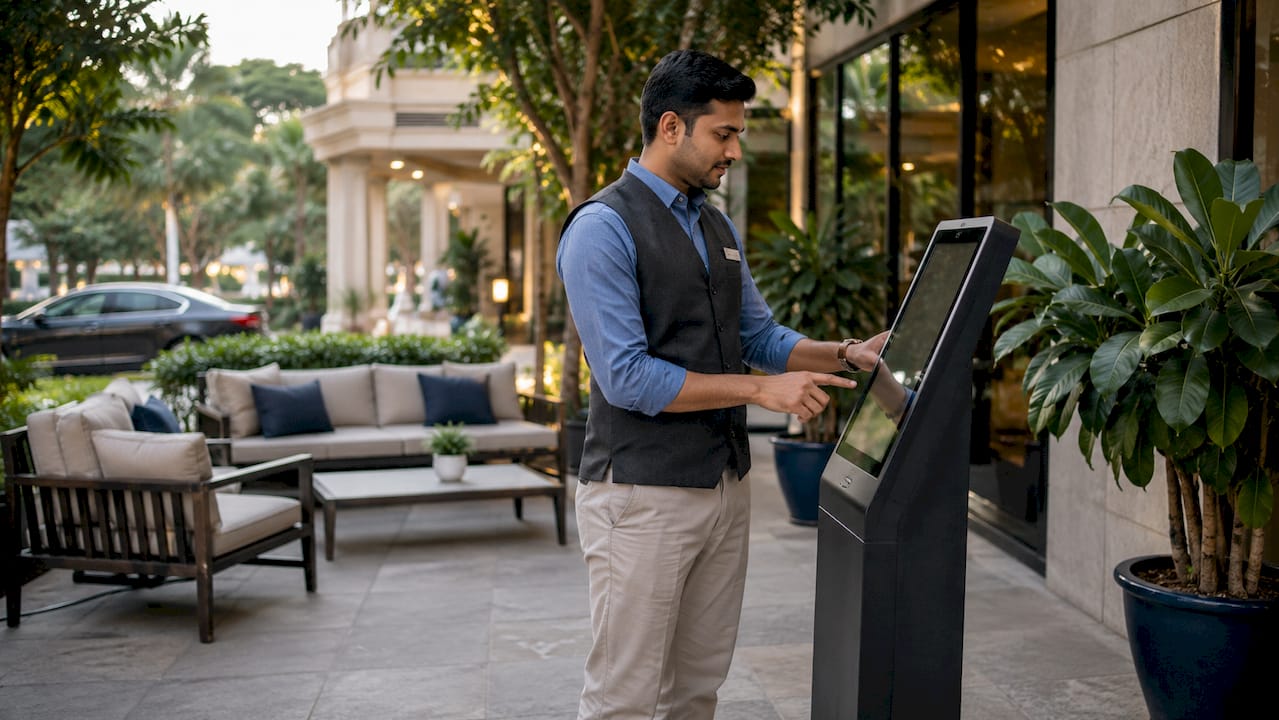
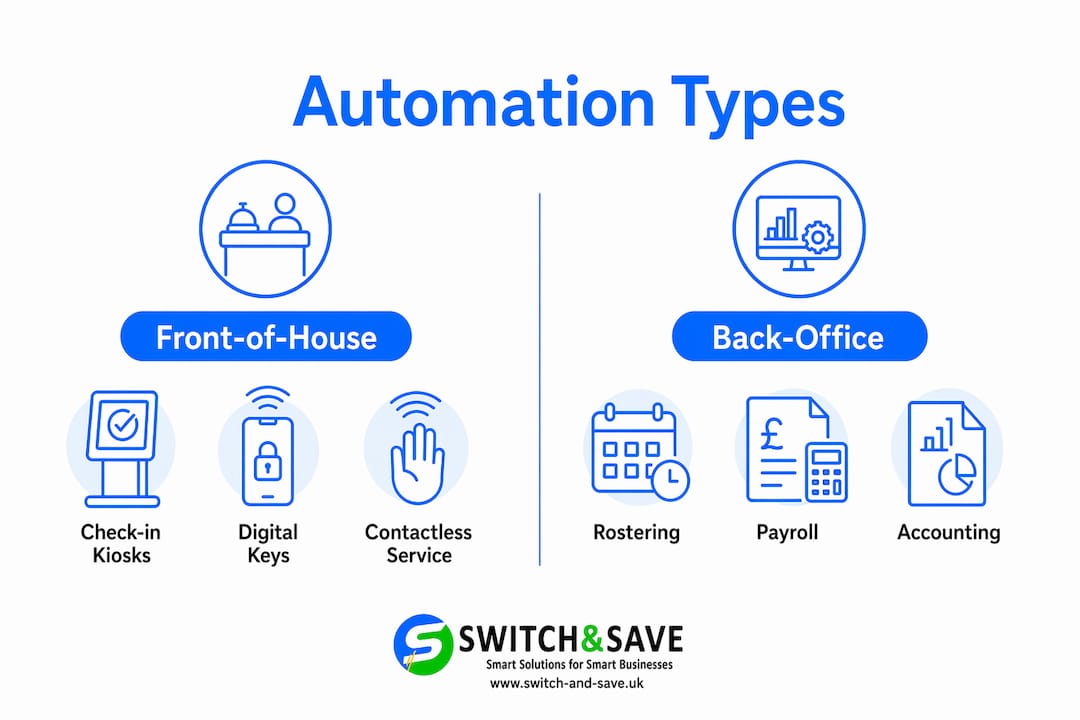
Front-of-house automation covers automated check-in and check-out kiosks, digital room keys, and contactless service platforms. These reduce queue times and allow guests to arrive and depart on their own schedule. Many hotels now combine these with voice assistant hospitality tools that handle room service requests and local recommendations without involving reception staff.
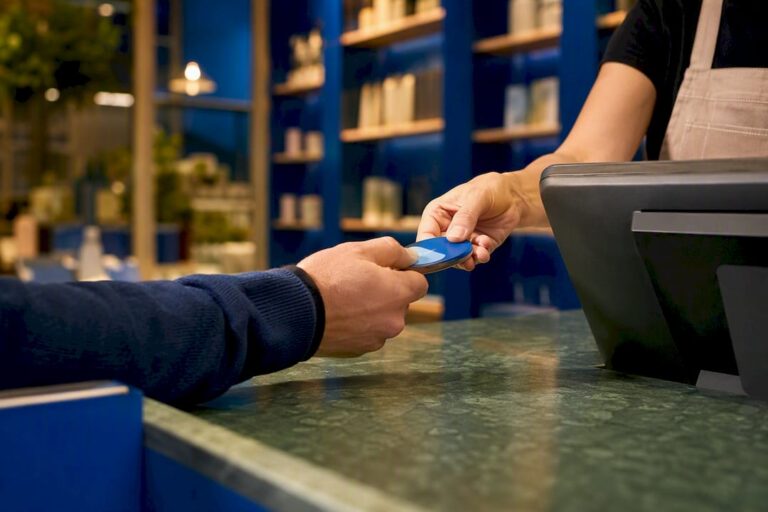
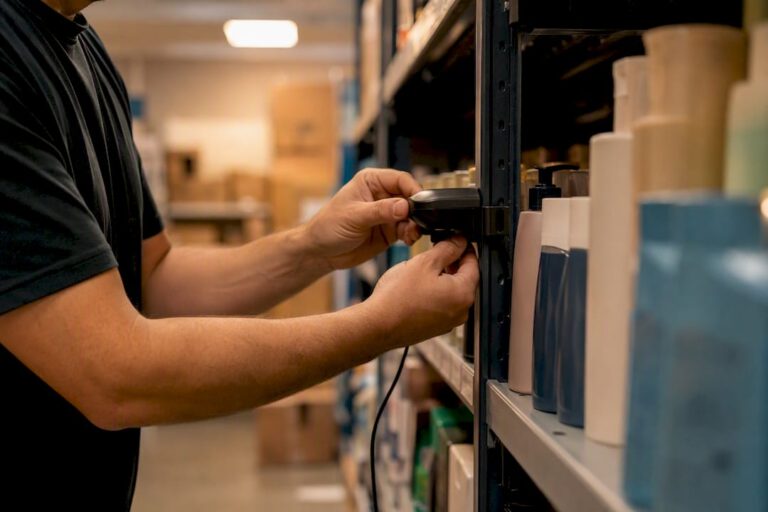
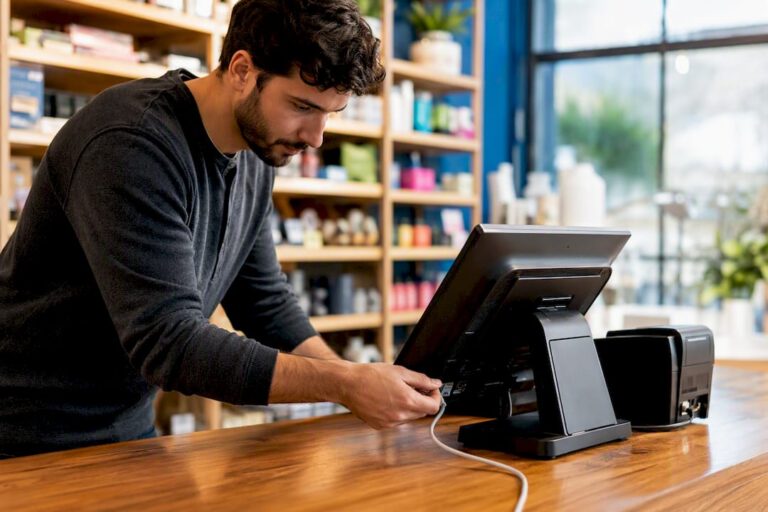
EPOS and transaction automation sits at the heart of restaurant and bar operations. A modern hospitality EPOS system handles order taking, payment processing, and real-time inventory tracking in one place. The result is fewer errors, faster table turns, and accurate stock data without manual counting.
Agentic AI is the most significant development in hospitality tech trends for 2026. These systems autonomously re-price rooms based on demand, manage guest recovery workflows, and complete complex multi-step tasks without human input at each stage. They integrate with major property management systems (PMS) and yield measurable revenue gains of 4–9% RevPAR within 90 days of deployment.
Back-office automation covers staff rostering, payroll integration, purchase order generation, and accounting reconciliation. These are the tasks that consume the most admin hours and are the easiest to automate with clear, immediate returns.
| Automation type | Primary benefit | Typical tools |
|---|---|---|
| Front-of-house kiosks | Faster check-in, reduced queue times | Self-service terminals, digital key apps |
| EPOS and payment systems | Fewer errors, real-time stock data | Integrated EPOS with cloud dashboard |
| Agentic AI pricing | RevPAR uplift, dynamic revenue management | AI-powered PMS integrations |
| Back-office BPA | Admin hour savings, reduced labour costs | Rostering, accounting, and PO software |
| Predictive maintenance | Fewer breakdowns, lower repair costs | IoT sensors, automated alert systems |
How does automation improve efficiency and reduce costs?
The numbers from UK hospitality operations in 2026 are specific enough to plan a business case around.
Automating back-office workflows eliminates 15–25 hours of weekly admin work in hotels with 20–80 rooms. At standard fully-loaded UK hospitality labour rates, that translates to £22,000–£45,000 in annual savings. For most independent hotels, that figure alone covers the cost of implementation several times over.
Maintenance is another area where the returns are measurable. Hotels using AI-powered maintenance systems see a 35% reduction in maintenance costs and a significant drop in guest complaints related to room faults. Fewer complaints mean better review scores, which directly affect booking conversion rates.
The revenue side of the equation is equally compelling. Agentic AI pricing tools deliver a 4–9% RevPAR uplift. For a typical 120-room UK hotel, that range equals £180,000–£420,000 in additional annual revenue. That is not a marginal improvement. It is a structural change in how the business performs.
Key efficiency gains at a glance:
| Metric | Improvement |
|---|---|
| Weekly admin hours saved | 15–25 hours per week |
| Annual labour cost saving | £22,000–£45,000 |
| Maintenance cost reduction | 35% |
| RevPAR uplift from AI pricing | 4–9% |
| Hours lost to software switching (annual) | 286 hours |
Pro Tip: Before calculating your ROI, map every software tool your team uses in a single week. The number of manual handoffs between systems is usually the biggest hidden cost, and the easiest to fix with a single integrated platform.
How should you implement hospitality automation successfully?
Most automation projects fail within six months. The reason is almost always the same: teams automate perceived inefficiencies rather than proven bottlenecks. The fix is straightforward. Identify where time actually goes before you buy anything.
Start with integration, not features
Your automation tools must write data back into your PMS. Integration with systems like Mews, Cloudbeds, or Opera is not optional. Without bidirectional data exchange, you create a new layer of manual input that cancels out the time savings you were trying to achieve. Check integration capability before signing any contract.
Comply with the Data (Use and Access) Act 2025
The Data (Use and Access) Act 2025 requires that AI decision-making in UK businesses allows meaningful human intervention and override capabilities. Your staff must be able to challenge and reverse automated decisions. Build this into your system configuration from day one, not as an afterthought.
Run a phased pilot with clear metrics
Define your success metrics before you go live. A contract model that specifies deliverables and expected outcomes holds vendors accountable and gives you a clear basis for evaluation. Run a pilot in one department or one property for 60–90 days before scaling.
Common implementation challenges and practical solutions:
- Staff resistance: Involve your team in the selection process. People adopt tools they helped choose.
- Poor data quality: Clean your existing data before migration. Garbage in, garbage out applies to every automation system.
- Vendor lock-in: Confirm data export rights and API access before signing. You need the ability to switch providers without losing your operational data.
- Skill gaps: 30% of UK hospitality businesses still do not use AI in 2026, primarily due to a lack of implementation skills. Budget for training alongside the technology investment.
How does automation support staff and improve guest experience?
Automation does not replace hospitality staff. It changes what they spend their time doing. AI tools handle inventory tracking, order processing, and routine communications, which frees your team for the work that actually requires a human: reading a guest’s mood, resolving a complaint with empathy, or recommending a local restaurant with genuine enthusiasm.
The reinvestment of saved time matters as much as the saving itself. For every five hours saved through automation, three hours should fund staff training. That ratio maximises both retention and financial returns. Staff who feel developed stay longer, and experienced staff deliver better guest experiences.
“AI in hospitality works best when it handles the boring, repetitive tasks. That frees your team to focus on human-to-guest interaction and the kind of personalised service that no algorithm can replicate.”
The guest experience impact shows up in measurable ways. Automated check-in solutions reduce arrival friction. AI-powered communications send personalised pre-arrival messages and post-stay follow-ups without adding to your team’s workload. Predictive maintenance means fewer broken air conditioning units and fewer angry guests at 11pm. These are not abstract improvements. They show up in your TripAdvisor scores and your repeat booking rate.
Smart inventory management practices also contribute directly to guest satisfaction. When your kitchen knows exactly what stock is available in real time, you avoid the awkward conversation where a server has to explain that the dish a guest ordered is no longer available.
Key takeaways
Hospitality automation delivers its strongest returns when you integrate systems fully, target proven bottlenecks, and reinvest time savings into staff development rather than headcount reduction.
| Point | Details |
|---|---|
| Automation pays back fast | UK hotels with 20–80 rooms typically recover implementation costs within 4–8 months. |
| Integration is non-negotiable | Automation tools must connect bidirectionally with your PMS to avoid creating new manual work. |
| Target real bottlenecks | Most projects fail because they address perceived problems rather than validated time drains. |
| Staff training amplifies returns | Reinvesting saved hours into training improves both retention and guest experience outcomes. |
| Compliance is built-in from day one | The Data (Use and Access) Act 2025 requires human override capability in all AI decision-making. |
What I have learned from watching automation projects succeed and fail
Having observed automation roll-outs across UK hospitality businesses of all sizes, the pattern that separates success from failure is almost never the technology. It is the process that surrounds it.
The businesses that get the best results treat automation as an operational discipline, not a technology purchase. They map their workflows before they talk to vendors. They define what success looks like in hours saved and revenue gained, not in features ticked off a checklist. And they test under real conditions, not demo environments. A system that works perfectly in a vendor presentation can behave very differently during a Saturday night dinner service.
The businesses that struggle tend to automate the wrong things first. They invest in guest-facing technology before fixing the back-office chaos that undermines it. There is no point in a beautiful self-service check-in kiosk if the room allocation system behind it is still managed on a spreadsheet.
My honest advice: start with the task that costs you the most time every single week. Automate that one thing properly. Measure the result. Then move to the next. Gradual, evidence-based adoption beats a big-bang implementation every time. The technology is ready. The question is whether your processes are ready to support it.
— Amir
How Switch-and-save can support your automation plans
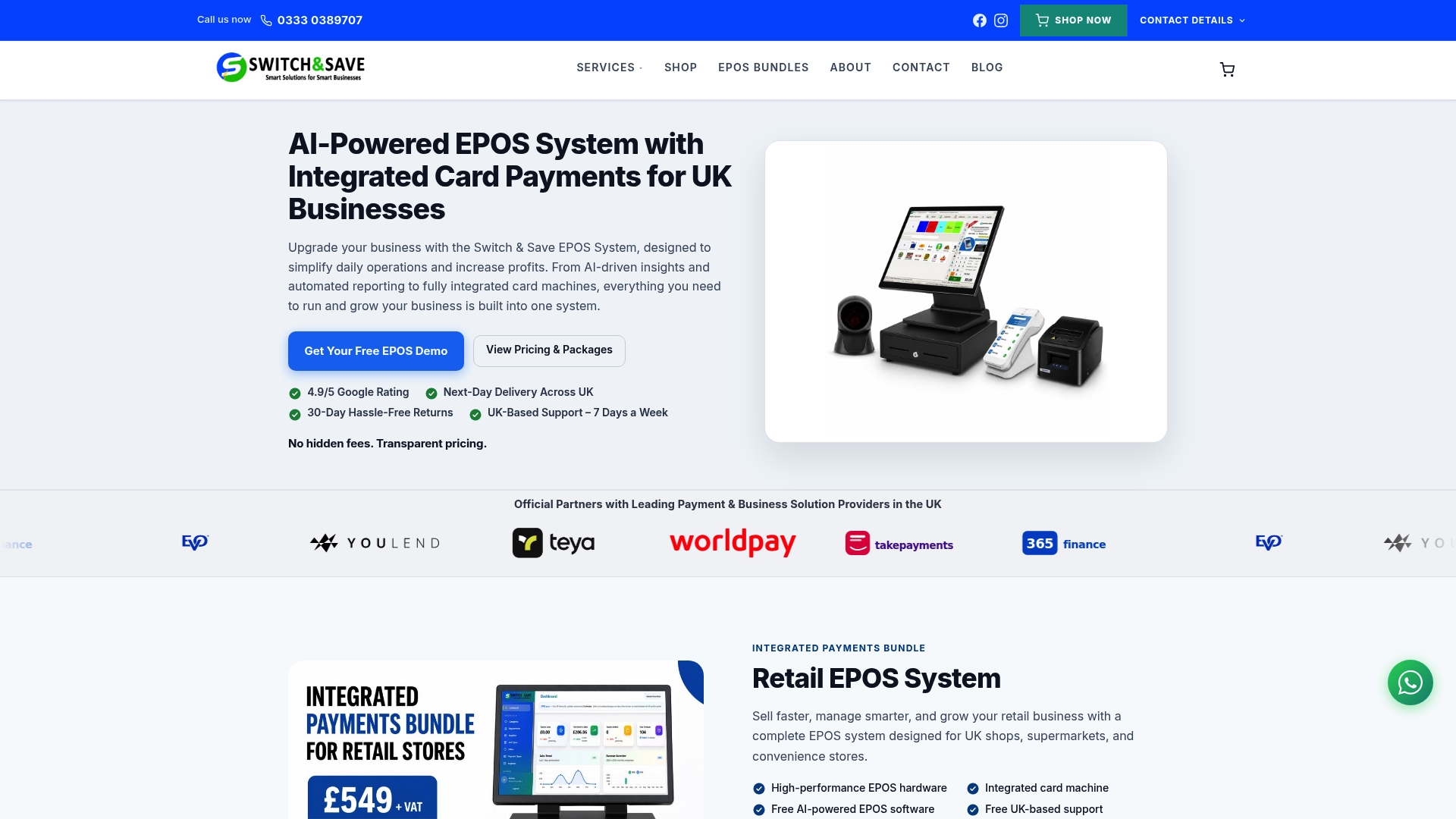
If you are ready to put automation to work in your hospitality business, the right EPOS system is the most practical starting point. Switch-and-save offers hospitality EPOS bundles that combine AI-powered software, integrated payment processing, and real-time inventory management in one package. The systems are built for UK hospitality businesses and come with UK-based support, transparent pricing, and a free demo so you can see exactly what you are getting before you commit. You can also browse the full range of EPOS systems to find the right fit for your operation, whether you run a single-site café or a multi-location hotel group. Get in touch with the Switch-and-save team to book your free demo today.
FAQ
What is hospitality automation?
Hospitality automation is the use of software and hardware to handle repetitive operational tasks in hotels, restaurants, and bars, including check-in, inventory tracking, pricing, and back-office administration, without requiring manual staff input at each step.
How much does hospitality automation cost in the UK?
Implementing business process automation in a UK hotel with 20–80 rooms typically costs £3,000–£8,000, with payback achieved within 4–8 months through labour savings of £22,000–£45,000 per year.
Does automation replace hospitality staff?
Automation does not replace staff. It removes repetitive tasks from their workload, freeing them for guest-facing work. Reinvesting saved time into staff training improves both retention and service quality.
What systems does hospitality automation need to integrate with?
Automation tools must integrate bidirectionally with your property management system, such as Mews, Cloudbeds, or Opera, to avoid creating new manual data entry and to maximise operational efficiency gains.
Is AI in hospitality legal under UK law?
Yes, but the Data (Use and Access) Act 2025 requires that any AI decision-making in UK businesses allows meaningful human intervention and override capabilities. Staff must be able to challenge and reverse automated decisions at any point.