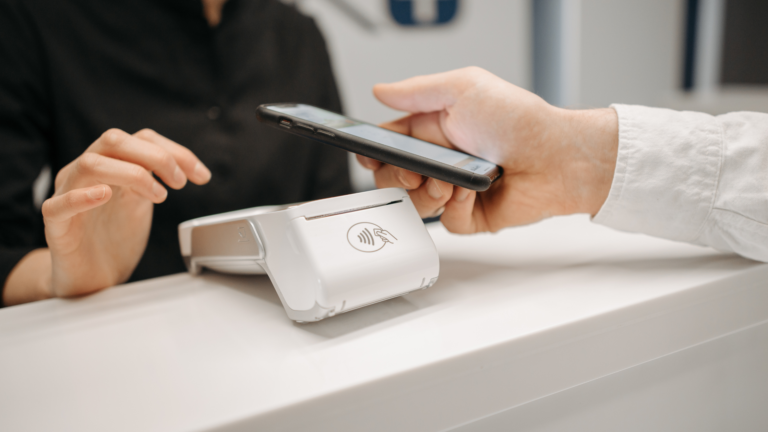

Most UK card payments settle into a business bank account within one to three working days, though the exact timing depends on your provider’s cut-off times, batching schedule and product type. “Next-day” claims often come with conditions attached, and even settled funds can still be reversed by a chargeback. Before you plan cash flow around any settlement promise, check five contract details: settlement basis, business-day definition, daily cut-off, holiday treatment and fee or reserve policy.
TL;DR:
- Settlement times mostly range from one to three working days, with delays caused by batch schedules, cut-off times, and bank holiday processing.
- The actual transfer of funds depends on multiple parties and can be delayed at any stage, often not matching the card authorization or clearing times.
- Faster settlement options like same-day or instant usually involve strict conditions, extra fees, or reserves, and are not guaranteed without contractual proof.
- Holidays and weekends extend settlement dates since banking and batch processing only occur on business days, affecting cash flow planning.
- Maintaining detailed records, including batch and bank credit dates, helps identify delays and avoid misjudging payment timings.
Table of Contents
- What settlement actually means and who is involved
- Typical settlement times in the UK with worked examples
- What actually moves your settlement date forward or back
- Next-day, same-day and instant settlement: what the labels really mean
- Chargebacks, reversals and why settled money is not always final
- A one-page checklist for choosing or auditing a payments provider
- Why settlement clarity matters more than speed
- How Switch-and-save keeps settlement visible, not just fast
- Sources
- FAQ
What settlement actually means and who is involved
A terminal receipt tells your customer the sale went through. It does not tell you the money has reached your bank account, and confusing the two is the most common cash-flow mistake retailers and hospitality operators make.
There are three distinct stages. Authorisation happens in seconds: the card network confirms the customer’s account has the funds or credit available and the issuer approves the transaction. Clearing follows, usually the same day or overnight, when transaction details pass between your acquirer and the customer’s card issuer to confirm the exact amount owed. Settlement is the final step, when funds actually move from the issuer to your acquirer and then into your merchant bank account, net of fees.
Several parties sit between your till and your bank balance: the payment gateway or terminal that captures the sale, your acquirer (the business that processes the payment on your behalf), the card issuer (the customer’s bank), the card network (Visa or Mastercard, for example) and finally your merchant bank account. The PSR’s market review of card-acquiring services sets out the acquirer’s role in authenticating, clearing and settling payments, and explains how pricing models can differ between providers in ways that affect timing as well as cost.
Each handoff in that chain can introduce a delay. A transaction authorised on a Friday evening might not clear until Monday, and a settlement that clears on Monday might not credit your account until Tuesday or Wednesday depending on your bank’s own processing schedule. When a payout looks late, the first place to look is not your till, it is the batch report from your provider: that document shows exactly when your transactions were grouped and sent for settlement.
Typical settlement times in the UK with worked examples
Realistic expectations sit in three bands: T+1 (next working day), T+2 and T+3. According to Barclaycard Business, most of its payments products settle within around 1 to 2 working days as standard, though some customers receive funds within 2 to 3 working days depending on the product and circumstances. That range, not a single fixed number, is the honest baseline for cash-flow planning.
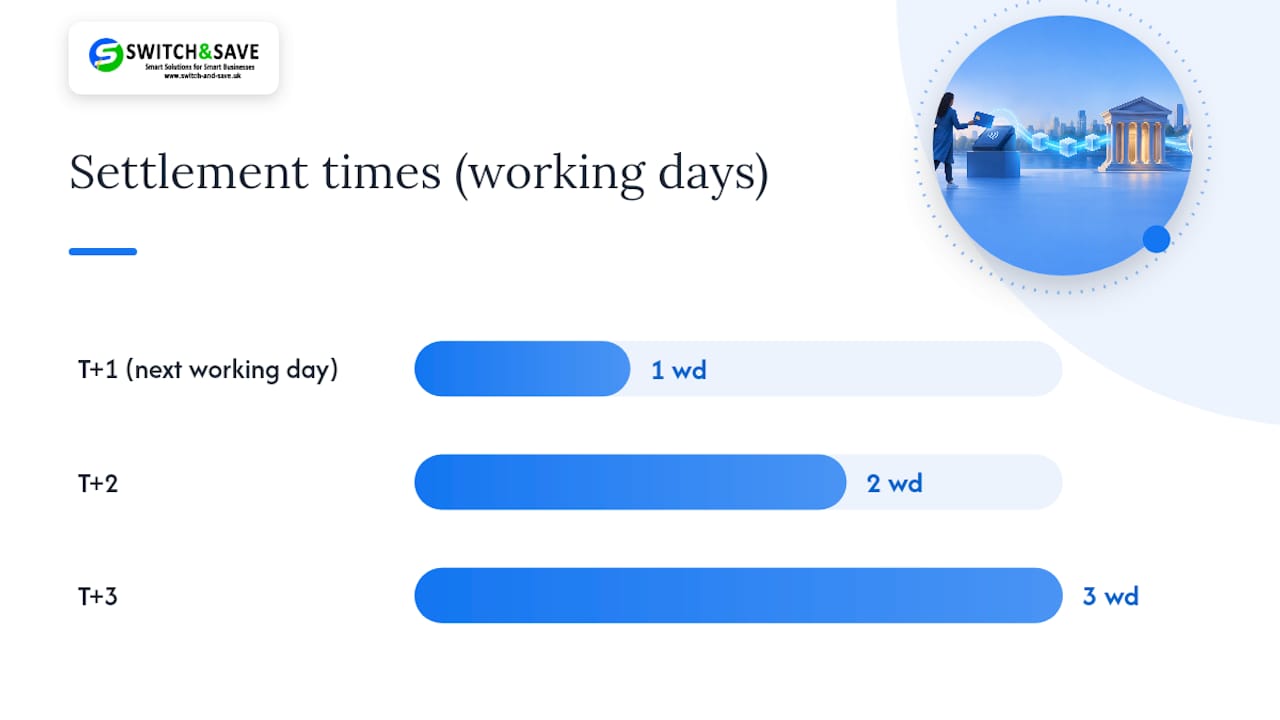
A worked example makes the pattern concrete. Say a café takes a card payment at 3pm on a Monday. If the provider’s cut-off for that product is 7pm and the batch closes on time, the funds might appear in the business account on Tuesday. If the same sale happens at 9pm, after the cut-off, it rolls into the next day’s batch and might not land until Wednesday. A sale made on a Friday evening, batched after cut-off, often will not clear until the following Tuesday once the weekend is factored in.
Weekends and bank holidays shift these dates further because banking settlement runs on working days, not calendar days.
- A Friday sale batched after cut-off typically settles the following Tuesday, not Saturday or Sunday.
- A sale made the day before a bank holiday often adds a full extra working day to the usual window.
- Back-to-back bank holidays, such as the late May or Christmas period, can push a T+1 product closer to T+3 or T+4 in practice.
None of this means your provider has made an error. It means the settlement clock only runs on working days, and any bank holiday or weekend sitting inside that window adds to the wait.
What actually moves your settlement date forward or back
Four things determine when a payout lands: the provider’s daily cut-off, how batching works, the specific product terms and the bank’s own clearing timetable. Get these wrong and you will misjudge cash flow every single week.
Cut-off times matter more than most merchants realise. Barclaycard documents an end-of-day terminal tally at 10pm, but the cut-off for next-day settlement eligibility varies by product: Smartpay Anywhere and Smartpay Touch require transactions before 7pm, while Flex allows until 9pm. Miss the cut-off by ten minutes and your transaction moves into the next batch, which can add a full working day.
Gateway, card machine and e-commerce transactions often run on different schedules within the same provider, so the cut-off that applies to your online store may not match the one for your countertop terminal. On top of that, bank clearing runs to its own timetable. The Bank of England’s RTGS daily timetable shows when settlement events happen during the banking day, and while card schemes settle separately between issuers and acquirers, the final acquirer-to-bank credit still depends on these bank settlement windows.
- Compare your provider’s batch file timestamp with the actual bank credit date to spot where the delay sits.
- Check your provider’s published holiday calendar, since bank holiday treatment differs between providers and is rarely obvious from marketing pages.
- Ask whether gateway, terminal and e-commerce transactions share the same cut-off or run on separate schedules.
Pro Tip: Keep a simple weekly log of sale date, batch date and bank credit date for a month; it turns “my payouts feel slow” into a pattern you can actually query with your provider.
Next-day, same-day and instant settlement: what the labels really mean
“Next-day” usually means funds arrive the working day after the batch closes, provided you hit the cut-off. “Same-day” is rarer and typically restricted to specific products or higher-risk pricing tiers. “Instant” settlement claims almost always carry conditions that are easy to miss in marketing copy but sit clearly in the contract terms.
Common conditions attached to faster settlement include strict cut-off adherence, a lower-risk trading profile, additional per-transaction fees, and sometimes a rolling reserve or minimum turnover threshold before you qualify. A retailer with a strong chargeback history and predictable turnover is far more likely to be offered genuine next-day terms than a new business with volatile sales.
- Ask for the guaranteed contractual settlement window in writing, not the headline marketing label.
- Confirm whether faster settlement carries an extra fee per transaction or a percentage premium.
- Check whether eligibility depends on turnover, trading history or a rolling reserve being held back.
The PSR’s market review notes that acquirer pricing models vary considerably, and a faster settlement promise is often bundled into a pricing structure that costs more overall. Weigh the cash-flow benefit against that premium before switching purely for speed.
Chargebacks, reversals and why settled money is not always final
Settlement is not the end of the story. A card issuer can reclaim a transaction in qualifying circumstances, and Gov confirms that a dispute or chargeback claim can be made up to 120 days after the transaction or its due date. That means funds sitting in your account today could still be pulled back months later.
Acquirers typically hold liability for chargebacks in the interim, and some will apply reserve arrangements, holding back a percentage of your takings, or deduct fees and refunds before releasing the net payout. This is standard acquirer risk management rather than a sign of a problem with your business.
The practical response is straightforward. Keep clear reconciliation trails linking each sale to its settlement and any later deduction, hold a modest cash reserve sized to your historical refund and chargeback rate rather than treating every settled pound as spendable, and keep receipts, delivery confirmations and customer correspondence ready in case a dispute lands. Our guide to disputing a chargeback walks through the evidence providers typically ask for.
A one-page checklist for choosing or auditing a payments provider
Before you sign, renew or query a provider, work through five contract items and a short reconciliation routine. This is the checklist we recommend every retail or hospitality manager keeps to hand.
- Settlement basis: ask whether the product is genuinely T+1, T+2 or T+3, and get the answer in writing rather than relying on the sales page.
- Business-day definition: confirm whether the provider’s “business day” excludes weekends and bank holidays, and whether that matches your bank’s own definition.
- Daily cut-off: get the exact cut-off time for each channel you use, terminal, gateway and e-commerce, since these often differ within the same account.
- Holiday handling: request the provider’s published holiday calendar so you can predict delays around Christmas, Easter and other bank holidays.
- Fees, refunds and reserves: ask exactly what is deducted before payout and whether any rolling reserve applies to your account.
For reconciliation, match each day’s till total against the provider’s batch report, then match that batch against the actual bank credit date and amount. Where the numbers do not tie out, check first for late batching, then for deducted fees or refunds, and only then treat it as a genuine missing payment. Our step-by-step guide to reconciling card payments sets out this routine in more detail.
When you approach a provider, ask them directly for a sample payout report, their written cut-off schedule and their holiday calendar. A provider that cannot produce these documents quickly is one whose settlement promises you should treat with caution.
Pro Tip: Request the holiday calendar and cut-off schedule before you sign anything, not after; providers that hesitate to share them in writing are the ones most likely to surprise you in December.
Why settlement clarity matters more than speed
The real problem with UK card settlement is not that it is slow, most products land within a few working days, but that the terms are rarely written down anywhere the average manager will read them before signing. Businesses lose more time chasing missing payouts than they would ever save by switching to a marginally faster product.
An integrated EPOS and payments system reduces that friction because sales, batches and bank credits sit in one place instead of three separate logins. When a payout looks short, you can trace it in minutes rather than spending an afternoon on the phone. That visibility, not headline settlement speed, is what actually protects cash flow for a small retail or hospitality business.
— Amir
How Switch-and-save keeps settlement visible, not just fast
Chasing a missing payout across a card machine login, a bank statement and a spreadsheet costs you time you do not have during a busy trading week. Switch-and-save’s Integrated Payments Bundle links your EPOS sales data directly to your card batches, so a delayed payout shows up as a flagged batch rather than a mystery.

Such bundles typically pair EPOS hardware with an EPOS software subscription, giving retail and hospitality businesses one dashboard for sales, batching and reconciliation instead of three separate systems to check. Hospitality businesses have a dedicated option too: the Hospitality EPOS Bundle at £549 one-off, paired with AI-powered cloud software at £20 per month.
- See exactly which batch a payout belongs to instead of guessing from a bank statement.
- Flag late or missing settlements against your own sales records the same day.
- Get support if a batch or settlement figure does not reconcile.
Request a demo or view the Integrated Payments Bundle page for full UK terms.
Sources
- Settlement periods – getting paid | Barclaycard Business
- Gov
- Market review card‑acquiring services | PSR
FAQ
What is the settlement cycle in the UK?
The settlement cycle covers authorisation, clearing and settlement: the card is approved in seconds, transaction details clear between issuer and acquirer, and funds then move into the merchant’s bank account. Most UK products complete this cycle within 1 to 2 working days as standard, sometimes 2 to 3, depending on the product and cut-off times.
What time of day do bank transfers go through in the UK?
Bank transfers and settlement credits follow the timetable the Bank of England publishes for RTGS settlement events, which run at set points during the banking day rather than continuously. Card settlement credits from your acquirer typically land as part of your bank’s normal daily processing rather than at a fixed time you can rely on.
How long does it take for credit card settlement?
Most UK credit card settlements complete within 1 to 3 working days of the transaction, depending on the provider’s cut-off and whether a weekend or bank holiday falls inside that window. Faster next-day or same-day options exist but usually carry eligibility conditions or extra fees.
How long does it take to get a debit card refund in the UK?
A debit card refund generally follows the same clearing and settlement path as the original payment, typically appearing within a similar working-day window rather than instantly. Where a dispute or chargeback is involved instead of a simple refund, GOV.UK guidance notes that claims can be raised up to 120 days after the original transaction.