

To compare merchant service statements, add up every charge on each statement for the same month. Then divide that total by your card takings for the month. The percentage you get is your effective rate, and it’s the fairest way to compare card machine fees between providers.
Headline rates on their own don’t tell you much. One provider might quote a lower percentage but add a charge on every transaction, a pricier terminal or a monthly minimum. Once you put everything into one number, you can see which deal actually costs your business less.
This guide walks you through what’s on a typical statement, how to line two up side by side, and the warning signs worth looking out for.
Key takeaways
| Point | What it means for your business |
| Effective rate is the number that matters | Total fees ÷ total card takings gives you one figure you can compare fairly. |
| Compare like for like | Use the same month, or months with similar takings, from each provider. |
| Fixed fees hit smaller businesses harder | Terminal rental and monthly charges take a bigger bite when your card takings are lower. |
| Pence-per-transaction fees matter for small sales | Cafés and takeaways with low average spends feel these more than restaurants do. |
| Read the contract, not just the statement | Exit fees, contract length and rate reviews can wipe out a saving. |
What is a merchant service statement?
A merchant service statement is the monthly breakdown your card payment provider sends you. It shows how much your customers paid by card, and what you were charged for processing those payments.
In theory, it’s simple. In practice, statements can run to several pages, use different names for similar charges and split fees across card types. That’s why so many owners just check the total and move on. The trouble is, the total alone won’t tell you whether you’re getting a fair deal.
The card machine fees you’ll see on a statement
Every provider lays things out differently, but most charges fall into a few groups. Here’s how it works.
Transaction fees
These are the charges on each card payment. They’re usually a percentage of the sale, a fixed amount in pence, or both. For example, you might see 1.2% on one statement and 0.9% plus 4p on another.
Some providers charge one blended rate for every card. Others list separate rates for debit, credit, business and non-UK cards. Business and overseas cards usually cost more to accept.
Interchange and scheme fees
Interchange is the fee your provider pays to the customer’s bank. Scheme fees go to the card networks, such as Visa and Mastercard.
For UK consumer cards used in the UK, interchange is capped at 0.2% for debit and 0.3% for credit. If your statement shows these fees separately with a small margin on top, that’s often called interchange plus pricing. It’s more transparent, but it’s also harder to read.
Authorisation fees
An authorisation fee is a small fixed charge for checking that a card is valid and has funds. Not every provider charges one. When they do, it’s easy to miss because it sits on a separate line from the main transaction fee.
Fixed monthly charges
These stay the same whether you take £2,000 or £50,000. Common ones include:
- Terminal rental: the monthly cost of hiring your card machine.
- PCI compliance fee: a charge linked to the security standard for handling card data.
- Minimum monthly service charge: a top-up if your fees fall below a set amount.
- Statement or account fees: admin charges for running your account.
One-off and occasional charges
These don’t appear every month, so they’re easy to forget. Look for chargeback fees (when a customer disputes a payment), refund fees, PCI non-compliance penalties and early termination charges in your contract.
How to compare two statements, step by step
You don’t need to be an accountant to do this. A calculator and ten minutes are enough.
- Pick the same month. Use statements for the same period, or months with similar takings. Comparing December with February will skew the result.
- List every charge. Go line by line and write down each fee, including small ones like authorisation charges.
- Add up the total fees. Include fixed monthly costs, not just transaction charges.
- Find your total card takings. This is usually shown near the top of the statement.
- Work out your effective rate. Divide total fees by total card takings, then multiply by 100.
- Check the contract. Note the contract length, exit fees and whether rates can change.
If you’re comparing a quote rather than a real statement, ask the new provider to apply their pricing to your actual transactions. A quote based on your own numbers is far more useful than a headline rate.
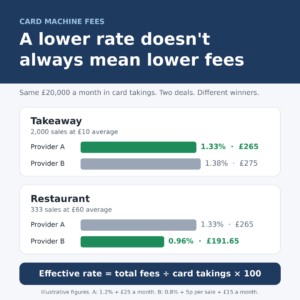
So, which fees matter most for your business? It depends on how your customers pay. The figures below are illustrative, not real provider prices.
Imagine two businesses in Manchester. Both take £20,000 a month on cards. The takeaway’s average sale is £10, so it processes 2,000 transactions. The restaurant’s average bill is £60, so it processes around 333.
Now compare two made-up deals:
- Provider A:2% per transaction, £20 terminal rental and a £5 PCI fee.
- Provider B:8% plus 5p per transaction, and £15 terminal rental.
| Business | Provider A monthly cost | Provider A effective rate | Provider B monthly cost | Provider B effective rate |
| Takeaway (2,000 × £10) | £265.00 | 1.33% | £275.00 | 1.38% |
| Restaurant (333 × £60) | £265.00 | 1.33% | £191.65 | 0.96% |
The good news is the maths tells a clear story. Provider B’s lower percentage looks cheaper on paper. For the restaurant, it is. But the 5p charge on every sale makes it the more expensive option for the takeaway, because it handles six times as many payments.
That’s exactly why you should compare statements using your own transaction pattern, not someone else’s.
Red flags to look out for
Some charges deserve a closer look. A minimum monthly service charge can catch out seasonal businesses, like a seaside café in winter. An introductory rate that rises after six or twelve months can quietly undo your savings.
Watch for PCI non-compliance fees too. These often apply when a simple online questionnaire hasn’t been completed, so they’re usually avoidable.
Long contracts with high exit fees are another one. And if there’s a charge you can’t identify, ask your provider to explain it in writing. You’re entitled to know what you’re paying for.
When is it worth switching?
Switching makes sense when the saving is clear after you’ve counted everything, including any exit fee from your current contract. For example, if you’d save £40 a month but face a £200 exit fee, you’ll be ahead after five months.
It’s also worth looking beyond price. Settlement times, reliable terminals and support when a machine goes down on a busy Saturday all affect your business. A slightly cheaper deal isn’t much use if payments take days to reach your account.
How Switch & Save can help
If reading statements isn’t how you want to spend your evenings, you don’t have to do it alone. Switch & Save works with UK small businesses, from corner shops and mobile phone shops to busy bars and family restaurants, to make sense of what they’re paying.
Send over a recent statement and the team can look at your actual transactions, not a generic example. You’ll see where your money is going and what a card payment setup matched to your business could cost instead.
Because Switch & Save also offers AI-powered EPOS systems and business finance, you can look at your payments, till and cash flow together rather than juggling separate suppliers.
Ready to find out what you could save?
Switch & Save helps UK businesses reduce costs with AI-powered EPOS systems, card payment solutions and business finance.
FAQs
What are card machine fees?
Card machine fees are the charges you pay to accept card payments. They usually include a fee on each transaction, plus fixed costs such as terminal rental and PCI compliance. Some providers add authorisation, refund or chargeback fees too.
What is an effective rate?
Your effective rate is your total monthly card fees divided by your total card takings, shown as a percentage. It combines every charge into one figure, so it’s the simplest way to compare providers fairly.
Why are my card fees higher some months?
Fixed charges stay the same even when takings drop, so your effective rate rises in quieter months. A higher share of business, credit or overseas cards can also push costs up.
Can I compare a quote with my current statement?
Yes, but only if the quote uses your real figures. Ask the new provider to price up your last statement, including your transaction count and card mix. That way you’re comparing like for like.
Do I have to pay a PCI compliance fee?
Many providers charge one, but the amount varies. What you can usually avoid is a non-compliance fee, by completing your provider’s annual PCI questionnaire on time.