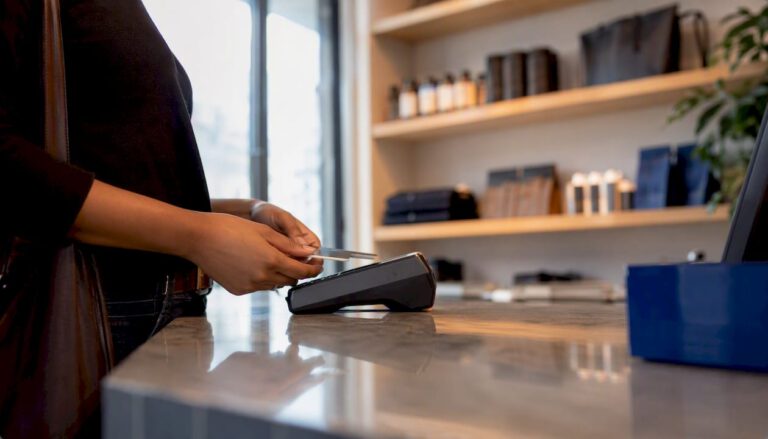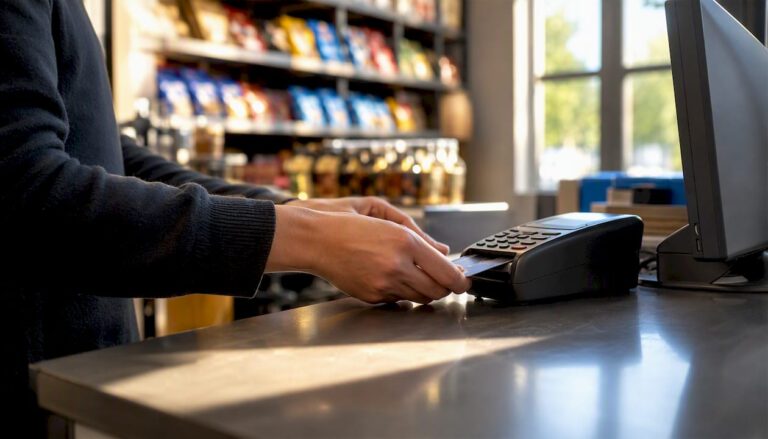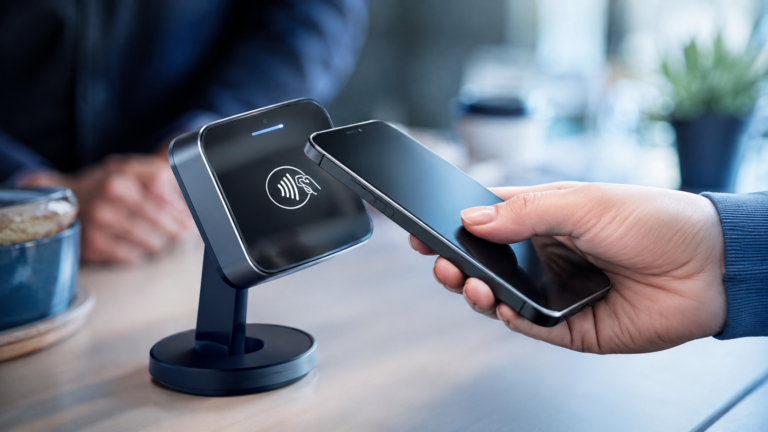

Switching to card payments increases sales, speeds up cash flow, and simplifies bookkeeping for most UK SMEs. If customers expect to tap and go, and your till still runs on cash alone, you are likely losing sales you never even see. Here is what you need to know before making the move.
TL;DR
- Card payments raise average transaction values and reduce the friction that causes customers to walk away.
- Faster settlement means money reaches your account in one to two business days, not whenever you get to the bank.
- Integrated EPOS links every card sale to your stock and accounts automatically, cutting manual reconciliation.
- Trade-offs exist: transaction fees, terminal costs, and PCI DSS compliance obligations all need budgeting for.
Table of Contents
- Why card payments are good for your business
- What does it actually cost to accept cards in the UK?
- Security, fraud, and compliance: what you need to know
- How to start accepting card payments in your business
- Cards vs Direct Debit vs cash: which method fits which situation?
- Going cashless in the UK: what the law says
- Operational gains from integrated EPOS and card payments
- Key takeaways
- The case for going card-first is stronger than most owners realise
- How Switch-and-save can help you make the move
- Useful sources
- FAQ
1. Why card payments are good for your business
The FSB confirms that accepting cards helps small businesses meet customer expectations, boost sales, improve cash flow, and simplify bookkeeping. Those are not abstract promises. They show up in the day-to-day numbers.
Sales and basket size. Customers who pay by card tend to spend more per visit. Without the psychological ceiling of “how much cash have I got on me?”, impulse additions and upsells land more often. A café that starts accepting contactless frequently reports that customers add a pastry or an extra drink they would have skipped if paying cash.
Cash flow. Card settlements typically clear within one to two business days, compared with the delay of physically banking notes and coins. Fewer unpaid invoices, no float management, and no waiting for a cheque to clear.

Efficiency. Cash handling takes time. Counting the till, preparing floats, making bank runs — these tasks add up across a week. Removing or reducing them frees staff for customer-facing work.
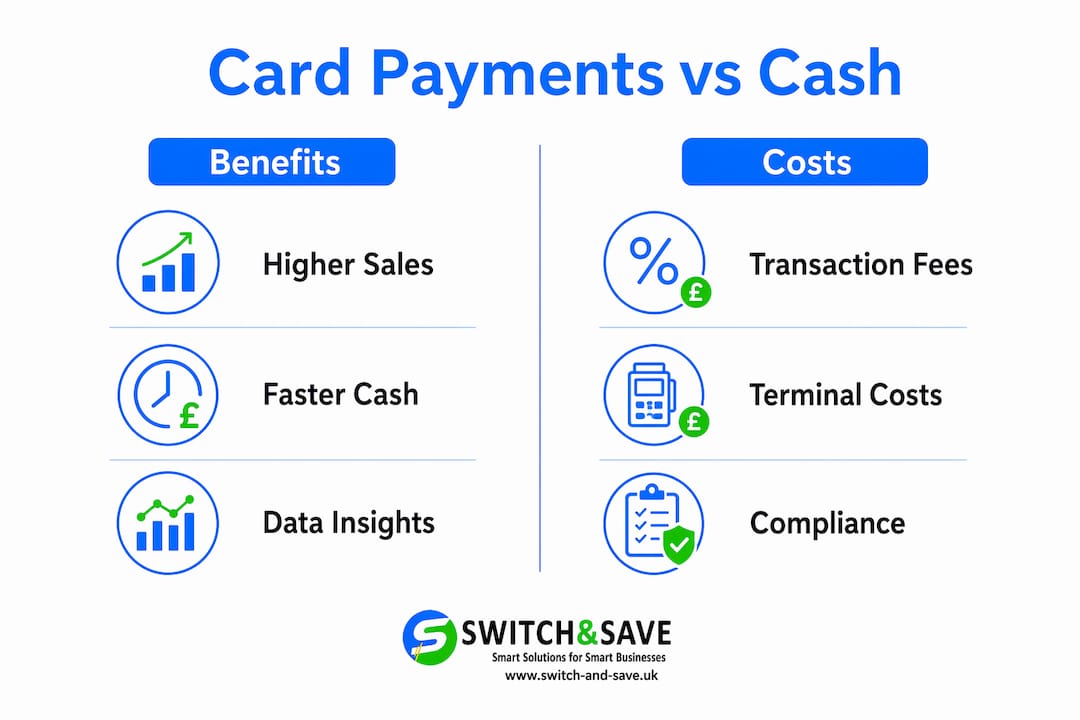
Data and reporting. When card payments run through an integrated EPOS system, every transaction creates a timestamped record linked to a product, a time of day, and a staff member. That data feeds sales reports, stock alerts, and targeted promotions in ways that a cash-only till simply cannot.
Pro Tip: Measure your baseline average transaction value for two weeks before switching, then compare it four weeks after going card-first. The difference is your uplift figure — and it is usually the most persuasive number you can show a sceptical business partner.
2. What does it actually cost to accept cards in the UK?
Cost is the most common reason business owners hesitate. The good news is that the fees are predictable once you know what to look for.
Ongoing fees to expect:
- Transaction rate: varies per transaction for consumer debit and credit cards, depending on your provider and monthly volume.
- Per-transaction fixed fee: some providers add a small flat fee per transaction on top of the percentage.
- Monthly gateway or merchant account fee: normally ranges from a low to moderate monthly amount for a standard account.
One-off and recurring hardware costs:
- Terminal purchase: entry-level card readers start from a low to moderate cost; countertop terminals with receipt printers vary widely in price.
- EPOS integration and software subscription: varies by provider; monthly software fees normally range within a moderate price band for a single-site retail or hospitality setup.
Additional cost areas to watch:
- Chargeback fees per dispute.
- Card-not-present (CNP) surcharges for phone or online orders, usually higher than in-person rates.
- Cross-border or interchange uplift on non-UK-issued cards.
One thing you cannot do: pass these fees on to customers as a surcharge. Under the Consumer Rights (Payment Surcharges) Regulations 2012, businesses are prohibited from adding a surcharge to consumer debit or credit card payments. Commercial and corporate cards are a limited exception.
It is also worth comparing card costs against what cash actually costs you. Survey evidence shows around half of retailers pay more than £50 per month in cash-handling charges, with 15% paying over £200. That context changes the fee maths considerably.
Worked example: A retail shop with typical monthly card turnover at common blended rates pays transaction fees accordingly. Even a modest increase in average spend after switching to card-first can result in notable additional revenue — a net gain before any saving on cash-handling costs.
| Fee type | Low end | Mid range | High end |
|---|---|---|---|
| Transaction rate | varies per transaction | varies per transaction | varies per transaction |
| Monthly account fee | — | £15 | £30 |
| Chargeback fee | — | £15 | — |
Ranges are illustrative industry-typical bands. Your actual rates will depend on card volume, provider, and business type.
3. Security, fraud, and compliance: what you need to know
88% of SMBs say fraud protection is critical when choosing a payments partner, according to Visa UK research. That figure reflects a real concern, and it is one the card industry has built substantial infrastructure to address.
Key protections in place:
- PCI DSS (Payment Card Industry Data Security Standard): a mandatory compliance framework for any business that stores, processes, or transmits cardholder data. Most small businesses qualify for a simplified self-assessment questionnaire rather than a full audit.
- Tokenisation: replaces actual card numbers with a unique token during processing, so even if data is intercepted, it is useless to a fraudster.
- Contactless limits: the UK contactless limit is currently £100 per transaction, with additional authentication required above that threshold.
- Acquirer-level monitoring: your payment processor monitors transactions for unusual patterns and flags or blocks suspicious activity automatically.
Chargebacks are the most operationally disruptive fraud-related event for merchants. A customer disputes a transaction, the card scheme reverses the payment, and you face both the lost revenue and a dispute fee. Common causes include “item not received”, “not as described”, and genuine fraud. Typical resolution timeframes run from 30 to 120 days depending on the card scheme and the complexity of the dispute.
Stat to know: Visa UK research found that security and trust are now the primary drivers of payment adoption decisions among UK merchants — ahead of cost.
Pro Tip: When evaluating providers, ask specifically about their chargeback dispute workflow. A good provider will give you a clear portal to submit evidence, set realistic timelines, and flag high-risk transaction patterns before they become disputes.
4. How to start accepting card payments in your business
Getting set up is more straightforward than many owners expect. The route you choose depends on your trading environment.
Your main options:
- Standalone card terminal — the simplest entry point. Plug in or connect via SIM, and you are taking payments the same day. Best for businesses with low transaction volumes or those testing the water.
- Integrated EPOS with card reader — the card terminal connects directly to your till software. Every sale updates stock, triggers a receipt, and posts to your accounts automatically. This is the setup most retail and hospitality businesses move to once they see the operational gains.
- Online payment gateway — for e-commerce or phone orders. Connects your website or virtual terminal to a payment processor. Setup typically takes a few days to two weeks.
- Mobile or portable terminal — ideal for market traders, pop-ups, or table-service hospitality. Modern devices accept NFC contactless, chip and PIN, Apple Pay, and Google Pay.
Implementation checklist:
- Choose a provider and confirm PCI DSS scope for your setup.
- Order and test your terminal before going live.
- Train staff on the device, refund process, and end-of-day reconciliation.
- Update till signage and receipts to show card acceptance (including contactless logos).
- Set up your merchant account and confirm settlement timelines with your provider.
Timeline expectations: a standalone terminal can be live the same day. An integrated EPOS with payment gateway typically takes one to three weeks from order to full go-live, depending on software configuration and staff training.
When choosing hardware, prioritise NFC-ready devices. PwC projects digital wallets will reach roughly 21% of UK transaction volume by the end of 2026. A terminal that cannot accept Apple Pay or Google Pay is already behind the curve.

Pro Tip: Check your payment terminal options before committing to a provider. Some providers lock you into proprietary hardware that cannot integrate with third-party EPOS software — which limits your options later.
5. Cards vs Direct Debit vs cash: which method fits which situation?
No single payment method wins every use case. The right answer depends on what you are selling, how often, and to whom.
Where cards excel:
- Walk-in retail and hospitality (one-off, face-to-face transactions).
- Online checkout (card or digital wallet is the default customer expectation).
- Any situation where speed of payment and immediate settlement matter.
Where Direct Debit makes more sense:
- Regular, fixed-amount subscriptions (gym memberships, monthly service retainers).
- B2B invoicing where the customer has agreed a payment schedule.
- Account-to-account (A2A) payments are also growing in this space, though PwC notes they remain immature for many retail scenarios compared with cards.
Where cash still has a role:
- Very low-value community sales (school fairs, charity stalls) where terminal costs outweigh the benefit.
- Customers who genuinely cannot access card payments (see the accessibility section below).
| Payment method | Best for | Cost profile | Speed | Customer acceptance |
|---|---|---|---|---|
| Card (debit/credit) | One-off, in-store, online | Low–mid per transaction | 1–2 day settlement | Very high |
| Digital wallet | Contactless, mobile | Similar to card | 1–2 day settlement | Growing rapidly |
| Direct Debit | Recurring billing | Low per transaction | 3–5 days | High for subscriptions |
| Cash | Low-value, ad hoc | Hidden handling costs | Immediate | Declining |
| A2A / bank transfer | B2B, high-value | Low fees | Hours–1 day | Low in retail |
A practical hybrid approach works well for many businesses: use card payments for all point-of-sale transactions, and Direct Debit for any recurring invoices or subscription customers. That way you get the speed and data benefits of cards where they matter most, without forcing a card payment on a customer who prefers a monthly direct payment.
6. Going cashless in the UK: what the law says
You are legally permitted to refuse cash in the UK. Full Fact confirms that “legal tender” has a narrow technical meaning around debt repayment and does not obligate businesses to accept cash in everyday transactions. The government has confirmed it does not plan to mandate cash acceptance.
That said, the legal permission to go cashless does not mean there are no obligations to consider.
Key legal and accessibility points:
- Equality Act 2010: if refusing cash disproportionately affects customers with protected characteristics (age, disability), you could face a discrimination claim. Older customers and those with certain disabilities are statistically more likely to rely on cash. An impact assessment before going fully cashless is advisable.
- Clear signage: you must communicate your payment policy clearly before a customer commits to a purchase. Displaying your accepted payment methods at the entrance and point of sale is both a legal courtesy and good practice. Effective storefront signage reduces confusion and prevents disputes at the till.
- Consumer Rights (Payment Surcharges) Regulations 2012: as noted above, you cannot charge customers extra for paying by consumer debit or credit card.
- GDPR and Data Protection Act 2018: collecting cardholder or customer data through your payment system creates data-handling obligations. Your provider’s PCI DSS compliance covers card data; your own data practices cover everything else.
- PSR and FCA oversight: the Payment Systems Regulator (PSR) and Financial Conduct Authority (FCA) set the rules for payment service providers operating in the UK. While these bodies regulate your provider rather than your business directly, understanding their role helps you ask the right questions when choosing a partner.
Pro Tip: Run a phased transition rather than switching overnight. Keep a cash option available for the first few weeks, communicate the change clearly to regular customers, and monitor whether any specific customer group is struggling to adapt.
7. Operational gains from integrated EPOS and card payments
The real productivity argument for switching is not just about taking payments. It is about what happens to your data after the payment goes through.
When card payments run through an integrated EPOS, every sale automatically updates stock levels, posts to your accounts, and contributes to a real-time sales report. There is no end-of-day manual count, no spreadsheet reconciliation, and no gap between what the till says and what the accounts show. The FSB notes that card payment records make businesses “audit-ready” by default, with timestamped transaction data that syncs directly to accounting software.
Practical operational gains:
- Automated reconciliation: no manual daily cash-up against card totals.
- Inventory accuracy: each card sale deducts from stock in real time, reducing over-ordering and stockouts.
- Faster reporting: sales by hour, product, or staff member are available instantly from a cloud dashboard.
- Multi-site control: a centralised dashboard lets you compare performance across locations without waiting for end-of-week reports.
Consider a mid-sized café group with three sites. Before integrating card payments with EPOS, the manager spent roughly two hours each Monday reconciling weekend sales manually across all three locations. After integration, that task takes under 15 minutes, with discrepancies flagged automatically. Stock reorders are triggered by the system rather than by a weekly stocktake. That is not a marginal improvement — it is a structural change in how the business runs.
One in seven UK shops has already turned cashless in the past year, with security and falling customer demand for cash cited as the main drivers. The operational case is increasingly the deciding factor for those that follow.
Key takeaways
Switching to card payments gives most UK SMEs a measurable uplift in sales, faster cash flow, and significantly less time spent on manual reconciliation.
| Point | Details |
|---|---|
| Sales and spend uplift | Card-paying customers tend to spend more per visit, raising average transaction values. |
| Cash-handling costs | Around half of UK retailers pay over £50 per month to handle cash; cards remove most of that. |
| Transaction fees | Typical rates run vary per transaction–vary per transaction; weigh these against the revenue gain and cash-handling savings. |
| Legal position | UK businesses may refuse cash but must consider Equality Act obligations and display clear signage. |
| Switch-and-save recommendation | An integrated EPOS with card acceptance is the most efficient setup for UK retail and hospitality. |
The case for going card-first is stronger than most owners realise
The conventional wisdom is that card fees are the main obstacle. They are not. The real obstacle is inertia — the assumption that switching is complicated, expensive, and risky.
The fee maths almost always favours cards once you factor in what cash actually costs: the handling charges, the staff time, the reconciliation errors, and the sales lost to customers who simply do not carry notes. The businesses that hesitate longest tend to be the ones with the most to gain, usually because they have never properly costed their current cash operation.
What gets underestimated is the data side. A business running on cash has almost no granular insight into what sells, when, and to whom. A card-integrated EPOS gives you that picture from day one. That is not a luxury for large retailers — it is the kind of operational intelligence that helps a single-site café decide whether to extend its opening hours on a Thursday, or a boutique retailer know which product lines to reorder before they run out.
The accessibility concern is real and worth taking seriously. Going cashless without thinking through the impact on older or vulnerable customers is both a legal risk and a reputational one. But a phased transition with clear communication manages that risk without forcing you to stay cash-dependent indefinitely.
The question is not really whether to switch. For most UK retail and hospitality businesses, the question is how quickly and how well.
How Switch-and-save can help you make the move
If you have read this far, you are probably ready to act rather than just research. Switch-and-save offers AI-powered EPOS systems built specifically for UK retail and hospitality, with integrated card terminals, a cloud dashboard, real-time inventory management, and UK-based support included as standard.
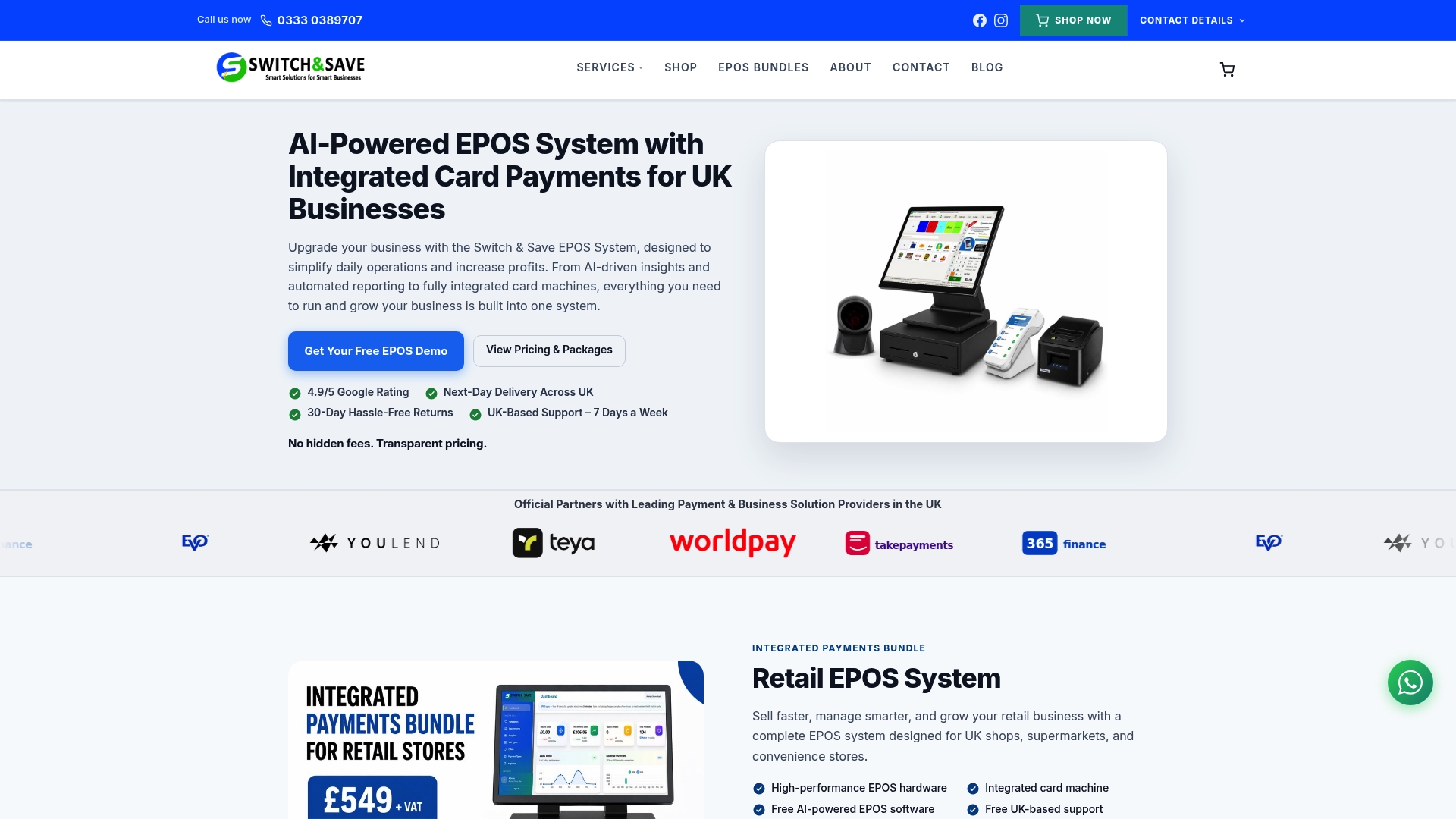
A typical Switch-and-save package covers hardware, software, payment processing integration, and staff training, with transparent monthly pricing and no hidden setup surprises. Most businesses are fully live within one to three weeks. Whether you run a single shop, a small café group, or a multi-site retail chain, there is a package sized to your operation.
Ready to see it in action? Request a free demo or browse the hospitality EPOS packages to find the right fit for your business.
Useful sources
The following official and industry sources were used in this article and are worth bookmarking for further reading.
- FSB — Benefits of taking card payments: practical guidance from the Federation of Small Businesses on sales, cash flow, and accounting benefits for small firms accepting cards.
- PwC UK — Future of retailer payments: covers digital wallet growth, A2A payment trends, and what UK retailers should prioritise in their payment strategies.
- BBC News — One in 7 UK shops turned cashless: survey data on the pace of cashless adoption and the cash-handling costs driving the shift.
- Visa UK — Security and trust drive payment choices: Visa’s UK SMB research on fraud protection priorities and payment adoption drivers.
- Sprintlaw UK — Navigating legal risks in the cashless future: legal guidance on Equality Act obligations, signage requirements, and risk management for businesses going cashless.
- Business Companion — Payment surcharges guidance: plain-language explanation of the Consumer Rights (Payment Surcharges) Regulations 2012 and what businesses can and cannot charge.
- Full Fact — Shops can refuse to take cash: fact-checked explanation of legal tender rules and the government’s position on cash acceptance.
FAQ
Are there advantages to accepting card payments over cash?
Yes. Card payments typically raise average transaction values, settle faster than cash banking, and create automatic transaction records that link to your accounts and stock system. The FSB identifies improved sales, smoother cash flow, and integrated bookkeeping as the core benefits for small businesses.
Is it legal to refuse card payments in the UK?
No law requires UK businesses to accept cards, just as no law requires them to accept cash. You may choose which payment methods you accept, provided you communicate your policy clearly and consider any Equality Act implications for customers who may be disadvantaged by your choice.
Will the UK go fully cashless?
The trend is firmly in that direction. One in seven UK shops has already turned cashless, and PwC projects digital wallets will account for roughly 21% of UK transaction volume by the end of 2026. The government has confirmed it does not plan to mandate cash acceptance, leaving the decision with individual businesses.
Why do customers prefer paying by card?
Convenience is the primary driver. Cards and digital wallets are faster at the point of sale, remove the need to carry cash, and offer purchase protections that cash does not. For higher-value purchases, the chargeback protection available on credit cards is a significant factor.
Can Switch-and-save help me set up card payments alongside an EPOS system?
Yes. Switch-and-save provides integrated EPOS and card payment solutions for UK retail and hospitality businesses, including hardware, software, payment processing, and UK-based support. Most setups go live within one to three weeks.