

Secure payment processing protects cardholder data across every point it touches — your EPOS terminal, payment gateway, and the wider card network — using encryption, tokenisation, and PCI DSS-validated infrastructure. In plain terms: when a customer taps or inserts their card, the right setup means their card number never exists in readable form on your systems. For UK retail and hospitality owners, that protection is not optional. It is what keeps you trading, trusted, and on the right side of your merchant agreement.
Three things to do right now:
- Confirm P2PE or hosted checkout: ask your EPOS or payment provider whether your terminals use point-to-point encryption or a hosted payment page — both keep raw card numbers off your systems.
- Check your SAQ category: your acquirer or provider can tell you which Self-Assessment Questionnaire applies to you. For most small merchants using modern integrated terminals, completing the SAQ is a 15–30 minute annual task in your provider dashboard — and doing it removes monthly non-compliance fees of £2–£5.
- Change any vendor default passwords: if your EPOS or router still has a factory password, change it today.
Table of Contents
- How does secure payment processing actually work?
- What security features must your EPOS and payment setup have?
- Common mistakes that put small businesses at risk
- How to secure your existing EPOS setup: a step-by-step checklist
- What does adding secure, integrated payments typically cost?
- How to choose a secure EPOS and payment provider
- Key takeaways
- The part most providers do not tell you upfront
- Switch-and-save supports UK retail and hospitality with secure EPOS packages
- Useful sources and further reading
- FAQ
How does secure payment processing actually work?
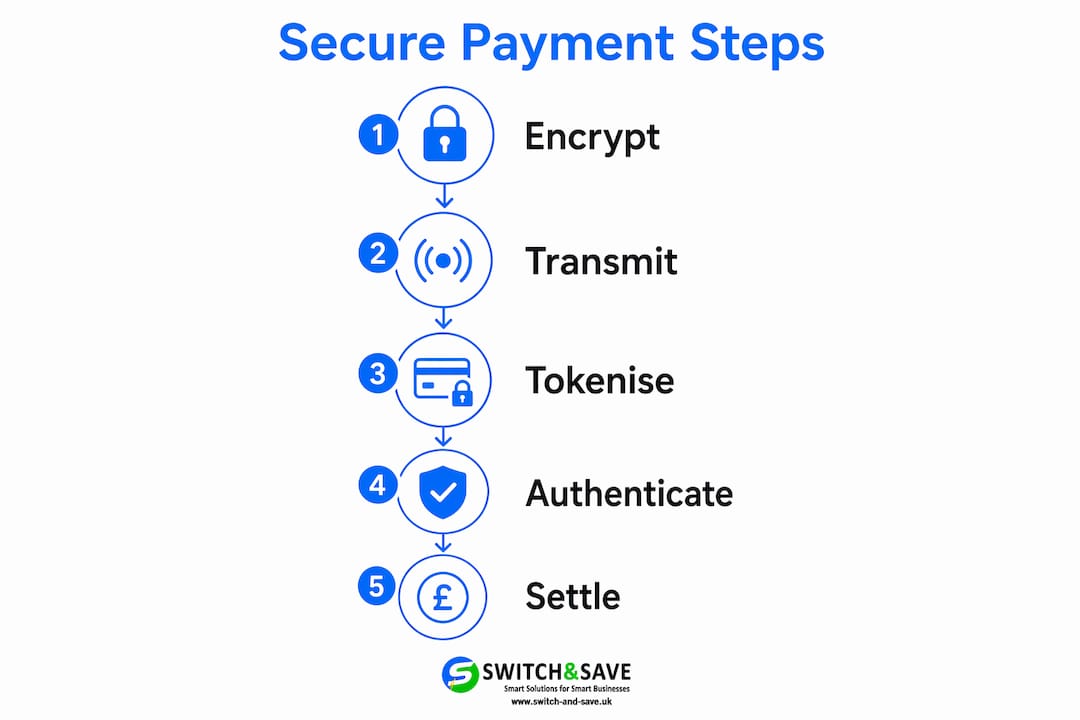
The transaction flow is simpler than it sounds. Here is what happens in the seconds after a customer pays:
- Card read: the customer taps, inserts, or swipes. EMV chip and PIN or contactless technology authenticates the card at the terminal.
- Encryption at the terminal: P2PE converts the card number into an unreadable code the moment it is read. That code travels through your EPOS and network — your systems never see the real card number.
- Tokenisation at the provider: once the encrypted data reaches the payment processor’s secure environment, tokenisation replaces the card number with a token — a meaningless reference that can be stored safely for recurring payments or refunds.
- Authorisation: the processor sends the request through the card network (Visa, Mastercard) to the issuing bank, which checks funds and fraud signals, then approves or declines.
- Settlement: approved funds move from the customer’s bank to your merchant account via the acquiring bank, typically within 1–3 business days.
Your EPOS records the sale, updates stock, and logs the transaction — all without a raw card number ever sitting in your system.
Pro Tip: If you accept contactless via a certified mobile device, Tap to Pay on validated platforms shifts card-data handling to the platform’s secure element — reducing what you need to protect yourself.
What security features must your EPOS and payment setup have?
Not every EPOS provider offers the same level of protection. When you are evaluating or auditing your current setup, these are the features that genuinely matter:
- PCI DSS compliance and scope reduction: ask whether the solution qualifies you for a simpler SAQ category (SAQ A or SAQ B-IP rather than SAQ D). Reducing scope — the systems, people, and processes that touch card data — cuts both cost and risk.
- P2PE or terminal-level encryption: the terminal must encrypt data before it leaves the device. Confirm the provider is PCI-validated for P2PE.
- EMV/contactless support with current firmware: chip and PIN and contactless are not just convenient; they carry a liability shift that protects you if a fraudulent transaction occurs on an up-to-date terminal.
- Tokenisation for stored references: any recurring billing, deposits, or tab-based payments should use tokens, not stored card numbers.
- Role-based access and MFA: PCI DSS v4.0.1, mandatory since 1 April 2025, requires multi-factor authentication on all access to payment system components. Every staff member should have a unique login; admin access should be tightly restricted.
- Network segregation: your payment terminal traffic should run on a separate network segment from guest Wi-Fi and back-office systems.
- Automatic updates and logging: firmware patches and security updates should apply automatically, and your provider should maintain accessible logs for any investigation.
Pro Tip: Ask your provider for their PCI attestation letter. A reputable supplier will share it without hesitation — if they cannot, that is a red flag.
Common mistakes that put small businesses at risk

Most payment breaches at small businesses are not sophisticated hacks. They are avoidable internal errors: default passwords left unchanged, staff with access they do not need, and software that has not been updated in months.
The most common vulnerabilities:
- Unchanged vendor passwords on routers, EPOS admin panels, and payment terminals — auditors find these regularly, and they are an open door.
- Over-permissive staff access: if every team member can access payment reports or refund functions, the risk of accidental exposure or internal fraud rises sharply.
- Outdated terminal or EPOS software: unpatched systems are the most common exploitation point for card-skimming malware.
- Taking card details over the phone and writing them down — or typing them into internal systems. This dramatically increases your PCI scope and your liability. Use pay-by-link instead: the customer enters their own details on a secure page, and your staff never handle the card number.
Statistic to note: Security guidance from the FSB highlights that leaving vendor-supplied defaults in place is one of the most frequently cited causes of compliance failures for small merchants — and one of the easiest to fix.
A data breach also triggers obligations under UK GDPR and the Data Protection Act 2018. If payment data is linked to identifiable customers, you must report certain breaches to the ICO within 72 hours. Keeping card data off your systems in the first place is the simplest way to limit that exposure.
How to secure your existing EPOS setup: a step-by-step checklist
Immediate actions (within 24–72 hours)
- Change all vendor default passwords on your EPOS, router, and payment terminals.
- Enable multi-factor authentication on your payment admin accounts.
- Confirm with your provider that P2PE or hosted checkout is active.
- Segregate your payment terminal network from guest Wi-Fi.
Short-term actions (1–4 weeks)
-
Complete your SAQ — check your provider dashboard first, as many providers prompt you directly.
-
Review user accounts: remove leavers, restrict access to payment functions by role.
-
Schedule firmware and EPOS software updates if not already automatic.
-
Review any phone or mail-order payment processes.
Medium-term actions (1–3 months)
- Run a vulnerability scan if your SAQ category requires one.
- Confirm your provider’s PCI attestation is current.
- Implement tokenisation for any stored payment authorisations (deposits, tabs, subscriptions).
- Train staff on payment security basics: what not to do with card details, how to spot suspicious terminal behaviour.
Pro Tip: For phone or mail-order payments, switch to pay-by-link immediately. It shifts liability, removes card data from your call recordings, and simplifies your SAQ category in one step.
What does adding secure, integrated payments typically cost?
Costs vary, but here is a realistic picture for a small UK retail or hospitality business:
- Hardware: a PCI-validated card terminal typically costs £100–£300 as a one-off purchase, depending on whether it is a standalone reader or an integrated EPOS bundle. P2PE-certified hardware sits at the higher end of that range.
- Setup and integration: a simple hosted checkout or certified terminal can be live within a day or two. Custom integrations with existing stock or booking systems take longer — typically one to three weeks.
- Ongoing fees: merchant services fees (charged as a percentage per transaction), a monthly gateway fee, and potentially a small PCI compliance support fee from your provider.
- SAQ non-compliance fees: many providers charge £2–£5 per month if your SAQ is not completed. Completing the annual SAQ — a 15–30 minute task for most small merchants — removes this fee entirely.
Budget note: For most small merchants, the biggest cost driver is not the compliance itself — it is the scope of your setup. The more card data that touches your systems, the more complex (and expensive) compliance becomes. Keeping card data off your systems with P2PE and hosted checkout is the most cost-effective approach.
How to choose a secure EPOS and payment provider
Use this table as your buyer worksheet when shortlisting providers:
| Area | Questions to ask |
|---|---|
| Security | Do you offer P2PE-validated terminals? Do you support tokenisation? What is your firmware update policy? |
| Compliance | Which SAQ category will I fall into? Do you provide SAQ support or prompts in your dashboard? Can you share your PCI attestation letter? |
| Support | Is your support team UK-based? What are your SLAs for payment incidents? Do you offer onsite or remote setup? |
| Pricing | What are the hardware, setup, monthly gateway, and merchant service fees? Are there contract lock-in periods or early termination charges? |
| Fraud and disputes | Do you support 3D Secure for online payments? How do you handle chargebacks and dispute evidence? |
Beyond the table, ask for a live demo and request customer references from businesses similar to yours. A provider confident in their product will offer both. Reviewing your payment solution options before signing any contract is time well spent.
Pro Tip: Ask specifically about ecommerce compliance if you also sell online — your in-store and online payment flows may have different PCI scope implications, and a good provider will address both.
Key takeaways
Secure payment processing works when card data never touches your systems in readable form — P2PE, tokenisation, and EMV together achieve that, and PCI DSS provides the framework to verify it.
| Point | Details |
|---|---|
| P2PE, tokenisation, and EMV | These three technologies together keep raw card numbers off your systems and reduce your compliance burden. |
| SAQ is a short annual task | For most small merchants, completing the SAQ takes 15–30 minutes and removes monthly non-compliance fees of £2–£5. |
| Change defaults immediately | Vendor default passwords are the most common and most avoidable cause of compliance failures. |
| UK GDPR applies too | A payment data breach may trigger a 72-hour ICO notification duty — keeping card data off your systems limits that risk. |
| Switch-and-save | Offers integrated EPOS packages with P2PE-capable terminals, SAQ guidance, and UK-based support — request a free demo to see it in action. |
The part most providers do not tell you upfront
The honest truth about payment security for small UK businesses is this: the technology is not the hard part. P2PE, tokenisation, and EMV are mature, well-understood tools. The hard part is the gap between what a provider promises and what they actually configure on your behalf.
Too many small retailers and hospitality operators sign up for a payment solution, assume the provider has handled everything, and never check whether their SAQ is complete, whether their terminal firmware is current, or whether their staff still share a single admin login. That assumption is where most breaches begin — not with a sophisticated attack, but with a configuration left unchanged from day one.
The other thing worth saying plainly: UK GDPR and PCI DSS are not the same obligation, but they overlap in ways that catch businesses off guard. If a card payment is linked to a named customer — a loyalty account, a booking, a tab — that data is personal data under UK law, and a breach triggers ICO reporting duties as well as card-scheme penalties. Reducing the card data your systems hold is not just a compliance tactic; it is the single most effective thing you can do to limit your legal exposure.
Ask your provider the hard questions. Request the attestation letter. Complete the SAQ. And if your current setup cannot answer those questions clearly, that tells you something important.
Switch-and-save supports UK retail and hospitality with secure EPOS packages
If you are running a retail shop or hospitality venue and your current payment setup leaves you uncertain about PCI scope, terminal encryption, or who handles your SAQ — Switch-and-save is built for exactly that situation.
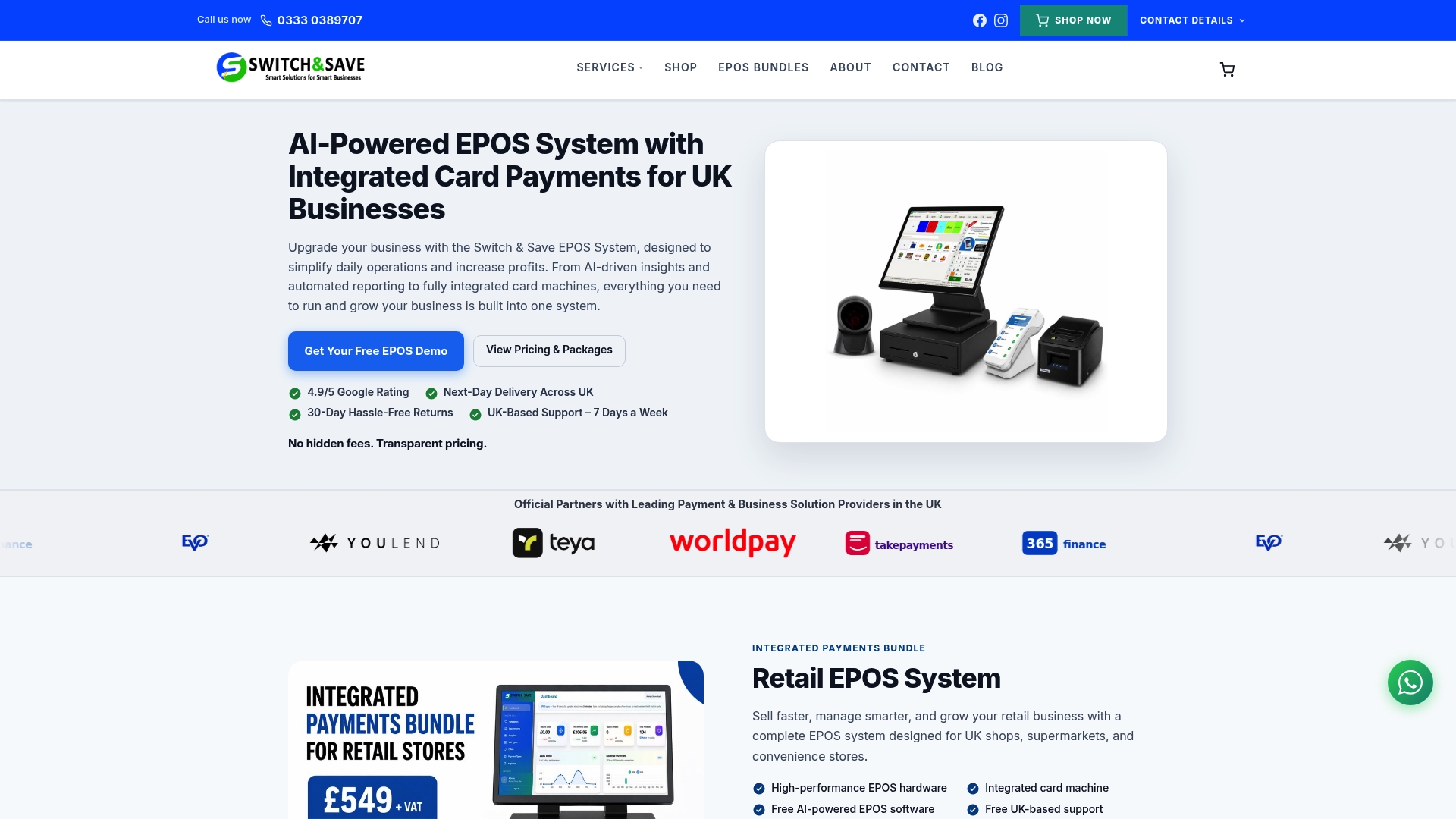
Switch-and-save provides integrated EPOS systems with P2PE-capable terminals, built-in tokenisation, and UK-based support that helps you through the SAQ process rather than leaving you to figure it out alone. Transparent pricing means no hidden gateway fees or surprise compliance charges. Free demos are available so you can see the full setup before committing. Whether you need a retail EPOS system or a hospitality package, the team can walk you through what your specific setup requires. Book a free demo today at switch-and-save.uk and get a clear picture of your payment security in one conversation.
Useful sources and further reading
- PCI Security Standards Council — Merchant Resources: the primary source for PCI DSS requirements, SAQ forms, and validated solution lists. Start here to understand your obligations directly from the standard-setter.
- Sprintlaw UK — PCI DSS Requirements for UK Businesses: a practical legal overview of how PCI DSS intersects with UK GDPR and merchant contracts — useful if you want to understand the contractual and legal dimensions.
- FSB — How to Become PCI Compliant: plain-language guidance from the Federation of Small Businesses on the 12 PCI DSS requirements and common small-business mistakes.
- Go Small Business — PCI DSS for Card Reader Users: focused on small UK merchants using card readers; explains SAQ categories and how to avoid monthly non-compliance fees.
- ClearPath Security — PCI DSS for UK SMEs: explains scope reduction in practical terms — helpful if you want to understand why hosted checkout and P2PE reduce your compliance workload.
FAQ
What is secure payment processing in simple terms?
Secure payment processing protects a customer’s card details as they travel from your terminal through the payment network to their bank, using encryption, tokenisation, and PCI DSS-validated infrastructure so the raw card number never sits on your systems.
Does PCI DSS apply to my small retail or hospitality business?
Yes. PCI DSS applies to any business that stores, processes, or transmits cardholder data, regardless of size or transaction volume. Most small UK merchants using modern integrated terminals qualify for a simplified SAQ category.
What is the difference between P2PE and tokenisation?
P2PE encrypts card data at the terminal so it travels through your systems unreadable. Tokenisation replaces the card number with a safe reference token at the processor, allowing recurring payments without storing the actual card number.
How do I know if my EPOS setup is PCI compliant?
Ask your provider which SAQ category you fall into and request their PCI attestation letter. Many providers prompt you to complete the SAQ in your dashboard — completing it annually removes monthly non-compliance fees of £2–£5.
Can Switch-and-save help with payment security for my business?
Switch-and-save offers EPOS packages with P2PE-capable terminals, tokenisation, SAQ guidance, and UK-based support. You can request a free demo at switch-and-save.uk to review your specific setup.