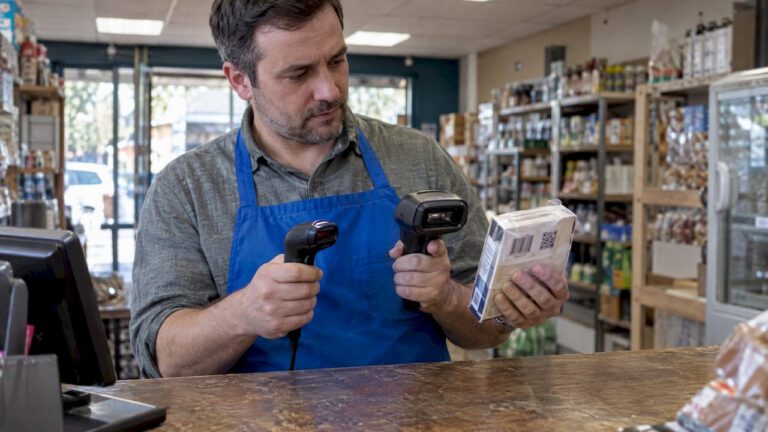

A purchase order (PO) is the buyer’s written purchase instruction that, once accepted, commits the supplier. Linked to your POS, it becomes the control point for inventory and committed spend. The immediate step is simple: make sure every PO number lands on the supplier invoice, and connect your EPOS reorder alerts to that PO trigger. Get that link right and you stop paying for stock nobody approved.
TL;DR:
- Properly linking purchase orders to supplier invoices prevents paying for stock that has not been explicitly approved through a confirmed PO.
- Including essential fields such as a unique PO number, clear item descriptions, and acceptance criteria ensures effective control and enforceability of purchase agreements.
- Using the correct type of PO, such as blanket or contract, depends on your business’s purchasing volume and relationship complexity, with thresholds around a few hundred to several thousand pounds.
- Automating PO creation through EPOS systems triggers reorder alerts at stock levels slightly above critical points, streamlining inventory control and reducing stockouts.
- Enforcing “No PO, No Pay” rules and setting role-based approval thresholds are critical controls to prevent maverick spend and unauthorized purchases.
Table of Contents
- What is a purchase order, and what does it do legally?
- The fields every PO needs to actually work
- Four types of PO, and which one your business actually needs
- How the purchase order process actually flows, step by step
- How POS systems turn purchase orders into automatic reordering
- The procurement controls that actually stop maverick spend
- What to put in your PO template, and how to test it before going live
- Legal, VAT and record-keeping points to check before you sign off
- Rolling out a PO system without grinding your business to a halt
- Why purchase orders matter more in hospitality than most owners realise
- Get PO automation built into your EPOS from day one
- Sources
- FAQ
What is a purchase order, and what does it do legally?
A purchase order is a document you, the buyer, issue to a supplier setting out exactly what you want, how much, and on what terms. It’s not a wish list. Once the supplier accepts it, whether by confirming, delivering, or invoicing against it, the PO becomes a binding contract. That’s the point most small retailers and hospitality owners miss: the moment of commitment isn’t when you place the order verbally or send a quick email. It’s when both sides have effectively agreed the same terms.
This trips people up because three documents get confused constantly:
- Purchase requisition — an internal request (“we need 40 cases of house wine”), never seen by the supplier
- Purchase order — the external, formal offer to buy, sent to the supplier
- Invoice — the supplier’s request for payment after delivery, which should match the PO
Under UK contract law, a contract forms when there’s offer, acceptance, and consideration, and this is where the so called “battle of the forms” causes real headaches. If your PO states your payment terms and delivery conditions, but the supplier’s invoice or order confirmation attaches their own different terms, whoever’s terms were sent last and not objected to often wins. Legislation sets out the statutory backdrop for this kind of contract formation, and it’s worth a look if you regularly deal with suppliers who push back on your standard terms.
The practical fix, Wikipedia’s overview of purchase orders confirms, is simply issuing the PO early and getting explicit acceptance before goods move. No PO in writing means no clear record of what was actually agreed if a dispute ever lands on your desk.
The fields every PO needs to actually work
A PO that’s missing fields isn’t really a control document, it’s a hopeful note. Every effective PO needs two tiers of information.
Commercial fields, which support the actual transaction and matching later:
- Unique PO number (this is what ties everything together downstream)
- Buyer and supplier legal names and addresses
- Item description, SKU or product code, quantity, and unit price
- VAT treatment and total value
- Delivery address and requested delivery date
- Payment terms
Operational fields, which most templates skip and shouldn’t:
- GL or nominal code, assigned at requisition stage, not later
- Incoterms or delivery responsibility, especially for imported stock
- Acceptance criteria (what “correct delivery” actually means)
- Change control notes, so amendments are tracked rather than just re-issued
Sprintlaw’s guidance on UK purchase order templates lists legal names, VAT treatment, and acceptance terms as non-negotiable for anything you’d want to enforce. Assigning the GL code at requisition rather than invoice stage matters more than most owners realise: Wise’s purchase order management guide notes it gives real-time visibility of committed spend, so you know what’s already earmarked before the invoice even arrives.
Pro Tip: Add an “acceptance criteria” line to every PO, even something as simple as “delivery must match SKU and quantity within 24 hours of the date stated.” It gives your team a clean reason to reject a bad delivery on the spot, rather than arguing about it after the invoice lands.
Four types of PO, and which one your business actually needs
Not every purchase deserves the same paperwork. Using the wrong type either buries your team in admin or leaves you exposed with no paper trail at all.
- Standard PO — a one-off order for a fixed quantity, price, and delivery date. Right for a café ordering a single bulk delivery of coffee beans from a new roaster.
- Blanket PO — an agreed value or quantity ceiling over a period, drawn down with smaller releases. Ideal for a restaurant group buying fresh produce daily from one supplier without raising a new PO every morning.
- Contract PO — tied to a formal supply agreement covering pricing, liability, and service levels, usually for higher-value or higher-risk categories. A multi-site retailer sourcing packaging or till rolls across ten stores would sit here.
- Planned or scheduled PO — a forecast order with agreed delivery dates set in advance, useful where demand is predictable, such as seasonal stock builds before Christmas trading.
As a rough threshold, anything under a few hundred pounds and infrequent probably stays a standard PO. Once a supplier relationship crosses several thousand pounds a year or involves recurring deliveries, step up to a blanket or contract PO so you’re not re-negotiating terms every single week.
How the purchase order process actually flows, step by step
The PO process has seven distinct stages, and knowing where each document gets created, and who owns it, is what separates a controlled operation from one where anyone can commit the business’s money.
- Requisition — a staff member or manager raises an internal request for stock or a service. Owner: department or shift lead.
- Approval — the requisition is checked against budget and approval thresholds. Owner: manager or finance.
- PO issued — the approved requisition becomes a formal PO sent to the supplier. Owner: procurement or the manager with PO authority.
- Supplier acknowledgement — the supplier confirms price, quantity, and delivery date. Owner: supplier, chased by buyer.
- Goods received note (GRN) — stock arrives and is checked against the PO. Owner: warehouse, kitchen, or till staff.
- Three-way match — the PO, the GRN, and the supplier invoice are compared before payment is released. Microsoft’s purchase order documentation describes this as the central control that catches pricing errors and short deliveries before money moves. Owner: accounts payable.
- Payment and close — the invoice is paid and the PO is marked complete. Owner: finance.
Where does this break down in practice? Almost always at two points:
- No GRN recorded, so nobody can prove what actually arrived versus what was invoiced
- Verbal approvals bypass the requisition stage entirely, meaning the PO gets raised after the goods are already on the shelf, which defeats the entire purpose
The fix for both is procedural, not technical: require a GRN entry before any invoice is queued, and set a hard rule that no PO means no order gets placed, full stop.
How POS systems turn purchase orders into automatic reordering
This is where a purchase order stops being a form and starts being a live control system. Your EPOS already knows your stock levels in real time, so the smartest move is letting it trigger the paperwork rather than waiting for someone to notice the shelf is empty.
Here’s how that connection actually works in practice:
- Reorder points and low-stock alerts feed straight into a requisition the moment stock drops below a set threshold, so nobody’s relying on a manager doing a manual stock count on a Friday afternoon.
- Automatic PO creation from the POS dashboard or a linked supplier portal turns that requisition into a formal order without re-typing anything, cutting the errors that creep in when someone manually copies quantities from a spreadsheet.
- GL code assignment at the point the requisition fires, not later at invoice stage, gives you live visibility of committed spend against budget, exactly the benefit Wise highlights as the difference between reactive and proactive cost control.
- Multi-site and multi-terminal support means a five-site retail group can see stock and PO status across every location from one dashboard, rather than chasing five separate spreadsheets.
Switch-and-save’s SSPOS software for EPOS systems is built around exactly this workflow: real-time inventory tracking that feeds reorder alerts, GL coding captured at requisition, and multi-store visibility so committed spend is never a surprise at month end. If you’re weighing up what your current EPOS is missing, our guide to the role of POS in inventory management walks through the mechanics in more depth.
Pro Tip: Set your reorder point slightly above your actual “panic” threshold. A PO triggered too late still takes days to arrive, and an EPOS alert that fires the moment you’re already out of stock has already cost you sales.
The procurement controls that actually stop maverick spend
Every PO template in the world won’t help if staff can still walk into a cash-and-carry and buy stock on a personal card, then expense it later. Controls exist to close that gap, and three matter more than the rest.
Enforce “No PO, No Pay.” This is the single rule Wise’s research on purchase order management points to as the most effective lever against unauthorised spend: if an invoice arrives with no matching PO number, accounts payable simply doesn’t process it. No exceptions, no “we’ll sort it out later.”
Automate three-way matching, but route exceptions to a human. Matching PO, GRN, and invoice automatically for anything within tolerance saves hours. But price variances above a set percentage, or quantity mismatches, should always land on someone’s desk rather than auto-approving.
Set clear approval thresholds and keep your supplier master clean. A junior manager approving £50 of stationery is fine. The same person approving a £5,000 equipment order without a second signature is a governance gap waiting to become a problem.
- Fix approval limits by role, not by individual, so cover during holidays doesn’t break the rule
- Review and deactivate dormant supplier records regularly to stop old accounts being reused for fraud
- Track match rate, average PO cycle time, and percentage of spend under formal PO as your core KPIs
Manual order processing isn’t cheap either. Industry estimates cited by Wise put the cost of processing a single order anywhere from £4 to £25, depending on how much manual chasing and correction is involved, a range that makes automating the routine matches an easy financial call once your order volume climbs.
What to put in your PO template, and how to test it before going live
A working PO template doesn’t need to be complicated. It needs to be complete, consistent, and used every time, with no shortcuts for “quick” orders.
- Buyer and supplier legal names and addresses
- Unique PO number and issue date
- Line items with SKU, quantity, unit price, and VAT treatment
- Delivery address, requested date, and acceptance criteria
- Payment terms and reference to your standard Terms of Trade
- GL or nominal code assigned at requisition
Here’s what one line item actually looks like in practice:
| Field | Example entry |
|---|---|
| PO number | PO 2026 |
| Item | House red wine, SKU WR |
| Quantity | 24 cases |
| Unit price | £ per case (ex VAT) |
| VAT treatment | standard VAT rate |
| Delivery date | payment terms per PO |
| GL code | nominal code (Beverage COGS) |
Reference your Terms of Trade directly in the PO rather than retyping liability clauses every time, Sprintlaw’s template guidance suggests this keeps the PO itself short while still being contractually watertight. Before switching your legacy method off entirely, run a short parallel period where both the new template and the old process raise orders side by side, then compare matched invoice rates and dispute counts to confirm the new template actually performs better in practice.
Legal, VAT and record-keeping points to check before you sign off
A few compliance checks save real trouble later. Under UK contract law, a PO becomes binding once accepted, and if your terms clash with a supplier’s own terms sent afterwards, the “battle of the forms” can leave you bound to terms you never intended, legislation.gov.uk sets out the framework governing how offer and acceptance actually work here.
- State VAT treatment clearly on every PO line, standard rate, zero rate, or reverse charge for qualifying cross-border services
- Where a supplier won’t sign your terms, reference your Terms of Trade in the PO itself and record their acknowledgement by email
- Keep POs, GRNs, and invoices filed together by PO number for at least six years to meet HMRC record-keeping expectations
- Flag reverse charge VAT explicitly when buying services from outside the UK, since the accounting treatment differs from a standard domestic purchase
Rolling out a PO system without grinding your business to a halt
Moving from ad-hoc buying to a formal PO system fails most often when it’s rolled out everywhere at once. A phased approach wins far more reliably.
- Define your approval matrix first — who can approve what value, and what needs a second signature.
- Pilot with one high-volume supplier category, food and drink for a restaurant, or fast-moving stock for a retailer, rather than every supplier simultaneously.
- Train the staff who’ll actually raise requisitions, not just managers, since they’re the ones spotting low stock first.
- Monitor match rates and cycle time weekly for the first month, adjusting thresholds if approvals are bottlenecking.
- Prioritise automation on your highest-friction integration points, supplier portals, GRN capture on mobile, and AP matching, before expanding to every supplier category.
Starting with your highest-volume category produces faster wins and genuine staff buy-in, a lesson Scawdi’s guidance on PO best practice for SMEs backs up directly, rather than trying to convert the whole business in one weekend and losing goodwill when it inevitably wobbles.
Pro Tip: Pick your pilot supplier deliberately. Choose one who’s reliable and easy to work with, not your most difficult account. A smooth first month builds staff confidence in the new process far faster than a rocky one with your trickiest supplier.
Why purchase orders matter more in hospitality than most owners realise
Retail and hospitality owners often treat POs as back-office admin that finance cares about and nobody else does. That’s backwards, and it’s the biggest misconception in this whole subject.
Tight PO control in hospitality protects margin directly, not indirectly. Duplicate orders, panic-buying from a cash-and-carry because nobody tracked stock properly, and pricing errors that slip through because there’s no PO to check the invoice against, these erode profitability in ways that never show up as a single dramatic loss. They show up as a slow, steady leak, analysis from Esconnect on purchase order control in hospitality makes this case well, and it matches what we see across retail and hospitality clients running on EPOS.
The gap between what procurement software promises and what actually moves the needle is usually the connection between the till and the ordering system. A PO template alone changes nothing if nobody’s watching stock levels. An EPOS that watches stock levels and can’t trigger a PO changes nothing either. It’s the link between the two, reorder alert to requisition to PO to GL code, that turns a paperwork exercise into a genuine profit control. Switch&Save’s packages are built around closing exactly that gap for retail and hospitality operators who’ve outgrown spreadsheets and verbal orders.
— Amir
Get PO automation built into your EPOS from day one
Chasing paper POs while your till system sits disconnected from your stock room is the exact friction this guide has been pulling apart. Switch-and-save closes that gap directly: real-time inventory tracking that triggers reorders, multi-site PO visibility from one dashboard, and GL coding captured at requisition so committed spend never surprises you at month end.
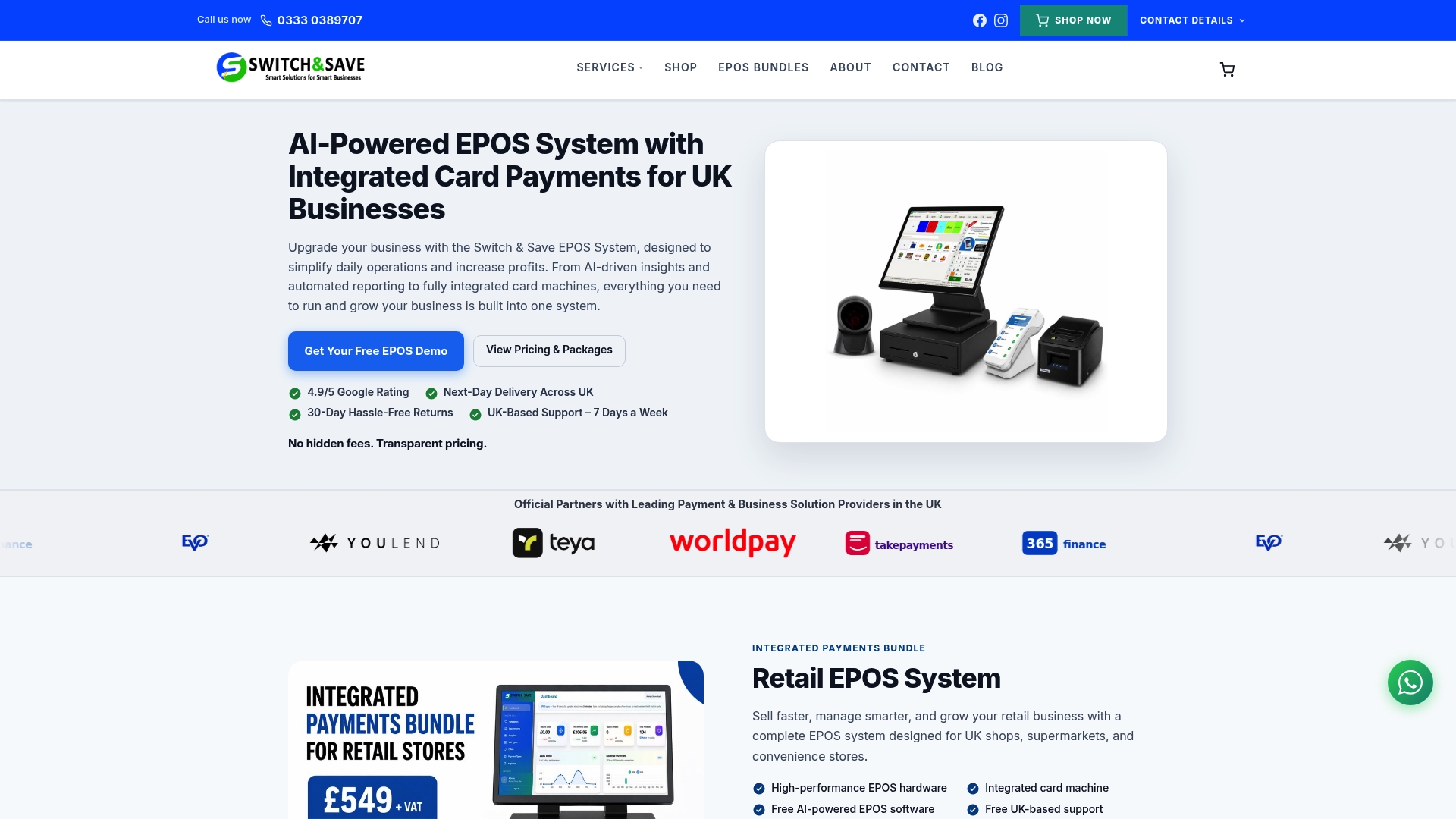
Our SSPOS software for EPOS systems is designed specifically so reorder alerts flow into requisitions without a manual step, and multi-store operators can see stock and PO status across every site at once. Retail businesses looking at a full hardware and software bundle should check the retail EPOS system range, while restaurants, cafés, and takeaways will find a tailored fit in the hospitality EPOS bundle. If your business also relies on customer relationship data alongside stock control, it’s worth reading how POS and CRM integration can tighten purchasing decisions even further.
Browse the full EPOS systems range and book a free demo to see exactly how PO automation would work against your own stock and supplier data.
Sources
- Legislation
- Purchase order template UK | Sprintlaw
- Purchase order overview – Microsoft Learn
- What is Purchase Order Management? (Wise)
- Purchase order — Wikipedia
FAQ
What does PO mean in a purchase order?
PO stands for purchase order, a buyer-issued document that instructs a supplier what to deliver, in what quantity, and on what terms, becoming binding once accepted.
Is it “POs” or “PO’s” for the plural?
The correct plural is “POs”, with no apostrophe, since the apostrophe would incorrectly suggest possession rather than a simple plural.
What are the four main types of purchase order?
The four common types are standard, blanket, contract, and planned (or scheduled) purchase orders, each suited to different buying patterns from one-off purchases to forecast stock builds.
What does it mean when a PO says “purchase”?
It means the document represents a formal commitment to buy specific goods or services from a named supplier, distinct from an internal requisition or a supplier’s invoice.
How do purchase orders connect to a POS or EPOS system?
An EPOS system tracks stock in real time and can trigger a requisition automatically once inventory drops below a set reorder point, feeding straight into an automated purchase order with the GL code already assigned.