Choose POS-integrated loyalty over paper stamp cards or a standalone app. It captures purchase data automatically at checkout, so you get faster repeat visits, cleaner reporting for measuring ROI, and usable customer data without asking staff to juggle a second system. The steps, costs, and venue-specific mechanics below show exactly how to get there.
TL;DR:
- POS loyalty programs automatically capture purchase data at checkout, enabling faster repeat visits and cleaner ROI reporting without extra staff effort.
- Key features include quick one-tap enrollment, configurable earning rules, automated triggers, customer segmentation, and GDPR compliance.
- Successful setup requires defining goals first, choosing enrollment methods with consent, and running pilot programs before full deployment.
- Rewards should match venue type, with visit-count rewards for pubs, spend-based perks for restaurants, and tiered offers for retail, utilizing appropriate channels like SMS or wallet passes.
- Most loyalty program failures stem from enrolment friction or unclear rewards, which can be fixed by simplifying sign-up and offering instant-value rewards.
Table of Contents
- What is a POS loyalty programme and why does it matter in 2026?
- What core features should a POS loyalty system have?
- How do you set up a POS loyalty programme?
- How does loyalty work differently in retail versus hospitality?
- How do you measure loyalty programme success?
- What does a POS loyalty programme cost?
- What goes wrong with loyalty programmes, and how do you fix it?
- What we’ve learned from EPOS-integrated loyalty rollouts
- Switch&Save: loyalty built into your EPOS, not bolted on
- Sources
- FAQ
What is a POS loyalty programme and why does it matter in 2026?
A POS-integrated loyalty programme runs inside your point-of-sale system rather than alongside it. Instead of stamping a paper card or asking customers to download a separate app, the till itself records the visit, applies the reward rule, and logs the purchase against a customer profile. Compare that with a stamp card, which tracks nothing beyond what’s printed on it, or a bolt-on app that needs its own login, its own database, and a member of staff remembering to check it.
The UK loyalty market has grown up. Marketers now prioritise ROI and first-party data over experimentation, which means vague “reward everyone” schemes are losing ground to programmes that can prove what they’ve earned back. Adoption of AI-driven personalisation is high, but many operators still struggle to turn that data into action rather than letting it sit unused.
For a retailer or hospitality operator, the practical outcome is simple: more repeat visits, a clearer read on which customers actually drive profit, and a system that reports on itself rather than needing manual spreadsheet work every month.
What core features should a POS loyalty system have?
Not every EPOS vendor builds loyalty properly. Before you commit, check the system against this list.
- One-tap enrolment at checkout — staff should be able to sign a customer up in seconds, without a separate device or a customer needing to install anything.
- Flexible earning and redemption rules — points, visit counts, spend thresholds, and tiered rewards should all be configurable without calling support.
- Automated triggers — birthday offers, “we miss you” messages, and milestone rewards should fire on their own once rules are set.
- Segmentation and integrations — the system should feed customer behaviour into your CRM, email platform, or accounting software so you can see which segments actually spend.
- GDPR-ready data handling — opt-in consent capture and straightforward data deletion on request, since older EPOS systems often lack this by design.
Pro Tip: Ask any vendor to show you the enrolment screen live, on a real till, before you sign anything. If it takes more than one tap and ten seconds, your staff won’t use it consistently during a Friday night rush.
How do you set up a POS loyalty programme?
Launching a loyalty scheme badly is worse than not launching one at all, since a half-configured programme frustrates both staff and customers. Follow this order:
- Define your goal and reward mechanic first. A café chasing frequency needs a different mechanic to a boutique chasing average basket size.
- Choose how customers enrol and give consent. Phone number capture at the till is usually faster than app downloads or email forms.
- Configure earning and redemption rules in the EPOS. Decide whether rewards are points-based, visit-based, or spend-based, and set any automation for birthdays or milestones.
- Write a 15-second staff script and pilot it. Something as simple as “Can I pop your number in for our rewards scheme?” removes hesitation and awkwardness.
- Connect the loyalty data to CRM, email, or accounting tools. This is where you start measuring lifetime value and incremental revenue rather than guessing at it.
Run the pilot in one site or one till for two to three weeks before rolling it out everywhere. Small fixes are cheap early and expensive once every location depends on the same broken rule.
How does loyalty work differently in retail versus hospitality?
Mechanics that work in a pub often fall flat in a boutique, and vice versa. Venue type should decide your reward structure, not the other way round.
- Wet-led pubs do well with visit-count rewards — a free pint on the fifth visit, tracked automatically by the till, works better than points that feel abstract after a few rounds.
- Food-led restaurants respond to spend-based rewards layered with experiential perks: a birthday dessert, a loyalty-only tasting event, or early booking access. Occasion-led recognition tends to build emotional loyalty more effectively than discount coupons alone.
- Retail benefits from tiered, behaviour-based offers — spend more, unlock better perks — plus referral mechanics that reward existing customers for bringing in new ones, similar to the structures used in customer referral programmes more broadly.
- Channel choice matters too. SMS and email suit quick, low-cost campaigns; wallet passes work well for visual reward tracking; a dedicated app is usually only worth building once you have enough footfall to justify the maintenance.
Our restaurant loyalty system guide covers hospitality-specific setup in more depth if that’s your venue type.
How do you measure loyalty programme success?
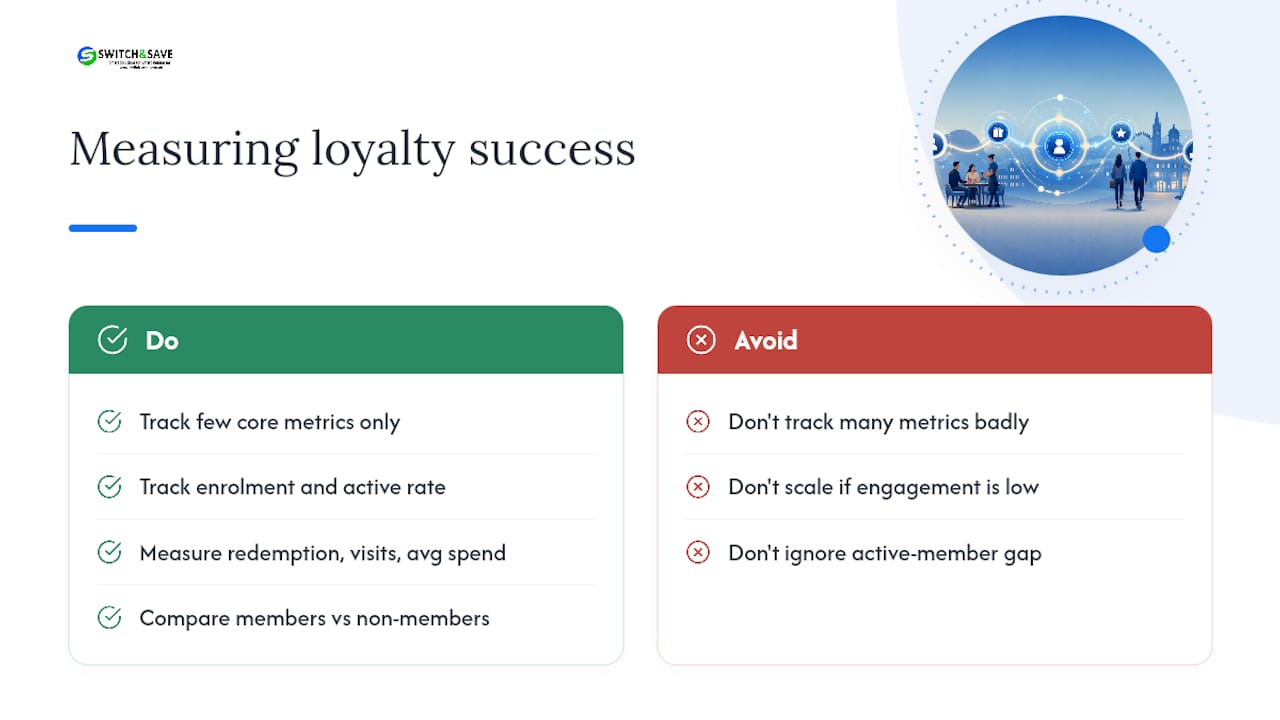
Track a small number of numbers properly rather than a large number badly. The core metrics are enrolment rate, percentage of members active in the last 90 days, redemption rate, visit frequency, average spend per visit, and the share of total sales attributed to loyalty members.
Incremental revenue is the number that actually justifies the programme: compare average spend and visit frequency for loyalty members against non-members over the same period. If members spend more per visit and visit more often, that gap is your return.
Roughly 55% of UK consumers belong to at least four loyalty schemes, yet 58% have actively used three or fewer in the past six months. That’s your benchmark for engagement risk: if your active-member rate drifts well below half of enrolled members, the rewards probably aren’t delivering fast enough value, and it’s worth revisiting the mechanic before scaling the programme further.
What does a POS loyalty programme cost?
Pricing usually falls into three shapes: a free entry-level tier with limited features, a flat monthly subscription bundled into your EPOS package, or a per-transaction fee on redeemed rewards.
The costs that catch operators out aren’t the subscription. They’re the hidden ones.
- Staff time spent training on enrolment scripts and troubleshooting redemption issues.
- Campaign management — someone needs to actually write the birthday offer copy and check the automation is firing correctly.
- Integration costs if your CRM or accounting software needs a paid connector to talk to your EPOS.
Independents typically budget modestly for a bundled EPOS loyalty module, since it’s included rather than separately priced; multi-site operators should expect higher totals once training and campaign management scale across locations. Build a simple spreadsheet comparing monthly cost against projected incremental revenue from repeat visits before committing, since staff training and ongoing management time can materially affect the real ROI even when the software itself is inexpensive.
What goes wrong with loyalty programmes, and how do you fix it?
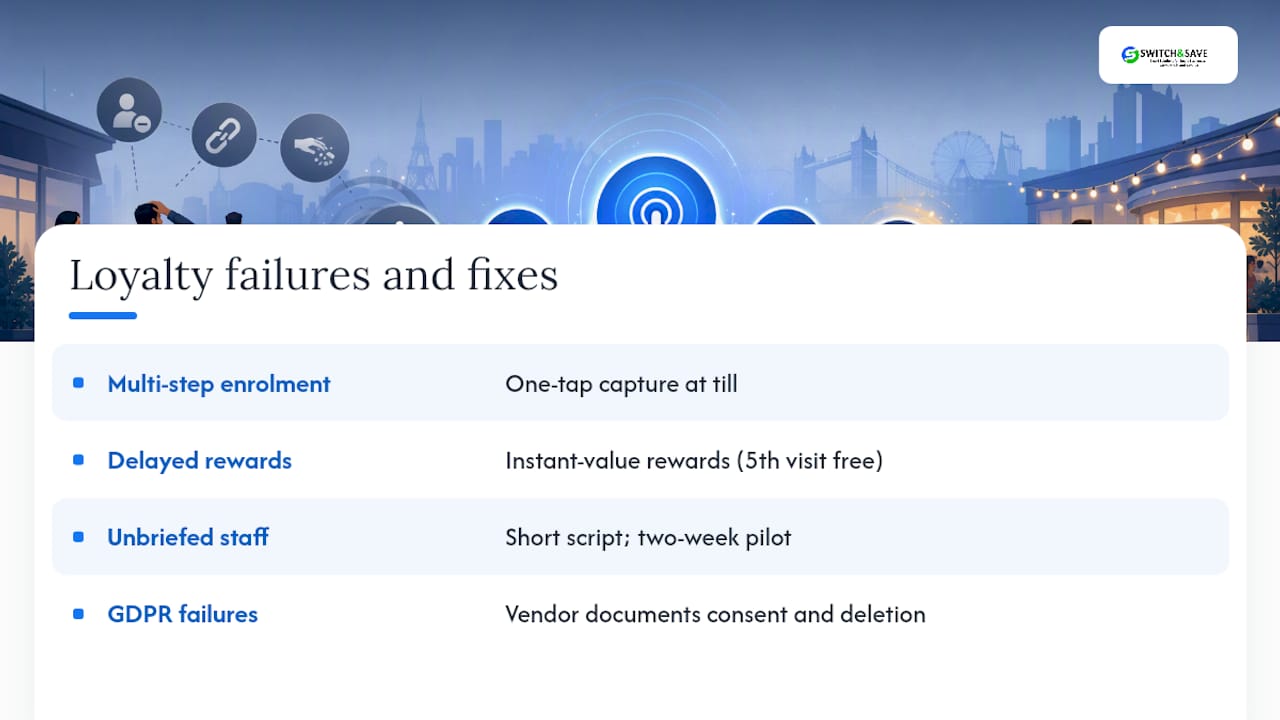
Most failures trace back to friction. If enrolment takes more than one step, adoption drops fast, so fix it with a single-tap capture at the till rather than a form. If rewards feel distant or unclear, customers disengage, so favour instant-value mechanics such as a fifth-visit freebie over a slow-building points system. Staff who aren’t trained simply won’t mention the scheme, so a short script and a two-week pilot matter more than any feature list. And GDPR missteps around consent or data deletion can undo trust instantly, so confirm your vendor documents this properly before launch.
Pro Tip: Before go-live, run a launch-day checklist: test enrolment on a live till, confirm one redemption end-to-end, and check a customer can request data deletion without a phone call to head office.
What we’ve learned from EPOS-integrated loyalty rollouts
Loyalty schemes fail more often from operational friction than from bad reward design. The pattern that shows up again and again is a scheme built around a great idea and a clunky sign-up process, and the sign-up process always wins. EPOS-native loyalty fixes this because the till is already doing the work. Data lands in one place, staff aren’t managing a second system, and the reporting reflects what actually happened rather than what was manually logged.
— Amir
Switch&Save: loyalty built into your EPOS, not bolted on
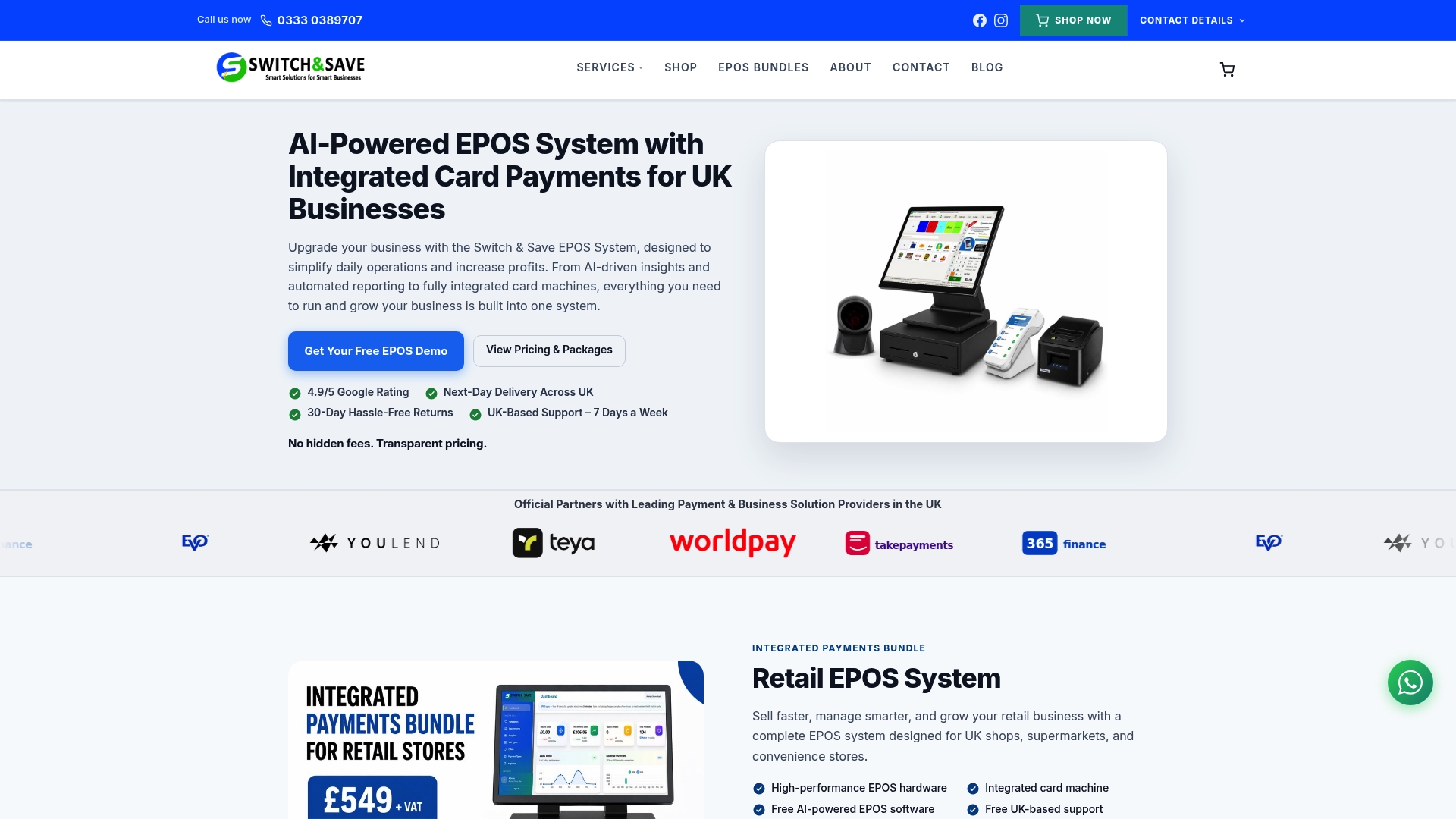
You don’t need a separate loyalty app fighting your till for attention. Switch&Save builds loyalty directly into the EPOS software, so enrolment, earning rules, and redemption all happen at the point of sale, with real-time sales and customer data feeding straight back into one dashboard.
Here’s what that gives you in practice:
- Real-time sales and loyalty data on one screen, across single or multiple sites.
- A built-in loyalty module, so there’s no separate app subscription to manage.
- Multi-store support if you’re running more than one location.
- UK-based support and free demos, so setup questions get answered by someone who understands British retail and hospitality.
Operators typically use this to cut the admin around campaign tracking and get a clearer view of which customers actually return. Browse the EPOS systems range or look at the SSPOS software directly, and book a free demo to see the loyalty module running on a real till before you decide anything.
FAQ
What are the top loyalty programmes in the UK?
Tesco Clubcard and Sainsbury’s Nectar dominate supermarket loyalty by member numbers, but the strongest-performing schemes for independent retail and hospitality are usually POS-integrated programmes built around instant, venue-specific rewards rather than national point schemes.
Is Nectar or Clubcard better?
Both work on similar points-for-discounts models; the better one depends on where you already shop most, since the real value comes from redeeming points at retailers you’d use anyway rather than either scheme’s underlying mechanics.
What is the best loyalty system for a small business?
For small independents, a POS-integrated system with one-tap enrolment and instant-value rewards, such as Switch&Save’s built-in loyalty module, typically outperforms standalone apps because staff and customers both use it without extra friction.
How much does a POS loyalty programme cost to run?
Costs usually combine a monthly subscription or bundled EPOS fee with hidden staff time for training and campaign management; budget for both, not just the software price, before committing.
How do I get customers to actually use a loyalty programme?
Make enrolment a single step at checkout rather than a separate app download, and offer a fast, tangible first reward, since engagement drops sharply when schemes fail to deliver quick value.