
To calculate food cost percentage, divide your food cost by your food sales and multiply by 100. For a week or month, calculate food cost as opening stock plus food purchases minus closing stock. For an individual dish, divide the ingredient cost per portion by its selling price.
For example, a meal with £3 of ingredients and a £10 selling price excluding VAT has a 30% food cost percentage. That leaves £7 to cover wages, rent, energy, payment fees and other expenses before you make a profit.
Below, you’ll find the formulas, practical UK examples and a free calculation template you can use in Excel or Google Sheets.
What is food cost percentage?
Food cost percentage shows how much of your food sales revenue goes towards the food you use.
If your percentage is 32%, you’re using £32 of food for every £100 of food sales. The remaining £68 must cover your other costs and profit.
You can measure it in two ways:
- Per dish: useful for setting prices and reviewing recipes.
- Across your business: useful for checking food usage over a week or month.
The business-wide calculation includes food that leaves your stock through waste, overportioning or unrecorded usage. That’s why it can differ from the percentage on your recipe cards.
Key takeaways
| Question | Quick answer |
|---|---|
| What is the food cost percentage formula? | Food cost ÷ food sales × 100 |
| How do you calculate food used? | Opening stock + purchases − closing stock |
| How do you cost one dish? | Add the ingredient costs for one standard portion |
| How do you price a dish? | Portion cost ÷ target food cost percentage expressed as a decimal |
| Does a 30% food cost mean 70% profit? | No. Other operating costs still need paying |
| Should you include VAT? | Exclude sales VAT and recoverable purchase VAT where applicable |
How to calculate food cost for your business
Use this formula for a trading period:
Food cost percentage = [(opening food stock + food purchases − closing food stock) ÷ food sales] × 100
This stock-based method adjusts purchases for food that remains unused at the end of the period. usfoods.com
Step 1: Choose your dates
Pick one week or month. Your stock counts, purchases and sales must all cover the same period.
For a café, you might count stock after closing every Sunday. Keeping the timing consistent makes comparisons more useful.
Step 2: Value your opening and closing stock
Count ingredients in your fridge, freezer and dry storage. Value them at cost, rather than their menu selling price.
Include usable prepared food where relevant. A batch of sauce still in the fridge has a cost, even though its ingredients have already been opened.
Step 3: Add food purchases
Record food received during the period, adjusting for supplier returns and credits. Keep cleaning products and other non-food purchases separate.
Step 4: Find matching food sales
Use food sales after discounts and refunds. Exclude drinks if their ingredient costs aren’t included in your calculation.
These illustrative figures cover one week:
| Item | Amount |
|---|---|
| Opening food stock | £1,200 |
| Food purchases | £2,800 |
| Closing food stock | £1,000 |
| Food sales excluding VAT | £10,000 |
Food used = £1,200 + £2,800 − £1,000 = £3,000
Food cost percentage = £3,000 ÷ £10,000 × 100 = 30%
Simply dividing purchases by sales would give 28%. That would miss the £200 reduction in stock during the week.
Keep VAT consistent
If you’re VAT registered, use sales excluding VAT and ingredient costs excluding VAT you can recover. Keep non-recoverable VAT within your costs.
UK food VAT treatment varies. Eat-in catering is generally standard-rated, while takeaway treatment depends on the product and circumstances. Check the applicable treatment rather than removing 20% from every sale. GOV.UK
For a standard-rated sale at 20%, a £12 customer price equals £10 excluding VAT: £12 ÷ 1.20.
Free food cost percentage calculator
Copy this template into Excel or Google Sheets. Put the labels in column A and the values or formulas in column B.
| Row | Column A: label | Column B: value or formula |
|---|---|---|
| 1 | Opening food stock (£) | 1200 |
| 2 | Food purchases (£) | 2800 |
| 3 | Closing food stock (£) | 1000 |
| 4 | Food sales (£) | 10000 |
| 5 | Food used (£) | =B1+B2-B3 |
| 6 | Food cost percentage | =IF(B4>0,B5/B4,"Check sales") |
Format B6 as a percentage, then replace the sample numbers with your own figures. The example returns 30%.
Don’t multiply the spreadsheet result by 100 when using percentage formatting. The formatting already displays 0.30 as 30%.
If sales are zero, the percentage is undefined. If food used comes out negative, check your counts, purchase records and dates before relying on the result.
How to calculate food cost per dish
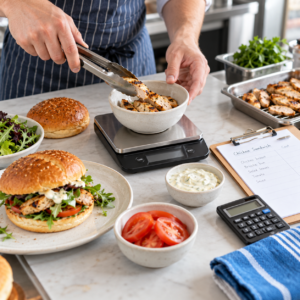
Start with a standard recipe and portion size. Include every ingredient customers receive, including oil, sauces and garnishes.
Here’s an illustrative chicken burger:
| Ingredient | Cost per portion |
|---|---|
| Chicken | £1.45 |
| Bun | £0.35 |
| Salad | £0.20 |
| Sauce | £0.15 |
| Chips | £0.65 |
| Oil and seasoning | £0.20 |
| Total | £3.00 |
At a £10 selling price excluding VAT:
£3 ÷ £10 × 100 = 30%
Use the cost of the usable ingredient. If trimming or cooking reduces what you can serve, spreading the purchase cost across the original weight will understate your portion cost.
Packaging also needs paying for. Track it separately from ingredient cost, then include it when checking whether the takeaway order makes enough money.
The menu pricing formula
To calculate a starting selling price:
Selling price excluding VAT = portion ingredient cost ÷ target food cost percentage as a decimal
Suppose the burger costs £3 and you choose an illustrative target of 30%:
£3 ÷ 0.30 = £10 excluding VAT
Where 20% VAT applies, that becomes £12 including VAT.
The target changes the calculated price:
| Illustrative target | Price excluding VAT | Price including 20% VAT |
|---|---|---|
| 25% | £12.00 | £14.40 |
| 30% | £10.00 | £12.00 |
| 35% | £8.57 | £10.29 |
These are pricing scenarios, not recommended targets.
Use the menu pricing formula as a starting point. Then check preparation time, packaging, delivery commissions, other overheads and what your customers are willing to pay.
What is a good food cost percentage?
There isn’t one percentage that suits every business.
A sandwich kiosk, a pub serving steaks and a takeaway offering meal deals have different ingredient costs, staffing needs and selling prices. Your target needs to work alongside those costs.
Also look at the pounds left per sale. A £20 dish costing £8 has a 40% food cost and leaves £12 before other expenses. A £10 dish costing £3 has a 30% food cost but leaves £7.
The lower percentage doesn’t automatically make the second dish more profitable. Labour, sales volume and preparation time also matter.
Actual versus theoretical food cost
Theoretical food cost is what ingredients should cost based on your recipes and the dishes sold.
Actual food cost comes from your stock counts and purchases.
Suppose recipe costs suggest you should have used £2,600 of ingredients, but your stock calculation shows £3,000. That leaves a £400 difference to investigate.
Possible causes include waste, larger portions, staff meals, missing stock or outdated recipe costs. Counting errors can also create a gap, so check the records before assuming food has been lost.
How to reduce food cost without cutting quality
Standardise portions
Use scales, scoops and clear recipe instructions. Customers should receive the same portion regardless of who’s working.
Consistency makes costing more reliable and helps you spot where ingredients are being used faster than expected.
Record waste
Note what was wasted, how much and why. Spoiled milk needs a different fix from meals remade because an order was entered incorrectly.
Look for repeated problems rather than treating every incident separately.
Review costs and menu prices together
Update recipe costs when supplier prices change. An old ingredient price can make a dish appear healthier financially than it really is.
Check discounts too. Reducing a £10 dish to £8 while its ingredients remain £3 raises food cost from 30% to 37.5%.
Buy around demand
A bulk deal only saves money if you use the stock. Review sales patterns before ordering extra perishables, particularly around quiet days and seasonal changes.
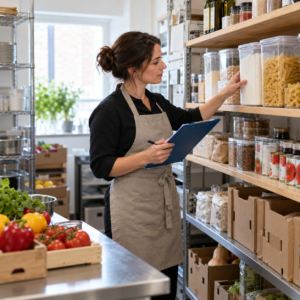
How EPOS helps you monitor food costs
Your calculations need dependable sales figures. An EPOS system can provide the sales records you use to compare food usage with revenue.
When reviewing a system, check whether it separates food and drink sales, records discounts and refunds, and provides reports for your chosen dates. Recipe-level costing requires suitable ingredient and stock functionality, so confirm that capability before relying on it.
Explore Switch & Save’s hospitality EPOS systems when reviewing how your café, restaurant or takeaway records sales.
You’ll still need accurate stock counts and current supplier costs. Together, those records give you a clearer basis for pricing and purchasing decisions.
Check your costs with Switch & Save
Knowing your food cost percentage helps you see where your menu needs attention. Reviewing payment fees and operating systems can help you assess other costs alongside it.
Switch & Save helps UK businesses reduce costs with AI-powered EPOS systems, card payment solutions and business finance.
Frequently asked questions
How do you calculate food cost percentage?
Divide food cost by food sales and multiply by 100. For a trading period, calculate food cost using opening stock plus purchases minus closing stock.
Can I use purchases instead of food cost?
Purchases alone can give a misleading result because some food remains in stock. Opening and closing stock adjust the calculation for what you actually used.
Does food cost percentage include wages?
No. Ingredient-based food cost excludes wages, rent, energy and other overheads. Assess those separately before deciding whether a dish is profitable.
How often should I calculate it?
A weekly calculation can help you spot changes promptly. A monthly review gives a broader view. Choose a schedule you can maintain with consistent stock counts.
How do I price a dish at a 30% food cost?
Divide its ingredient cost by 0.30. A £3 portion gives a £10 selling price excluding VAT. Then check VAT, other costs and customer demand.