
Your POS system already holds the data you need to segment customers, lift average order value, and win back lapsed visitors. The challenge is not collecting more data; it is activating what you already have. Three actions will get you moving today:
- Enable customer profiles in your POS so that every transaction is tied to an identity, not just a receipt.
- Run a basic RFM segment (Recency, Frequency, Monetary value) to separate your VIPs from customers who have gone quiet.
- Connect your POS to an email or SMS tool so those segments trigger automated campaigns without manual effort.
Do those three things and you can reasonably expect a higher average order value from your top tier, faster win-backs from lapsed customers, and smarter rostering based on actual footfall patterns rather than gut feel.
Key takeaways
Your POS system already contains the data to segment customers, personalise campaigns, and reduce churn — the priority is activating it through identity resolution, RFM segmentation, and consistent measurement.
| Point | Details |
|---|---|
| Fix identity first | Identity fragmentation undercounts true LTV by 40–60%; resolving it is the highest-value early step. |
| Run RFM from day one | A basic RFM model yields 8–10 segments with clear campaign triggers for VIPs and lapsed customers. |
| Start with win-backs | Automated lapsed-customer sequences and VIP offers deliver the fastest ROI for small to mid-size operators. |
| Measure with control groups | Always hold back 50% of a segment as a control; measure recovery rate at 30 days for win-back campaigns. |
| Switch-and-save | Switch-and-save’s AI-powered EPOS captures customer profiles, integrates payments, and supports multi-store reporting in one system. |
Table of Contents
- What customer insights in POS data actually look like
- How to turn raw POS sales into usable customer segments
- High-impact use cases for retail and hospitality
- What to look for in a POS or EPOS vendor
- How to measure impact and what it will cost you
- Data protection and consent: what you need to know
- The part most managers get wrong about POS analytics
- Switch-and-save makes POS customer analytics practical from day one
- Sources
- FAQ
What customer insights in POS data actually look like
Every POS transaction writes a structured record. Most managers glance at the daily sales total and move on. The real value sits in the individual fields, and each one maps to a specific customer-level insight.
| POS field | Insight it supports |
|---|---|
| Timestamp (date, time, day) | Visit cadence, peak hours, seasonal patterns |
| Items / SKU / category | Basket composition, cross-sell affinity |
| Price and discount applied | Price sensitivity, promotion response |
| Payment method | Card vs cash split, contactless adoption |
| Staff ID / terminal | Service quality signals, upsell performance by staff |
| Location / store ID | Multi-site behaviour, geographic preference |
| Loyalty ID / email / phone | Lifetime value, churn risk, personalisation |
When you understand what your POS records at the field level, the use cases become obvious. A customer who buys coffee every weekday morning but has not visited in three weeks is showing early churn. A basket that always pairs a main with a side dish is a cross-sell prompt waiting to be automated.
The catch is identity. Guest checkouts, multiple email addresses, and card-only transactions without loyalty capture all fragment the same customer into separate records. According to the retail customer analytics playbook, identity fragmentation commonly undercounts true lifetime value by a substantial percentage. That is not a rounding error; it means your best customers may look like average ones because their spend is split across three profiles.
The 40–60% LTV gap is the single most common reason POS-driven campaigns underperform. Fix identity first, then segment.
How to turn raw POS sales into usable customer segments
A repeatable six-step workflow keeps this practical rather than theoretical. You do not need a data team to start; you need discipline and the right sequence.
- Capture and profile. Switch on customer profiles in your POS. Collect at minimum an email or phone number at the point of sale. Even a 30% capture rate gives you enough to work with. Enabling profiles and running a few immediate queries — top spenders, lapsed visitors, frequency tiers — is the fastest way for local businesses to generate usable segments.
- Clean and resolve identity. Deduplicate records by matching email, phone, and card token. This is the step most operators skip, and it is the one that produces the largest single-day improvement to reported lifetime value. A governed semantic layer and stable identity resolution are higher-value early work than adding more data sources.
- Enrich with loyalty and channel data. Append loyalty tier, acquisition channel, and any online order history. Even a simple “in-store only vs. in-store + online” flag creates meaningfully different segments.
- Segment using RFM and behavioural cohorts. A basic RFM model typically yields 8–10 actionable segments — champions, loyal, at-risk, hibernating — each with a natural campaign trigger. Behavioural cohorts (e.g., “lunch-only visitors”, “weekend big-basket shoppers”) add a second dimension that RFM alone misses.
- Test activations with a control group. Run a win-back email to 50% of your lapsed segment and hold 50% back. Measure recovery rate over 30 days. A small café or boutique can run this with a free or low-cost email platform. The measurement window for a win-back sequence is typically 30 days; for a loyalty uplift test, allow 60 days to see repeat purchase behaviour shift.
- Measure and iterate. Track repeat purchase rate, average order value, and recovery rate against your control group. If the activation works, scale it. If it does not, adjust the offer or the timing before spending more.
Sample KPIs by step:
- Capture rate (% of transactions with a linked identity)
- Repeat purchase rate (% of customers who return within 90 days)
- Average order value (AOV) by segment
- Recovery rate (% of lapsed customers who return after a win-back campaign)
- Churn rate (% of previously active customers with no visit in 60+ days)
High-impact use cases for retail and hospitality
The five scenarios below cover the activations with the clearest return. Each one notes which POS fields you need, a realistic business impact, and whether it is a near-term or longer-term project.
👉 VIP recognition programme (retail) — near-term
Send a personalised offer — early access, a small gift, a discount on their most-purchased category. The activation mechanics are simple: an RFM export from your POS, a segment in your email tool, and a triggered send. Expected impact: higher AOV and improved retention among your most valuable customers. For example, a fashion boutique might identify 80 customers who each spend three times the average and send them a private-sale invitation before the general announcement.
👉 Cross-sell from basket affinity (retail) — near-term
Pull item-level co-purchase data from your POS to find which products are bought together. One targeted email or a staff prompt at the till is all it takes. POS-driven sales improvements often start here because the data is already in the system.
👉 Shift-level rostering optimisation (hospitality) — near-term
Timestamp and cover-count data from your POS reveals exactly when your busiest periods fall, down to the 30-minute slot. A small boutique applying payments-based analytics to staffing decisions reported a 20% weekly payroll saving after aligning rosters to actual demand. Match your staffing schedule to your POS heatmap and you cut idle labour cost without reducing service quality.
👉 Lapsed-customer win-back (hospitality and retail) — near-term
Filter for customers who visited regularly but have not returned in 45–60 days. Send a single, time-limited offer via email or SMS. Keep it simple: “We miss you — here’s 10% off your next visit, valid for two weeks.” The fastest ROI for small to mid-size operators typically comes from exactly this activation, paired with VIP recognition. Measure recovery rate at 30 days.

👉 Targeted time-limited offers (hospitality) — longer-term, requires identity layer
Once you have a reliable identity layer, you can send offers timed to a customer’s typical visit window. A customer who always orders on Thursday lunchtimes gets a Thursday-specific promotion. This requires POS-to-ESP integration and a stable customer profile, so it is a 60–90-day project rather than a week-one action. One retailer using anonymised payments data to inform decisions of this kind improved EBITDA by a modest margin through better labour allocation and more targeted marketing.
What to look for in a POS or EPOS vendor
Not every POS system makes customer analytics easy. Before you commit to a platform, run it against this checklist.
Must have:
- Customer profile creation and storage at the point of sale
- Transaction export via API or flat file
- Loyalty programme hooks (native or third-party)
Should have:
- Identity resolution or deduplication tools
- Real-time or nightly sync to an email/SMS platform or CRM
- Multi-store and multi-terminal support with unified reporting
Can have (useful if budget allows):
- RFID or footfall sensor integration — an experiment combining POS and RFID data across roughly 7,000 customers produced detailed journey maps and measurably improved staffing and inventory decisions
- Predictive lifetime value models
- Advanced AI-driven segmentation built into the dashboard
Integration priority order matters. Connect your CRM or email platform first — that is where campaigns actually run. Then link your loyalty platform to close the identity loop. Accounting integration comes third (useful for margin analysis). Analytics warehouse and payment processor data come last, once the basics are working.
Red flags to avoid: a POS that locks transaction data behind a proprietary dashboard with no export, a vendor with no API documentation, and any system that cannot capture a customer identifier at the till.
Pro Tip: Ask any vendor to show you a live export of transaction data with customer fields populated. If they cannot demo it in under five minutes, the feature probably does not work as advertised.
When choosing between a bundled EPOS-plus-retention approach and a standalone POS with a separate retention layer, the bundled route wins on speed and simplicity for most small to mid-size operators. Fewer integrations means fewer points of failure and faster time to first insight. Check the vendor selection guide for a fuller feature comparison.
How to measure impact and what it will cost you
Setting realistic expectations before you start saves a lot of frustration at the 30-day mark.
KPIs to track and how POS feeds them:
- Repeat purchase rate: transactions per customer per 90 days; your POS calculates this directly once profiles are linked.
- Average order value (AOV): total revenue divided by transaction count; segment by RFM tier to see which cohorts drive the most value.
- CAC-to-LTV ratio: acquisition cost (from your marketing spend) divided by predicted lifetime value; requires identity resolution to be accurate.
- Churn rate: percentage of previously active customers with no visit in a defined window (typically 60 days for hospitality, 90 days for retail).
- Recovery rate: percentage of lapsed customers who return after a win-back campaign; your benchmark for campaign effectiveness.
A realistic 90-day timeline:
- Days 1–30: Enable customer profiles, audit captured fields, run your first RFM export, identify VIPs and lapsed segments. POS data is equally useful for inventory and rostering decisions at this stage.
- Days 30–60: Launch a win-back sequence to your lapsed segment with a control group. Measure recovery rate. Run a VIP offer to your top tier.
- Days 60–90: Scale what worked, cut what did not, and begin building the identity layer for time-targeted campaigns.
Typical cost items to budget for:
- EPOS subscription (hardware and software)
- Integration or connector fees (POS to ESP or CRM)
- Email or SMS platform costs
- Staff time for initial setup and data audit (typically 4–8 hours)
- Optional: analytics consultant for identity resolution or warehouse setup
Most of the near-term wins require nothing beyond your existing EPOS subscription and a low-cost email platform. The more advanced activations add connector and platform fees, but the payback period is short when you have a working win-back sequence running.
Data protection and consent: what you need to know
Collecting customer data at the POS is only legal if you do it correctly. Under UK GDPR, you need a lawful basis before you capture, store, or use personal data for marketing.
A practical GDPR checklist for POS operators:
- Lawful basis: use consent for direct marketing (email, SMS); legitimate interest may apply for aggregated analytics, but document your assessment.
- Consent capture at the till: ask clearly (“Can we add your email to send you offers?”), do not pre-tick boxes, and record the date and method of consent.
- Retention windows: set a policy — for example, delete or anonymise inactive customer records after 24 months of no transaction.
- Records of processing: maintain a simple register of what data you hold, why, and who can access it.
- Secure data transfers: if your POS syncs to a third-party ESP or CRM, check that the processor’s data transfer terms permit marketing use.
- Anonymised cohorts: for aggregated insights (peak hours, category trends), use anonymised or pseudonymised data — no personal identifiers needed.
One specific risk: combining payments data with personal identifiers. Your card processor’s contract may restrict how transaction data can be used for marketing. Check the permitted-use clauses before building campaigns on payments data alone.
For authoritative guidance, the ICO’s direct marketing guidance is the primary reference for UK operators.
The part most managers get wrong about POS analytics
Most operators assume the hard part is the technology. It is not. The hard part is identity.
You can have the most capable EPOS system on the market and still produce misleading segments if the same customer appears in your database as three separate records — one from a loyalty sign-up, one from a guest checkout, and one from a card token.
The practical implication is this: before you invest time in building sophisticated campaigns or adding new data streams, spend a day auditing your identity capture rate. What percentage of your transactions have a linked customer profile?
There is also a tendency to over-engineer the first activation. A simple win-back email to customers who have not visited in 45 days, with a clear offer and a two-week deadline, will outperform a complex multi-step journey built on incomplete data every time. Start with the simplest possible test, measure it properly with a control group, and only add complexity when the basics are working.
The businesses that get the most from POS customer analytics are not the ones with the most data. They are the ones that have resolved identity, kept their segments clean, and run consistent, measurable campaigns over time.
Switch-and-save makes POS customer analytics practical from day one
Getting from raw transaction data to working customer segments takes the right system underneath it. Switch-and-save’s AI-powered EPOS systems are built for exactly this: customer profile capture at the till, real-time sales reporting, integrated payment processing, and multi-store support — all in one bundle with UK-based technical help when you need it.
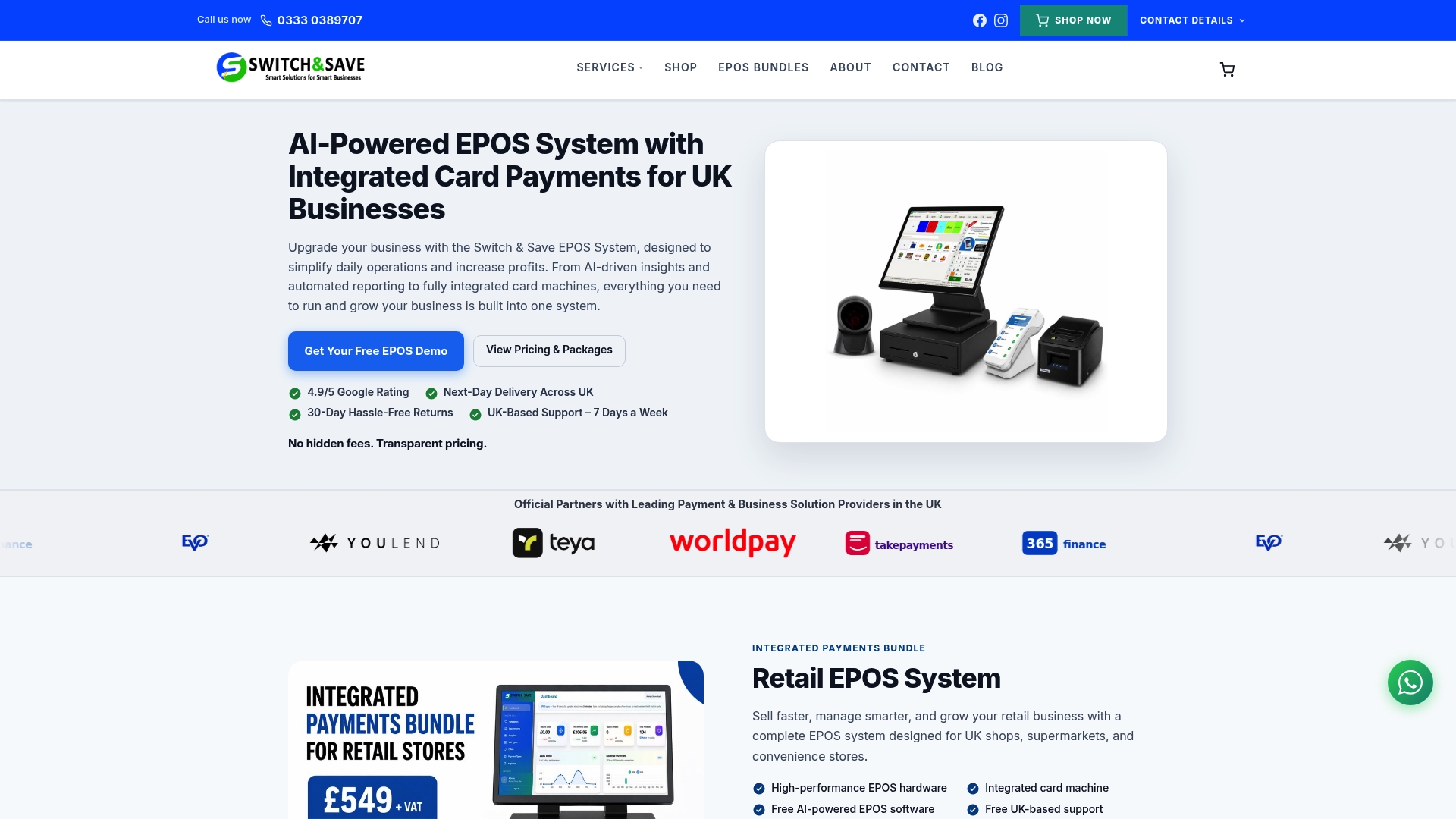
For hospitality businesses, the hospitality EPOS bundle includes the tools to track covers, shift performance, and customer visit patterns without stitching together separate platforms. For retail, the same system gives you the basket-level and loyalty data you need to run RFM segments and win-back campaigns from week one.
👉 Book a free demo or request a quote at Switch-and-save and see how quickly your POS data can start working harder for your business.
Sources
- Retail customer analytics: the 2026 playbook to turn first‑party data into revenue
- How to Turn Your POS Data Into Customer Insights | Regulr Blog
- Chase
FAQ
What are customer insights in POS?
Customer insights in POS are patterns and signals extracted from point-of-sale transaction data — such as visit frequency, basket composition, and spend level — that help businesses understand buying behaviour and personalise their marketing.
What are the four types of customer insights?
Definitions vary, but a common framework covers behavioural insights (what customers buy and when), attitudinal insights (why they buy), segmentation insights (which customer groups exist), and predictive insights (which customers are likely to churn or spend more).
How do you analyse customer insights from POS data?
The most effective approach follows a six-step workflow: capture and profile, clean and resolve identity, enrich with loyalty data, segment using RFM and behavioural cohorts, test activations with a control group, then measure and iterate using KPIs such as repeat purchase rate and recovery rate.
What are some practical examples of POS customer insights?
How quickly can a small business see results from POS analytics?
Most near-term activations — RFM segmentation, win-back emails, and rostering adjustments — can be set up within the first 30 days. Measurable results from a win-back campaign typically appear within 30 days of launch when tracked against a control group.