The card machine with the lowest processing fees depends on your monthly card turnover, customer card mix and payment method. For low-volume UK businesses, a pay-as-you-go reader with no monthly fee may cost less overall. For businesses processing more than approximately £3,000 per month, a subscription plan with a lower transaction rate may produce better savings. Established retailers, restaurants and takeaways may obtain an even more competitive overall deal through a tailored merchant-services quote.
Among widely available published plans, SumUp currently advertises a 1.69% pay-as-you-go rate and a 0.99% rate for eligible in-person domestic consumer-card payments under its £19-per-month Payments Plus plan. Square and PayPal Point of Sale, formerly Zettle, advertise standard in-person rates of 1.75%. Tailored providers such as Dojo calculate pricing according to the business, transaction volume, card type and payment setup.
However, the machine with the lowest percentage rate is not necessarily the cheapest card machine. Terminal rental, authorisation charges, minimum monthly fees, premium-card rates and contract costs can change the result.
Pricing note: Published rates in this guide were checked on 18 July 2026. Providers may change their prices, eligibility criteria and terms. Request a personalised quote before making a decision.
Key Takeaways
| Question | Direct answer |
|---|---|
| Which card machine has the lowest published rate? | SumUp Payments Plus advertises 0.99% on eligible in-person domestic consumer-card payments, with a £19 monthly charge. |
| Which option suits occasional sellers? | A no-monthly-fee pay-as-you-go reader will often suit seasonal and lower-volume businesses. |
| What about established shops and restaurants? | A tailored merchant-services quote may be more competitive than a standard flat-rate reader. |
| Should businesses compare transaction rates alone? | No. Compare rental, authorisation, PCI, settlement, refund and contract charges as well. |
| How should you compare providers? | Calculate the effective monthly cost using your actual turnover, transaction count and card mix. |
| Can Switch & Save help? | Yes. Switch & Save can compare card payment options alongside integrated EPOS requirements. |
Which Card Machine Currently Has the Lowest Advertised Processing Fee?
For eligible transactions, SumUp Payments Plus has one of the lowest publicly advertised in-person rates among mainstream UK small-business card-reader plans.
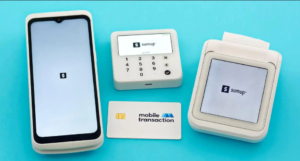
Its current structure includes:
- 0.99% for eligible in-person domestic consumer cards
- £19 monthly subscription
- 1.69% for international, corporate and premium cards, including American Express
- 2.50% for online payments
The standard SumUp pay-as-you-go plan charges 1.69% for in-person transactions without a monthly subscription.
That does not automatically make SumUp the cheapest provider for every business. A high-turnover convenience store, restaurant or bar may receive a tailored rate from a merchant-services provider that works out lower once its transaction volume and card mix are considered.
Switch & Save works with multiple established payment providers, allowing UK businesses to compare card machines and negotiated payment arrangements rather than being restricted to one fixed pricing model. Its current card-machine partners include providers such as Teya, Dojo, Worldpay and Shift4.
UK Card Machine Processing Fees Compared
The following table compares representative publicly advertised or quote-based pricing structures.
| Card payment option | In-person processing fee | Monthly payment | Most suitable for |
|---|---|---|---|
| SumUp Pay-as-you-go | 1.69% | £0 | Mobile, seasonal and lower-volume businesses |
| SumUp Payments Plus | 0.99% on eligible domestic consumer cards | £19 | Businesses processing regular in-person card sales |
| Square | 1.75% for UK cards | £0 on the standard payment plan | Businesses wanting straightforward POS and payment pricing |
| PayPal Point of Sale | 1.75% standard rate | £0 | Small businesses wanting simple flat-rate payments |
| Dojo | Tailored to the business | Hardware plans may apply | Established businesses wanting a personalised arrangement |
| Switch & Save payment partners | Tailored according to provider and application | Depends on the selected package | Retail and hospitality businesses comparing integrated options |
SumUp’s published rates are 1.69% under pay-as-you-go and 0.99% for eligible Payments Plus transactions. Square publishes a 1.75% in-person fee for UK cards and adds a further 1.5% for non-UK cards. PayPal Point of Sale publishes a 1.75% standard card-transaction fee, while Dojo uses tailored pricing based on the merchant’s setup.
These rates should be treated as comparison examples rather than a guarantee that one provider will be cheapest for your business.
Why the Lowest Transaction Rate May Not Be the Cheapest
Card processing costs usually contain more than one charge. Before selecting a machine, examine the complete pricing schedule.
Monthly terminal rental
Traditional card machines may involve a monthly rental or service charge. This can still be cost-effective when the accompanying transaction rate is sufficiently low.
For example, paying £20 per month for a lower processing rate may save money for a busy restaurant, but it may be unnecessary for a market trader processing only £800 per month.
Authorisation or per-transaction charges
Some providers apply a fixed charge every time a payment is authorised.
This matters particularly for businesses with a low average transaction value. A 5p authorisation charge on a £5 sale is equivalent to another 1% of that transaction.
A grocery shop processing hundreds of small basket transactions should therefore examine fixed pence charges carefully, even when the percentage rate looks attractive.
Customer card mix
Not every card is processed at the same cost.
Your final charges may vary according to whether customers use:
- UK consumer debit cards
- UK consumer credit cards
- Corporate or business cards
- Premium cards
- Cards issued outside the UK
- American Express
- Mobile wallets linked to different card types
For example, SumUp’s 0.99% Payments Plus rate applies to eligible domestic consumer cards, while international, corporate and premium cards remain at a higher published rate. Square also publishes an additional charge for non-UK cards.
Card-present and remote payments
A payment made through chip and PIN or contactless at the counter normally has a different risk profile from a telephone, payment-link or online transaction.
If your takeaway accepts a significant number of telephone orders or your service business sends payment links, compare the remote-payment rate separately. Do not assume that the rate shown for the physical card machine will also apply online.
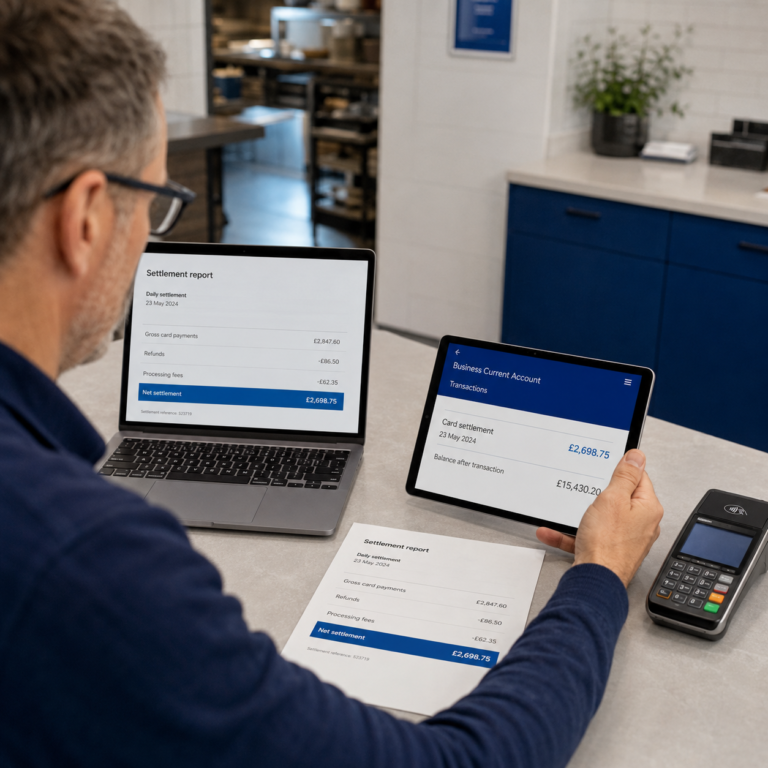
Refunds, chargebacks and additional services
Review whether the provider charges for:
- Refund processing
- Chargebacks
- PCI compliance assistance
- Paper statements
- Early contract cancellation
- Minimum monthly processing
- Faster settlement
- Additional card machines
- SIM or connectivity services
Dojo, for example, explains that its overall cost can include transaction charges, card-machine services and account extras. Its published information also identifies separate authorisation and refund charges within applicable arrangements.
Best Low-Fee Card Machine by Business Type
Mobile traders and occasional sellers
A pay-as-you-go card reader will normally be easier to justify when card turnover is low or unpredictable.
Suitable businesses may include:
- Market stalls
- Mobile beauticians
- Tradespeople
- Pop-up shops
- Seasonal businesses
- New sole traders
A mobile beautician processing £1,500 per month would pay approximately £25.35 at a 1.69% flat rate. Under a hypothetical 0.99% plan with a £19 subscription, the equivalent monthly cost would be approximately £33.85.
In that example, the higher percentage with no monthly fee is cheaper overall.
Cafés and small takeaways
A café taking £8,000 per month through eligible domestic consumer cards would pay approximately:
- £135.20 at 1.69%
- £140 at 1.75%
- £98.20 at 0.99% plus a £19 monthly subscription
Based only on those assumptions, the subscription option would be cheaper. However, the café should still check the number of corporate, international and premium cards it accepts, together with any hardware and service charges.
Businesses that need table service, kitchen printing or takeaway-order management should also consider whether the card machine integrates with their hospitality EPOS system.
Convenience stores and grocery shops
High-volume retailers should request tailored quotes rather than accepting the first flat-rate offer.
A convenience store may process:
- A large number of daily transactions
- Many low-value basket sales
- Mostly consumer debit cards
- Several tills or card machines
- Refunds and cashback-related enquiries
Even a small rate reduction can become significant at higher turnover. However, a per-authorisation fee can also add a substantial amount when the shop processes thousands of individual payments.
An integrated retail EPOS system can also reduce manual amount-entry errors and make card reconciliation easier.
Restaurants, bars and busy hospitality venues
Hospitality businesses should balance price with reliability.
A card machine that saves a few pounds per month but regularly loses connectivity during busy service can cause queues, abandoned orders and operational disruption.
Restaurants and bars should examine:
- Wi-Fi and 4G connectivity
- Battery life
- Pay-at-table functionality
- Tipping support
- Split payments
- EPOS integration
- Settlement speed
- Support availability
- Replacement-machine arrangements
For these businesses, a tailored portable terminal connected to the EPOS may offer better overall value than a basic standalone reader.
How to Calculate Your Real Card Processing Cost
Use the following formula:
Effective processing rate = total monthly payment costs ÷ monthly card turnover × 100
Include all payment-related costs, not merely the percentage transaction fee.
Example calculation
Assume a takeaway processes £20,000 per month and pays:
- £180 in percentage processing charges
- £25 terminal rental
- £60 in authorisation charges
- £10 in other account fees
Its total monthly payment cost is £275.
£275 ÷ £20,000 × 100 = 1.375% effective processing rate
A competing provider may advertise a lower transaction percentage but produce an effective rate of 1.45% after fixed charges. The first arrangement would therefore remain cheaper.
Information to collect before requesting quotes
Prepare the following information:
- Average monthly card turnover
- Number of monthly card transactions
- Average transaction value
- Current provider statements
- Number of terminals required
- Business type and trading history
- Approximate proportion of corporate and international cards
- Requirements for online, telephone or payment-link transactions
- Required settlement speed
- EPOS integration requirements
Supplying accurate information helps a payment provider produce a more meaningful quote.

How Switch & Save Can Help Reduce Card Payment Costs
Switch & Save helps UK businesses compare card payment solutions according to their actual operations rather than selecting a machine based on one headline rate.
The available card machine solutions include portable, countertop and integrated options for retail and hospitality businesses. Switch & Save can help assess factors such as turnover, business type, terminal requirements and EPOS compatibility.
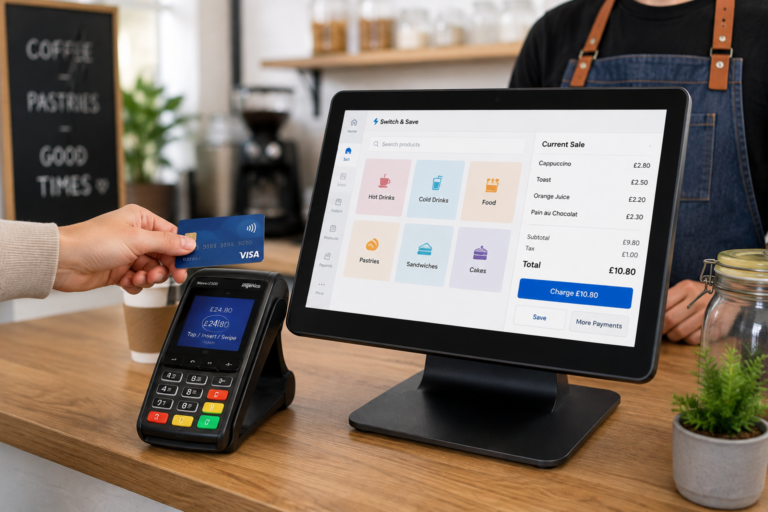
Integrated payments can also reduce staff errors because the amount is sent directly from the till to the card machine. This can improve checkout speed and make end-of-day reconciliation more straightforward.
Businesses comparing a basic card reader with a complete payment and EPOS package can also review the Switch & Save and SumUp comparison.
Switch & Save additionally provides access to business finance options for eligible UK businesses that need funding for stock, equipment, refurbishment or growth.
Which Card Machine Should You Choose?
Choose according to your payment profile:
- Low or irregular card turnover: Consider a no-monthly-fee pay-as-you-go reader.
- More than approximately £3,000 per month: Compare subscription pricing with lower eligible transaction rates.
- High card turnover: Request tailored merchant-services quotes.
- Many low-value payments: Pay close attention to fixed authorisation charges.
- Retail or hospitality operation: Prioritise EPOS integration, terminal reliability and support alongside price.
- Frequent remote payments: Compare online, telephone and payment-link charges separately.
The best card machine is the one with the lowest effective total cost while still providing the reliability, support and functionality your business needs.
Check Your Potential Savings
Switch & Save helps UK businesses reduce costs with AI-powered EPOS systems, card payment solutions and business finance.
Check your savings today by calling 0333 0389707 or exploring our card machine options.
Frequently Asked Questions
Which card machine has the lowest transaction fee in the UK?
Among mainstream providers with publicly advertised pricing, SumUp Payments Plus currently offers a 0.99% rate for eligible in-person domestic consumer-card transactions. The plan has a £19 monthly charge, while other card types may be processed at a higher rate.
A tailored merchant-services quote may produce a lower effective cost for some high-volume businesses.
Is a 0.99% card processing rate always cheaper than 1.69%?
No. The 0.99% plan may include a monthly subscription and eligibility conditions. A low-volume business could spend less under a 1.69% pay-as-you-go arrangement with no monthly payment.
What is a good card processing rate for a small UK business?
A good rate is one that produces a competitive total cost after terminal rental, authorisation fees, card-type differences and additional charges are included. The correct benchmark depends on turnover, average transaction value and customer card mix.
Are card machines with no monthly fees cheaper?
They can be cheaper for seasonal, mobile or lower-volume businesses. At higher turnover, paying a monthly subscription or terminal rental in return for a lower transaction rate may reduce the total cost.
Can I negotiate card processing fees?
Tailored merchant-service providers commonly calculate pricing using factors such as card turnover, business type, card mix and payment method. Providing recent processing statements can help the provider assess your business accurately.
Do integrated card machines cost more?
Not necessarily. An integrated machine may carry different hardware or service charges, but it can reduce manual entry errors, speed up checkout and simplify reconciliation. Businesses should compare both the financial cost and the operational value.
Does the same rate apply to every card?
Not always. International, corporate and premium cards can carry different rates from UK consumer debit or credit cards. Check the provider’s pricing schedule rather than relying on the lowest advertised rate.
How often should I review my card-machine agreement?
Review it at least once a year and whenever your turnover changes significantly. A pricing plan that suited a new business may become expensive as transaction volume grows.