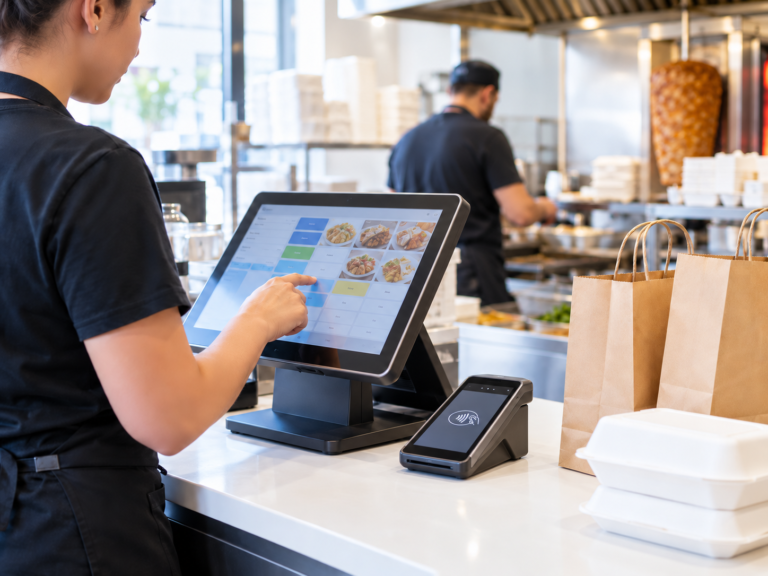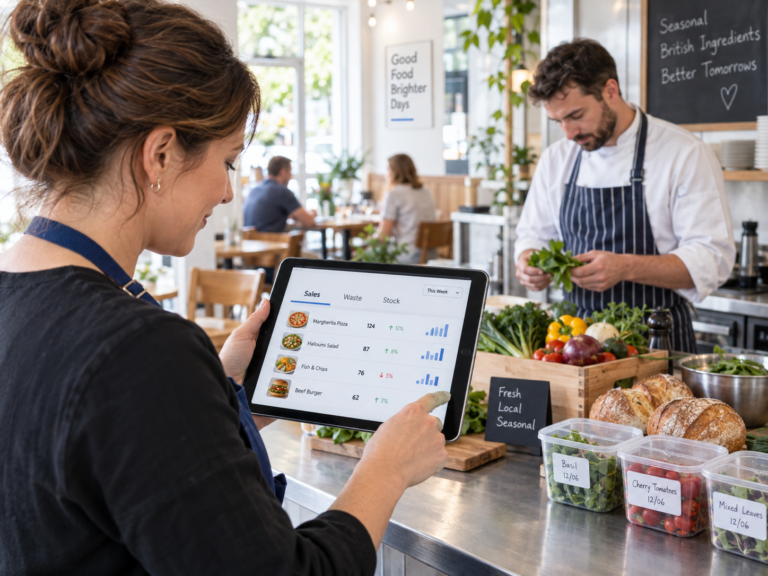
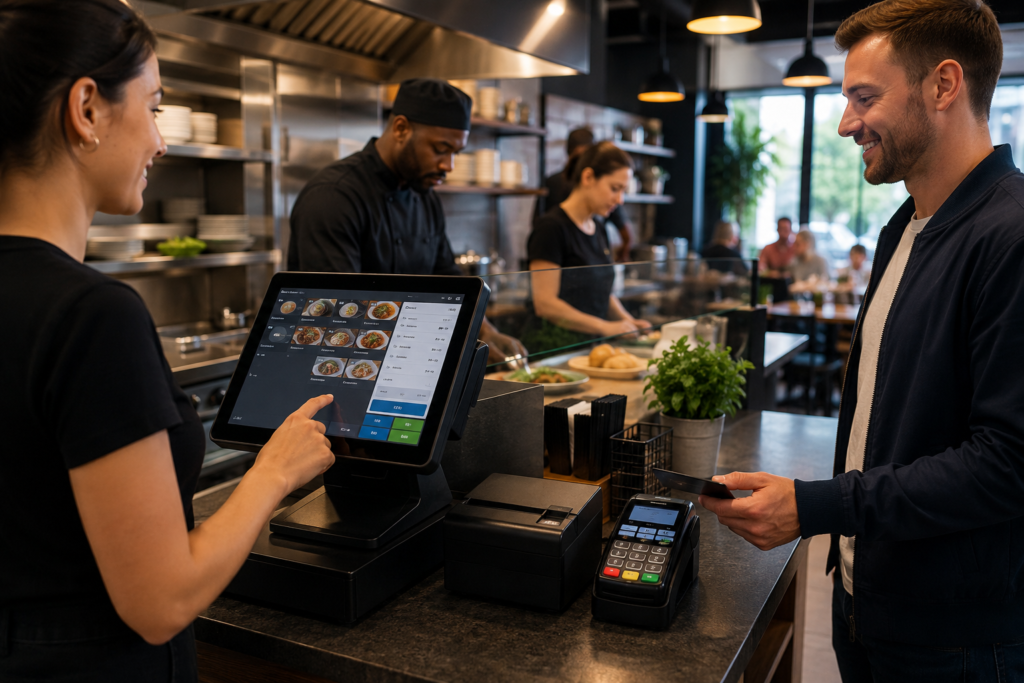
Yes, a modern POS or EPOS system can help reduce restaurant labour costs by making staff work faster, reducing manual admin, improving order accuracy, automating reporting, speeding up payments, and giving managers better data for rota and stock decisions. It does not replace good staff, but it helps every team member do more in less time.
For UK restaurants, cafés, takeaways, bars and food businesses, labour cost is one of the biggest pressures. From April 2026, the UK National Living Wage for workers aged 21 and over is £12.71 per hour, which means even small inefficiencies can quickly become expensive. Hospitality trade bodies have also warned that rising employment costs and business rates are putting serious pressure on hospitality operators.
That is why many restaurant owners are now looking at the efficiency and savings benefits of a smarter POS system. The right system can help reduce wasted staff time, improve service speed, and give managers better control over daily operations.
Switch & Save helps UK businesses reduce costs with AI-powered EPOS systems, card payment solutions ans business finance.
Key Takeaways
| Area | How a POS system helps | Labour cost benefit |
|---|---|---|
| Order taking | Staff enter orders faster and more accurately | Less time wasted correcting mistakes |
| Kitchen communication | Orders go directly to kitchen screens or printers | Fewer staff trips between counter and kitchen |
| Payments | Integrated card payments speed up checkout | Shorter queues and faster table turnover |
| Reporting | Sales, staff and product data update automatically | Less manual admin for managers |
| Stock control | Popular and low-stock items are easier to track | Less staff time spent checking stock manually |
| Staff planning | Managers can see busy periods and sales trends | Better rota decisions |
| Customer service | Faster service and fewer errors | Staff can focus on customers, not admin |
Can a POS System Reduce Restaurant Labour Costs?
A POS system can reduce restaurant labour costs by improving how work is done across the business. It helps staff take orders, process payments, send tickets to the kitchen, manage stock, check sales, and complete daily reports more quickly.
The saving does not usually come from cutting staff immediately. It comes from removing slow, repetitive and manual tasks.
For example, instead of a waiter writing down an order, walking to the kitchen, returning to the till, taking payment, and manually checking the bill, a connected restaurant EPOS system can handle much of that process from one screen.
That means fewer mistakes, faster service, better use of staff hours, and less pressure during busy periods.
For restaurants with tight margins, those small improvements can make a big difference over a week, month or year.
How Labour Costs Build Up in Restaurants
Restaurant labour costs are not only about hourly wages. They also include the hidden cost of inefficient processes.
Common examples include:
- Staff spending too long entering orders
- Kitchen mistakes caused by unclear handwriting or verbal messages
- Managers manually counting cash, checking sales and preparing reports
- Staff walking between the counter, tables, kitchen and payment terminal
- Extra time spent fixing wrong orders or refunds
- Poor rota planning because managers do not have clear sales data
- Stock checks done manually during busy hours
- Delays caused by slow payment processing
In a small café, five minutes wasted here and ten minutes wasted there may not seem serious. But across several staff members, multiple shifts and hundreds of orders, that wasted time becomes a real labour cost.
A good POS system helps reduce these leaks.
How a POS System Improves Staff Efficiency
1. Faster Order Taking
A restaurant POS system allows staff to take orders quickly using product buttons, categories, modifiers and saved menu items.
Instead of typing the same item again and again, staff can select items such as “Chicken Burger Meal”, “Large Latte” or “Margherita Pizza” in seconds.
This is especially useful for:
- Takeaways
- Fast food restaurants
- Cafés
- Dessert shops
- Pizza shops
- Busy lunch counters
- Casual dining restaurants
When order entry is faster, staff can serve more customers in less time.

2. Fewer Order Mistakes
Manual order taking often leads to mistakes. A staff member may write something incorrectly, forget a modifier, miss an allergy note or enter the wrong price.
A modern EPOS system can include:
- Menu modifiers
- Notes for the kitchen
- Meal deals
- Product images
- Clear order summaries
- Automatic VAT handling
- Table numbers
- Order types such as dine-in, takeaway and delivery
This reduces the time spent fixing errors. It also protects the customer experience.
For example, if a customer orders a burger with no onions, the note can go directly to the kitchen printer or kitchen display. The kitchen team does not need to ask the front counter again.
3. Better Kitchen Communication
In many restaurants, staff waste time walking between the front counter and kitchen. During busy periods, this can slow down service and increase pressure on the team.
With a connected restaurant EPOS system, orders can be sent directly to:
- Kitchen printers
- Bar printers
- Kitchen display screens
- Preparation stations
For example, drinks can go to the bar printer, pizza orders can go to the pizza station, and dessert orders can go to the dessert area.
This keeps work organised and reduces unnecessary movement.
Restaurant EPOS with kitchen printer
4. Faster Payments with Integrated Card Machines
When a card machine is not integrated with the POS system, staff often need to enter the amount manually into the terminal. This creates three problems:
First, it takes extra time. Second, it increases the chance of typing the wrong amount. Third, it makes end-of-day reconciliation slower.
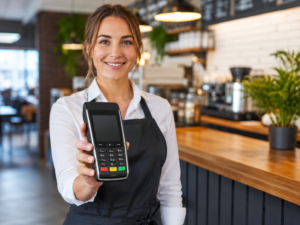
Integrated card payments help by sending the bill amount directly from the EPOS to the card terminal.
This can help restaurants:
- Serve customers faster
- Reduce payment errors
- Shorten queues
- Speed up table turnover
- Make cash-up easier
- Improve reporting accuracy
Switch & Save provides card payment solutions that can work alongside EPOS systems to help UK restaurants improve speed and control.
Read more about Integrated card payments for restaurants
5. Less Time Spent on End-of-Day Reports
Managers often spend time after closing checking sales, cash, card payments, refunds, discounts and staff activity.
A good EPOS system can automatically generate reports such as:
- Daily sales reports
- Product sales reports
- Department reports
- VAT reports
- Refund reports
- Staff performance reports
- Payment method reports
- End-of-day summaries
This saves manager time and reduces the chance of human error.
For small business owners who already work long hours, automated reporting can be one of the biggest efficiency and savings benefits.
Practical Ways POS Systems Reduce Labour Costs
Improve Rota Planning
A POS system gives managers sales data by time, day and product. This helps identify busy and quiet periods.
For example, a café may discover that Monday mornings are quiet, Friday lunch is very busy, and Sunday afternoons only need two staff instead of three.
With better data, managers can create more accurate rotas instead of guessing.
This does not mean understaffing. It means matching staff hours to real demand.
Reduce Training Time for New Staff
Restaurants often rely on part-time workers, students and seasonal staff. If the till system is complicated, new staff take longer to train.
A simple, visual EPOS system can reduce training time because staff can learn by using clear product buttons, categories and order flows.
This is useful for:
- New takeaways
- Independent cafés
- Busy restaurants
- Franchise-style food businesses
- Businesses with high staff turnover
When staff learn faster, managers spend less time supervising basic tasks.
Automate Discounts, Deals and Meal Combos
Manual discounts can create errors and slow down service.
A restaurant EPOS system can apply offers automatically, such as:
- Meal deals
- Lunch offers
- Buy one get one free
- Student discounts
- Set menus
- Happy hour pricing
- Combo meals
This saves staff from calculating prices manually. It also ensures customers are charged correctly.
For example, if a takeaway sells “burger, chips and drink” as a meal deal, the POS system can apply the correct price automatically when those items are selected.
Control Stock More Efficiently
Labour cost is connected to stock management. If staff spend too much time checking stock manually, that is labour time. If stock is poorly managed, staff may waste time explaining unavailable items to customers.
A restaurant EPOS system can help track:
- Best-selling items
- Slow-moving products
- Low-stock ingredients
- Wastage patterns
- Product profitability
- Stock usage by menu item
This helps owners order more accurately and reduce time spent on manual stock checks.
For example, if a pizza shop knows which toppings sell fastest, it can prepare better for weekend demand.
Speed Up Service During Peak Hours
Busy restaurants need speed. Slow tills, unclear orders and manual payment processes can cause queues and customer frustration.
A fast POS system helps staff:
- Take orders quickly
- Send tickets to the kitchen instantly
- Process payments faster
- Find menu items easily
- Handle refunds or changes correctly
- Keep service moving
This can help one team serve more customers without adding unnecessary extra staff.
What POS Features Help Reduce Labour Costs?
When choosing a POS system for a restaurant, look for features that directly improve efficiency.
Essential Features
- Fast touchscreen order entry
- Menu categories and modifiers
- Table management
- Takeaway and dine-in order types
- Kitchen printer or kitchen display support
- Integrated card payments
- End-of-day reports
- Staff logins
- Refund and discount tracking
- Stock control
- VAT reporting
- Cloud or remote reporting
- Customer receipts
- Simple user interface
Advanced Features
- AI-powered reporting
- Smart sales insights
- Product performance tracking
- Automated offers
- Multi-branch reporting
- Loyalty tools
- Customer database
- Online ordering integration
- Self-service kiosk integration
- Business finance support
Switch & Save provides AI-powered EPOS systems that are designed to help UK small businesses improve efficiency, reduce operating costs and make smarter decisions.
POS System vs Manual Processes
| Task | Manual process | POS system process |
|---|---|---|
| Taking orders | Written notes or basic till entry | Fast touchscreen selection |
| Sending kitchen orders | Staff walk to kitchen or call out order | Order sent directly to kitchen printer/display |
| Taking payment | Amount entered manually into card terminal | Amount sent from EPOS to terminal |
| End-of-day report | Manual checking and calculations | Automated sales report |
| Staff performance | Based on rough observation | Based on sales and activity reports |
| Stock checks | Manual counting only | Product and sales tracking |
| Offers | Staff calculate manually | EPOS applies offer automatically |
Can POS Systems Replace Staff?
No. A POS system should not be seen as a replacement for good staff.
Instead, it helps staff work better.
Restaurants still need people for customer service, food preparation, cleaning, hospitality and problem-solving. But a good POS system removes unnecessary admin and repetitive tasks.
The best result is not fewer people doing more stressful work. The best result is the right number of people working with better tools.
That is where the real efficiency and savings benefits come from.
Why Choose Switch & Save?
Switch & Save helps UK businesses reduce costs with:
- AI-powered EPOS systems
- Hospitality and retail EPOS solutions
- Integrated card payment options
- Business finance support
- Utility switching services
- Practical guidance for small businesses
For restaurant owners, this means you can review more than just your till system. You can look at your EPOS, card payments, business funding and utility costs together.
That wider cost-saving approach is useful for cafés, restaurants, takeaways, bars, grocery shops, mobile shops and retail businesses across the UK.
A POS system can help reduce restaurant labour costs by improving speed, accuracy and control across the business.
It helps staff take orders faster, reduces kitchen mistakes, speeds up card payments, improves rota decisions, automates reports and saves manager time.
For UK restaurants facing higher wage costs and tighter margins, the right EPOS system is not just a till. It is an operational tool that supports efficiency, better service and smarter cost control.
Switch & Save helps UK businesses reduce costs with AI-powered EPOS systems, card payment solutions ans business finance.
FAQs
Can a POS system really reduce restaurant labour costs?
Yes. A POS system can reduce labour costs by saving staff time, reducing manual admin, improving order accuracy and helping managers plan staff hours more effectively.
Does a POS system replace restaurant staff?
No. A POS system supports staff by making their work faster and more accurate. It helps reduce wasted time rather than replacing the human service customers expect.
How does EPOS help with staff scheduling?
EPOS reports show busy and quiet periods. Restaurant owners can use this data to create better rotas and avoid overstaffing during slow times.
Can integrated card payments save time?
Yes. Integrated card payments reduce manual amount entry, speed up checkout and make end-of-day reconciliation easier.
Is a POS system useful for small cafés and takeaways?
Yes. Small cafés and takeaways often benefit because they need fast service, simple order taking, accurate payments and easy daily reporting.
What is the biggest labour-saving feature in a restaurant POS system?
For many restaurants, the biggest labour-saving features are fast order entry, kitchen printer integration, integrated payments and automated end-of-day reports.
How can Switch & Save help my restaurant?
Switch & Save can help you review your EPOS, card payments, business finance and utility costs so your business can improve efficiency and reduce unnecessary expenses.