

Yes, a business with fluctuating sales can still get finance in the UK. Seasonal or uneven revenue doesn’t automatically prevent approval. Finance providers usually look at the wider health of your business, including its trading history, recent turnover, cash flow, card sales and ability to manage repayments.
The type of finance you choose matters. A fixed monthly repayment may suit a business with predictable income, while a flexible arrangement linked to card sales may be easier to manage when revenue rises and falls.
The key is to show why your sales fluctuate, how your business performs across a full trading cycle and how the funding will be used.
Key takeaways
| Question | Short answer |
|---|---|
| Can a seasonal business get finance? | Yes. Providers may assess performance across several months rather than judging one quiet period. |
| Do fluctuating sales mean bad cash flow? | Not necessarily. Predictable seasonal changes are different from a continuing decline in sales. |
| What information may be requested? | Bank statements, accounts, card-processing statements, turnover records and details of existing commitments. |
| Which finance may suit uneven revenue? | Options can include merchant cash advances, business loans, revolving credit and asset finance. |
| Are repayments always fixed? | No. Some products collect repayments as an agreed percentage of eligible card sales. |
| Does approval depend on turnover alone? | No. Trading history, affordability, credit profile and the purpose of the funding can also matter. |
Can you get business finance with fluctuating sales?
Many UK businesses don’t earn the same amount every week or month. A seaside café may be busiest in summer. A restaurant might take more during weekends and December. A grocery shop can experience sharp increases around religious festivals, local events or holiday periods.
Finance providers understand that this is normal in many sectors. What they’ll usually want to establish is whether the fluctuation forms part of a healthy trading pattern or points to a deeper financial problem.
A temporary quiet month isn’t always a concern. However, sales falling consistently over a longer period without a clear explanation may make approval more difficult.
When you apply for small business finance in the UK, present the full picture. Showing 12 months of revenue is often more useful than focusing only on your strongest or weakest month.
Why finance providers look beyond monthly turnover
Turnover is important, but one number rarely tells the complete story.
Imagine two takeaway businesses. Both generate £180,000 in annual sales. The first receives fairly consistent monthly revenue. The second earns much more during winter and considerably less during summer.
Their yearly turnover is the same, but their cash-flow patterns are different. A provider may therefore consider how and when money reaches each business before deciding what repayment structure is affordable.
Seasonal variation isn’t always a weakness
A predictable sales pattern can make your figures easier to understand.
If your ice cream shop has traded for three years and sales rise every spring, peak during summer and fall during winter, that pattern can be demonstrated through your records. It shows that the quieter period isn’t unexpected.
Accurate sales reports from an EPOS system can help you explain these changes. You can show daily, weekly and monthly revenue rather than relying on rough estimates.
Unexplained volatility can raise questions
Frequent changes without a clear pattern may require more explanation.
For example, a restaurant’s revenue might fall after nearby roadworks reduce passing trade. A retailer may experience a temporary drop while moving premises. A takeaway could see sales increase after adding online ordering.
These circumstances don’t necessarily prevent funding. You may simply need to explain what happened, whether the issue has been resolved and how your funding plan responds to it.
What will a finance provider check?
Every provider has its own criteria. However, it may consider several parts of your business rather than looking at turnover alone.
These can include:
- How long the business has been trading
- Recent bank statements
- Annual or management accounts
- Average monthly revenue
- Card-processing statements
- Existing loans and financial commitments
- Business and personal credit history
- Cash-flow trends
- The reason you need funding
- Whether the proposed repayments appear affordable
Some providers may place more weight on recent trading performance, while others look at a longer period. The documents required will also depend on the product and the amount requested.
You should never assume approval is guaranteed. Any finance agreement needs to be assessed carefully, including its total cost, repayment method and effect on cash flow.
Which finance options can suit fluctuating sales?
There isn’t one form of finance that suits every business. The right choice depends on why you need the money, how quickly you need it and how your revenue changes.
Merchant cash advance
A merchant cash advance provides an agreed amount of funding in exchange for a portion of future eligible card sales.
Instead of paying the same amount every month, repayments are generally collected as an agreed percentage of card transactions. When card sales are higher, you repay more. When they’re lower, you repay less.
For example, a café may receive funding to replace kitchen equipment. If it has a strong month, more of the advance is repaid. During a quieter month, the repayment amount falls with its card takings.
This structure may appeal to businesses with variable revenue and a significant level of card sales. However, you still need to understand the total repayment figure, the percentage collected and which transactions are included.
Read more about how much a business may be able to access through a merchant cash advance before comparing offers.
Fixed-term business loan
A business loan normally provides a lump sum that is repaid over an agreed period. Repayments may be fixed, although the exact terms depend on the agreement.
This can make budgeting straightforward when your income is reasonably predictable. It may be less comfortable during quiet months if the payment remains unchanged regardless of sales.
Before accepting a fixed repayment, test it against your lower-revenue months. A payment that looks affordable during December may feel very different in February.
Revolving credit facility
A revolving credit facility allows a business to access funds up to an agreed limit. You may draw money when needed and repay it according to the provider’s terms.
This can help manage short-term cash-flow gaps, such as paying suppliers before a busy trading period. It shouldn’t be treated as a replacement for proper cash-flow planning, and fees can vary.
Asset finance
Asset finance can be used to spread the cost of equipment such as catering machinery, vehicles or business technology.
If your main goal is to purchase a specific asset, this may be more suitable than taking unrestricted finance. Check whether the agreement is a hire purchase, lease or another structure, as ownership and end-of-term conditions may differ.
If you’re considering new till equipment, see how business finance can support an EPOS upgrade.
How repayments can work when sales change
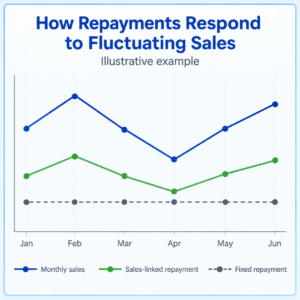
Repayments generally fall into two broad categories: fixed and sales-linked.
With a fixed arrangement, you know what needs to be paid on each due date. That provides certainty, but it means the payment doesn’t reduce automatically during a quiet month.
With a sales-linked arrangement, the amount collected changes with eligible sales. This can provide more breathing room when revenue falls, although a busy period may lead to faster repayment.
Neither method is automatically better. The important question is whether it matches the way your business receives money.
Use a realistic cash-flow forecast before making a decision. Include rent, wages, utilities, tax, supplier payments and existing commitments. Then compare the proposed repayment against both an average month and a difficult month.

How to improve your finance application
You can’t remove normal seasonal variation, but you can make your business easier to assess.
Keep business records accurate
Make sure your bank statements, sales reports and accounts reflect the same trading activity. Missing or inconsistent information may lead to delays or further questions.
An AI-powered EPOS system can help you track sales, payment types, busy periods and product performance. Clear reports make it easier to understand what’s happening inside your business.
Explain unusual changes
If sales fell because of a temporary closure, equipment failure or building work, explain it clearly. Include evidence where appropriate and describe what has changed since then.
Don’t try to hide a difficult month. A straightforward explanation is more useful than leaving a provider to guess.
Apply for a clear business purpose
Be specific about how you’ll use the funds.
“£15,000 to purchase seasonal stock based on last year’s category sales” is clearer than “money for the business”. A defined purpose also helps you judge whether the borrowing is likely to create enough value.
Review your existing commitments
List current loans, credit cards, leases and supplier arrangements. New finance needs to remain manageable alongside these payments.
Prepare a cash-flow forecast
A cash-flow forecast estimates when money will enter and leave the business. Keep it realistic and include your weaker trading months.
You can prepare three versions:
- An expected-sales forecast
- A lower-sales forecast
- A stronger-sales forecast
If the repayments only work in the strongest scenario, the finance may be too risky.
How much should a business borrow?
Borrow based on a defined need rather than the largest amount offered.
Start by calculating the full cost of your plan. If you’re buying stock, include delivery and storage. If you’re refurbishing a restaurant, allow for installation, temporary closure and unexpected costs.
Then decide how much your business can contribute without leaving itself short of working capital.
Finally, review the total amount repayable—not just the headline funding amount. Check fees, payment frequency, early-settlement terms and what happens if sales fall more than expected.
Borrowing a smaller, manageable amount can be more useful than taking extra finance that places pressure on future cash flow.
Common mistakes to avoid
One common mistake is applying during a crisis without reviewing alternatives. Urgency can make it harder to compare the total costs and terms properly.
Another is using short-term finance to cover an ongoing loss. Finance may help with stock, equipment or a temporary gap, but it won’t repair a business model that repeatedly spends more than it earns.
You should also avoid preparing forecasts based only on your busiest months. Your repayment plan needs to work when trade is slower.
Finally, don’t choose a product simply because the application is quick. Read the agreement, understand the repayment structure and ask questions about anything that isn’t clear.
How Switch & Save can help
Switch & Save supports UK retailers, restaurants, cafés, takeaways, bars, grocery shops and mobile businesses.
Our EPOS and card-payment solutions can give you a clearer view of daily sales, payment methods and trading patterns. This information can support better cash-flow planning and help you decide whether business finance is affordable.
Where suitable, we can also help you explore finance options based on your business circumstances. Availability and terms depend on the provider’s assessment, and finance should always be considered carefully.
Switch & Save helps UK businesses reduce costs with AI-powered EPOS systems, card payment solutions and business finance.
Frequently asked questions
Can I get business finance during a quiet trading period?
Possibly. A provider may examine your performance across a longer period and ask whether the lower sales are normal for your business. Trading history, affordability and the reason for borrowing will also affect the decision.
Do I need consistent monthly turnover?
Not always. Many hospitality, retail and mobile businesses have uneven monthly revenue. A clear and repeatable pattern can be easier to assess than unexplained sales changes.
Can a new business with fluctuating sales get finance?
It may be more difficult because there’s less trading history available. Some providers require a minimum time in business or a minimum level of turnover. The requirements vary between products and providers.
What documents will I need?
You may be asked for bank statements, card-processing statements, accounts, proof of identity, business details and information about existing financial commitments. The exact requirements will depend on the provider.
Is a merchant cash advance a loan?
A merchant cash advance is generally structured as an advance against future eligible card sales rather than a conventional business loan. Its costs, collection method and legal terms should be reviewed carefully before acceptance.
Will poor personal credit prevent business finance?
Not automatically, but it can affect the options available. Some providers assess both the business and its owners or directors. Recent business performance and card turnover may also form part of the assessment.
Can I use finance to buy seasonal stock?
Yes, subject to approval and the terms of the product. Use previous sales data to estimate demand and avoid borrowing for stock that may remain unsold.
What happens if my sales fall after taking finance?
That depends on the agreement. Fixed repayments normally remain due, while sales-linked collections may reduce when eligible card sales fall. Read the terms carefully and contact the provider early if you expect repayment difficulties.