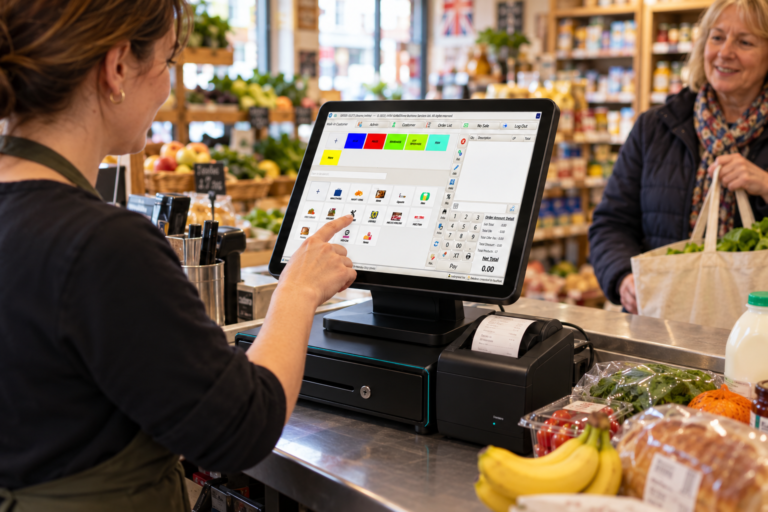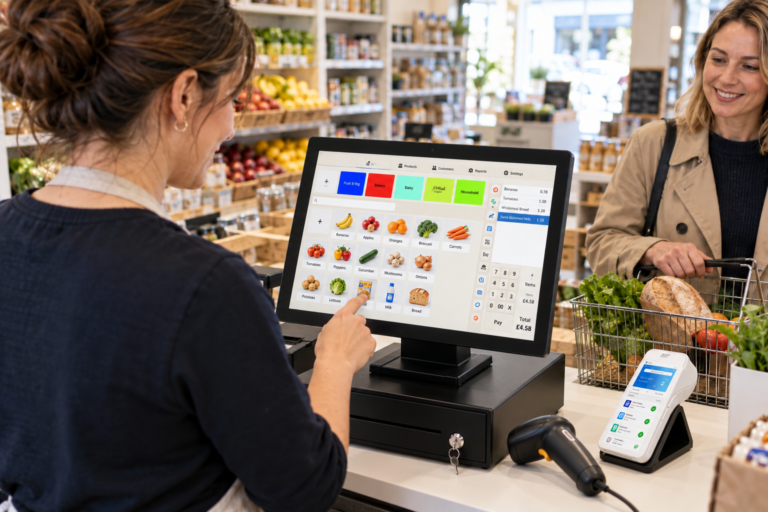
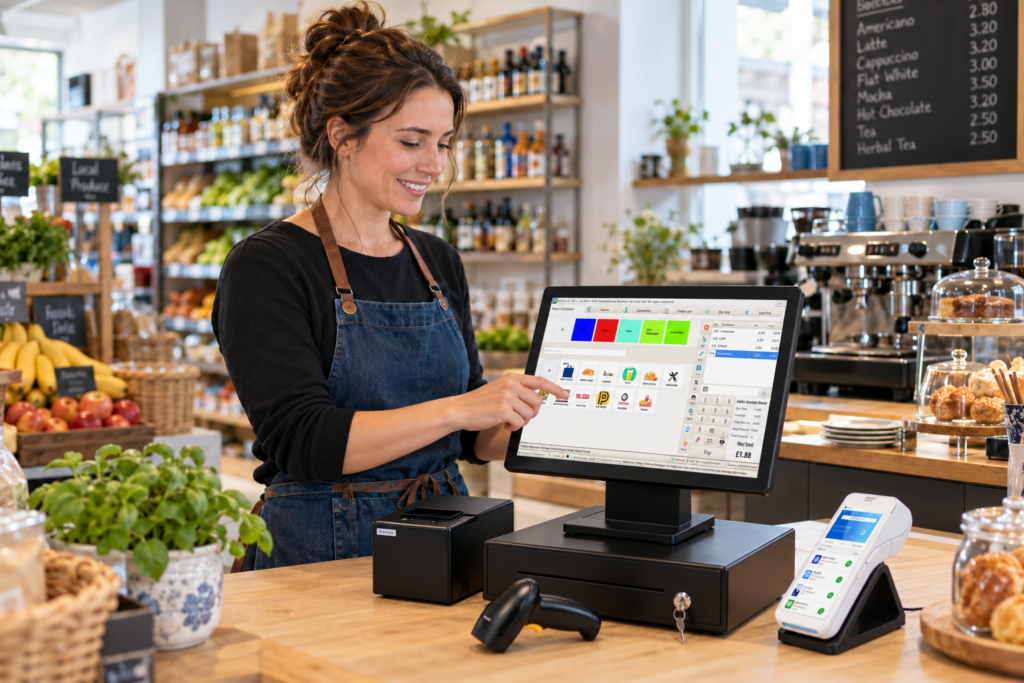
AI EPOS in retail and hospitality combines an electronic till system with tools that analyse business data and help you make decisions. Depending on the software, it can identify sales patterns, forecast demand or summarise performance. The aim is to help you understand what’s happening in your business and decide what to do next.
For a grocery shop, that might mean spotting products likely to sell out before the weekend. For a café, it could mean planning preparation around expected lunchtime demand. These are possible uses of AI, rather than features you should assume every EPOS package includes.
You don’t need to become a technology expert. You do need to know which features solve your everyday problems—and whether they’re worth paying for.
What is an AI EPOS system?
An AI EPOS system brings together electronic point of sale software and artificial intelligence features. The EPOS records transactions and supports daily operations. The AI layer uses available data to recognise patterns, produce explanations or suggest actions.
There’s a useful distinction here. A report showing yesterday’s sales is ordinary reporting. A tool estimating next week’s demand uses predictive analysis. An assistant that answers “Which products sold less this month?” may use generative AI to turn data into a written response.
These functions can sit within the EPOS software or come through a connected service. Ask your provider which features are included, which require an integration and which cost extra.
If you’re starting with the basics, our guide to what EPOS is explains how the till, software and connected equipment work together.
Key takeaways
| Area | What it means for your business |
|---|---|
| Core purpose | Turn transaction data into information you can act on |
| Retail uses | Demand forecasting, stock planning and product performance analysis |
| Hospitality uses | Preparation planning, trading-pattern analysis and menu insights |
| Main limitation | Poor or incomplete data can produce misleading suggestions |
| Buying priority | Choose reliable daily operations first, then useful AI features |
| Best approach | Start with one problem and measure whether the system helps |
How AI EPOS works
Here’s how it works: your EPOS records details such as products sold, quantities, prices, discounts and transaction times. Depending on your setup, it may also hold stock levels, purchasing costs and order-channel information.
An AI tool analyses selected information to produce an output. That could be an expected sales figure, an unusual-trading alert or a plain-English explanation of a trend.
For example, demand forecasting uses historical sales and other relevant information to estimate future demand. It can support stock planning, but its usefulness depends on the data and the forecasting method.
Your knowledge still matters. A forecast based on normal Fridays may miss a road closure, private booking or nearby event unless that information is available to the system.
Think of the output as a starting point for a decision. Check it against what you know before changing an order or preparation plan.
AI EPOS in retail
Plan stock around demand
A convenience shop can have healthy total sales while repeatedly running out of a few popular lines. Looking at overall turnover won’t necessarily reveal the problem.
Where forecasting is supported, an AI-powered EPOS system can help identify changing demand across individual products. You can use that information alongside supplier lead times, delivery schedules and shelf life.
Imagine a Birmingham grocery shop selling more bottled water during warm weather. A suitable forecasting tool could support its ordering decision if it can use relevant sales and weather information.
There’s a catch: low recorded sales don’t always mean low demand. A product that was unavailable for three days couldn’t sell during those days. Check whether the system accounts for stockouts before trusting its recommendations.
Understand which products deserve attention
Sales volume alone doesn’t tell you whether a product is working for your shop. Purchase costs, discounts, returns and waste can change the picture.
AI-assisted analysis may help surface products that need closer inspection. For a mobile phone shop, that could mean identifying slow-moving accessories or highlighting frequently purchased combinations.
You then decide whether to adjust the range, change a display or review pricing. Any margin analysis needs accurate costs and clear calculation rules.
Switch & Save’s retail EPOS system brings together stock management, sales reporting and integrated payments. During a demonstration, ask to see the specific AI functions available for your business. AI-Powered POS for Shops
AI EPOS in hospitality
Prepare for your actual trading pattern
A café owner usually knows when the shop feels busy. Detailed transaction data can help explain the pattern more precisely.
Perhaps the main queue starts at 8.15 am, while food orders peak later. Where suitable analysis is available, those patterns can inform preparation, counter setup and discussions about staffing.
For a takeaway, separate collection, delivery and walk-in orders where possible. One busy channel can hide a quiet period in another.
Forecasts should support your judgement. School holidays, local events and large bookings can make a normal week a poor comparison.
Review menu performance properly
A popular dish isn’t automatically your most profitable dish.
To assess menu profitability, you need dependable ingredient costs, portion sizes and recipe information. An EPOS system recording only selling prices can show revenue, but it cannot establish reliable dish-level margins from that information alone.
With the necessary data and functionality, AI-assisted analysis may help you spot items worth reviewing. A restaurant might investigate a dish that sells well but generates frequent waste or requires expensive ingredients.
The next step could be a portion review, supplier discussion or preparation change. The system provides evidence; you choose the response.
Keep service reliable
AI features are useful only if the everyday service works smoothly.
For restaurants, cafés, bars and takeaways, that means clear menus, accurate modifiers, dependable kitchen routing and straightforward payments. Staff need to record the correct order even when the queue is growing.
Switch & Save’s hospitality EPOS supports functions including dine-in and takeaway orders, kitchen printing, integrated card payments and live reporting. Ask separately which AI capabilities are available with your proposed setup. Restaurant & Takeaway POS UK
What AI doesn’t automatically do
Not every helpful till feature uses AI.
Barcode scanning, low-stock thresholds, kitchen printing and sending an amount to a connected card terminal can all work through standard software rules. They can deliver practical value without predictive technology.
AI also doesn’t guarantee higher profits, eliminate waste or make every recommendation correct. An impressive dashboard won’t fix missing purchase costs or duplicated products.
For tools that generate written answers, check important figures against the underlying report. A confident explanation still needs evidence.
Be clear about customer information, too. Ask what data the AI service receives, where it goes and whether customer details are necessary for the feature you want. Stock forecasting, for example, may be possible without identifying individual shoppers.
How to choose the right system
Start with a business problem you can describe clearly.
“We keep running out of our best-selling drinks” is more useful than “We need AI.” It gives the provider something concrete to demonstrate.
During the demo, ask:
- Which AI features are available now, and are they included in this package?
- What data does each feature need?
- Can I inspect the figures behind a recommendation?
- What happens when the internet connection fails?
- What are the full hardware, software, payment and support costs?
Use your own examples. A grocery shop should test weighted products, promotions and returns. A restaurant should test modifiers, split payments and kitchen routing.
Ask the provider to complete a realistic sale and correct a mistake. Then explore the reporting and AI functions. You’ll learn more from that sequence than from a presentation of headline features.
Getting started
Choose one area to improve first: stock availability, preparation planning or time spent reviewing reports.
Clean the relevant data before relying on recommendations. Check product names, units, categories and costs. In hospitality, review menu modifiers and recipes where the proposed feature needs them.
Next, establish a baseline. Record how often key products run out or how much food is discarded. Trial the feature over a representative period and compare the result, allowing for changes in trading conditions.
Keep the process manageable. A useful tool should help you make a better decision without creating another daily administrative job.
Find an EPOS setup that fits your business
Switch & Save helps UK businesses reduce costs with AI-powered EPOS systems, card payment solutions and business finance. Check your savings today.
Explore Switch & Save or call 0333 0389707 to discuss your current setup and request a demonstration. Bring one everyday problem you’d like to solve, so the conversation stays focused on your business.
Frequently asked questions
What does AI EPOS mean?
AI EPOS means an electronic point of sale system with artificial intelligence capabilities, either built in or connected. These may include forecasting, pattern detection or written explanations of business data.
Is AI EPOS suitable for a small shop?
It can be, if the features address a real problem and justify their cost. A small shop may benefit more from accurate stock records and reliable checkout functions before adding advanced analysis.
Can AI EPOS help reduce food waste?
It may support better preparation and purchasing decisions when suitable forecasting and accurate data are available. Results also depend on portion control, storage, stock rotation and staff practices.
Do integrated card payments use AI?
Not necessarily. Transferring the sale amount from the till to a card terminal is an integration function. It doesn’t require AI, although separate payment services may use AI for other purposes.
Will AI EPOS replace staff?
AI EPOS is generally used to support tasks such as reviewing data and planning stock. Staff still handle service, exceptions, product knowledge and the decisions that require business context.