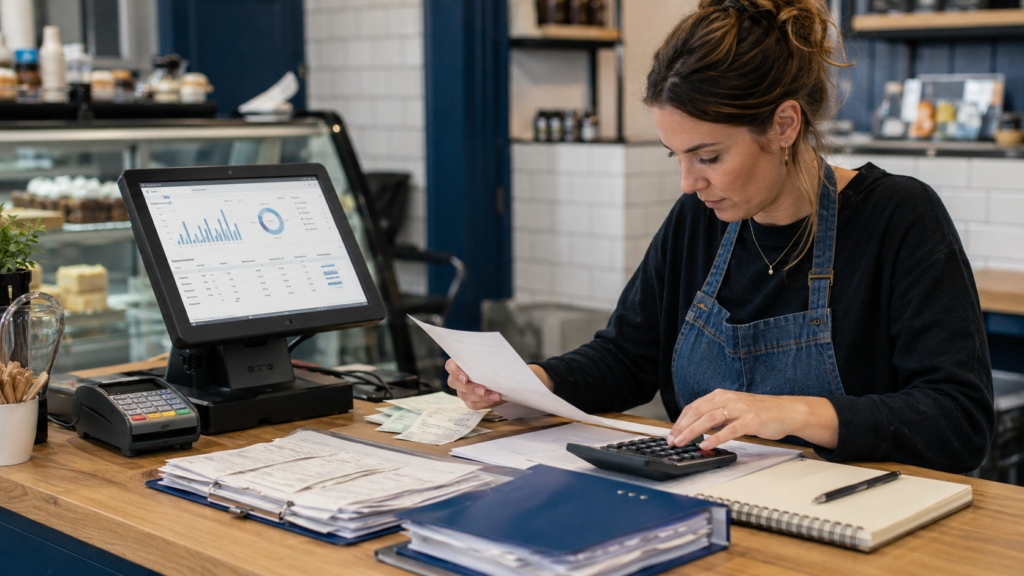
A small business in the UK should keep clear records of sales, income, purchases, expenses, invoices, receipts, bank transactions, stock and business assets. If you’re VAT registered or employ staff, you’ll also need VAT, payroll, pension and employment records.
How long you need to keep them depends on your business structure and the type of record. For example, self-employed business records normally need to be kept for at least five years after the relevant Self Assessment filing deadline, while limited companies generally need to retain tax and accounting records for six years.
Good record keeping isn’t only about satisfying HMRC. It makes it much easier to understand your cash flow, calculate profit, manage VAT and find out where your money is actually going.
Key Takeaways
| Question | Simple answer |
|---|---|
| What records should a small business keep? | Sales, expenses, receipts, invoices, bank statements, stock, asset and tax records |
| Do I need to keep till and EPOS records? | Yes, sales and till records can form an important part of your business records |
| How long should sole traders keep records? | Usually at least five years after the 31 January Self Assessment deadline for the relevant tax year |
| How long should limited companies keep records? | Generally six years from the end of the financial year they relate to for tax purposes |
| How long should VAT records be kept? | Normally at least six years |
| Can business records be digital? | Yes, and some businesses are required to keep certain records digitally |
| Do employers need extra records? | Yes, including payroll, working time, minimum wage and workplace pension records |
What Business Records Should You Keep?
The basic rule is simple: your records should allow you to show where your business money came from, where it went and how the figures in your accounts or tax return were calculated.
HMRC says self-employed people should keep records of all sales and income, business expenses, VAT where applicable, PAYE where applicable and supporting evidence such as receipts, invoices, bank statements and till rolls.
In practice, that means keeping a clear trail from a transaction happening in your shop, café or restaurant through to your accounts.
1. Sales and Income Records
You should keep evidence of the money your business receives.
For a convenience store, that could include daily till totals, cash sales, card sales and online orders. For a takeaway, it could also include delivery and collection orders.
Useful sales records include customer invoices, sales receipts, till rolls, EPOS reports, online sales records, credit notes and records of refunds or discounts.
Imagine your café takes £2,300 on a Saturday. Your records should help you see how much came through cash, cards and other payment channels rather than relying on one figure written down at closing time.
An EPOS system from Switch & Save can help bring transaction history and sales reporting into one system, making those figures easier to check later.
2. Purchase and Expense Records
You also need evidence of the money leaving your business.
This includes stock purchases, ingredients, packaging, rent, utilities, insurance, marketing, repairs, software subscriptions, professional fees and other legitimate business costs.
Keep supplier invoices and receipts wherever possible.
For example, if a grocery shop buys £4,000 of stock from wholesalers during the month, simply recording “stock £4,000” isn’t as useful as keeping the underlying invoices as well.
Those documents help support the figures in your accounts and may also be needed if HMRC checks your return.
If you’re reviewing where your business money is actually going, your records can also help you calculate the true profitability of the business. Our guide to how much profit a small business should make explains this in more detail.
3. Bank, Cash and Card Payment Records
Your business records should also match the money moving through your accounts.
Keep bank statements, paying-in records and relevant card payment or merchant statements. If you regularly take cash, maintain proper cash records too.
For example, suppose your EPOS report shows £850 of card sales but the settlement reaching your bank account is slightly lower because payment processing charges have been deducted. Keeping both records makes reconciliation much easier.
That’s one reason sales records and bank records shouldn’t be treated as separate worlds.
Switch & Save also provides card payment solutions for UK businesses alongside EPOS, helping businesses bring their payment processes closer to their day-to-day sales operation.
4. VAT Records
If your business is VAT registered, there are additional record-keeping requirements.
You generally need records covering everything you buy and sell, copies of invoices you issue, invoices you receive, credit and debit notes and other information used to prepare your VAT Return.
HMRC also requires VAT-registered businesses to maintain a VAT account. Most VAT businesses must keep certain VAT information digitally under Making Tax Digital rules. VAT records generally need to be retained for at least six years.
For a restaurant selling items at different VAT treatments, accurate product and sales records become especially useful. The wrong VAT treatment applied repeatedly across hundreds of transactions can create a much larger bookkeeping problem later.
For a practical explanation of the numbers themselves, see our guide to calculating VAT for your business.
5. Stock and Business Asset Records
Retailers, grocery shops, mobile shops, restaurants and takeaways should also keep good records of stock.
That might include supplier purchases, goods received, stock adjustments, damaged products, wastage, returns and year-end stock values.
This matters because stock affects your business accounts and profitability.
For example, if a shop buys 100 cases of drinks but only 65 are sold, the remaining stock hasn’t simply disappeared as an expense. Knowing what you still hold at the end of the accounting period helps produce a more accurate picture of the business.
You should also keep records relating to equipment and assets such as tills, refrigeration equipment, kitchen machinery, vans, computers and other substantial purchases.
6. Payroll and Employee Records
Employing people creates another layer of record keeping.
PAYE records should include what you pay employees, deductions, reports sent to HMRC, tax code notices, taxable expenses or benefits, sickness and leave information and payments made to HMRC.
PAYE records normally need to be kept for three years from the end of the tax year they relate to.
However, don’t assume that means every employment record can be deleted after three years.
Employers must keep sufficient records to demonstrate compliance with National Minimum Wage rules. Relevant minimum wage records created under the current rules generally need to be retained for at least six years.
Workplace pension records generally need to be kept for six years, while records of pension opt-out requests generally need to be kept for four years.
So in practice, your retention policy should consider the longest rule applying to each document.
7. Limited Company Records
Running a limited company involves additional responsibilities.
As well as everyday accounting information, the company must maintain records about money received and spent and supporting documents such as invoices, receipts, contracts, bank statements and till records.
Companies also need certain records about the company itself, including information relating to shareholders and company decisions.
For tax purposes, HMRC guidance says limited companies should normally keep relevant records for six years from the end of the financial year they relate to. Some records may need to be kept longer, for example where a transaction spans more than one accounting period or HMRC has opened a compliance check.
How Long Should Small Business Records Be Kept?
There isn’t one retention period that applies to everything.
| Record type | Typical minimum retention period |
|---|---|
| Sole trader business records | At least 5 years after the 31 January filing deadline |
| Limited company tax/accounting records | Generally 6 years from the end of the relevant financial year |
| VAT records | Normally at least 6 years |
| PAYE records | 3 years from the end of the relevant tax year |
| National Minimum Wage records | Generally at least 6 years |
| Workplace pension records | Usually 6 years |
| Pension opt-out records | 4 years |
If the same document is needed for more than one tax purpose, HMRC guidance says you should keep it for the longer applicable period.
That’s a useful rule for small businesses. Don’t automatically delete an invoice simply because one retention requirement has expired if another still applies.
Should You Keep Business Records Digitally?
Yes. In many cases, digital records are easier to organise, search and back up than boxes of paper receipts.
HMRC generally allows records to be maintained on paper, digitally or through software, provided they are accurate, complete and readable.
There are also specific digital requirements for some businesses.
VAT-registered businesses generally need to keep certain VAT records digitally under Making Tax Digital for VAT.
Making Tax Digital for Income Tax also began applying from 6 April 2026 to qualifying sole traders and landlords with more than £50,000 of qualifying annual self-employment and property income. Those affected need compatible software to create, store and correct digital income and expense records and send quarterly updates to HMRC.
The threshold is scheduled to extend to qualifying income above £30,000 from April 2027 and above £20,000 from April 2028.
How EPOS Can Make Business Record Keeping Easier
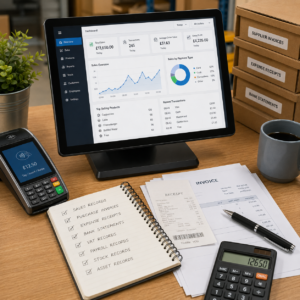
A modern EPOS system won’t replace your accountant or remove your legal record-keeping responsibilities.
What it can do is make the starting information much easier to organise.
Instead of manually adding up receipts every evening, your business can have clearer records of sales, payment types, refunds, discounts, products sold and stock movements.
For a takeaway, that might mean being able to compare today’s orders with payment totals. For a convenience store, it could mean checking sales against stock movements. For a restaurant, it may mean reviewing VAT and end-of-day reports without rebuilding the day’s figures from handwritten notes.
Switch & Save’s hospitality EPOS, for example, includes sales, payment and VAT reports, X and Z report history, refunds, discounts and downloadable reporting.
Good systems don’t remove the need for accurate bookkeeping. They reduce the amount of information you have to reconstruct afterwards.
Common Small Business Record-Keeping Mistakes
One common mistake is mixing personal and business spending without keeping enough information to explain individual transactions.
Another is keeping bank statements but throwing away supporting invoices. A payment appearing on your bank statement proves that money moved, but it may not show exactly what was bought or why it was a business expense.
Cash can cause similar problems. If cash sales, petty cash spending or supplier payments aren’t recorded consistently, your accounts can quickly stop matching what actually happened.
It’s also worth backing up digital information. Having years of records on one laptop isn’t much protection if that device fails.
Finally, don’t keep customer or employee personal information indefinitely simply because you have storage space. UK data protection rules require businesses to consider how long personal information is genuinely needed and establish appropriate retention periods.
A Simple Record-Keeping Routine for Small Businesses
You don’t need to turn record keeping into a major project.
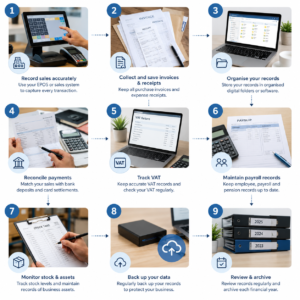
Record sales through your EPOS or sales system as they happen. Save purchase invoices and expense receipts in an organised digital folder or bookkeeping platform. Reconcile card, cash and bank totals regularly. Keep payroll and tax records separate and clearly labelled by tax year.
At month end, check that your sales, bank transactions and expenses broadly agree.
Then at year end, archive the completed period rather than leaving everything mixed with your current records.
A consistent ten-minute process is usually much easier to manage than trying to reconstruct twelve months of transactions just before a tax deadline.
Keep Better Records and Understand Your Business
Record keeping may start as a tax requirement, but the information can also help you run the business properly.
Your sales records show what customers are buying. Your stock information can highlight wastage or slow-moving products. Your expense records show where margins are being squeezed. And your payment reports make it easier to understand what you’re actually paying to process transactions.
The better your underlying records are, the easier it becomes to calculate VAT, assess profit, control costs and plan what happens next.
Switch & Save helps UK businesses reduce costs with AI-powered EPOS systems, card payment solutions and business finance. Check your savings today.
Frequently Asked Questions
What records does HMRC require a small business to keep?
For most businesses, HMRC will expect sufficient records to support the figures reported for tax. These commonly include sales and income records, invoices, receipts, expenses, bank records and supporting documents. VAT-registered businesses and employers have additional requirements.
Do I need to keep every business receipt?
You should keep evidence supporting business expenses and purchases. This may be a receipt, supplier invoice or appropriate electronic record. Keeping proper evidence makes it much easier to explain a transaction if your accounts are checked.
Can I scan receipts and throw away the originals?
Many business records can be retained electronically, provided the digital record remains accurate, complete and readable. However, some documents can have special requirements, so don’t automatically destroy originals where another rule requires them to be retained. HMRC provides specific guidance for VAT records.
Do sole traders need to keep records for seven years?
Not normally as a blanket rule. For a Self Assessment business, the standard requirement is generally at least five years after the 31 January filing deadline for the relevant tax year. Longer periods can apply in particular circumstances.
What happens if my business records are lost?
Try to obtain replacement copies from banks, suppliers or other sources and reconstruct the records as accurately as possible. HMRC has procedures for situations where records have been lost, stolen or destroyed, including the use of provisional or estimated figures in certain circumstances.