Starting a café business in the UK requires more than finding premises and buying a coffee machine. You need to validate your concept, prepare a realistic financial plan, choose a suitable location, register your food business, comply with food-safety rules, arrange the right licences and install reliable systems for orders, payments and reporting.
The safest approach is to plan the café around measurable local demand rather than personal preference alone. Before signing a lease, confirm the premises can legally be used as a café, calculate how many daily transactions you need to break even and ensure you have enough working capital to cover the early months.
Key Takeaways
| Question | Direct answer |
|---|---|
| Do you need to register a café? | Yes. A food business must normally be registered with its local authority at least 28 days before opening. |
| Do you need a licence to open a café? | Not usually for standard daytime food and drink service, but additional licences may be needed for alcohol, late-night refreshments, music or outdoor seating. |
| What business structure should you choose? | Most independent cafés operate as sole traders, partnerships or limited companies. |
| What should you check before signing a lease? | Planning use, extraction, utilities, business rates, repair obligations, accessibility and licence restrictions. |
| What technology does a café need? | A hospitality EPOS system, card machine, kitchen printer, sales reporting and stock or menu management tools. |
| What is the biggest financial risk? | Underestimating fit-out costs, payroll, rent, waste and the working capital needed before sales become stable. |
1. Decide What Type of Café You Want to Open
Begin with a clearly defined café concept. Trying to serve every possible customer can increase stock, equipment and staffing costs without creating a strong reason for people to visit.
Your concept might be:
- A speciality coffee shop
- A neighbourhood breakfast café
- A bakery café
- A takeaway-led coffee bar
- A work-friendly café with Wi-Fi
- A family café
- A dessert and drinks venue
- A health-focused café
- A mobile or pop-up café
Define your target customer, average selling price, opening hours and core menu. A commuter-focused coffee shop may need to open early and process orders quickly, while a brunch café may depend more heavily on table service and weekend trade.
Your concept should influence the premises, staffing, menu, equipment and EPOS features you choose.
2. Research the Local Café Market
Visit the area at different times before committing to a location. Check footfall during weekday mornings, lunchtimes, evenings and weekends.
Look at:
- Nearby offices, colleges, stations and residential areas
- Existing cafés and takeaway businesses
- Competitors’ prices and busiest periods
- Parking and public transport
- Local delivery demand
- Customer reviews of nearby cafés
- Vacant premises and business turnover
- Planned developments or roadworks
Speak to potential customers where practical. Ask what they currently buy, how much they spend and what is missing locally.
For example, an area may already have several premium coffee shops but no affordable breakfast café. Alternatively, a location may appear busy at lunchtime but have insufficient early-morning footfall for a coffee-led operation.
The objective is not simply to prove that people like coffee. It is to prove that enough customers are likely to buy your particular offer at your intended location and price.
3. Write a Café Business Plan
A café business plan should explain how the business will attract customers, generate sales and control costs.
Include:
Executive summary
Describe the café concept, target market, location and competitive advantage.
Menu and pricing
List your main products, estimated ingredient costs and selling prices. Keep the opening menu manageable so that staff can prepare it consistently and wastage remains controlled.
Sales forecast
Estimate transactions by daypart, average order value and trading days per month. Prepare conservative, expected and optimistic forecasts.
Staffing plan
Identify the number of baristas, kitchen staff and supervisors required for quiet and busy periods.
Marketing strategy
Explain how you will use signage, local partnerships, social media, Google Business Profile, delivery platforms and loyalty offers.
Financial forecast
Include start-up costs, monthly overheads, cash-flow projections and break-even sales.
A business plan is particularly important when seeking commercial finance, negotiating with a landlord or bringing investors into the business.
4. Calculate Your Café Start-Up Costs
The cost of opening a café in the UK varies significantly according to the size, condition and location of the premises.

Your budget may need to cover:
- Lease deposit and legal fees
- Planning or licensing applications
- Refurbishment and interior design
- Electrical, plumbing and extraction work
- Coffee machine and grinders
- Refrigeration and cooking equipment
- Furniture and signage
- Crockery, utensils and packaging
- Initial ingredients and stock
- EPOS equipment and card machines
- Insurance
- Recruitment and training
- Website and launch marketing
- Professional fees
- Working capital
Do not spend the entire budget on the fit-out. Keep a cash reserve for rent, payroll, utilities, supplier payments and unexpected repairs while the café builds regular trade.
Calculate your break-even point
Use this basic formula:
Monthly fixed costs ÷ contribution margin = monthly break-even sales
Suppose a café has estimated fixed costs of £12,000 per month and assumes a 68% contribution margin after ingredients and directly variable costs:
£12,000 ÷ 0.68 = approximately £17,647 in monthly sales
At an assumed average transaction value of £8 and 26 trading days, the café would need approximately 85 transactions per day to cover those assumptions.
This is an illustrative example rather than an industry benchmark. Use quotations, proposed wages, rent figures and recipe costs from your own business plan.
5. Choose a Business Structure
Most café owners choose to operate as a sole trader, partnership or limited company.
A sole trader structure is comparatively straightforward, but the owner is personally responsible for the business. A limited company is legally separate from its owners but comes with additional reporting and administrative responsibilities. GOV.UK provides separate registration processes for sole traders and limited companies.
Discuss the tax, liability and ownership implications with an accountant before deciding.
You should also:
- Open an appropriate business bank account
- Set up bookkeeping and payroll
- Keep invoices and expense records
- Monitor taxable turnover
- Register for VAT when required
The compulsory VAT registration threshold is currently £90,000 of VAT-taxable turnover, although businesses below the threshold can register voluntarily.
6. Find Suitable Café Premises
A busy-looking location is not automatically suitable for a café.
Before signing a lease, check:
- Permitted planning use
- Extraction and ventilation
- Gas and electrical capacity
- Water supply and drainage
- Customer and staff toilets
- Waste storage
- Delivery access
- Accessibility
- Signage restrictions
- Outdoor seating permissions
- Existing premises licences
- Business rates
- Service charges
- Repair obligations
- Break clauses and rent reviews
In England, cafés where food and drink are mainly consumed on the premises generally fall within Class E. A hot-food takeaway where consumption is mainly off the premises is treated differently for planning purposes. Confirm the position with the local planning authority, particularly when your model combines seating, takeaway and delivery.
Ask a commercial property solicitor to review the lease. An inexpensive-looking unit can become costly when it requires extraction, rewiring, drainage work or a change-of-use application.
You should also ask the council whether the property qualifies for any available small business rate relief. Eligibility depends on the premises and local circumstances.
7. Register Your Café as a Food Business
A café that sells, prepares, stores or handles food must normally be registered as a food business with the local authority.
Registration is free and should be completed at least 28 days before opening. The requirement also applies when taking over an existing food business.
Food-business registration is separate from registering as a sole trader or limited company. It informs the council’s environmental health team about the premises and activities.
Do not leave registration until the final week before launch.
8. Meet Food-Safety and Allergen Requirements
Your café must operate a documented food-safety management system based on Hazard Analysis and Critical Control Point principles.
For many cafés, restaurants and sandwich shops, the Food Standards Agency’s Safer Food, Better Business pack provides a practical way to document cleaning, chilling, cooking, cross-contamination controls and daily checks.
Your procedures should cover:
- Food deliveries and approved suppliers
- Chilled and frozen storage
- Temperature monitoring
- Cooking and reheating
- Handwashing
- Cleaning schedules
- Pest control
- Raw and ready-to-eat food separation
- Staff illness
- Traceability
- Allergen management
- Corrective action when something goes wrong
Staff must receive food-hygiene instruction and training appropriate to their responsibilities. Keep records showing what training was provided and when.
Allergen information
You must provide accurate allergen information and manage cross-contamination risks.
Food packaged on the premises before a customer selects it may be classed as prepacked for direct sale. In England, Wales and Northern Ireland, qualifying products must show the food name and a complete ingredients list, with regulated allergens emphasised.
Examples may include sandwiches, salads or cakes packaged and placed in a display cabinet before purchase.
Create an allergen matrix for every menu item and establish a procedure for recipe or supplier changes. Staff should never guess whether a product is safe for a customer with an allergy.
9. Check Which Café Licences You Need
A standard daytime café selling food and non-alcoholic drinks does not normally require a general café licence. However, your activities may trigger additional requirements.
You may need permission for:
- Selling alcohol
- Providing hot food or drink between 11pm and 5am
- Playing recorded music
- Hosting certain entertainment
- Installing tables and chairs on a public pavement
- Displaying external signage
- Operating a street-trading unit
A premises licence is generally required in England and Wales when selling alcohol or conducting other licensable activities. Late-night refreshment covers the sale of hot food or drink between 11pm and 5am, subject to exemptions and local arrangements.
Requirements vary across the UK, so check with the council responsible for the premises.
10. Choose Café Equipment, EPOS and Payment Systems
Your operational systems should be selected before staff training and menu setup begin.
A modern café may need:
- Touchscreen hospitality EPOS
- Integrated card machine
- Receipt printer
- Kitchen or drinks-station printer
- Cash drawer
- Customer display
- Menu and modifier management
- Staff permissions
- Table and takeaway order modes
- Sales reporting
- Stock monitoring
- Loyalty and promotion tools
- Online ordering integration
An integrated system reduces the need to enter payment amounts manually and creates a clearer link between orders, payments and sales reports.
Switch & Save provides a dedicated restaurant, takeaway and café EPOS system with order management, kitchen printing, card-payment integration and live reporting. New businesses can also compare card machine solutions based on their expected transaction volume and service model.
Choosing the system before opening also gives you time to build the menu, configure prices, create staff accounts and test receipts before serving customers.
11. Hire and Train Your Café Team
Recruit based on the café’s service model rather than job titles alone.
A small café may require employees who can:
- Prepare drinks
- Take orders
- Handle food safely
- Operate the till
- Clean equipment
- Receive deliveries
- Answer allergen questions
- Open or close the premises
Prepare written procedures for customer service, recipes, cleaning, refunds, cash handling and allergy enquiries.
As soon as you become an employer, you will normally need employers’ liability insurance with at least £5 million of cover. Eligible staff may also need to be enrolled into a workplace pension scheme from the date your employer duties begin.
You must also arrange lawful commercial waste disposal. Businesses are responsible for storing waste securely, using authorised carriers and maintaining the appropriate waste documentation.
12. Market the Café Before Opening
Do not wait until opening day to begin marketing.
Four to six weeks before launch, consider:
- Creating a Google Business Profile
- Publishing fit-out progress on social media
- Collecting email sign-ups
- Offering invitation-only preview sessions
- Partnering with nearby offices or community groups
- Distributing menus locally
- Photographing your drinks and food
- Creating a loyalty offer
- Installing visible exterior signage
- Asking early customers for genuine reviews
Run a soft opening before the public launch. Use it to test preparation times, order routing, card payments, kitchen communication and staff confidence.
Avoid offering heavy discounts that attract one-off customers without testing whether your normal prices and service are sustainable.
How Switch & Save Supports New Café Businesses
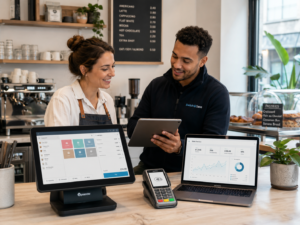
Opening a café involves several connected decisions: ordering technology, payment processing, cash flow and cost control.
Switch & Save helps UK cafés compare and implement:
- Hospitality EPOS systems
- Integrated card-payment solutions
- Sales, menu and staff reporting
- Kitchen printing and order routing
- Online ordering
- Business finance guidance
The objective is to create a practical setup that fits how the café will actually operate, rather than paying for unnecessary hardware or unsuitable contracts.
Switch & Save helps UK businesses reduce costs with AI-powered EPOS systems, card payment solutions and business finance.
Frequently Asked Questions
How much money do you need to start a café in the UK?
There is no single amount. Costs depend on the premises, lease deposit, refurbishment, equipment, menu and working-capital requirements. A unit already fitted for food service may cost considerably less to prepare than an empty retail property requiring extraction, plumbing and electrical work.
Do I need qualifications to open a café?
You do not normally need a specific academic qualification simply to own a café. However, you must understand your food-safety responsibilities and ensure staff receive appropriate food-hygiene instruction and training.
Can I open a café from home?
Potentially, but you may need permission from your landlord or mortgage provider, planning approval, suitable insurance and local authority registration. The food preparation area must meet applicable food-safety requirements.
Can I sell alcohol in a café?
Yes, provided the necessary alcohol licences and permissions are in place. In England and Wales, this will normally include a premises licence and arrangements involving a personal licence holder.
When should I register the food business?
Register it with the appropriate local authority at least 28 days before opening or taking over an existing café.
Does a café need an EPOS system?
It is not usually a legal requirement, but an EPOS system can make order entry, kitchen communication, payment reconciliation, menu updates and sales reporting easier. It becomes especially useful when the café handles multiple order types or employs several staff members.
How can a new café reduce the risk of failure?
Validate local demand, avoid an oversized menu, negotiate the lease carefully, retain working capital, track daily margins and monitor sales by product and time of day. Make operational decisions using actual sales data rather than assumptions.