
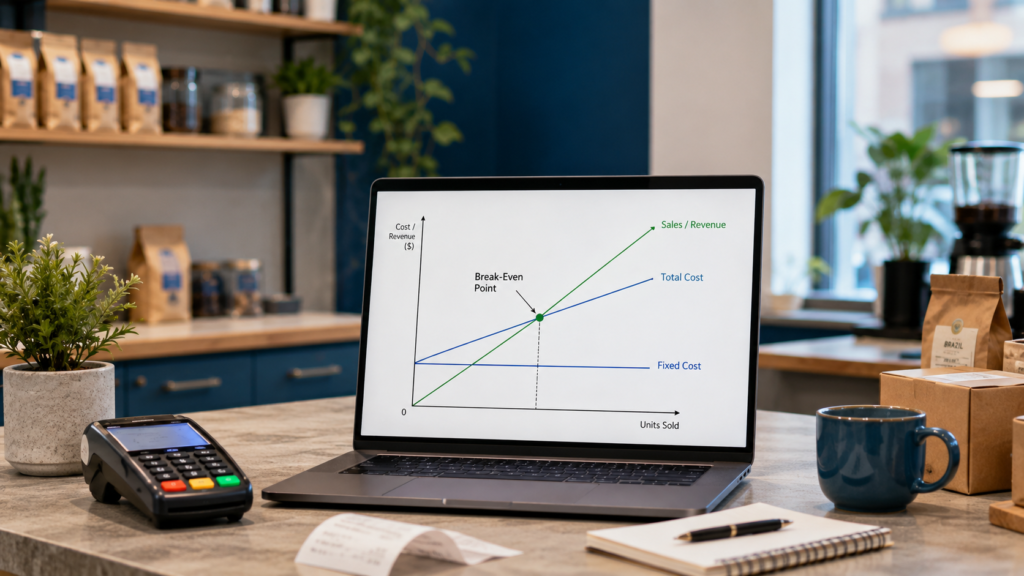
Your break-even point is the level of sales where your business covers all its costs but hasn’t made a profit yet. To calculate it, divide your fixed costs by the amount each sale contributes towards those fixed costs.
For example, if your business has £5,000 in monthly fixed costs and makes £5 contribution from each sale after variable costs, you need 1,000 sales to break even.
It’s a simple calculation, but it can tell you a lot. You can use it when setting prices, planning a new business, deciding whether to hire staff or working out whether your current sales are actually enough.
This guide explains how to calculate break-even point step by step, with practical examples for UK cafés, shops, takeaways and other small businesses.
Key Takeaways
| What you need to know | Simple explanation |
|---|---|
| Break-even point | Where total sales equal total costs |
| Fixed costs | Costs that don’t usually change directly with sales volume |
| Variable costs | Costs that increase or decrease as you sell more |
| Contribution | Selling price minus variable cost |
| Break-even units | Fixed costs ÷ contribution per unit |
| Break-even revenue | Fixed costs ÷ contribution margin ratio |
| Why it matters | Helps with pricing, budgeting, sales targets and cost control |
What Is the Break-Even Point?
The break-even point is where your total revenue equals your total business costs.
At this point:
Revenue = Costs
You’re not losing money, but you’re not making a profit either.
Once sales move above the break-even point, the additional contribution from those sales starts generating profit. If sales stay below it, the business is operating at a loss.
The British Business Bank describes break-even as the point where revenues match expenses. It also distinguishes fixed costs, such as rent, from variable costs that change with the level of business activity.
For a small business owner, that makes break-even a useful number to know.
If you’re running a café, for example, knowing you need £18,000 in monthly sales before covering your costs gives you something much more useful than simply saying, “We need to sell more.”
You now have a target.
Why Does Knowing Your Break-Even Point Matter?
Break-even analysis gives you a clearer picture of whether your numbers make sense.
You can use it before opening a business, but it’s just as useful once you’re trading.
For example, you might use your break-even point when:
- setting or reviewing prices
- deciding whether you can afford additional staff
- assessing a new product or menu item
- considering a second location
- negotiating supplier prices
- planning promotions
- comparing opening hours with sales
- reviewing rising rent, energy or other overheads
It can also show you when small cost increases are creating a much bigger problem than expected.
If your monthly fixed costs rise from £6,000 to £7,500, your business now has to generate additional contribution every month just to reach zero profit.
That’s why reducing business costs without hurting sales can have a direct impact on your break-even point.
What Is the Break-Even Point Formula?
For businesses selling a product or service at a reasonably consistent price, the standard formula is:
Break-even point in units = Fixed costs ÷ Contribution per unit
Your contribution per unit is:
Contribution per unit = Selling price − Variable cost per unit
“Contribution” simply means how much money is left from a sale to contribute towards your fixed costs after the direct variable costs of making that sale have been deducted.
Once all fixed costs have been covered, further contribution can go towards profit.
A Simple Example
Imagine you sell a product for £20.
The variable costs associated with each sale are £8.
Your contribution is:
£20 − £8 = £12
Your monthly fixed costs are £6,000.
So:
£6,000 ÷ £12 = 500
You need to sell 500 units per month to break even.
Sell fewer than 500 and you’re below break-even.
Sell more than 500 and, assuming your costs behave as expected, you’ve moved beyond your break-even point.
How to Calculate Break-Even Point Step by Step
Here’s how it works in practice.
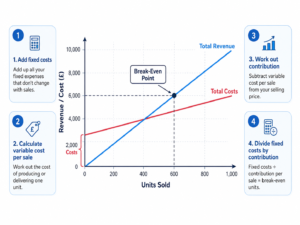
Step 1: Add Up Your Fixed Costs
Fixed costs are expenses that don’t usually change directly because you sold one more product.
Typical examples include:
- shop or office rent
- business rates
- insurance
- software subscriptions
- fixed equipment rental
- broadband
- accounting costs
- salaried staffing costs, where applicable
- fixed finance repayments or charges
The distinction matters. A cost doesn’t have to stay exactly the same forever to be treated as fixed for a particular break-even period.
Your rent might increase next year, for example, but it may still be a fixed cost when calculating this month’s break-even point.
Step 2: Calculate Your Variable Cost Per Sale
Variable costs change depending on how much you sell.
For a café, these could include coffee beans, milk, takeaway cups and food ingredients.
For a takeaway, they might include ingredients, packaging and commission charged as a percentage of an order.
A retailer may include the cost of stock sold and transaction-related charges.
Card processing fees that are charged as a percentage or amount per transaction can also form part of variable costs, while a fixed monthly terminal rental would normally sit within fixed costs.
Step 3: Calculate Contribution
Subtract the variable cost from the selling price.
For example:
Selling price: £12
Variable cost: £5
Contribution: £7
That £7 goes towards covering your fixed overheads.
Step 4: Divide Fixed Costs by Contribution
Suppose your monthly fixed costs are £7,000.
Your contribution per sale is £7.
£7,000 ÷ £7 = 1,000 sales
Your monthly break-even point is 1,000 sales.
How to Calculate Break-Even Sales Revenue
Many small businesses don’t sell one product at one price.
A grocery shop could have thousands of products. A café sells coffees, breakfasts, cakes and lunches. A restaurant may have very different margins across starters, drinks and main courses.
In those situations, calculating break-even using sales revenue can be more practical.
The formula is:
Break-even sales revenue = Fixed costs ÷ Contribution margin ratio
Your contribution margin ratio is:
Contribution ÷ Sales revenue
The British Business Bank identifies contribution margin as sales earnings after variable costs, which helps a business assess the profitability of its products or services.
Example
Imagine your shop generates £30,000 in monthly sales.
Variable costs total £19,500.
Your contribution is:
£30,000 − £19,500 = £10,500
Your contribution margin ratio is:
£10,500 ÷ £30,000 = 35%
If your fixed costs are £8,000:
£8,000 ÷ 0.35 = £22,857
Your shop therefore needs roughly £22,857 in monthly sales to break even, assuming the same sales mix and cost structure continue.
Let’s put the calculation into situations that feel more familiar.
A café has monthly fixed costs of £6,000.
It sells a coffee for an average of £3.50, with approximately £1.10 of variable costs associated with each sale.
Contribution:
£3.50 − £1.10 = £2.40
Break-even:
£6,000 ÷ £2.40 = 2,500 coffees
If coffee were the café’s only product, it would need to sell 2,500 coffees per month to cover its fixed costs.
Real cafés obviously sell several products, so an overall contribution margin calculation will usually give a more useful business-wide figure.
If you’re still planning a new café, our guide on how to start a café business in the UK can help you think through the wider costs involved.
A takeaway’s average customer order is £22.
Food, packaging and other variable costs average £9.50 per order.
Contribution per order:
£22 − £9.50 = £12.50
Monthly fixed costs are £10,000.
Break-even orders:
£10,000 ÷ £12.50 = 800 orders
The business therefore needs approximately 800 orders per month to break even.
That can then be converted into a daily target.
If the takeaway trades 30 days that month:
800 ÷ 30 = around 27 orders per day
Now the break-even figure becomes something the owner can actually monitor.
A retailer has fixed costs of £8,000 per month and an average contribution margin of 35%.
Break-even revenue is:
£8,000 ÷ 0.35 = £22,857
That means the shop needs roughly £22,857 of sales each month before it reaches break-even.
For grocery businesses with large product ranges, using accurate sales and margin data becomes particularly important. Our guide to starting a grocery business covers some of the other costs shop owners need to consider.
Which Costs Should You Include?
This is where break-even calculations often become less accurate.
It’s easy to remember rent and stock. It’s also easy to forget smaller expenses that add up.
Look through your actual business records rather than relying on memory.
Depending on your business, relevant costs could include rent, insurance, wages, utilities, software, stock, ingredients, packaging, merchant fees, delivery commissions and equipment costs.
UK sole traders and partnerships are required to keep records of their business income and expenses for tax purposes, so these records can also provide useful information for building a realistic break-even calculation.
Some costs are also semi-variable.
Electricity is a good example. You may have a base level of usage regardless of sales, but costs can rise when trading becomes busier.
Staffing can work similarly.
Don’t worry about making the calculation academically perfect. The goal is to build a realistic model that helps you make better decisions.
Should You Include VAT in Your Break-Even Calculation?
Be consistent.
If your business is VAT registered and you’re able to recover VAT on relevant business purchases, management calculations are often clearer when comparable sales and costs are considered on a net-of-VAT basis.
VAT-registered businesses account for VAT charged on taxable sales, while VAT paid on eligible business purchases can generally form input tax, subject to the relevant VAT rules.
The exact treatment can be more complicated where VAT isn’t fully recoverable or your business supplies goods and services with different VAT treatments.
If you’re unsure, ask your accountant how VAT should be handled in your specific break-even model.
How Can You Lower Your Break-Even Point?
There are three main levers.
You can reduce fixed costs, improve contribution margins or increase prices.
Suppose your business needs £25,000 of monthly revenue to break even. If you negotiate lower supplier costs, reduce unnecessary subscriptions or improve the margin on your product mix, you might reach break-even at a lower level of sales.
That can make the business more resilient during quieter periods.
Pricing needs more care.
Increasing your prices improves contribution per sale if costs remain unchanged, but you also need to consider how your customers will respond.
The same applies to discounting. A promotion may increase sales volume, but if it cuts your contribution too heavily, you could need far more transactions to make the same amount of money.
That’s why break-even calculations can be useful before launching an offer rather than afterwards.
How EPOS Data Can Make Break-Even Calculations More Useful
A break-even calculation is only as useful as the numbers you put into it.
If you’re guessing your average selling price, sales mix or product margins, the final figure will also be a guess.
A modern EPOS system can give you much clearer information about what your business is actually selling.
You can review sales by product, category, branch or period and compare busy and quiet trading times.
For example, a café owner might discover that coffee has a strong contribution margin but certain food lines are selling slowly and creating waste.
A retailer might find that a high-revenue product produces far less contribution than expected once its purchase cost is considered.
That’s more useful than looking at turnover alone.
Switch & Save’s AI-powered EPOS systems can help businesses track sales and understand their trading performance more clearly, while integrated card payment solutions can make it easier to keep day-to-day payment data connected to the wider operation.
Break-Even Point vs Profit Target
Breaking even shouldn’t normally be your final goal.
Once you know your break-even point, you can calculate the sales needed to reach a particular profit target.
Use:
Required sales units = (Fixed costs + Target profit) ÷ Contribution per unit
Suppose:
- Fixed costs = £6,000
- Contribution per unit = £12
- Target monthly profit = £3,000
Your calculation becomes:
(£6,000 + £3,000) ÷ £12 = 750 units
You need to sell 750 units to generate the £3,000 target profit, assuming your estimates hold.
This turns break-even analysis into something more useful than simply finding the point where profit is zero.
Common Break-Even Mistakes to Avoid
The biggest mistake is using numbers that don’t reflect the way your business really operates.
Another common problem is calculating break-even once and never updating it.
Supplier prices change. Rent changes. Staffing changes. Your sales mix changes. Your card processing costs may change.
So your break-even point can change too.
You should also avoid assuming every additional sale produces the same contribution if you sell a wide range of products.
A £40 sale doesn’t necessarily make twice as much money as a £20 sale.
What matters is the contribution left after the variable costs behind each sale.
Finally, don’t confuse break-even with cash flow. A business can appear profitable on paper but still experience cash-flow pressure because cash enters and leaves the business at different times. The British Business Bank defines cash flow as the movement of cash into and out of a business, which is different from simply measuring profit.
Make Your Break-Even Figure Part of Your Monthly Review
You don’t need complicated financial software to start.
Work out your fixed costs, understand your variable costs and calculate how much contribution your typical sales generate.
Then compare your break-even target with your actual sales.
If you’re comfortably above it, you can start thinking about profit targets and growth.
If you’re consistently below it, the calculation gives you somewhere practical to start: costs, pricing, margins, sales volume or product mix.
And if you’re only just launching, knowing your break-even figure before opening can help you build much more realistic sales targets.
If you’re setting up independently, our Sole Trader Guide UK 2026 may also help you understand some of the wider practical responsibilities involved in running your business.
How Switch & Save Can Help
Sales data becomes far more useful when you can actually see what’s happening across your business.
Switch & Save helps UK businesses reduce costs with AI-powered EPOS systems, card payment solutions and business finance.
Whether you’re running one shop, opening your first café or managing multiple locations, having clearer information on sales, products and payments can make financial decisions easier.

Frequently Asked Questions
What is the easiest way to calculate break-even point?
Use:
Fixed costs ÷ Contribution per unit
Contribution per unit is your selling price minus the variable cost of making that sale.
If fixed costs are £5,000 and each sale contributes £10, your break-even point is 500 sales.
What is the break-even point formula?
The basic formula is:
Break-even units = Fixed costs ÷ (Selling price − Variable cost per unit)
For businesses selling many different products, break-even sales revenue may be more useful:
Break-even revenue = Fixed costs ÷ Contribution margin ratio
What are fixed costs in a small business?
Fixed costs are expenses that don’t usually move directly with each individual sale. Examples can include rent, insurance, software subscriptions and certain staffing or equipment costs.
What are variable costs?
Variable costs change as sales or production change.
Examples include stock, ingredients, packaging and transaction charges that are calculated based on sales.
What is contribution margin?
Contribution is the amount remaining from a sale after variable costs have been deducted.
For example, if you sell something for £15 and the variable cost is £6, the contribution is £9.
The contribution helps pay your fixed costs. Once those have been covered, additional contribution can support profit.
Can break-even point be calculated using revenue?
Yes.
If you sell many different products, calculate your overall contribution margin ratio and use:
Fixed costs ÷ Contribution margin ratio
This gives you the approximate amount of revenue needed to break even.
How often should a small business calculate its break-even point?
There’s no single required timetable, but it’s useful to review the calculation whenever important costs, prices or sales patterns change.
Many businesses can also benefit from including it in regular monthly or quarterly performance reviews.
Is break-even the same as profit?
No.
At break-even, your revenue has covered your costs but your profit is zero.
Profit begins once your contribution exceeds the amount required to cover your costs.