

Choosing the right integrations for your EPOS system can feel like one of the most consequential decisions you make for your business. Get it right, and your stock levels, sales data, and customer experience all start working together. Get it wrong, and you are dealing with data that does not match, staff who are frustrated, and customers who notice the gaps. This article walks through the most practical epos integration examples available to UK retail and hospitality businesses today, with real context on how each one works, what it costs you in setup time, and where to watch out.
Table of Contents
- Key takeaways
- 1. E-commerce platform integration
- 2. Direct local printing for hospitality and retail
- 3. Native EPOS integration within ERP systems
- 4. Accounting software integration
- 5. Loyalty programme integration
- 6. Booking system integration for hospitality
- 7. Comparison of integration types and how to choose
- My take on what actually makes EPOS integration succeed
- How Switch-and-save makes EPOS integration straightforward
- FAQ
Key takeaways
| Point | Details |
|---|---|
| E-commerce sync saves time | Connecting your EPOS to platforms like Shopify unifies stock and sales data across channels automatically. |
| Cloud printing is fast to set up | Direct printing via services like PrintNode can be live in 10 to 15 minutes and removes manual order handling. |
| Native integration beats middleware | EPOS built directly into your ERP avoids data drift and delivers real-time accuracy across all locations. |
| Business tools multiply EPOS value | Linking your EPOS to accounting software, loyalty programmes, and booking systems removes double entry and saves hours. |
| Pilot before peak | Test every integration during quiet periods to protect your customer experience and give staff time to adapt. |
1. E-commerce platform integration
One of the most requested epos integration examples in retail right now is connecting an in-store EPOS to an online shop. Platforms like Shopify are popular choices because they offer direct point of sale integration with many EPOS systems, allowing inventory, pricing, and customer records to sync both ways.
The typical epos configuration workflow for this kind of integration looks like this:
- Install the EPOS software and configure your product catalogue with SKUs that match your online store
- Connect the EPOS to the e-commerce platform using an API key or built-in connector
- Map product categories, tax rates, and warehouse locations so data flows correctly in both directions
- Run a test cycle: place an online order and confirm the EPOS reduces stock in real time
When the sync works correctly, you never oversell an item that sold out in-store, and your online customers see accurate availability. That has a direct impact on trust and repeat purchases.
The pitfalls tend to come from mismatched product data at the start. If your in-store catalogue uses different SKUs or naming conventions than your online shop, syncing creates duplicate entries rather than unified records. Spend time cleaning your catalogue before you go live.
Pro Tip: Run a full stock audit and reconcile your product catalogue across all channels before activating the integration. This single step prevents the majority of sync errors that appear in the first week.
Integrating EPOS with social commerce platforms is also growing, with retail social commerce becoming a channel businesses can no longer afford to ignore. The same principles of unified data and clean product records apply there too.
2. Direct local printing for hospitality and retail
For hospitality businesses in particular, the gap between a customer placing an order and that order arriving in the kitchen is where errors and delays happen. Direct printing integration solves this by connecting your cloud-based EPOS directly to local printers, whether that is a kitchen ticket printer, a receipt printer at the bar, or a delivery note printer in the stockroom.

The technical bridge here is a cloud printing service. PrintNode setup can typically be completed in 10 to 15 minutes per printer location, making this one of the fastest integrations in this list.
Here is how the epos setup step by step typically looks for direct printing:
- Install a cloud printing client (such as PrintNode) on the computer connected to your local printer
- Register your printers within the cloud printing account and note each printer’s unique ID
- In your EPOS settings, navigate to the printing configuration and assign each document type to the correct printer ID
- Set routing rules: kitchen orders go to the kitchen printer, receipts go to the counter printer, delivery notes go to the back office printer
- Process a test order through the full workflow and confirm each document prints to the right location
- Adjust print formatting if needed for readability on kitchen display paper
“The PrintNode client runs silently in the background, receiving cloud print jobs and sending them to the correct local printer without any manual intervention from staff.”
For a busy restaurant or café, this integration removes the need for staff to shout orders or walk to the kitchen. Orders arrive the moment they are entered, correctly routed, and without the errors that come from verbal communication. That is a measurable improvement in service speed and accuracy.
Pro Tip: Label each printer clearly in your EPOS settings with its physical location (e.g. “Bar Printer,” “Kitchen Printer 1”) rather than a model number. When routing rules need updating, staff can identify the correct printer immediately without consulting documentation.
3. Native EPOS integration within ERP systems
If you run a high-volume retail operation or a multi-site hospitality business, the depth of your EPOS integration matters as much as its breadth. Native POS integration built directly into your enterprise resource planning system gives you a single source of truth for stock, sales, and financials, with no third-party connector sitting between the EPOS and your core ledger.
The difference between native and middleware integration is significant in practice:
| Feature | Native integration | Middleware/third-party sync |
|---|---|---|
| Data update speed | Real time | Delayed (batch intervals) |
| Risk of data drift | Very low | Moderate to high |
| Stock accuracy | Consistently high | Variable |
| Financial reconciliation | Immediate | Requires manual checks |
| Setup complexity | Managed by vendor | Requires technical configuration |
| Long-term reliability | High | Depends on connector updates |
Batch synchronisation of POS data creates delays in inventory accuracy, which risks overselling and customer dissatisfaction in fast-moving environments. This is the core argument for native integration: when every sale writes directly to your ERP ledger in real time, your stock figures are accurate at every moment of the trading day.
For retailers managing multiple product lines or hospitality groups running several venues, the financial reconciliation benefit is just as valuable. You are not cross-referencing two systems at month-end; the numbers already match.
The trade-off is that native integrations are typically locked to a specific ERP or EPOS vendor ecosystem. Before committing, confirm that your chosen EPOS system has a certified, maintained native integration with your ERP rather than relying on an unofficial connector.
4. Accounting software integration
Connecting your EPOS to accounting software is one of the highest-return epos integration examples for small and medium-sized businesses. Linking POS to QuickBooks or Xero reduces bookkeeping errors and the manual work that comes from re-entering sales figures at the end of each day.
The practical workflow is straightforward:
- Sales totals, refunds, and payment method breakdowns are pushed from the EPOS to your accounting platform automatically at set intervals or end of day
- VAT is calculated and coded to the correct accounts without manual intervention
- Supplier invoices and stock costs can be matched against sales in one view
- Cash flow reports reflect the current trading position rather than yesterday’s manually entered figures
For a small retailer processing 50 to 100 transactions a day, this integration alone can save an hour of bookkeeping time each day. Over a year, that is meaningful.
5. Loyalty programme integration
Loyalty programmes are one of the most customer-facing epos integration examples, and hospitality businesses in particular see strong returns when they get this right. When your EPOS talks directly to your loyalty platform, points are awarded automatically at checkout, redemptions are verified in real time, and your customer data builds a genuine record of purchasing behaviour rather than a list of names and email addresses.
The integration typically works through an API connection between your EPOS and the loyalty platform. Staff do not need to do anything differently at the till; the system handles point accrual, tier updates, and redemption validation in the background.
What you gain from this is not just repeat visits. You also get data that tells you which customers respond to which offers, which products drive loyalty behaviour, and where your highest-value customers concentrate across different times of day or week.
6. Booking system integration for hospitality
For restaurants, hotels, and event venues, connecting your EPOS to a booking platform like ResDiary or a similar reservation tool creates a joined-up view of the customer from table booking through to final bill. This is one of the epos system examples with the most visible impact on customer experience.
When the integration is live, a table booking creates a guest record in your EPOS before the customer arrives. Staff can see the party size, any dietary notes, and any loyalty status without asking the customer to repeat themselves. At the end of service, the bill is attributed to the correct booking record automatically, which makes your revenue reporting by cover, by day part, and by table much more accurate.
The epos installation workflow for booking integrations requires careful mapping of table numbers and covers between the two systems. Mismatched table numbering is the most common cause of attribution errors, so test this thoroughly with real bookings before go-live.
7. Comparison of integration types and how to choose
With several integration types available, the decision usually comes down to your operational priorities and your current pain points. This table gives you a quick reference:
| Integration type | Best for | Setup time | Key benefit |
|---|---|---|---|
| E-commerce platform | Retailers with online stores | Half a day to one day | Unified stock and sales data |
| Direct local printing | Cafés, restaurants, pubs | 1 to 2 hours | Faster, error-free order routing |
| Native ERP integration | Multi-site or high-volume businesses | Several days to weeks | Real-time accuracy, no data drift |
| Accounting software | All business types | A few hours | Automated financial data flow |
| Loyalty programme | Hospitality and repeat-trade retail | Half a day | Customer data and retention |
| Booking system | Restaurants, hotels, venues | Half a day to one day | Joined-up customer journey |
A few principles are worth keeping in mind when you decide where to start.
Treat the first 30 days post-setup as a refinement period. Do not rely on integrated data for financial reporting until you have confirmed that every edge case behaves as expected. This is particularly true for accounting and ERP integrations where a silent sync error can compound over time.
Hands-on staff training with real scenarios before going live prevents the kind of operational issues that are most damaging: errors in front of customers during a busy service.
Pro Tip: Start with the integration that addresses your biggest daily frustration. If you are losing time on bookkeeping, start with accounting. If orders are being missed in the kitchen, start with printing. Phasing your integrations means each one gets proper attention and staff buy-in.
Before signing off on any integration, run through this checklist:
- Confirm the integration is officially supported and maintained by your EPOS vendor
- Test with real transactions during a quiet period before full deployment
- Train staff on the new workflow, including how to handle errors or system prompts they have not seen before
- Define who owns troubleshooting if the integration breaks
- Review data accuracy after the first week of live use
My take on what actually makes EPOS integration succeed
I have seen businesses invest significantly in EPOS integrations and then undermine their own investment by rushing the go-live. The technology works. The part that breaks is usually the transition.
What I have learnt from working with retail and hospitality clients is that the first two weeks after launch are the most critical. This is not the time to be running your busiest service period. Launching during off-peak times gives staff the space to ask questions without pressure, and gives you the chance to catch any sync issues before they become financial discrepancies.
Native integration consistently outperforms middleware in my experience. The promise of a cheaper third-party connector sounds appealing, but middleware creates data silos that tend to surface at the worst moments, usually month-end or during an audit.
The businesses that get the most from integrating epos solutions are not the ones with the most integrations. They are the ones that implement each integration deliberately, train their teams properly, and take the time to verify the data before trusting it. Start with one integration, do it well, and build from there.
— Amir
How Switch-and-save makes EPOS integration straightforward
If the examples above have given you a clearer picture of what you need, the next step is finding a system that supports them without requiring a technical team to manage.
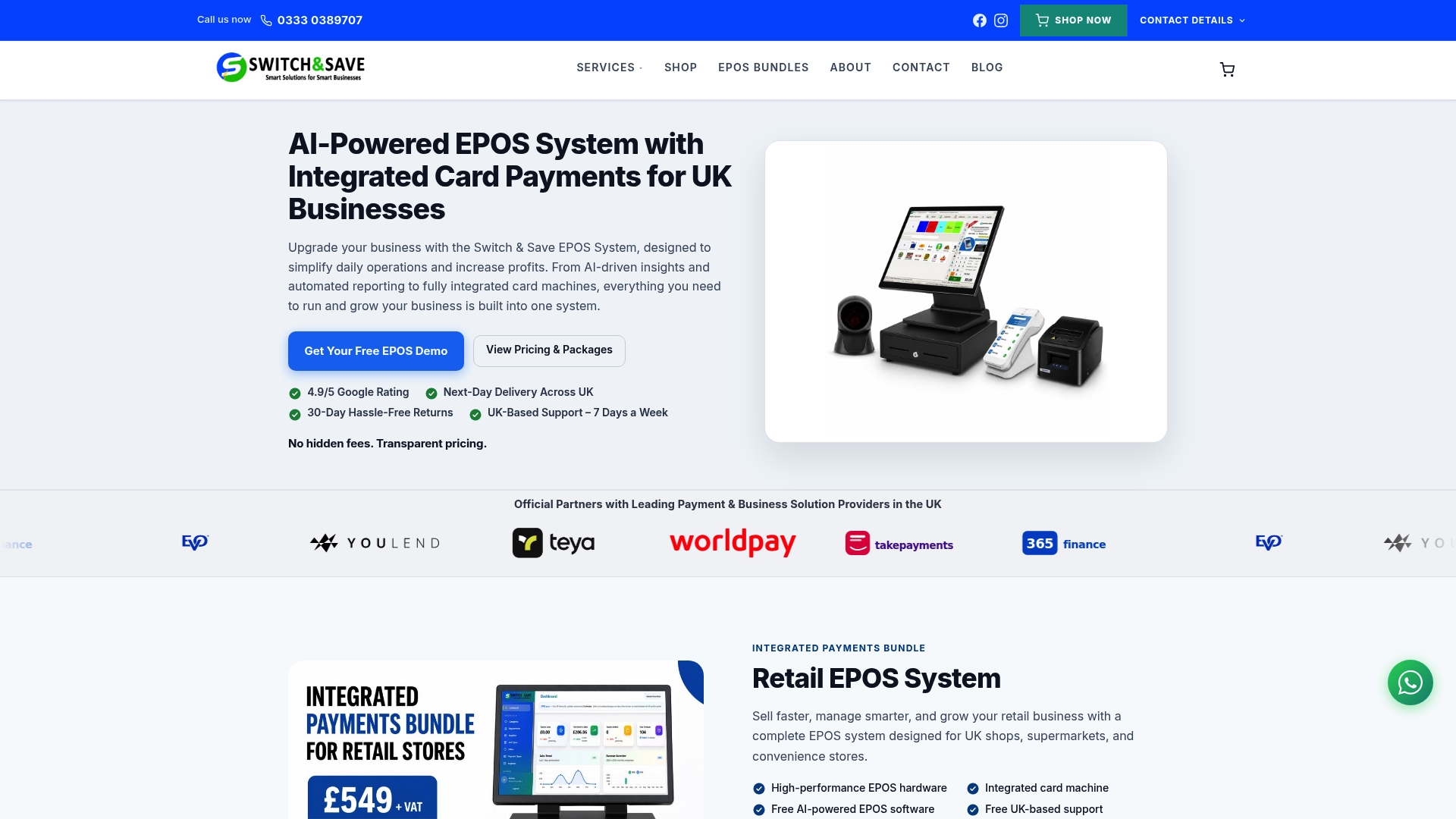
Switch-and-save provides EPOS systems designed specifically for UK retail and hospitality businesses, with support for e-commerce sync, direct printing, accounting software, loyalty programmes, and booking platforms built in. The SSPOS software handles real-time inventory, AI-powered reporting, and cloud-based access across multiple locations. EPOS bundles combine hardware and software so you are not piecing together a system from separate suppliers. UK-based support is included, and Switch-and-save offers free demos so you can see the integration workflow before you commit. 👉 Explore the full range at switch-and-save.uk.
FAQ
What are the most common epos integration examples for retail?
The most common integrations for retail are e-commerce platforms (such as Shopify), accounting software (such as Xero or QuickBooks), and loyalty programmes. These three together cover stock management, financial reporting, and customer retention in one connected setup.
How long does a typical epos integration take to set up?
Setup time varies by integration type. Direct printing via cloud services like PrintNode typically takes 10 to 15 minutes per printer, while e-commerce or accounting integrations usually take a few hours to half a day with proper data preparation.
What is the difference between native and middleware EPOS integration?
Native integration writes data directly to your core business system in real time, while middleware syncs data between separate systems at intervals. Native integration is more reliable and reduces the risk of stock or financial discrepancies.
How do I reduce errors when setting up EPOS integrations?
Structured staff training before go-live, including refund handling and reporting, significantly reduces errors. Launching during quiet periods and verifying data accuracy in the first week also protects against issues compounding over time.
Can a small hospitality business benefit from epos software integration?
Yes. Even a single-site café or restaurant benefits from connecting EPOS to a kitchen printer and an accounting platform. Cloud and native EPOS integrations reduce human error and improve daily management without requiring a large IT setup.