
Card fraud is a growing problem for UK retail and hospitality businesses. Fraud losses reached $15.9 billion in 2025, up 27% from the previous year, and your business does not need to be a large chain to be a target. Knowing how to secure card payments protects your customers, your reputation, and your bottom line. This guide walks you through everything from choosing the right payment provider to locking down online transactions, so you can take practical steps with confidence rather than guesswork.
Table of Contents
- Key takeaways
- The foundations of secure card payment processing
- Securing in-person card transactions
- Securing online and card-not-present payments
- Ongoing monitoring and verification
- My honest take on card payment security
- How Switch-and-save helps you stay protected
- FAQ
Key takeaways
| Point | Details |
|---|---|
| Start with PCI compliance | Meeting PCI DSS requirements is the foundation of secure card handling, not an optional extra. |
| Use EMV and contactless in-store | Chip readers and contactless terminals significantly reduce in-person card fraud compared with magnetic stripe. |
| Layer your online defences | Combining tokenisation, SCA, and velocity rules protects against the most common e-commerce fraud attacks. |
| Monitor transactions continuously | Set up automated alerts and fraud scoring so suspicious activity is flagged before losses occur. |
| Train your staff regularly | Human error remains one of the biggest vulnerabilities. Regular training refreshes close that gap. |
The foundations of secure card payment processing
Before you put any security measure in place, it pays to understand how card payments actually work and what the rules require of you. You cannot protect something you do not fully understand.
Key terms you need to know:
- Payment gateway: The technology that securely transmits card data from your checkout to the payment processor. As payment gateway research shows, gateways handle data transmission but do not hold or settle funds. That is why gateway reputation matters so much.
- Payment processor: The company that handles the actual transaction between your bank and your customer’s card network.
- PCI DSS: The Payment Card Industry Data Security Standard. This is the global framework every business that accepts card payments must follow to protect credit card information.
PCI DSS 4.0, released in 2022 and now fully enforced, brought significant changes. PCI DSS 4.0 requires continuous validation rather than annual tick-box assessments. Many small businesses underestimate what this means in practice. It is not just a document you sign once a year. It is an ongoing operational commitment.
When choosing a payment provider, look for one that is already PCI-compliant and transparent about fees. Modern payment providers allow merchants to get set up in as little as 10 minutes with straightforward business verification and no hidden costs. Speed of onboarding is useful, but compliance credentials should always come first.
Pro Tip: Ask any payment provider directly for their PCI DSS compliance certificate before you sign anything. A reputable provider will share this without hesitation.
Securing in-person card transactions
In-store and on-site payments carry their own specific risks. Skimming devices, card cloning, and staff-assisted fraud are all real threats in retail and hospitality environments. Here is a step-by-step process to close those gaps.
- Upgrade to EMV chip readers. Magnetic stripe cards are easy to clone. EMV chip technology generates a unique code for every transaction, making copied card data useless. If you are still running older terminals, upgrading is one of the highest-impact steps you can take. Our payment terminal guide for UK businesses covers your options in detail.
- Enable contactless payments. Contactless uses tokenisation, which means the actual card number is never transmitted. This reduces exposure at the point of sale significantly.
- Physically secure your card terminals. Check your terminals at the start and end of each shift for signs of tampering. Fit privacy shields around PIN entry pads so customers cannot be observed entering their PIN. Never leave terminals unattended in public areas.
- Train staff to recognise suspicious behaviour. A customer who insists on swiping rather than inserting, asks staff to enter a PIN on their behalf, or presents a card that looks altered should trigger a quiet verification process. Staff who know the signs can stop fraud before it completes.
- Apply address verification and transaction velocity checks. Many card terminals and EPOS systems allow you to set rules that flag unusually high transaction values or multiple rapid purchases on the same card. These are simple to configure and catch a surprising amount of opportunistic fraud.
- Keep your POS software updated. Outdated software is a common entry point for attackers. Set your system to update automatically where possible, or build a weekly check into your routine.
Pro Tip: Run a brief five-minute security refresher during staff meetings every quarter. Most in-person card fraud succeeds because staff did not recognise the warning signs, not because the technology failed.
Securing online and card-not-present payments

Card-not-present fraud is the fastest-growing type affecting retail and hospitality businesses with an online presence. When a customer pays remotely, you cannot check a signature or a face. That shifts the security burden entirely onto your systems.
Core technologies to implement:
- Strong Customer Authentication (SCA): Required under UK FCA rules for most online card payments, SCA typically means two-factor verification such as a one-time passcode plus a password. This alone eliminates a large proportion of unauthorised online transactions.
- Tokenisation: Rather than storing actual card numbers, tokenisation replaces them with a unique identifier. If your system is ever compromised, attackers get tokens that are worthless outside your specific payment environment. Credit cards combined with tokenisation represent one of the most secure online payment methods available.
- Encryption: Learning how to encrypt card details starts with choosing a payment provider that applies TLS 1.2 or higher for all data in transit. Never store raw card numbers on your own servers.
- Bot detection: Automated card testing, where fraudsters run thousands of small transactions to identify live card numbers, is a persistent threat. Cloudflare Turnstile blocks around 80% of automated card testing with minimal friction for genuine customers. It is free to implement and takes less than an hour to set up.
Fraud signals to monitor in real time:
| Risk signal | What it indicates | Recommended action |
|---|---|---|
| BIN/IP country mismatch | Card issued in one country, IP address in another | Flag for manual review |
| Disposable email domain | Throwaway address used at checkout | Require verified email or block |
| Multiple failed card attempts | Possible card testing in progress | Temporary IP block after 3 failures |
| High order value from new account | Unusual purchase pattern | Hold order for 24-hour review |
| Multiple cards from single IP | Possible carding attack | Block IP, alert fraud team |
Choosing the right platform matters here. Look for secure payment gateway options that include built-in fraud scoring, not just data transmission. Layered anti-fraud stacks for e-commerce can start from as little as £79 per year, a small investment when each chargeback can cost you £15 to £25 on top of the lost goods.
Ongoing monitoring and verification
Getting secure is one thing. Staying secure is another. Fraud tactics change constantly, and a system that worked well last year may have gaps today.
Reactive versus proactive security approaches:
| Approach | What it involves | Limitation |
|---|---|---|
| Reactive | Investigating fraud after it happens, disputing chargebacks | Losses already incurred before action taken |
| Proactive | Real-time alerts, velocity rules, risk scoring, regular audits | Requires initial setup time and staff commitment |
The proactive approach wins every time. Velocity rules that block IPs after repeated payment failures are a practical example. Set a rule that temporarily blocks an IP address after three consecutive card failures. This stops automated attacks in their tracks without affecting real customers.
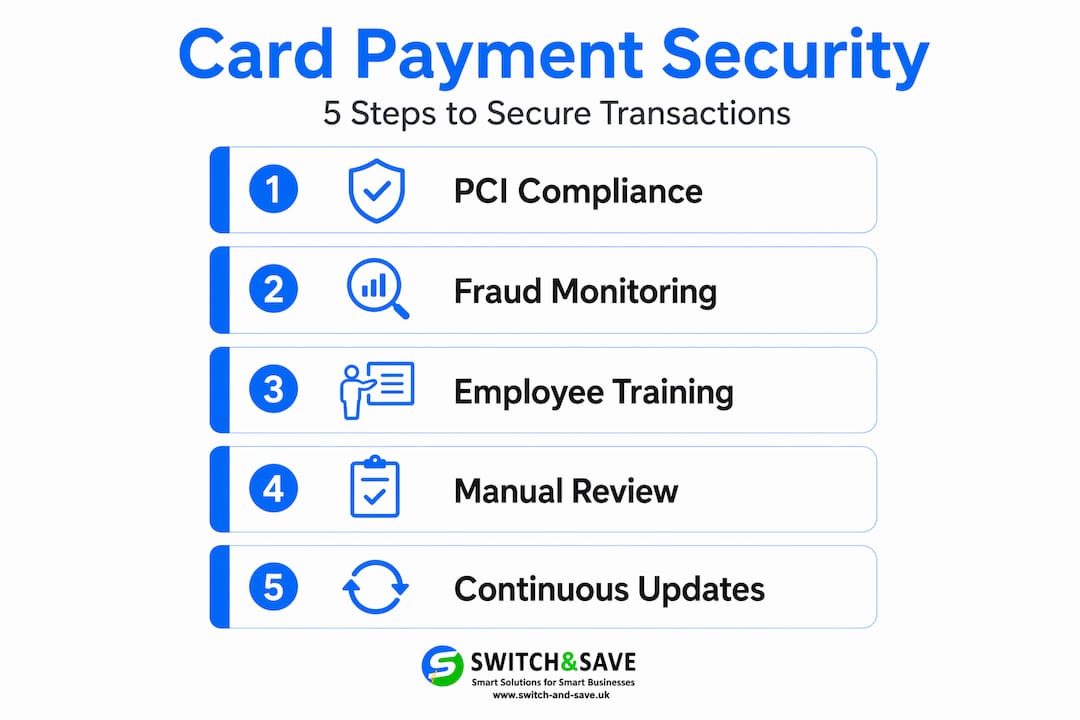
For higher-value or unusual orders, a short manual review window makes a real difference. Holding orders for up to 14 days during a review period before fulfilment can prevent losses on fraudulent transactions that would otherwise pass automated checks. Most legitimate customers accept a short delay for larger purchases.
On the compliance side, PCI DSS continuous validation means you should be scheduling quarterly internal reviews rather than waiting for an annual assessment. Pull a simple report on your payment flows, check which systems handle card data, and confirm nothing new has been added that falls outside your existing compliance scope. Small integrations or third-party plugins can quietly bring new systems into scope without you realising.
Pro Tip: Appoint one person in your business as the payments security lead. It does not need to be a full-time role. Even a 30-minute weekly review of flagged transactions and system alerts dramatically improves your fraud catch rate.
My honest take on card payment security
I have spent years working alongside retail and hospitality business owners on payment systems, and the same misunderstanding comes up again and again. Many owners assume their payment provider handles security so they do not have to. That is not how it works.
Your payment provider protects their part of the transaction. You are responsible for everything that touches your systems: your POS terminals, your staff behaviour, your online checkout, and your data storage practices. The split responsibility catches people off guard, especially during a fraud investigation or a chargeback dispute.
What I have found actually works is treating security as a layered system rather than a single solution. One good tool does not protect you. But combining EMV terminals, SCA for online payments, velocity rules, and quarterly staff training creates overlapping layers of defence that fraudsters will move on from rather than attempt to break through.
The businesses I have seen struggle most are those that set up their payment systems once and never revisit them. Fraud tools get stale. Staff forget their training. Software goes unpatched. The businesses that stay protected are those that treat security as routine maintenance, not a one-time project.
If you are choosing a new payment partner or reviewing your current setup, do not just compare transaction fees. Compare their fraud tools, their compliance support, and how quickly they respond when something goes wrong. That last point matters more than most people expect.
— Amir
How Switch-and-save helps you stay protected
If you are reviewing your payment security setup and want hardware and software that already has compliance built in, Switch-and-save is worth a look.

Switch-and-save’s EPOS systems for retail and hospitality are designed with integrated payment processing that meets current PCI DSS requirements. Whether you run a single shop or multiple sites, the systems are built to handle secure transactions without requiring you to become a payments expert yourself. The SSPOS software integrates directly with compliant payment gateways, includes real-time transaction monitoring, and comes with UK-based support if anything flags up. You can explore the full range of EPOS bundles to find a package that fits your business size and budget. 👉 Request a free demo and see how it works for your specific setup.
FAQ
What does PCI DSS mean for small businesses?
PCI DSS is the Payment Card Industry Data Security Standard. Every business that accepts card payments must comply with it, regardless of size. It covers how you store, transmit, and protect card data.
How can I prevent card fraud in my shop or restaurant?
Use EMV chip readers, train staff to spot suspicious behaviour, shield PIN entry pads, and keep your POS software up to date. Layered measures work better than any single fix.
What is tokenisation and do I need it?
Tokenisation replaces a real card number with a unique substitute code so that intercepted data cannot be used fraudulently. Most modern payment providers include it automatically, but it is worth confirming before you sign up.
How do I secure online card payments on my website?
Implement Strong Customer Authentication, use a payment gateway with built-in fraud scoring, enable bot detection tools like Cloudflare Turnstile, and set velocity rules to flag unusual transaction patterns.
What should I do when a card payment is flagged as suspicious?
Hold the order before fulfilment, contact the customer through verified details, and check for mismatched BIN or IP data. If fraud is confirmed, report it to your payment provider and document the case to support any chargeback dispute.