
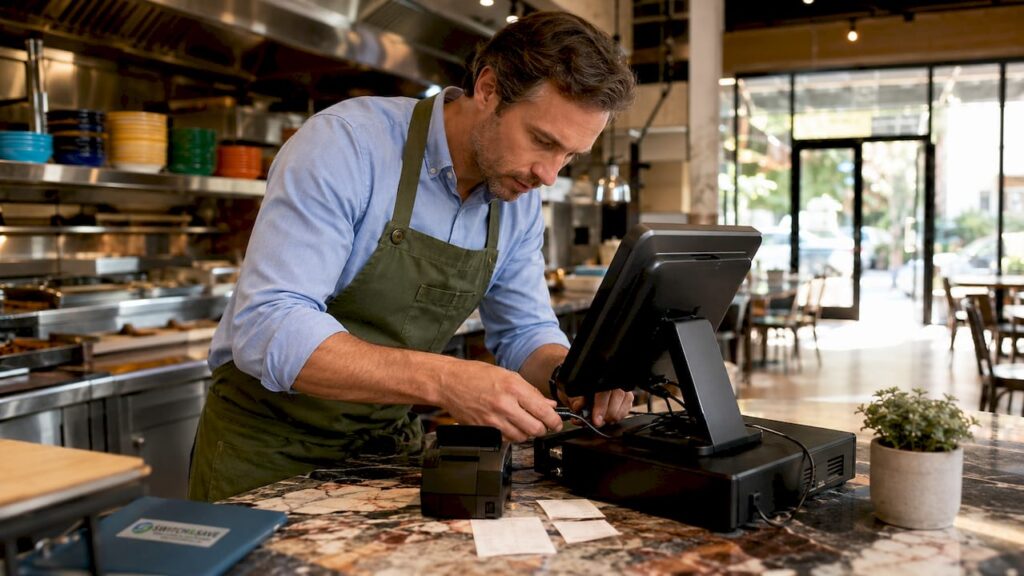
Bundled POS systems give UK restaurant owners something that piecing together separate hardware and software simply cannot: guaranteed compatibility, a single support contact, and a faster path from box to trading. A restaurant-grade EPOS bundle typically includes a touchscreen terminal, receipt printer, cash drawer, barcode scanner, and integrated software covering sales, inventory, staff management, and payments. Buying these components as a tested unit means they work together from day one, rather than leaving you to discover driver conflicts mid-service.
The practical benefits of POS bundles stack up quickly:
- Faster deployment. Businesses using standard POS hardware kits report 40% faster deployment times and 35% lower deployment costs compared to piecemeal procurement.
- Reduced downtime. One vendor handles all hardware and software issues, so you are not bouncing between three suppliers when a printer fails on a Friday night.
- Lower admin overhead. Integrated bundles reduce management time from 15–20 hours monthly to under two hours, by eliminating duplicate data entry across disconnected systems.
- Simpler staff training. Every terminal looks and behaves identically, which matters enormously when you are onboarding seasonal staff at pace.
- Built-in scalability. Adding a second location means replicating a known, tested configuration rather than starting the compatibility hunt again.
Pro Tip: When evaluating bundles, ask the vendor specifically which printer models and cash drawer trigger cables are included and tested. Printer interoperability is the most common failure point in restaurant POS setups, and a vague answer here is a warning sign.
Which POS bundles are best for UK restaurants?
Six providers dominate the conversation for UK restaurant operators in 2026. Each suits a different business size and operational profile, so the right choice depends on your workflow, your growth plans, and how much UK-based support matters to you.

| Provider | Best for | Hardware included | Software features | UK availability/support |
|---|---|---|---|---|
| Switch&Save | UK restaurants of all sizes wanting local support | Terminal, printer, cash drawer, scanner | AI-powered software, real-time inventory, cloud dashboard, multi-store | UK-based support, flexible bundle tiers |
| Toast | Medium to large restaurants needing cloud depth | Terminal, kitchen display, card reader | Cloud POS, online ordering, payroll integration | Limited direct UK support |
| Square for Restaurants | Small restaurants and food trucks | Terminal, card reader, optional printer kit | Table management, online ordering, reporting | UK available; support via online channels |
| Clover | Small cafés and counter-service businesses | All-in-one terminal, printer, card reader | App marketplace, basic inventory, loyalty | Growing UK presence; third-party app reliance |
| Lightspeed Restaurant | Multi-location operators | Terminal, kitchen display, scanner | Advanced inventory, analytics, CRM | UK available; strong cloud analytics |
| Revel Systems | Large restaurant enterprises | Wide hardware compatibility, custom configs | Customisable workflows, enterprise integrations | Enterprise-grade support; higher complexity |
Switch&Save is the strongest fit for UK restaurant owners who want a locally supported bundle with AI-powered software and transparent pricing. Its packages span standard through to hospitality tiers, and UK-based support means a real person answers when something goes wrong at service time. For a small independent restaurant or a growing group, that combination of flexibility and local accountability is hard to match.
Toast is genuinely powerful for cloud-based restaurant management, with strong integrations covering online ordering, payroll, and kitchen display systems. The caveat for UK operators is limited direct local support, which can be a real problem when you need help urgently.
Square for Restaurants keeps entry costs low and setup simple, making it a practical choice for food trucks, pop-ups, and small fast-casual sites. Its modular hardware approach lets you start lean and add peripherals as the business grows.
Lightspeed Restaurant earns its place for multi-location operators who need granular inventory control and cloud analytics across sites. Its reporting depth goes well beyond what most single-site restaurants require, but for a growing chain it pays for itself.
Revel Systems targets large enterprises that need extensive customisation. It is a capable platform, but the complexity and cost make it overkill for most independent UK restaurants.
How to choose the right POS bundle for your UK restaurant
The comparison table narrows the field, but the final decision comes down to your specific operation. Here is how to work through it.
Start with your workflow, not the feature list. A quick-service counter needs fast transaction processing and reliable kitchen printing above all else. A table-service restaurant needs floor management, split billing, and course-by-course ordering. Match the bundle to how your team actually works, not to a checklist of features you may never use.
- Assess your current pain points: slow checkout, stock discrepancies, manual reconciliation, or staff errors at the till.
- List the integrations you already rely on, such as accounting software like Xero or Sage, delivery platforms, or reservation systems.
- Decide whether you need a cloud-based system for remote access or whether a local server setup suits your environment better.
Hardware-software compatibility is non-negotiable. Buying a terminal from one supplier and software from another is possible, but it requires you to validate every peripheral yourself. A printer that looks compatible often lacks the correct command drivers for your chosen software, causing silent failures during service. Pre-tested POS hardware bundles remove that risk entirely.
Vendor support quality matters more than upfront price. A bundle that costs £200 more but includes UK-based telephone support will save you money the first time your system goes down during a Saturday dinner service. Ask vendors specifically about response times, whether support is UK-based, and what their warranty covers.
Think about total cost of ownership, not just the purchase price. Factor in monthly software fees, payment processing rates, hardware replacement costs, and any charges for additional users or locations. A bundle with a higher upfront cost but lower monthly fees often works out cheaper over three years.
For multi-location rollouts, standardisation is your biggest asset. Multi-location operators using standardised hardware templates report substantially faster store opening timelines and lower total costs by avoiding incompatibility issues. Create a standard bill of materials for each site format and stick to it.
Pro Tip: Most reputable vendors offer free demos or trial periods. Use them. Run the system through a realistic service scenario, including a busy period simulation, before committing. A demo that only covers the easy parts is not a real test.
What does a POS bundle actually include?
A POS bundle differs from a standalone POS system in one key way: it packages compatible hardware and software together as a single, pre-validated unit. A POS system refers to the full operational solution, including software, configuration, and support. A bundle is the physical and digital package you buy to build that system.
A restaurant-grade bundle typically contains:
- Touchscreen terminal for order entry and payment processing
- Receipt printer (usually 80mm thermal) for customer and kitchen tickets
- Cash drawer triggered automatically by the printer on cash transactions
- Barcode scanner for packaged goods or loyalty card scanning
- Customer-facing display to show order totals and reduce disputes at the counter
- POS software covering sales, inventory, staff management, and payment integration
The software layer is where bundles earn their keep. When sales data, stock levels, and staff costs all feed into one system automatically, you get real-time visibility without manual data entry. A sale at the till immediately updates your stock count, contributes to your labour efficiency calculation, and posts to your accounts. That kind of joined-up data flow is what separates a modern EPOS bundle from a basic till setup.
Optimised hardware configurations also improve checkout speed by up to 30% during peak service, which directly affects customer satisfaction and table turn times in a busy restaurant.
Why integration problems make unbundled systems costly
The hidden cost of mixing hardware from different vendors is management time. When your printer, terminal, and software each come from a different supplier, you become your own systems integrator. That means chasing down driver updates, diagnosing which component caused a crash, and calling three different support lines when something breaks.
Printer integration and cash drawer trigger mechanisms account for the majority of deployment complications in restaurant POS setups. A printer that looks compatible with your terminal may lack the correct ESC/POS command support for your software, causing it to fail silently or print garbled tickets. The cash drawer, which typically fires via the printer, then stops working too. Neither issue is obvious until you are mid-service.
Business owners acting as their own integrators also face the physical reality of cable management and driver conflicts in busy kitchen environments, where heat, moisture, and constant movement put hardware under real stress. Disconnected systems create what engineers call “dongle hell”: a tangle of adapters, workarounds, and undocumented fixes that nobody on your team fully understands.
The management time cost is measurable. Reconciling data across separate POS, inventory, and accounting systems consumes 15–20 hours of management time monthly. An integrated bundle reduces that to under two hours. That is not a marginal saving; it is the difference between a manager who spends their week on the floor and one who spends it in a spreadsheet.
What UK restaurant owners say about switching to POS bundles
UK hospitality operators who have moved from disconnected systems to integrated EPOS bundles consistently report the same pattern: the upfront effort of switching pays back quickly in time saved and errors avoided.

Independent pub and restaurant owners describe the pre-bundle experience as managing scattered spreadsheets, chasing stock discrepancies, and discovering cash flow problems only when they had already become urgent. One recurring theme is the VAT quarter: without real-time financial visibility, quarterly returns become a stressful exercise in reconstructing data rather than a straightforward reporting task.
The shift to an integrated bundle changes that dynamic. When sales, stock, and costs update automatically in one place, the business owner gets a live picture of where the operation stands, not a delayed reconstruction. For UK restaurants operating on tight margins, that visibility is the difference between catching a problem early and discovering it too late.
The hidden costs of disconnected systems go beyond software fees. Double data entry, reconciliation time, and delayed decisions all carry a real cost that rarely appears on a single invoice but adds up across a year of trading.
Do POS bundles actually save money compared to buying separately?
Buying components separately can look cheaper on a spreadsheet. In practice, the savings rarely survive contact with real-world deployment.
When you source a terminal, printer, cash drawer, and software independently, you pay the list price for each component without the volume pricing a bundle vendor negotiates. You also absorb the cost of compatibility testing, configuration, and any failed attempts before you find a combination that works reliably. If a component fails outside its individual warranty, you own that problem entirely.
Bundles consolidate those costs. The upfront price includes configuration, setup, and testing. More importantly, it includes a single point of contact for support, which eliminates the time and frustration of being passed between vendors when something breaks. For a restaurant where every hour of downtime costs real revenue, that single contact is worth paying for.
Integrated pub and restaurant systems save operators over £2,000 annually by eliminating duplicate software subscriptions and reducing admin time. That figure does not include the value of faster decision-making or the errors avoided by removing manual data entry from the equation.
For multi-site operators, the savings compound. Standardised bundles mean identical hardware across every location, which cuts training time, simplifies spare parts management, and makes support calls faster to resolve because every site runs the same configuration.
What are the limitations of POS bundles for restaurants?
Bundles are not the right answer for every situation. Understanding the trade-offs helps you choose with confidence rather than discovering them after purchase.
Upfront cost is higher. A pre-configured bundle costs more than sourcing basic components separately. For a restaurant with very limited capital and a simple operation, a stripped-back setup may be the practical starting point, with a full bundle as a later upgrade.
Vendor lock-in is real. When your hardware and software come from the same provider, switching software later may mean replacing hardware too. Check whether the bundle uses proprietary hardware or industry-standard components before you commit.
Not every bundle suits every workflow. A bundle designed for quick-service counter operations may lack the table management and course-by-course ordering features a full-service restaurant needs. Always verify that the software matches your specific service style, not just the hardware spec.
Support quality varies. The single-contact support model only works if that contact is responsive and knowledgeable. For UK restaurants, choosing a provider with UK-based support is worth the extra scrutiny during the buying process. An overseas call centre with long response times defeats the purpose of consolidated support.
Upgrade paths are not always flexible. Some bundle providers tie hardware upgrades to software subscription tiers, meaning a hardware refresh triggers a cost increase across the whole package. Ask about upgrade pricing before you sign.
Switch-and-save offers a practical alternative for UK restaurants
If you have read through the comparisons and want a bundle built specifically for the UK market, Switch-and-save is worth a close look. Unlike the US-headquartered platforms on this list, Switch-and-save is a UK-focused EPOS provider with packages designed around the realities of British hospitality: VAT compliance, UK payment processing, and support from people who understand the market.
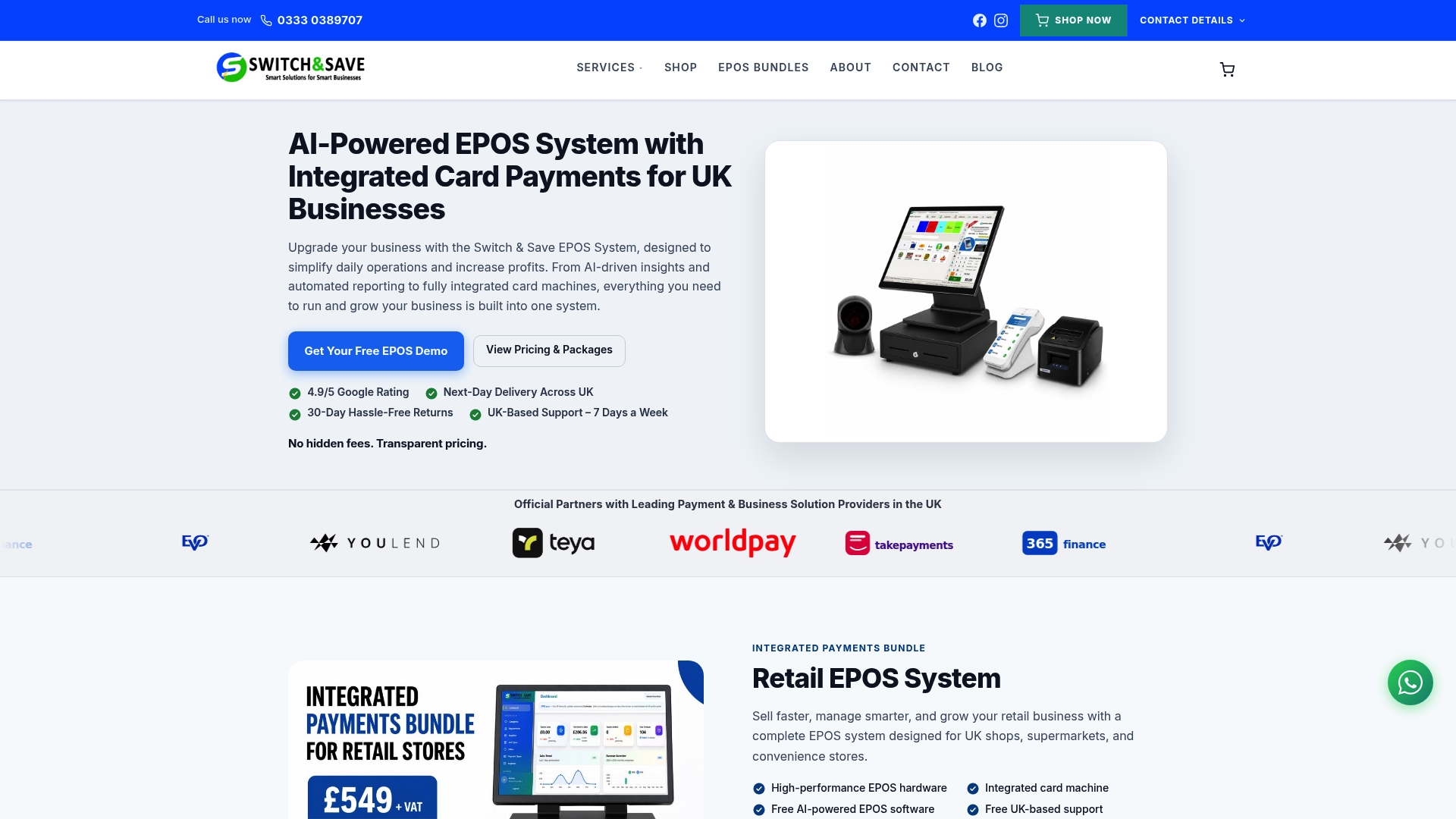
Switch-and-save’s EPOS bundles combine AI-powered software with pre-tested hardware, covering everything from a single-site café to a multi-location restaurant group. The cloud dashboard gives you real-time sales and stock visibility from anywhere, and the hospitality package includes the table management and staff features that full-service restaurants actually need. There are no hidden monthly hardware rental charges: you own the equipment. UK-based support means a real conversation when something goes wrong, not a ticket queue.
Explore Switch-and-save’s EPOS systems or book a free demo to see how the bundle fits your operation.
FAQ
What are the main advantages of using a POS system in a restaurant?
A POS system speeds up transactions, reduces order errors, and gives you real-time data on sales, stock, and staff costs. Integrated bundles add the benefit of automatic data flow between departments, cutting manual admin significantly.
Is a POS bundle worth the money for a small UK restaurant?
Yes, for most small restaurants the total cost of ownership is lower with a bundle than with separately sourced components, once you factor in compatibility testing, support costs, and the management time saved by having one integrated system.
What are the disadvantages of a POS bundle?
The main drawbacks are higher upfront cost, potential vendor lock-in if the hardware is proprietary, and the risk of choosing a bundle whose software does not match your service style. Always verify the software features before committing to the hardware.
What is the difference between a POS bundle and a POS system?
A POS bundle is the packaged set of compatible hardware components, often sold with software included. A POS system refers to the complete operational solution: hardware, software, configuration, and support together. Many vendors use the terms interchangeably, but the distinction matters when you are comparing what is actually included.
Does a POS debit or card payment benefit from a bundled setup?
Yes. Integrated payment processing within a bundle means card transactions post directly to your sales records and stock data without manual reconciliation, reducing errors and speeding up end-of-day reporting.
Key takeaways
Bundled POS systems deliver faster deployment, lower admin overhead, and a single support contact that standalone component setups simply cannot match for UK restaurant operators.
| Point | Details |
|---|---|
| Deployment speed | Standard POS hardware kits deliver 40% faster deployment times and 35% lower deployment costs versus piecemeal procurement. |
| Admin time saved | Integrated systems reduce monthly management time from 15–20 hours to under two hours by eliminating manual reconciliation. |
| Annual cost saving | Integrated hospitality systems save operators over £2,000 annually by removing duplicate subscriptions and reducing admin overhead. |
| Multi-site efficiency | Standardised hardware templates cut store opening timelines substantially for multi-location operators. |
| Switch-and-save | UK-focused EPOS bundles with AI-powered software, local support, and no monthly hardware rental charges. |