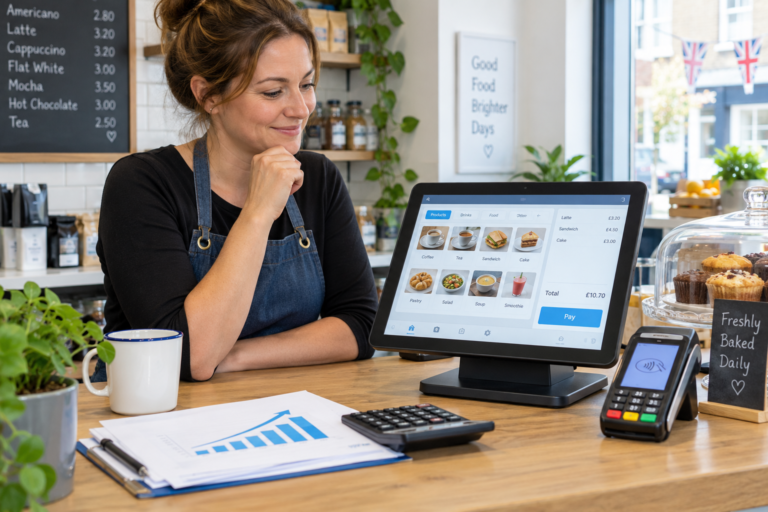

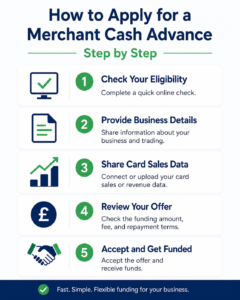
A merchant cash advance is usually applied for online by checking your eligibility, sharing basic business details, connecting or providing card sales information, reviewing the offer, and accepting the terms if the funding suits your business. For many UK small businesses, the main advantage is that repayments are linked to future sales rather than fixed monthly repayments.
Understanding how merchant cash advance works shows why it is useful for businesses that take regular card payments, such as retail shops, cafés, restaurants, takeaways, bars, grocery stores, salons, and mobile phone shops. Instead of applying for a traditional bank loan, the business can use its card sales history to support the funding application.
Apply for business finance with Switch&Save — we work with business finance partners to help UK businesses access flexible funding alongside AI-powered EPOS systems, card payment solutions, and cost-saving services. You can start by using the Eligibility Check to see what your business may qualify for.
YouLend describes its funding as revenue-based finance where businesses can repay automatically through a fixed percentage of future daily sales, and states that eligible merchants may receive funding in as little as 48 hours.
Key Takeaways
| Key Point | What It Means for UK Businesses |
| Application is usually online | You can often start with an eligibility check rather than a long bank process. |
| Card sales matter | Your payment history can help show how your business trades. |
| Repayments are flexible | Repayments are usually linked to a percentage of sales, so they can adjust with trading levels. |
| Useful for seasonal businesses | Retail, hospitality, cafés, takeaways, and bars may benefit because sales often fluctuate. |
| Review the offer carefully | Always check the total repayment amount, fixed fee, sales percentage, and terms before accepting. |
| Switch & Save can support the process | Switch & Save helps businesses with EPOS, card payments, business finance, and cost reduction. |
What Is a Merchant Cash Advance?
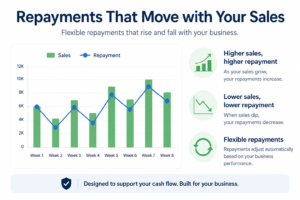
A merchant cash advance is a type of business funding based on your future card sales. The provider gives your business an upfront amount of funding. You then repay it through an agreed percentage of your future card transactions.
For example, if your shop has strong card sales during busy weeks, repayments may be higher because sales are higher. If your business has a slower week, repayments may reduce because they are linked to your sales activity.
This is different from a traditional loan, where you usually make fixed monthly repayments whether your business had a strong month or a quiet month.
A merchant cash advance is often used for:
- Buying stock
- Refurbishing premises
- Upgrading EPOS or payment systems
- Managing cash flow
- Hiring staff
- Marketing campaigns
- Seasonal preparation
- Covering short-term business costs
For small UK businesses that rely heavily on card payments, this type of funding can feel more aligned with how the business actually earns money.
Who Can Apply for a Merchant Cash Advance?
Before applying, it helps to understand how much can I borrow with a merchant cash advance to set the right expectations.
A merchant cash advance is generally suited to businesses that already trade and receive regular card payments. It is especially relevant for businesses where sales can be tracked through card terminals, payment processors, or EPOS-linked payment data.
Common examples include:
- Convenience stores
- Grocery shops
- Mobile phone shops
- Cafés
- Takeaways
- Restaurants
- Bars and pubs
- Hair and beauty salons
- Retail stores
- Hospitality venues
You may be a good fit if your business has consistent card payment activity and you want funding without the pressure of fixed monthly repayments.
However, eligibility depends on the finance provider’s checks. The provider may review trading history, revenue, card sales volume, business type, affordability, and other risk factors before making an offer.

How to Apply for a Merchant Cash Advance Step by Step
Step 1: Check Your Eligibility
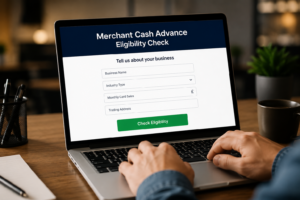
The first step is to check whether your business may qualify. This is usually done through an online eligibility form.
You can begin with the YouLend eligibility check through Switch & Save.
At this stage, you may be asked for basic details such as your business name, trading activity, estimated revenue, and contact information.
This step does not mean you must accept funding. It simply helps you understand whether your business may be eligible.
Step 2: Share Business Information
After the initial eligibility check, the provider may ask for more information about your business. This can include:
- Business trading name
- Company or sole trader details
- Business address
- Industry type
- Monthly revenue
- Card sales volume
- Trading history
- Business bank details
- Payment processor information
The purpose is to understand how your business trades and whether the funding is affordable.
For example, a takeaway with strong evening and weekend card sales may be assessed differently from a seasonal retail shop that earns most of its revenue during Christmas.
Step 3: Provide Card Sales or Revenue Data
Card sales are one of the most important parts of a merchant cash advance application.
Because repayment is linked to future sales, the provider needs to understand your previous sales pattern. This helps estimate how much funding may be suitable and what repayment percentage may apply.
You may be asked to connect your payment account, upload card statements, or provide access to sales reports.
If your EPOS system and card payments are organised, this stage can be much easier. This is where a reliable EPOS setup can help because clean sales reporting gives a clearer picture of business performance.
Switch & Save provides AI-powered EPOS systems and card payment solutions that help small businesses track sales, manage reporting, and improve operational visibility.
Step 4: Review Your Funding Offer
If your business meets the criteria, you may receive a funding offer. Do not rush this step.
Carefully check:
- Funding amount
- Total repayment amount
- Fixed fee
- Percentage taken from future card sales
- Expected repayment structure
- Any conditions attached
- What happens if sales are lower than expected
- Whether early repayment terms apply
A merchant cash advance can be useful, but only if the repayment structure fits your cash flow.
For example, if your business has strong card sales but low margins, you need to understand whether the daily repayment percentage will leave enough cash for stock, wages, rent, supplier bills, and VAT.
Step 5: Accept the Terms
Once you understand the offer and are happy with the terms, you can accept it. The provider will usually complete final checks before funding is released.
YouLend states that business cash may be available in as little as 48 hours, depending on eligibility and approval. (youlend.com)
Before accepting, make sure the funding has a clear business purpose. Good reasons might include buying stock before a busy season, replacing broken equipment, improving your shop layout, or investing in marketing that can generate more sales.
Step 6: Use the Funding Responsibly
Once the funds arrive, use them according to your business plan.
A merchant cash advance should ideally help your business generate revenue, reduce pressure, or improve efficiency. It should not be used casually without a clear return or operational need.
Practical uses include:
- A café buying outdoor seating before summer
- A grocery store increasing stock before Ramadan, Christmas, or local events
- A takeaway upgrading kitchen equipment
- A bar improving its payment system before the weekend rush
- A mobile phone shop buying fast-moving accessories in bulk
Practical UK Examples
Example 1: Retail Shop Preparing for a Busy Season
A convenience store in Manchester expects higher sales during the festive period. The owner wants to buy extra stock but does not want to drain cash reserves.
A merchant cash advance could help the shop buy stock upfront. Repayments would then come from future card sales as customers purchase those products.
This can work well if the stock is likely to sell quickly and the business has strong card transaction history.
Example 2: Café Upgrading Equipment
A café in Birmingham needs a new coffee machine and a better EPOS setup. The current system is slow, and staff are losing time during busy mornings.
The owner applies for funding based on card sales. If approved, they can invest in equipment that improves speed, customer service, and reporting.
In this case, business finance is not just covering a cost. It is supporting operational improvement.
Example 3: Takeaway Managing Cash Flow
A takeaway in Leeds has strong weekend sales but quieter weekdays. Fixed monthly repayments may feel risky because income changes week by week.
A merchant cash advance may be more suitable because repayments are linked to sales. When card sales are higher, repayment is higher. When sales are lower, repayment may reduce.
This is why many hospitality businesses look at revenue-based funding instead of traditional finance.
How Much Can You Borrow With a Merchant Cash Advance?
The amount you can borrow depends on your business performance, card sales, trading history, and eligibility. There is no single amount that applies to every business.
A shop taking £8,000 per month in card sales will usually be assessed differently from a restaurant taking £80,000 per month. The provider needs to make sure the funding amount is realistic based on sales volume and repayment capacity.
For more detail, read: How Much Can I Borrow With a Merchant Cash Advance?
What Happens After You Apply?
After applying, the provider may review your application, check your business information, assess your sales data, and decide whether to make an offer.
The process may include:
- Eligibility review
- Sales data assessment
- Offer calculation
- Terms presentation
- Final checks
- Funding release
The exact process depends on the provider and your business details.
The most important point is this: receiving an offer does not mean you should automatically accept it. You should compare the funding amount, repayment structure, and business benefit before making a decision.
Common Mistakes to Avoid When Applying
Applying Without Knowing Your Sales Numbers
Before applying, review your monthly revenue and card sales. If you do not know your numbers, it becomes harder to judge whether the offer is suitable.
Your EPOS system should help you understand:
- Daily sales
- Weekly sales
- Monthly revenue
- Card vs cash payments
- Best-selling products
- Busy trading periods
- Seasonal trends
Borrowing Without a Clear Purpose
Funding should solve a business problem or support growth. Avoid applying just because funding is available.
Better reasons include stock, equipment, refurbishment, marketing, or cash flow support during a planned trading period.
Ignoring the Total Repayment Amount
A merchant cash advance may not have traditional fixed monthly repayments, but there is still a cost. Always check the total amount repayable and the fixed fee.
Do not focus only on how quickly you can get funding. Focus on whether the funding makes commercial sense.
Choosing Funding Without Improving Business Systems
If your sales, stock, staff, and reporting are disorganised, funding alone may not fix the problem.
This is why Switch & Save supports UK businesses with AI-powered EPOS systems, card payment solutions, business finance, and utility switching services. Reducing costs and improving efficiency can be just as important as accessing funding.
Is a Merchant Cash Advance Right for Your Business?
A merchant cash advance may be right for your business if:
- You take regular card payments
- Your sales fluctuate by day, week, or season
- You want repayments linked to sales
- You need funding for a clear business purpose
- You understand the total cost
- You are comfortable with repayments being taken from future card sales
It may not be right if:
- Your card sales are very low
- Your margins are already under pressure
- You do not have a clear use for the funds
- You prefer fixed repayment schedules
- You are unsure about the total repayment cost
For more background, read: Is YouLend Business Finance Right for Your Small Business?
You can also read: How Small Businesses in the UK Can Get Funding Using Card Sales
Why Apply Through Switch & Save?
Switch & Save supports UK small businesses with more than one cost-saving solution. The business context matters because funding is only one part of running a stronger business.
Switch & Save helps with:
- AI-powered EPOS systems
- Card payment solutions
- Business finance support
- Utility switching services
- Cost reduction for small businesses
- Operational efficiency for retail and hospitality
For example, a business may need funding to upgrade equipment, but it may also be overpaying on utilities or using an outdated till system. Looking at the full cost base can help the business make better decisions.
That is why Switch & Save focuses on helping small businesses reduce costs and improve efficiency, not just access finance.
We help UK businesses reduce costs with AI-powered EPOS systems, card payment solutions ans business finance. Check your savings today.
Start here: Check your funding eligibility
FAQs
How do I apply for a merchant cash advance in the UK?
You can usually apply online by checking eligibility, providing business details, sharing card sales or revenue information, reviewing the offer, and accepting the terms if the funding suits your business.
Do I need card sales to apply for a merchant cash advance?
Yes, card sales are usually important because repayment is commonly linked to future card transactions. A business with regular card payment activity may be better suited to this type of funding.
Is a merchant cash advance the same as a bank loan?
No. A traditional bank loan usually has fixed monthly repayments. A merchant cash advance is typically repaid through an agreed percentage of future card sales.
How quickly can I receive funding?
Timeframes depend on eligibility, checks, and approval. YouLend states that eligible businesses may receive business cash in as little as 48 hours. (youlend.com)
What can I use a merchant cash advance for?
Businesses commonly use funding for stock, equipment, refurbishment, marketing, hiring, cash flow, or seasonal preparation.
Can a takeaway apply for a merchant cash advance?
Yes, a takeaway may be suitable if it takes regular card payments and meets the provider’s eligibility checks.
Can a retail shop apply?
Yes, retail shops, grocery stores, convenience stores, and mobile shops may apply if they have regular trading and card sales history.
Will repayments change if my sales are lower?
With a merchant cash advance, repayments are usually linked to a percentage of sales. This means repayment amounts can move with trading performance, depending on the agreed terms.
Should I apply if my business has low card sales?
If card sales are low, eligibility may be limited. It is still worth checking, but the funding offer may depend heavily on your actual sales volume and business performance.
Where can I check my eligibility?
You can start with the Switch & Save eligibility check link to see what your business may qualify for.