

Thousands of UK small and medium-sized businesses are quietly overpaying on energy and utilities every single year. Not because better deals don’t exist, but because they miss their renewal window, don’t fully trust brokers, or simply don’t know where to start. If you run a retail shop, café, restaurant, or hospitality venue, those extra costs eat directly into your margins. This guide cuts through the noise. We’ll explain how business utility switching services actually work, what to look for, how to time your switch correctly, and how to sidestep the pitfalls that catch too many SMEs off guard.
Table of Contents
- How business utility switching services work in the UK
- Must-have criteria for choosing the best switching service
- Navigating contract timing, renewals, and moving premises
- Common pitfalls and expert tips for SMEs
- A realistic look: what matters most in utility switching for UK SMEs
- Save time and money with proven switching and SME technology solutions
- Frequently asked questions
Key Takeaways
| Point | Details |
|---|---|
| Plan your switch timing | Switch during your contract renewal window to avoid fees and costly default rates. |
| Demand broker transparency | Only use switching services that clearly show fees, commissions, and supplier comparisons up front. |
| Check the small print | Review unit rates and standing charges together and always verify long-term costs, not just headline savings. |
| Act quickly when moving | Notify suppliers and submit documents immediately if your business changes premises. |
How business utility switching services work in the UK
With the problem made clear, let’s explore what switching services for businesses actually do and where they add genuine value.
A business utility switching service acts as a go-between for your company and energy suppliers. Rather than you contacting each supplier individually, a broker or switching platform does the legwork. They gather quotes from multiple suppliers, present your options clearly, and then manage the paperwork and administrative process once you choose a deal. As Utility Bidder explains, UK SME switching services work as comparison brokers, handling supplier quotes and all switch administration on your behalf.

That’s a meaningful time saving. For a business owner already juggling staff rotas, stock management, and customer service, spending hours comparing energy tariffs simply isn’t realistic. A good switching service compresses that process into something manageable.
Here’s what a quality business utility switching service typically covers:
- Multi-supplier quote comparison across a broad panel of business energy providers
- Contract management, including reviewing terms and flagging any renewal clauses
- Switching administration, from notifying your old supplier to setting up your new account
- Post-switch support, resolving billing errors or transfer disputes if they arise
- Renewal reminders, so you never accidentally roll onto an expensive default rate
“Brokers provide practical support and contract clarity post-switch, which is especially valuable for SMEs without a dedicated finance or procurement team.” WhichBusinessEnergy
It’s worth noting that collective switching schemes also exist. These pool multiple businesses together to negotiate group rates. They can work well, but they don’t always produce the best deal for every individual business. Your usage profile, contract length preference, and location all affect which tariff genuinely suits you. Always verify a collective offer against a tailored comparison before committing.
| Service type | How it works | Best suited for |
|---|---|---|
| Broker/comparison service | Gathers quotes from multiple suppliers on your behalf | Most SMEs wanting choice and support |
| Collective switching scheme | Groups businesses to negotiate bulk rates | Businesses with standard usage patterns |
| Direct supplier approach | You contact suppliers individually | Businesses with specialist energy needs |
| Online comparison tools | Self-serve quote comparison | Confident buyers who know their usage data |
If you manage a retail business, understanding retail energy switching options specific to your sector can sharpen your approach further. And if you want a broader foundation, guidance on reducing business energy costs covers the compliance and efficiency angles that sit alongside any switch.
Must-have criteria for choosing the best switching service
Now that you understand the role of switching services, here’s how to identify the best options for your needs.
Not all brokers are equal. Some work with a limited panel of suppliers. Others earn higher commissions from certain providers, which can subtly influence the quotes they surface. Knowing what to look for protects you and ensures you get genuine value.
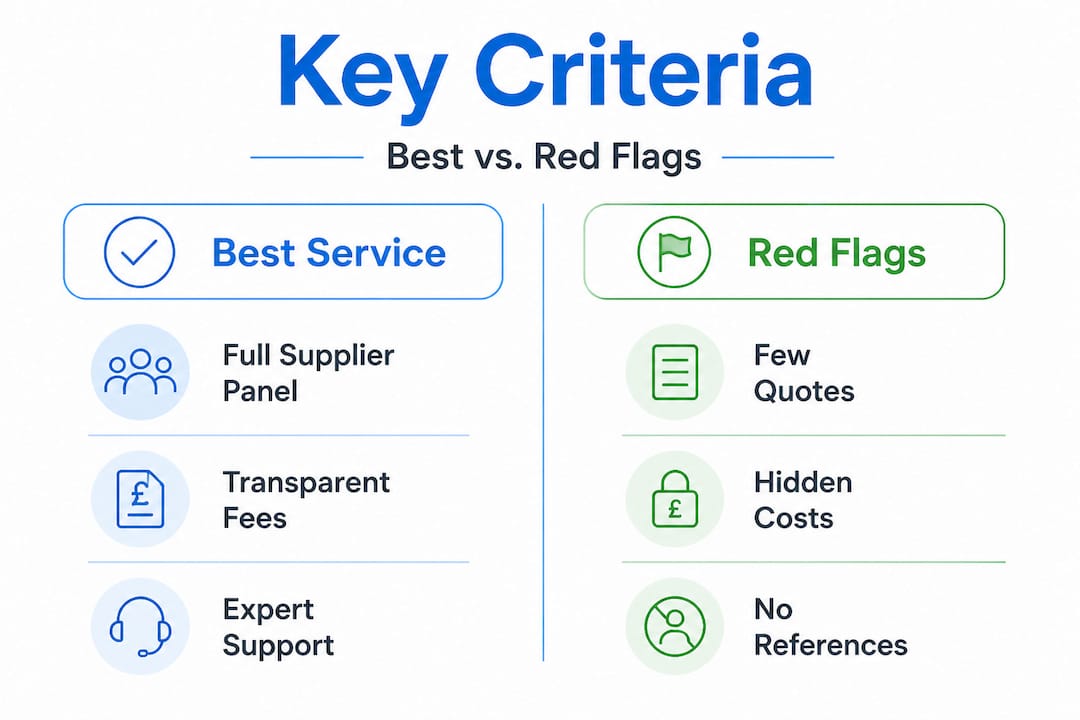
According to WhichBusinessEnergy, the best brokers are transparent about commissions, offer multi-supplier quotes, and provide practical support throughout the switching process. That’s your baseline. Here’s how to apply it in practice:
- Check the supplier panel size. Ask how many suppliers they compare. A service that only works with three or four providers may miss better deals elsewhere. Aim for services that access at least eight to ten suppliers.
- Request full commission disclosure. Brokers typically earn a commission from the supplier you choose, built into your unit rate. This isn’t inherently wrong, but you deserve to know the amount. Ask for it in writing before signing anything.
- Assess post-switch support. What happens if your first bill is wrong? Or if the transfer stalls? A broker who disappears after the deal is signed is a liability, not an asset. Ask specifically what aftercare looks like.
- Look for contract clarity. Your broker should walk you through key contract terms: contract length, exit clauses, renewal dates, and what happens at the end of the term. If they rush past this, that’s a warning sign.
- Verify their regulatory status. Business energy brokers in the UK are not currently required to be regulated by Ofgem, though this is changing. Look for voluntary accreditations or membership of industry bodies as a positive signal.
Pro Tip: Before your first call with a broker, pull together your last 12 months of energy bills. Having your actual usage data to hand means quotes will be accurate, not estimates. Inaccurate usage data leads to misleading comparisons.
| Criteria | What to ask | Red flag |
|---|---|---|
| Supplier panel | “How many suppliers do you compare?” | Fewer than five suppliers |
| Commission | “Can I have written commission disclosure?” | Refusal or vague answers |
| Post-switch support | “What happens if there’s a billing dispute?” | No clear process described |
| Contract review | “Will you explain all key contract terms?” | Rushing through the paperwork |
| Accreditation | “Are you a member of any industry body?” | No voluntary accreditation |
Guidance on saving on utility contracts from Bionic provides a solid reference point for understanding what a well-structured switch looks like. And if you’re already working on cutting your electricity costs more broadly, combining those efforts with a well-timed switch amplifies your savings considerably.
Navigating contract timing, renewals, and moving premises
With selection criteria understood, it’s essential to handle timing and unique business changes correctly for a smooth, cost-effective switch.
Timing is where many SMEs lose money without realising it. You can find the perfect broker, get excellent quotes, and still end up paying more than necessary simply because you acted at the wrong moment in your contract cycle.
Here’s what you need to know:
- The renewal window typically opens six months before your contract end date. This is your prime switching period. You can lock in a new deal that starts when your current contract ends, avoiding any gap or overlap.
- Missing the renewal window can trigger a rollover contract. Some suppliers automatically roll you onto a new fixed-term deal, often at a higher rate, if you don’t act in time. Others move you to a “deemed rate,” which is essentially a default tariff and almost always expensive.
- Switching outside the renewal window may incur early-termination fees. These vary widely but can run into hundreds of pounds for SMEs. Always check your current contract’s exit terms before initiating a switch.
- The actual supplier change typically takes four to six weeks from the point of contract agreement. Factor this into your planning, especially if your current contract ends soon.
As Bionic confirms, switching during your contract’s renewal window avoids expensive early-termination fees and the trap of rolling onto unfavourable default rates.
Statistic to note: Businesses that miss their renewal window and roll onto deemed rates can pay up to 40% more per unit than those on a fixed business tariff. That’s a significant cost for any SME operating on tight margins.
Moving premises adds another layer of complexity. If your business relocates, you can’t simply transfer your current energy contract to the new address. You need to follow a formal process.
Ofgem guidance makes clear that the Change of Tenancy process must be followed when moving premises, requiring evidence and timely communication with your current and new suppliers. In practice, this means:
- Notifying your current supplier of your move-out date as soon as possible
- Providing meter readings on the day you vacate
- Contacting the new premises’ existing supplier to register as the new occupant
- Submitting any required documentation, such as your lease or tenancy agreement
Failing to do this promptly can result in billing disputes, unexpected charges, or gaps in your energy supply. If you operate in hospitality, the nuances of hospitality energy switching are worth reviewing, particularly if you’re managing multiple sites or a premises change. Equally, if you’re setting up a new location, the starting a business energy guide covers the essentials from day one.
Pro Tip: Set a calendar reminder six months before your contract end date labelled “energy renewal review.” It takes 30 seconds to set up and could save you hundreds of pounds by keeping you out of rollover territory.
Common pitfalls and expert tips for SMEs
Beyond core mechanics and timing, knowing the biggest SME pitfalls and how to avoid them can turn a good switch into a great one.
Even well-informed business owners make avoidable mistakes when switching utilities. Here are the most common ones, and what to do instead.
- Focusing only on the unit rate. Many SMEs compare quotes based on the unit rate alone. But the standing charge, the daily fixed cost you pay regardless of usage, can significantly affect your total bill. A low unit rate paired with a high standing charge may actually cost more than a slightly higher unit rate with a lower standing charge. Always compare the two together using your actual usage figures. As Connection Technologies notes, SMEs must evaluate unit rate and standing charge together using actual usage patterns to get an accurate picture.
- Assuming collective switching always wins. Group schemes sound appealing, but they’re built around average usage profiles. If your business has unusual hours, seasonal spikes, or high consumption, a tailored quote from a broker will almost certainly serve you better. Never skip the individual comparison step.
- Not getting commission details in writing. Verbal assurances aren’t enough. If your broker earns a commission from the supplier, you should have a written summary of that amount before you sign. This protects you and gives you a clear record if disputes arise later.
- Delaying supplier notifications during a move. This is especially common in hospitality and retail, where a premises move is hectic enough without adding energy admin to the list. But delays here create real problems: disputed bills, unexpected charges from the previous occupant’s supplier, and potential gaps in supply. Act on the day of your move, not the week after.
“Small errors in utility management add up. A missed notification here, an unreviewed rollover there, and suddenly you’re paying thousands more annually than you need to.”
Pro Tip: Ask your broker for a written summary of all fees, commissions, and contract terms before you agree to anything. A reputable broker will provide this without hesitation. If they push back, that tells you something important.
Integrating your utility cost tracking with your wider business systems makes a real difference. If you use an EPOS system, linking integrating utility savings with EPOS insights into your operational reporting helps you see the full cost picture, not just energy in isolation.
A realistic look: what matters most in utility switching for UK SMEs
Here’s an unvarnished view on how to make utility switching genuinely work for your business.
There’s a persistent assumption among small business owners that broker commissions are inherently suspicious. That using a broker means you’re paying more than you should. In our experience, this framing misses the point entirely.
Commission isn’t the problem. Undisclosed commission is the problem. A broker who earns a fee from the supplier but gives you access to ten suppliers, manages your paperwork, resolves post-switch disputes, and reminds you when your next renewal window opens is delivering real value. The commission is the cost of that service. The issue arises when that commission is hidden, inflated, or used to steer you towards a deal that suits the broker more than it suits you.
The bigger risk for most SMEs isn’t paying a modest broker fee. It’s the uncertainty and delay that comes from trying to manage utility switching alone, without the time, expertise, or supplier relationships to do it well. Businesses that avoid brokers out of commission concerns often end up on rollover contracts or deemed rates that cost far more than any broker fee ever would.
Treat utility switching as an annual strategic review, not a last-minute scramble. Build it into your business calendar alongside your annual accounts, your insurance renewal, and your staffing review. When you approach it proactively, you have leverage. You can compare properly, negotiate if needed, and lock in a deal that genuinely reflects your usage.
Technology helps here too. Modern EPOS systems, like those covered in our guide to best EPOS solutions, increasingly allow you to track operational costs alongside sales data. When your cost management is integrated into your day-to-day systems, nothing slips through the cracks. Utility renewals, supplier changes, and cost benchmarks become part of your regular business rhythm rather than a reactive panic.
The SMEs that consistently manage their utility costs well aren’t necessarily the ones with the most time or the biggest teams. They’re the ones who treat it seriously, use the right tools, and ask the right questions.
Save time and money with proven switching and SME technology solutions
Ready to act on these insights? Here’s how Switch&Save can help streamline your switching and SME operations.
At Switch&Save, we work with UK retail and hospitality businesses every day. We understand that managing utility costs is just one part of running a profitable operation. That’s why we combine practical switching guidance with the technology tools that help you stay on top of costs long term.

Whether you’re looking to reduce your energy bills or streamline your entire operation, our EPOS systems for SMEs give you real-time visibility across sales, stock, and costs from one central dashboard. Pair that with smart switching habits and you have a genuinely powerful combination. Explore our full range of comprehensive EPOS solutions and see how the right technology supports better decisions across your whole business, not just at the checkout.
Frequently asked questions
How long does switching business utilities take in the UK?
Typical switches are completed in roughly four to six weeks from contract agreement, though timing depends on supplier transfer speed and your specific contract terms. Bionic confirms this is the standard industry timeframe for most SME switches.
Do I pay for business utility switching services or is it free?
Most brokers do not charge you directly but earn a commission from the supplier, built into your tariff rate. Always ask for clear, written commission and contract disclosure up front, as WhichBusinessEnergy recommends for any reputable broker.
What is the renewal window and why does it matter?
The renewal window is the six-month period before your contract ends. Switching during this time lets you secure a new deal without early-termination fees or the risk of rolling onto costly default rates, as outlined in Bionic’s switching guide.
How do I switch if my business moves premises?
Notify your energy supplier immediately on your move-out date, provide meter readings, and follow the Ofgem Change of Tenancy process, submitting any required documentation such as your lease agreement for a smooth transition.
Is a collective switching scheme always better for small businesses?
No. Collective schemes are built around average usage profiles and may not reflect your specific consumption. As Uswitch notes, a tailored individual comparison will often beat a collective offer for businesses with distinct usage patterns.