
Switching your business utilities sounds straightforward, but many SME owners get caught out by focusing purely on the headline rate. The real savings come from understanding contract structure, timing, and the quality of the switching service itself. 33% of UK businesses changed utility contracts in the past year, mostly chasing better deals, yet many still end up disappointed. This guide will show you how to compare switching services properly, avoid costly contract pitfalls, and make a decision that genuinely improves your bottom line.
Table of Contents
- Understanding business utility switching in the UK
- Comparing leading business utility switching services
- Key contract management considerations for SMEs
- Handling property moves and change of tenancy
- Why the best switching service is not always the cheapest
- Explore efficient business utility solutions with Switch&Save
- Frequently asked questions
Key Takeaways
| Point | Details |
|---|---|
| Price versus contract structure | Prioritise both unit rates and contract terms to maximise utility savings. |
| Transparency matters | Choose switching services that clearly explain sourcing deals and handle paperwork. |
| Timing is critical | Manage contract end dates and notify suppliers early to avoid costly periods. |
| Paperwork support | The best switching services assist with all paperwork, reducing admin headaches. |
| Service quality | A switching service’s level of support affects savings and hassle when resolving issues. |
Understanding business utility switching in the UK
Business utility switching is the process of moving your electricity, gas, or water contracts from one supplier to another, usually to reduce costs or improve service. For retail shops and hospitality businesses, utilities are a significant overhead. Getting them wrong is expensive. Getting them right creates real, recurring savings.
So why do SMEs switch? The main drivers are:
- Lower unit rates on electricity and gas
- Shorter or more flexible contract terms that suit seasonal trading patterns
- Better customer service and account management
- Consolidating multiple utilities under one supplier for simplicity
According to Ofgem’s non-domestic research, one in three businesses changed their utility contracts in the past year, primarily to secure better deals. That is a significant proportion, and it tells you that switching is now a mainstream business practice, not a niche activity reserved for large corporations.
Key insight: One in three UK businesses switched utility contracts last year, but not all of them saved money. The difference between those who did and those who didn’t often came down to contract structure, not price.
The biggest mistake SMEs make is focusing only on the unit rate. A lower rate on paper can be wiped out by high standing charges, long lock-in periods, or exit fees. Proper utility switching for UK SMEs means looking at the full picture, including what happens at the end of the contract.
There are also practical tips for lowering shop utility bills beyond switching alone, such as LED lighting upgrades and smart metering. But switching remains the single biggest lever most SMEs have not yet pulled effectively. For more sector-specific guidance, the retail store utility tips section covers common scenarios for shop owners in detail.
Comparing leading business utility switching services
Once you understand what switching involves, the next step is choosing the right service to manage it for you. Not all switching services are equal. Some simply show you a comparison table and leave you to handle the rest. Others assign you a dedicated account manager who handles every piece of paperwork from start to finish.
Here is how some of the leading services compare across the criteria that matter most to SMEs:
| Service | Suppliers compared | Paperwork support | Account manager | Customer reviews |
|---|---|---|---|---|
| Love Energy Savings | Multiple | Partial | Yes | 23,000+ Trustpilot reviews |
| Bswitch | 60+ suppliers | Full | Yes | Positive, call-based |
| Utility Bidder | Multiple | Full via manager | Yes | Strong reputation |
What to look for in a switching service:
- Breadth of comparison: Does the service compare enough suppliers to give you a genuinely competitive quote? Bswitch, for example, compares across more than 60 suppliers and handles all paperwork, with most switches completed in a single short call.
- Paperwork handling: Switching involves a surprising amount of admin, including termination notices, new contract sign-offs, and meter readings. Services that manage this for you save time and reduce the risk of errors.
- Transparency: Are all costs shown upfront, including standing charges and any broker commission? Opaque pricing is a red flag.
- Customer reputation: Look for verified reviews on independent platforms. Love Energy Savings has accumulated over 23,000 Trustpilot reviews, which gives you a meaningful sample of real customer experiences.
- Ongoing support: What happens after you switch? Can you contact someone if there is a billing dispute or a supplier error?
Pros and cons at a glance:
Full-service brokers (like Bswitch and Utility Bidder):
- ✅ Handle all paperwork and supplier communication
- ✅ Access to a wide range of suppliers and live quotes
- ✅ Dedicated account manager reduces your workload
- ❌ May earn commission from suppliers, so always ask how they are paid
Online comparison platforms:
- ✅ Quick and convenient for initial research
- ✅ Useful for getting a ballpark figure
- ❌ Often require you to handle switching admin yourself
- ❌ May not cover the full market
For retail and hospitality businesses especially, time is money. A full-service broker that handles everything is usually worth it, even if the headline rate is not always the absolute lowest. You can also cut business electricity costs by combining a good switching service with smart usage habits. Before you commit, it is also worth reviewing switching service checks to understand what due diligence looks like across different types of business services.
Key contract management considerations for SMEs
Comparing switching services is just the start. The contract itself is where many SMEs lose money without realising it. Understanding the structure of your utility contract is just as important as finding a competitive rate.
1. Contract length: short vs long-term
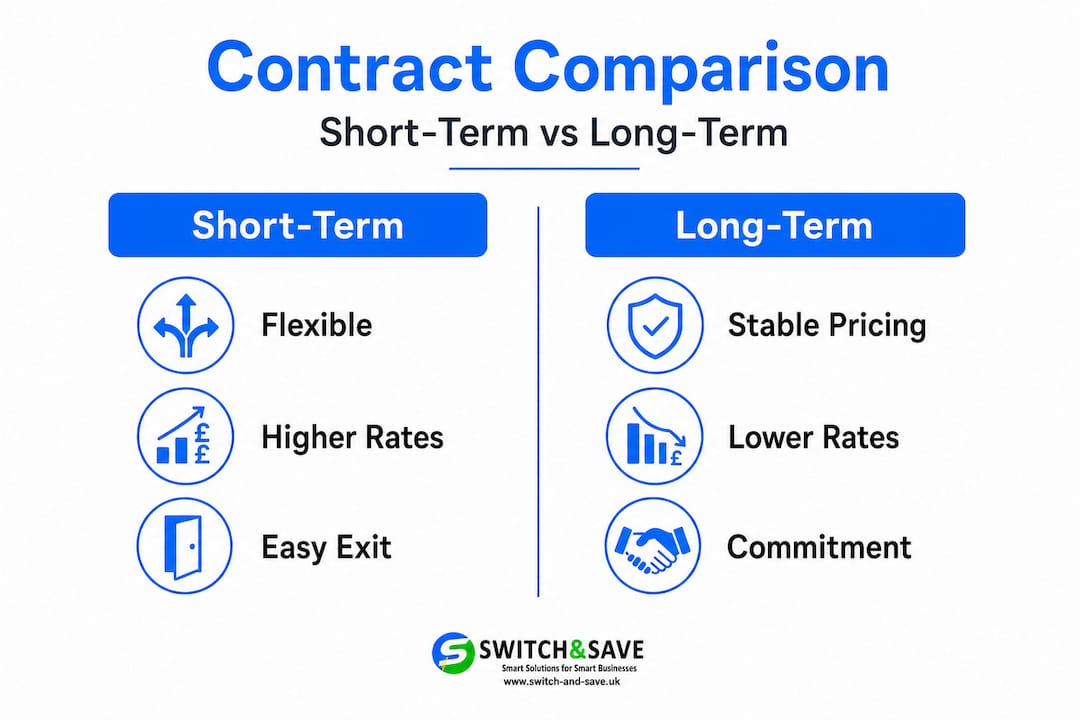
Short-term contracts (12 months or less) offer flexibility but often come with higher unit rates. Long-term contracts (two to three years) typically offer lower rates but lock you in. For a retail business with seasonal peaks, flexibility may be worth paying a small premium for.
2. Standing charges
Standing charges are fixed daily costs you pay regardless of how much energy you use. A contract with a low unit rate but a high standing charge can cost more overall than a slightly higher unit rate with a low standing charge. Always ask for a full bill breakdown before signing.
3. Pass-through elements
Some contracts include pass-through costs, meaning that certain network charges are passed directly to you as they change throughout the year. These can make your bills unpredictable. Fixed contracts remove this uncertainty, which is often worth the slightly higher rate for smaller businesses.
4. Timing your switch correctly
Ofgem advises businesses to actively manage contract end dates and recontracting periods. If your contract expires and you do not act, you may be moved onto a deemed contract, which typically carries much higher rates. Set a reminder at least three months before your contract ends.
Numbered steps for managing your utility contract:
- Note your contract end date and set a calendar reminder 90 days before
- Request a full breakdown of your current tariff, including standing charges
- Use a switching service to compare live quotes at least 60 days before renewal
- Confirm any exit fees or notice periods in your current contract
- Sign the new contract before your current one expires to avoid deemed rates
Pro Tip: Always compare the total annual cost of a contract, not just the unit rate. Ask your switching service or supplier to provide a full annual cost estimate based on your actual consumption figures. This is the only fair way to compare two contracts side by side.
| Contract type | Rate predictability | Flexibility | Best for |
|---|---|---|---|
| Fixed short-term | High | High | Seasonal businesses |
| Fixed long-term | High | Low | Stable, high-usage businesses |
| Variable | Low | High | Businesses expecting usage changes |
| Pass-through | Low | Medium | Larger businesses with energy expertise |
For businesses just starting out, the starting a business utility contracts section covers what you need to know from day one. If your business also relies on reliable connectivity, exploring business broadband options alongside your energy switch can help you consolidate costs effectively. For mobile device management alongside your utility planning, mobile management for SMEs is a useful resource.
Handling property moves and change of tenancy
Switching services and contract management mean little if you overlook critical steps during a business relocation. Moving premises is one of the most common moments when utility billing goes wrong, and the consequences can be costly and time-consuming to resolve.
What you must do when moving business premises:
- Notify your current supplier immediately when you know you are moving. Do not wait until the moving date. Early notification gives the supplier time to process the change correctly.
- Take a meter reading on the day you vacate the premises and again on the day you take possession of the new premises. Photograph both readings with a timestamp if possible.
- Provide documentation to support the change. This typically includes your tenancy agreement, sale documents, or title deeds. Without this, suppliers may continue to bill you for a property you no longer occupy.
- Confirm the new occupier’s details if you are leaving a property, so the supplier can transfer responsibility correctly.
- Check for any outstanding balances before you move. Unresolved bills can complicate the process and delay your new account setup.
Ofgem’s change of tenancy guidance is clear: notify your supplier immediately about tenancy changes and provide the required evidence to prevent billing complications. Failing to do so can result in you being billed for energy used by the new occupier, or the new occupier being billed for your usage. Both situations are frustrating and avoidable.
Pro Tip: Document every communication with your supplier during a move. Keep a log of dates, names, and what was discussed. If a billing dispute arises later, this record is invaluable. Email is better than phone for this reason, as it creates an automatic paper trail.
For hospitality businesses in particular, where premises moves can coincide with refurbishments and rebranding, the hospitality business utility tips section provides practical guidance tailored to your sector.
Why the best switching service is not always the cheapest
Here is something most comparison guides will not tell you: the cheapest switching service is rarely the best one for your business. This is not a comfortable truth, but it is an important one.
We have seen SME owners chase the lowest broker fee or the most aggressive unit rate, only to find themselves dealing with billing disputes, missed contract renewals, and suppliers who are difficult to contact. The money they saved on the rate was spent three times over in management time and stress.
The most robust switching services do more than find you a low rate. They manage the paperwork, monitor your contract timeline, and act as an intermediary if something goes wrong with your supplier. That kind of operational support has real monetary value, even if it does not show up on a comparison table.
Ofgem’s research confirms that service quality affects contract administration and supplier relations, even when price is the primary switching driver. In other words, a poor service experience can undo the financial benefit of a good rate.
The best switching service for your business is the one that:
- Fits your operational reality. A busy restaurant owner does not have time to chase suppliers. A full-service broker is worth every penny.
- Is transparent about how it earns money. Commission-based brokers are not inherently bad, but you should know what they earn and from whom.
- Has a track record you can verify. Independent reviews on platforms like Trustpilot are a reliable signal.
- Supports you beyond the switch. The relationship should not end when you sign the contract.
Price matters. Of course it does. But it is one variable in a more complex equation. The best service criteria go well beyond the rate card. Transparency, operational fit, and genuine after-switch support are what separate a good switching service from a great one.
Explore efficient business utility solutions with Switch&Save
Running a retail shop or hospitality business means managing a lot of moving parts at once. Utilities are just one of them.
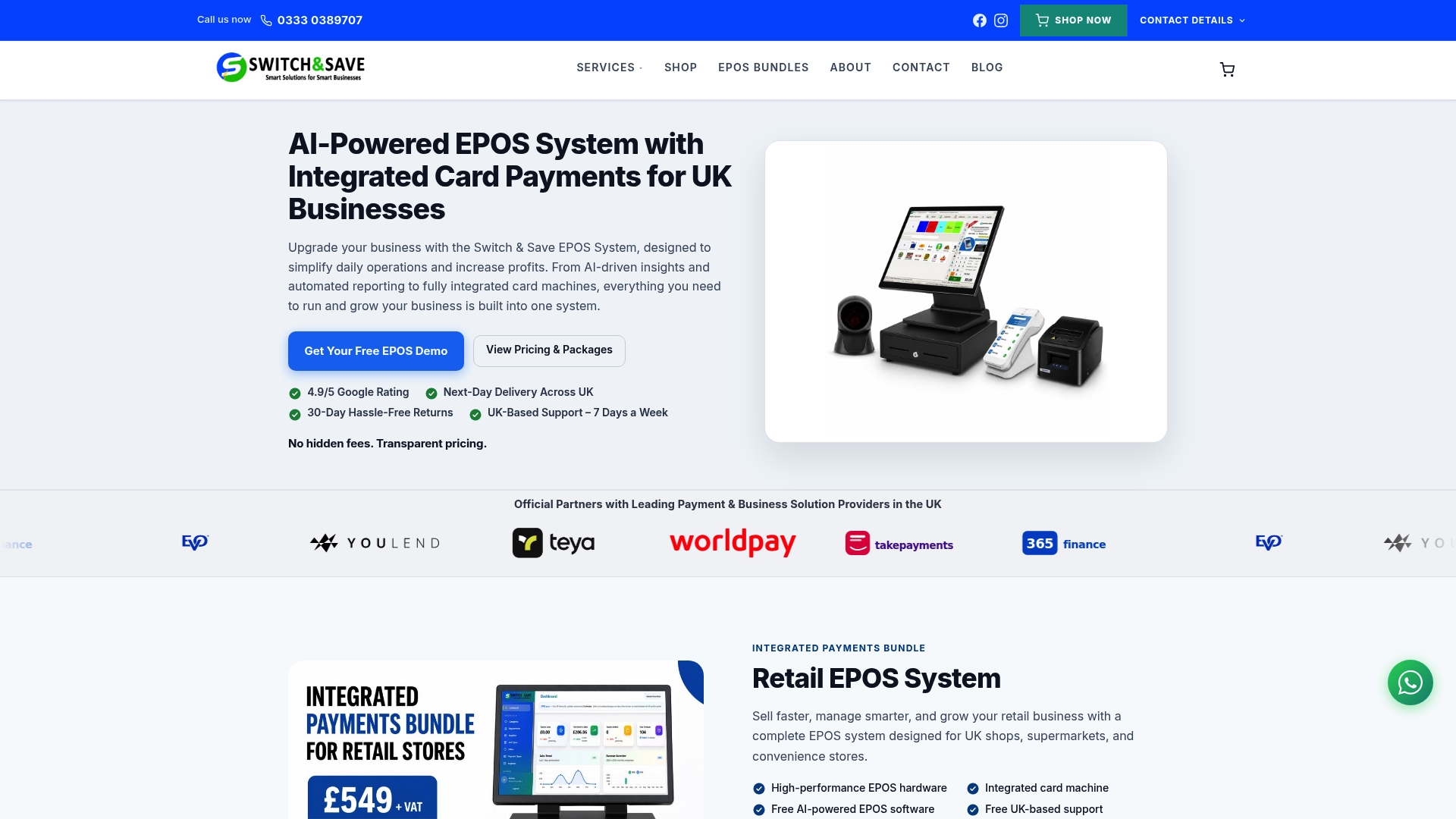
At Switch&Save, we understand that operational efficiency matters as much as cost savings. That is why our solutions are designed to help you manage more with less effort. Whether you are looking for an all-in-one EPOS system that streamlines your checkout and stock management, or EPOS software solutions that give you real-time business insights, we have packages built for UK retail and hospitality businesses of all sizes. If you run a café, restaurant, or hotel, our hospitality EPOS is designed specifically for your environment. Explore our solutions today and see how the right technology can make every part of your operation run more smoothly. 👉
Frequently asked questions
What documents are needed when switching utilities due to a change of tenancy?
You will need your tenancy agreement, sale documents, or title deeds, along with a meter reading taken on the day of the move. Ofgem confirms that providing this evidence promptly is essential to avoid billing complications.
Is price the most important factor when choosing a business utility switching service?
Price matters, but it is not the only factor. Contract structure, paperwork support, and service quality all affect your real-world savings. Ofgem’s research shows that service quality directly influences contract administration outcomes, even when price drives the initial decision.
How long does switching business utilities actually take?
The comparison and selection process can often be completed in a single call, particularly with services like Bswitch, but the actual transfer to a new supplier typically takes several weeks depending on the supplier and meter type.
What risks should SMEs watch out for with deemed or out-of-contract periods?
If your contract expires without renewal, you may be placed on a deemed contract at significantly higher rates. Ofgem advises businesses to monitor contract end dates carefully and begin recontracting at least 60 to 90 days in advance.
Do business utility switching services handle all the paperwork?
Many leading services do handle paperwork on your behalf. Utility Bidder assigns a dedicated account manager to coordinate the switch and manage supplier communication, and Bswitch similarly handles the full process from comparison through to completion.