
Electricity bills are one of the biggest overheads facing UK retail and hospitality businesses, yet most owners treat them as a fixed expense rather than something they can actively control. The average annual bill for a small UK business sits around £4,986, while micro businesses pay roughly £2,700. What’s striking is that up to 20% of that spend in hospitality alone is entirely avoidable. This guide walks you through practical, evidence-backed strategies to reduce your electricity costs, from a simple energy audit to long-term green investments, all tailored to the realities of running a small UK shop, café, or restaurant.
Table of Contents
- Start with an energy audit for smart savings
- Quick wins: lighting, heating, and appliances
- Use smart technology to monitor and cut waste
- Long-term strategy: green energy and switching suppliers
- What most businesses get wrong about energy savings
- How Switch&Save helps you cut costs further
- Frequently asked questions
Key Takeaways
| Point | Details |
|---|---|
| Audit before acting | Start with an energy audit to find where most savings can be made easily. |
| Focus on quick wins | LED lighting and switching off appliances deliver immediate, significant reductions. |
| Use smart monitoring | Smart meters and digital tools help cut ongoing waste and spot costly issues fast. |
| Switch and save | Regularly reviewing and switching energy suppliers prevents overpaying on default tariffs. |
| Go green for long-term gains | Investing in solar and sustainable technology attracts funding and slashes bills sustainably. |
Start with an energy audit for smart savings
Before you can cut costs, you need to understand where your money is actually going. That’s where an energy audit comes in. It doesn’t have to be complicated. At its simplest, it’s a structured walkthrough of your premises to identify what’s consuming electricity and when.
Conducting an energy audit identifies key areas of waste and creates a clear priority list for action. Think of it as taking stock of your energy, just as you would your inventory.
Here’s a simple step-by-step approach to get started:
- Take meter readings at opening and closing time for a full week. Compare the overnight figures. If your meter is running significantly when the premises are empty, something is drawing power it shouldn’t be.
- List all major appliances and note whether they’re switched off, on standby, or left running overnight. Refrigeration units, extraction fans, and display lighting are common culprits in retail and hospitality.
- Use a plug-in energy monitor (available for under £20 online) to measure the actual wattage of individual appliances. You may be surprised what a single old chest freezer costs to run.
- Check your extraction units. Many hospitality businesses leave these running long after service ends. That’s a significant and unnecessary drain.
- Review your bill against your readings. If the numbers don’t match your expectations, you may have faulty equipment or a meter issue worth investigating.
Real examples make this tangible. A busy café in Manchester discovered their commercial refrigerator was running at twice its expected energy draw because the door seal had perished. A small clothing retailer found their display lighting was left on every night by staff who assumed someone else had turned it off. Neither issue was obvious without a deliberate audit.
Pro Tip: Do a post-closure walkthrough every week, ideally on a Friday evening. Check every socket, switch, and appliance. Small habits like this catch overnight leaks before they become costly patterns. This is especially relevant if you’re looking at cost reduction for retail stores as part of a wider efficiency drive.
Once you know where your energy goes, you can act with confidence rather than guesswork.
Quick wins: lighting, heating, and appliances
Now you’ve identified the main culprits, it’s time to act. The good news is that some of the most impactful changes cost very little to implement and deliver results almost immediately.
Lighting is the obvious starting point. Switching to LED lighting reduces electricity consumption for lighting by 70 to 80%, and lighting accounts for 20 to 40% of total business electricity use. That’s a substantial portion of your bill to address with a relatively modest upfront investment.
| Lighting type | Average wattage | Annual cost (8 hrs/day) | Lifespan |
|---|---|---|---|
| Halogen bulb | 50W | ~£22 per bulb | 1,000 hrs |
| Fluorescent tube | 36W | ~£16 per tube | 8,000 hrs |
| LED equivalent | 8W | ~£3.50 per bulb | 25,000 hrs |
The savings stack up fast when you multiply those figures across every fitting in your premises.
Heating and cooling is another area where small adjustments make a real difference. Adjusting your thermostat by just 1°C lower can save up to 10% on heating costs. More importantly, many businesses unknowingly run heating and air conditioning simultaneously in different parts of the building. That’s money going directly to waste. Set clear rules for your team about thermostat use, and consider a programmable thermostat that adjusts automatically based on opening hours.
Standby power is a hidden drain that’s easy to underestimate. Turning off standby power and unused appliances eliminates 10 to 15% of wasted electricity. Smart power strips, which cut power to a group of devices when the main device is switched off, are a simple and affordable solution.
Here’s a quick action list you can implement this week:
- Unplug phone chargers, card readers, and display screens overnight
- Schedule dishwashers and ovens to run during off-peak hours where possible
- Replace any appliance over 10 years old with an A-rated energy-efficient model
- Fit occupancy sensors in storage rooms, toilets, and staff areas
- Set computers and tills to sleep mode after 5 minutes of inactivity
You’ll find more practical guidance on energy-efficient EPOS tips that apply directly to your checkout and back-office systems. For hospitality businesses specifically, there’s detailed advice on hospitality energy efficiency worth exploring alongside these quick wins.
Pro Tip: Schedule a quarterly lighting and heating review into your business calendar. Set a reminder for the first Monday of each new quarter. Treat it like a financial review, because it effectively is one.
Use smart technology to monitor and cut waste
Once you’ve maximised your quick wins, technology can deliver ongoing visibility and deeper cuts over time. Smart meters and energy monitoring systems are the most accessible entry point.
Installing smart meters and monitoring systems provides real-time data that helps you spot anomalies and reduce waste by up to 20 to 30%. Rather than waiting for your monthly bill to reveal a problem, you can see unusual spikes the moment they happen.
| Monitoring approach | Typical annual saving | Setup cost | Best for |
|---|---|---|---|
| Smart meter (basic) | £200 to £500 | Free (via supplier) | All business types |
| Plug-in energy monitors | £100 to £300 | £20 to £50 | Small retail, cafés |
| Full monitoring system | £1,000 to £2,500 | £500 to £1,500 | Restaurants, pubs |
| Government-funded digital tool | ~£2,500 avg | £0 (subsidised) | Hospitality/retail |
The government-funded option is particularly worth your attention. A digital tool developed by Zero Carbon Services and supported by government funding has delivered impressive results across hospitality and retail businesses.
“Pubs, restaurants, and hotels using the government-backed monitoring tool reduced overnight energy use by 66% on average, saving approximately £2,500 per year per business through real-time alerts on fridges, ovens, and extraction units.”
That overnight figure is significant. Refrigeration, extraction, and heating systems running through the night when your premises are empty represent pure waste. The tool sends alerts when equipment behaves unexpectely, so you can act before the waste accumulates.
If you’re thinking about how your point-of-sale systems fit into this picture, it’s worth reading about the best EPOS for savings to understand how modern systems are designed with energy efficiency and operational insight in mind.
Getting access to the government-subsidised tool is straightforward. Search for Zero Carbon Services through the GOV.UK business support pages, or ask your local council’s business support team whether your area has active funding available. Eligibility typically covers small hospitality and retail businesses in England, though schemes vary by region.
Long-term strategy: green energy and switching suppliers
With monitoring in place, it’s time to consider the bigger moves that lock in future savings and protect your business from energy price volatility.
Switching your energy supplier is the single fastest way to reduce your unit rate. Yet many small businesses stay on default tariffs for years simply because switching feels complicated. Avoiding default tariffs is critical because these are consistently the most expensive options available. Use a business energy comparison site and set a calendar reminder to review your contract at least three months before it expires.
Solar panels are the most talked-about long-term investment, and for good reason. Solar panels can reduce bills by up to 70%, with payback periods ranging from 2 to 10 years depending on your energy use, roof size, and whether you pair the installation with battery storage and the Smart Export Guarantee (SEG), which pays you for surplus energy exported back to the grid.
Here’s how to assess whether solar is right for your premises:
- Check your roof. South-facing roofs with minimal shading offer the best return. Flat commercial roofs can also work well with the right mounting system.
- Review your daytime energy use. Solar generates power during daylight hours. Businesses that use most of their electricity during the day, like cafés, convenience stores, and restaurants at lunchtime, benefit most.
- Get three quotes from MCS-certified installers. This certification is required to access government incentives and the SEG.
- Calculate your payback period using your current unit rate and estimated annual generation. Many installers provide this calculation as part of their quote.
- Explore available grants. Over £2 million in government funding is available for SMEs adopting green technology, and 67% of SMEs that have adopted sustainability measures report reduced operating costs as a result.
Battery storage is worth adding to any solar installation if your budget allows. It lets you store energy generated during the day and use it during evening trading hours, maximising the value of every kilowatt your panels produce.
For businesses exploring how technology investments connect to broader operational savings, finding reliable solutions that integrate well with your existing setup is always the right starting point.
What most businesses get wrong about energy savings
Here’s an honest observation after reviewing what actually works in retail and hospitality: most businesses focus their energy-saving efforts in the wrong place, or in the wrong order.
The instinct is to jump straight to the big-ticket items. Solar panels. New refrigeration units. A full building retrofit. These are worthwhile investments, but they’re not where the fastest or easiest gains come from. And if you install solar panels while your extraction unit runs all night and your heating and cooling fight each other, you’re solving a fraction of the problem.
The evidence from hospitality and retail is clear: overnight baseload from refrigeration and extraction is one of the biggest sources of waste, and it can be addressed without any capital expenditure using digital monitoring tools. Yet most businesses don’t even know their overnight consumption figures.
Behavioural changes are consistently underrated. Staff habits matter enormously. A team that understands why switching off equipment matters will outperform a business full of expensive kit that nobody uses correctly. Training your team to do a proper closing checklist takes 20 minutes and costs nothing. The return on that 20 minutes can be hundreds of pounds per year.
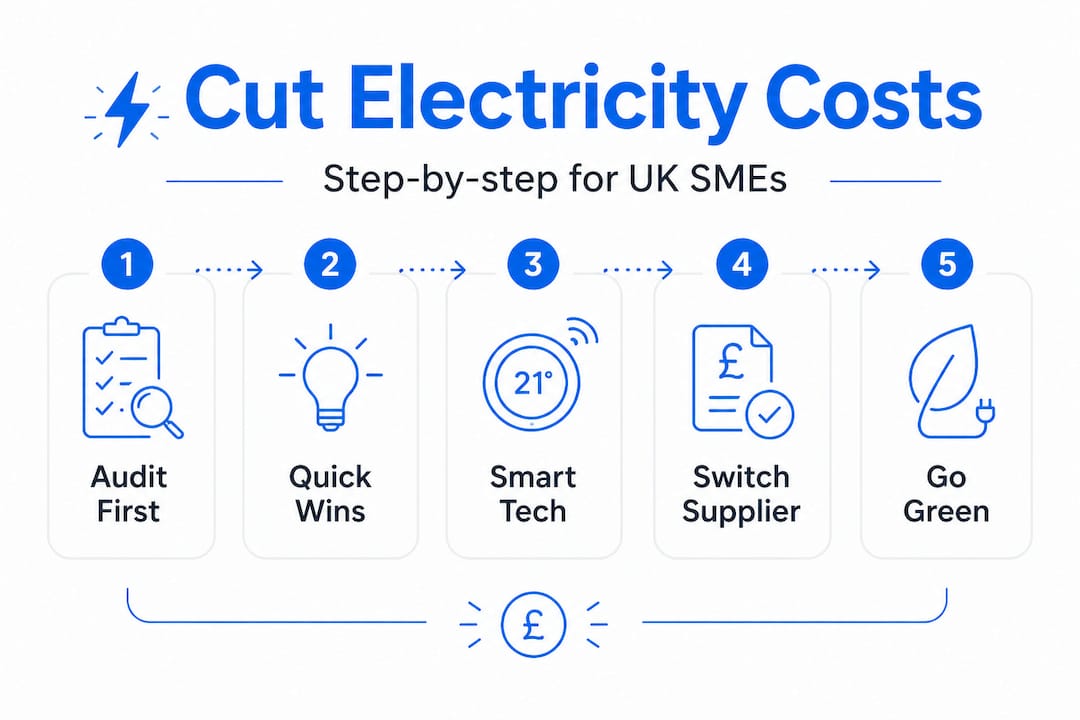
The right sequence looks like this: start with the audit, implement quick wins, add monitoring, then consider infrastructure investment. Each stage builds on the last. Quick wins like LEDs and thermostat adjustments typically yield 5 to 15% savings. Monitoring adds another 20%. Capital investment in solar or upgraded equipment then layers on top of an already-efficient operation.
The uncomfortable truth is that many businesses invest in solar while still leaving the back office lights on overnight. Focus on best EPOS solutions UK and operational efficiency first, then scale up your investment from a position of genuine understanding.
Pro Tip: Prioritise actions with the lowest upfront cost and effort first. The cumulative effect of many small changes is often greater than a single large investment, and it builds the habits that make larger investments worthwhile.
How Switch&Save helps you cut costs further
Reducing energy costs is one piece of the efficiency puzzle. The other is making sure every system in your business works as hard as possible. At Switch&Save, our EPOS system solutions are designed specifically for UK retail and hospitality businesses, combining real-time sales data, inventory management, and integrated payments in one streamlined platform.
A modern retail EPOS system doesn’t just speed up your checkout. It gives you the operational visibility to make smarter decisions across your whole business, including where your resources, including energy, are being used most effectively. 👉 Book a free demo today and see how the right system can support your cost-reduction goals from the ground up.
Frequently asked questions
What is the quickest way to reduce my energy bill?
Switching to LED lighting and turning off unused appliances are the fastest wins. LED lighting cuts consumption by 70 to 80% for lighting, and eliminating standby power removes a further 10 to 15% of waste immediately.
How much can a smart meter really save a small business?
Quite a lot, if you act on what it tells you. Smart meters and monitoring systems can reduce energy waste by 20 to 30% by surfacing hidden issues like overnight equipment running when premises are empty.
Are there government grants for reducing small business energy costs?
Yes. Over £2 million is currently available for SMEs adopting sustainable technology, and government-subsidised digital monitoring tools are available to hospitality and retail businesses at no upfront cost.
Is investing in solar panels worth it for a small shop or café?
For many businesses, yes. Solar panels can reduce electricity bills by up to 70%, with payback periods between 2 and 10 years. Pairing panels with battery storage and the Smart Export Guarantee maximises your return.
How do I avoid overpaying for business energy?
Review your contract regularly and switch before it expires. Default tariffs are consistently the most expensive option, and most businesses can save significantly simply by moving to a competitive fixed-rate deal.